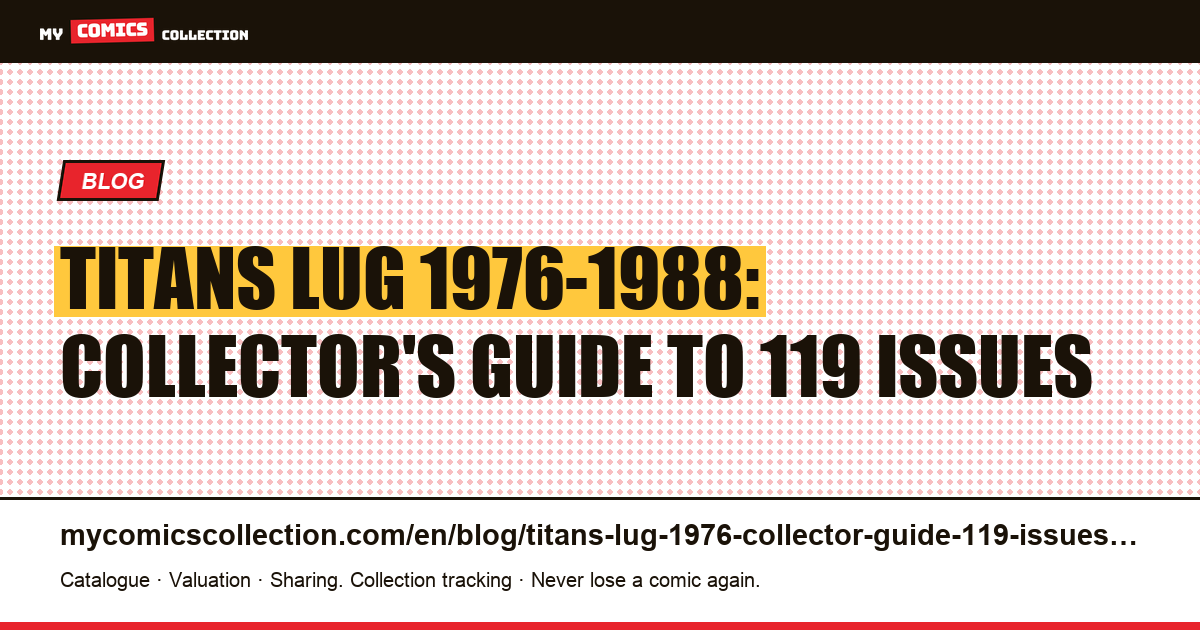
Titans was published by Lug from 10 March 1976 to 10 December 1988, that is 119 issues. The magazine was bimonthly up to #36 in January 1982, then monthly from #37 to the end, with not a single hole in the calendar. Jean Frisano is credited on art for 77 issues, Jean-Yves Mitton for 52, and Chris Claremont on writing for 51. The recorded titles mix series episodes, documentary pages and puzzles.
When you open a box of Titans bought at a flea market, you are not holding an American series translated issue by issue. You are holding a French magazine that ran for thirteen years, changed its rhythm once, and carried pages that no American index records. Knowing how this structure works changes everything: what looks like a duplicate is often the next part of a serial story.
As always on this guide, only verified information (creators, issue numbers, dates) is stated as fact; the analysis is our own, with no reproduction of artwork or protected dialogue.
What Titans published, and what the titles reveal
The catalogue keeps one title per issue, and reading that column alone already reveals an editorial line. Issue #1 of 10 March 1976 opens with "Le long chemin du retour", written by Larry Hama, Jeff Rovin and Archie Goodwin. Issue #119 of 10 December 1988 closes with "Une taupe chez les Vengeurs !", credited to Jean-Yves Mitton, Chris Claremont and Steve Englehart. Between those two markers, the magazine carried science fiction, team superheroes, fantasy and French creations.
Several titles from the early years are not episode titles but references to other publications of the house: "Kabur n° 5" for #5, "Spécial Strange n°8" for #8, "Planète des Singes n°6" for #9, "Album Conan n°4 : Conan le conquérant" for #10, "Strange n°95" for #11. The most plausible reading is that these advertising pages were indexed as content in their own right; sources differ on the exact status of these inserts, and only the copy in hand can settle it. For you, the practical consequence is this: do not look for an episode behind these titles, look for an advertising page.
A steady rhythm: bimonthly up to #36, monthly after that
The cover dates tell a story of rare regularity. From #1 in March 1976 to #36 in January 1982, each issue came out two months after the previous one, without exception. Then #37 arrived in February 1982, only one month after #36: the magazine had gone monthly, and it stayed that way until #119 in December 1988.
This switch is the most useful editorial fact to know when you rebuild a collection. The first 36 issues cover almost six years, the following 83 less than seven: the first half of the series had time to scatter, while the second half remained much more abundant in circulation. This is the first explanation for the very uneven difficulty of completing the set, depending on the range you target.
Two dates that do not behave like the others
Two entries break the mould, and each calls for a different reflex. #7 carries the date of 5 March 1977, whereas all its neighbours are dated the 10th of the month. #86 is dated March 1986 with no day given, while #85 shows 10 February 1986 and #87 10 April 1986.
These two cases do not mean the same thing. A date brought forward by five days on a single issue looks like a peculiarity of release or of recording, and you can confirm it on the cover fold of your copy. A missing day, on the other hand, is more likely a gap in the checklist than a sign of a different release, since the issue's place in the monthly sequence remains intact. In both cases, note what your copy actually bears: it is the printed mention that counts in a listing, not the reconstructed date.
The creators who hold the series together
One name dominates the art column: Jean Frisano, credited on 77 of the 119 issues, from #1 to #107 in December 1987. This presence over almost twelve years explains the visual uniformity of a stack of Titans: you recognise the series at a glance, before even reading the logo. His son Thomas Frisano appears occasionally, notably in #40, #43 and #53, which pins down quite precisely the period when the handover took place.
The other pillar is Jean-Yves Mitton, credited on art from #26 in May 1980 to the last issue, and on writing from #41 in June 1982. With 65 writing credits and 52 art credits, he accumulates more credits than any other name in the series, and he is the only one to appear in both roles over such a span. Two titles confirm him as an in-house author: "Les colles de Mikros..." in #38 and "Mikros en France !" in #54. Ciro Tota also appears in #100 with "Au commencement était le chat", then in #111 and #118.
On the American side, three names structure three periods. Archie Goodwin is credited on 32 issues, from #1 to #85, with peak density around the turn of the 1980s; Carmine Infantino accompanies him on art from #19 to #55. Chris Claremont appears from #7 in March 1977 and remains credited through #119: with 51 credits, he is the American writer most present in the magazine. Steve Englehart has the widest span, in two blocks separated by a long silence: a few issues at the very beginning, then the last period from #86, of which four issues escape him.
The documentary features and puzzles, the half of the magazine that is forgotten
Here is the peculiarity that American indexes cannot convey. Between #17 in November 1978 and #69 in October 1984, the recorded title is very often a documentary page or a puzzle, not an episode: "A quoi servaient les pyramides d'Egypte ?", "Comment fonctionne le réfrigérateur ?", "Prévoir les tremblements de Terre", "Au Japon : l'art de la calligraphie", "Le transport des icebergs", "Les fourmis sauveront les forêts", "Qui a inventé le train ?".
Thirteen titles in the series take the form of a question, and eight are explicitly games: crosswords in #24, #47, #55 and #63, word searches in #68, a brain teaser in #85, and "Le labyrinthe de la Guerre des Etoiles" in #53 and #69. Two very concrete consequences follow for you. First, these puzzle pages were often filled in pencil by their first reader, which creates a condition defect specific to Titans and absent from a magazine with no games section. Second, an informed buyer checks them before concluding, exactly as they would check a torn-out letters page.
The issues that matter to a collector
Issue #1 of 10 March 1976 remains the centrepiece, for the usual reason of a newsstand launch: a cautious initial print run, unsold copies sent back for destruction, and no reader aware at the time of holding a first issue. Issue #100 of May 1987, with "Au commencement était le chat" credited to Ciro Tota, is the second natural landmark, because round-numbered issues were bought in duplicate by loyal readers and are therefore often found in good condition.
Issue #37 of February 1982 deserves a place of its own on your wish list, for a reason that only the calendar reveals: it is the first monthly issue, and so the hinge of the magazine. Collectors who reason by range often stop at #36 or start at #37, which makes this particular issue more sought after than it appears. Issue #119 of December 1988 closes the series, and a final issue is always rarer than a mid-run issue, because distribution contracts before a stop.
Finally, the issues in which French creations appear interest a distinct public: #38 of March 1982 and #54 of July 1983 for Mikros, #100 for Ciro Tota. This market does not overlap with that of American superhero fans, and it explains why a mid-run issue can sell above its immediate neighbours.
Do you collect this series?
Track what you own, what you are missing and what your collection is worth. 7-day trial.
Start my trial →
Recognising an edition, and reading what it announces
Get into the habit of checking three elements on the copy: the printed issue number, the cover date and the title highlighted. On Titans, the third is the least reliable of the three, because the cover promotes the episode judged most saleable, not necessarily the one that opens the contents. An issue for which the catalogue records a documentary page can perfectly well show a superhero on its cover.
Be wary of bound compilations too. Lug grouped several issues under a house hardback cover, and a seller may present such a compilation as a "lot of three issues". The issues are there, but their original covers have disappeared in the process, which has nothing to do with three complete newsstand copies. Ask for a photo of the back before committing.
Condition of a copy, and the defects specific to this magazine
The general criteria apply: freshness of the colours, firmness of the central fold, unrusted staples, an unbroken spine, pages not yellowed beyond the age of the paper. But Titans adds two checkpoints that you will not find on a purely narrative magazine.
The first is the games page. On the eight issues where the catalogue explicitly records a grid, a maze or a brain teaser, check that it is blank. A filled-in grid does not disqualify the copy, but it must appear in the description, and it weighs all the more if you are aiming for a high grade. The second is the central signature: on a stapled monthly of this period, it is where the paper gives way first when the magazine has been read and re-read.
Buying pitfalls, and why the contents still need checking
The main pitfall lies in a limit of the available data, and it must be stated plainly. The catalogue keeps only one title per issue, whereas a Titans issue contained several episodes plus features. You can therefore never deduce from this column that an issue contains the first French appearance of a character, or that it matches a particular American issue.
The series itself provides proof of this limit. #116 of September 1988 is catalogued as "Noces mortelles 2ème partie", but no earlier issue carries the first part: it was therefore in a contents list that the checklist does not detail. Similarly, "La proie du Vautour" appears in #92 and #93, "Nemrod" in #110 and #111, "Hulk et la Chose" in #113 and #114: these are not catalogue duplicates, they are serial stories where each part was indexed under the same title.
Completing the 119 issues, and tracking progress
Approach the series by ranges rather than in order: the difficulty is not spread evenly. The bimonthly range, up to #36, is the most time-consuming to search: six years of publication, early print runs, and copies that have lived through fifty years. The monthly range, from #37 to #119, fills up much faster, and it is through it that most collections take shape.
This is the job of a collection manager: you record your 119 slots, you see what is missing and in what condition, and you stop buying the same issue twice. You can also cross your stack with the character hubs if you follow an American series in parallel, or with the guides devoted to the Fantastic Four for the episodes flagged by the titles of the final period.
Value today, and what moves it
No fixed price means anything for a French newsstand magazine: the range between a read, handled copy and a near-mint copy is counted in multiples, not in percentages. So reason in ratios. For Titans, the three variables that move the needle most are, in this order, the condition of the cover, the position of the issue in the series, and the presence or absence of the French creation that interests a particular buyer.
To set a price, always compare concluded sales, not current listings, and check that the condition described is comparable to yours. An issue from 1976 to 1979 and one from 1985 to 1988 are no more comparable to each other than two different series. You will find method benchmarks in our comparison of the US-English and French-language markets and in the guide to buying comics in France.
Frequently asked questions
The series has 119 issues, from #1 dated 10 March 1976 to #119 dated 10 December 1988, from Lug. It therefore covers nearly thirteen years of continuous publication. No gap longer than two months appears between two consecutive issues, which means that a missing issue in your stack always corresponds to an issue that was really published.
With #37, dated 10 February 1982. #36 was dated 10 January 1982, only one month earlier, whereas every previous interval was two months. The first 36 issues therefore cover almost six years, and the following 83 less than seven years, which explains the very uneven rarity depending on the range.
On art, Jean Frisano is credited on 77 issues, from #1 to #107, and Jean-Yves Mitton on 52, from #26 to #119. On writing, Mitton has the largest number of credits, ahead of Chris Claremont, present from #7 to #119, and Steve Englehart, credited at the very start of the magazine and then across most of the last period, from #86.
Because Titans published documentary pages and games in addition to episodes, and the checklist kept only one title per issue. Hence entries such as "Comment fonctionne le réfrigérateur ?" at #18 or a crossword at #47. The full contents are not in the data: they are checked on the copy, with its contents page in hand.
No. "Nemrod" appears in #110 and #111, "Hulk et la Chose" in #113 and #114, "La proie du Vautour" in #92 and #93. These are serial stories where each part was indexed under the same title. #116, catalogued as "Noces mortelles 2ème partie", confirms this: its first part was in a contents list that was not detailed.