Organizing a comic book collection is based on four pillars: appropriate physical protection (Mylar-D or polypropylene bags + acid-free cardboard boxes), a stable environment (40-50% humidity, 18-22°C, away from direct light), a consistent storage system (short or long boxes, classification by title then by number) and an up-to-date digital inventory to track the condition, value and location of each issue.
A collection of comics that grows without method always ends up the same way: unstable piles, issues that cannot be found when you need them, and copies that deteriorate without you noticing. This is not inevitable. The conservation practices used today by serious collectors and by certification houses like CGC are based on precise principles, inherited from decades of trial and error on fragile newsprint.
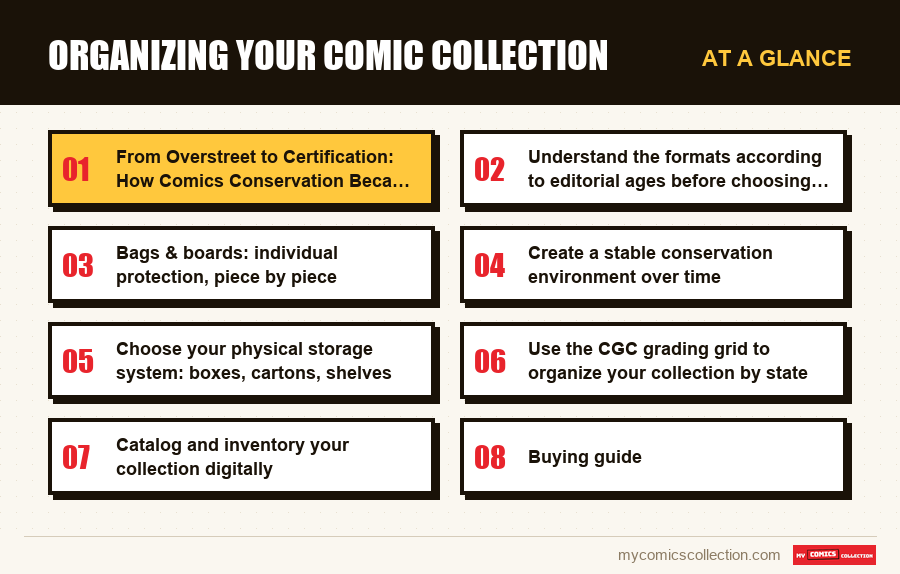
This guide details, step by step, how to structure a collection of comics from A to Z: understanding the formats according to editorial ages, choosing the right protection, mastering the climatic parameters which make the difference between a copy that lasts for decades and another that turns yellow in ten years, physically organizing the boxes and shelves, then digitally cataloging the whole thing so that you never again buy an issue already owned by mistake.
The objective is not only aesthetic. A well-preserved comic maintains better page quality, better rating potential during possible certification, and a well-inventoried collection allows you to precisely track what you have, what is missing, and what it is worth over time.
From Overstreet to Certification: How Comics Conservation Became Professionalized
For a long time, storing comics simply meant stacking them in a box at the back of a closet. It was only from the 1970s that the notion of market value, then of methodical conservation, took shape. In November 1970, Robert M. Overstreet published the first edition of his Comic Book Price Guide: 218 pages, an initial print run of barely 1,000 copies sold for 5 dollars, built largely on the notes accumulated by Jerry Bails, author of Collector's Guide to the First Heroic Age. This guide gave for the first time a common basis of price and rarity to scattered fans who exchanged numbers by correspondence.
This standardization had a direct effect on the way in which comics began to be treated as objects to be preserved rather than as disposable paper after reading: once an issue has documented value, the way in which it is stored becomes an issue. The rise of the direct market in the years that followed, with specialized stores selling on non-returnable consignment sales, accelerated this evolution: comics ceased to be only sold on newsstands to become a collector's product in their own right, with its own circuits and its own conservation codes.
The next decisive step for the modern organization of a collection came in 2000 with the founding of Certified Guaranty Company (CGC) by Steve Borock in Sarasota, Florida. Before CGC, the rating of a comic depended on the judgment of the seller or buyer, with no objective reference. CGC introduces a standardized numerical grid, from 0.5 to 10.0, and a “slabbing” process: the comic is placed in an internal case made of Barex (a polymer almost impermeable to gases), itself sealed by ultrasound in a rigid, tamper-proof shell, with a label indicating title, date, grade and quality of the pages. Since 2000, several million comics have been graded by this company alone, a volume that has made CGC grading almost essential for transactions of old or high-grade comics. This story explains why current conservation practices (acid-free bags, buffer boxes, controlled climate environment) are not the whims of maniacal collectors: they arise directly from the standards that a comic must meet to hope for a high grade the day it is submitted for certification.
Understand the formats according to editorial ages before choosing your protection
Before ordering any bag or box, you need to know what format each comic in the collection belongs to, because the dimensions have varied significantly over the editorial decades. A bag sized for a modern issue will not adequately protect a Golden Age, and conversely a bag too large will allow the comic to move and wrinkle inside.
Comics from the Golden Age (roughly from the end of the 1930s to 1955) did not follow any strict manufacturing standards: sizes ranged from approximately 7.25 x 10.25 inches to 8.25 x 10.5 inches, with the average being around 7.75 x 10.5 inches. This is the most irregular format and the most difficult to store, because two issues from the same year can have slightly different dimensions.
Silver Age comics (from around 1956) narrowed down to a more consistent format of approximately 7.125 x 10.5 inches, with nuances depending on the publisher: early Marvel issues from this period are approximately 6.875 inches wide, compared to approximately 7 inches for the DC equivalents. The Bronze Age (from the late 1960s-1970s) saw the width rise slightly to around 7.25 x 10.5 inches.
Since the modern age until current releases, the format has stabilized and standardized at 6.625 x 10.25 inches (or approximately 16.8 x 26 cm), a dimension that has remained virtually unchanged for several decades among the two main American publishers. It is this “current” format that we find on the overwhelming majority of comics published today, including the current Spider-Man, Batman or X-Men series.
This diversity of formats means in concrete terms that a collection combining several editorial ages must be equipped with at least two, or even three different sizes of bags and boxes. Storing a Golden Age in a Modern bag that is too small forces the comic to fold and irreparably damage the cover; Conversely, a Current Age lost in a Golden Age bag that is too large slips, wrinkles and absorbs ambient humidity more easily due to lack of proper sealing.
Bags & boards: individual protection, piece by piece
Individual protection of each issue is a collection's first line of defense. Two elements come into play: the bag and the board, and both must be chosen with the same level of requirement.
For bags, two materials dominate the market. Polypropylene and polyethylene are the most common and affordable, but they degrade over time: the general recommendation is to replace them every 5 to 7 years to avoid any risk of chemical migration or static deposits on the roofing. Mylar (specifically Mylar-D or Mylar-M), a biaxially stretched polyester film, is considered the archival gold standard: chemically stable, acid-free, it can protect a comic over decades without degrading in the same way as a standard polypropylene bag. For high-value numbers or those intended for certification submission, Mylar remains the preferred choice despite its higher cost and its rigidity which requires more careful handling.
For the reinforcement boxes, two terms are non-negotiable at the time of purchase: “acid-free” and “lignin-free”. Lignin, present in the cheap newsprint used to print many old comic books, chemically degrades over time and yellows the paper; a box containing it accelerates this phenomenon in direct contact with the cover. So-called “buffered” cartons go further by integrating a component which actively neutralizes any migration of residual acidity coming from the comic paper itself, a real plus for old issues that are already weakened. For long-term storage, the combination of a full-back board (which covers the entire comic rather than just a partial backing) with a Mylar bag provides the most stable individual storage environment available today.
An often overlooked detail: the bag must correspond exactly to the editorial age of the comic it protects, as detailed above. A bag that is slightly too large is not insignificant: it allows the comic to move each time the box is handled, which wears out the corners and encourages corner creases, one of the most penalizing defects when grading.
Create a stable conservation environment over time
Personal protection is of no use if the overall storage environment is unstable. Two climatic parameters determine the real longevity of a collection: humidity and temperature.
The recommended relative humidity level is between 40 and 50%. Above that, the risk of mold increases sharply, with irreversible stains on the paper and sometimes an odor which permanently permeates the comic and everything around it in the box. Below this range, the paper dries out, becomes brittle and loses flexibility, which increases the risk of tearing during handling. A small dehumidifier or silica gel sachets placed in storage boxes can stabilize this parameter in a room subject to seasonal variations.
Temperature-wise, the recommended range is approximately 18 to 22°C (65 to 72°F), maintained stable rather than fluctuating. It is precisely for this reason that attics and garages, often cited by new collectors as a “practical” storage solution, should be avoided: these spaces experience considerable temperature differences between summer and winter, sometimes even between day and night, and these repeated expansion-contraction cycles weaken the paper much faster than occasional exposure to a slightly unusual temperature.
Light constitutes the third factor, less often measured but just as destructive: prolonged exposure to direct light, and in particular UV, discolors the covers and accelerates the yellowing of the paper. A dark room or a closed box away from any window is preferable to an exposed shelf, however aesthetic it may be, for displaying your favorite comics.
Finally, the storage position matters: protected comics must be stored vertically in their box, tight without excess to prevent them from sagging, but not too packed either so as not to exert pressure on the corners. Stacking comics flat over a long period of time should be systematically avoided: the cumulative weight ends up warping the bottom issues, a conservation defect that is almost impossible to correct afterwards.
Collecting this series?
Track what you own, what you are missing and what your collection is worth. 7 day trial.
Start my trial →Choose your physical storage system: boxes, cartons, shelves
Once each comic is individually protected, you need a container adapted to the volume of the collection and the frequency of consultation. Collectors traditionally use two formats of sturdy cardboard boxes, sized to receive ringed and boarded comics vertically.
The short box, approximately 38 cm long, in practice accommodates between 150 and 175 current or silver age comics ringed and boarded, some compact models announcing up to 200 issues. Its main advantage is the weight: full, it remains easy to handle, which makes it suitable for storage on a shelf or for regular transport, for example to take part of the collection to a convention or to a collector friend.
The long box, approximately 68 cm long, offers an announced capacity of 300 to 350 comics, but the real figure once the numbers are ringed and boarded is rather around 220 to 240 copies on average, the cumulative thickness of the polypropylene bags and the 24 point (pt) cardboard boxes mechanically reducing the available capacity compared to bare comics. A full long box can weigh 15 to 18 kg, making it difficult to move alone and better suited to fixed storage, on the floor or on a low, sturdy shelf, rather than for portable use.
The choice between the two formats therefore depends above all on use: favor short boxes for regularly consulted issues, keys to the collection or runs currently being read; reserve long boxes for background storage, for numbers rarely handled once classified. Many collectors combine the two, with the short boxes front-facing on an accessible shelf and the long boxes stacked in a more discreet storage space.
For classification inside the boxes, the most effective method remains alphabetical by series title, then increasing numerically within each title. Indexed cardboard dividers, slipped between each series or each run, avoid having to turn over an entire box to find a precise number. For mixed collections of all eras, physically separating the boxes by editorial age (a Golden Age box, a Silver Age box, etc.) further simplifies research and avoids mixing different bag formats in the same container.
Use the CGC grading grid to organize your collection by state
Beyond physical storage, organizing a collection also requires knowing how to evaluate and classify each issue according to its condition, whether the comic is intended for official certification or simply for rigorous personal monitoring. The CGC grid, which has become the industry benchmark since 2000, ranges from 0.5 (Poor, the most degraded condition) to 10.0 (Gem Mint, without the slightest detectable manufacturing or handling defect).
This scale progresses in steps of 0.5 points from 0.5 to 9.0, then in finer steps of 0.2 points or less between 9.0 and 10.0: this tighter granularity at the top of the scale is explained by the fact that the difference in value between two comics very close in condition (for example 9.6 and 9.8) can be considerable on a key number sought, which justifies a more precise distinction than on grades. intermediaries. Concretely, a 9.8 (Near Mint/Mint) remains the reference for the majority of modern issues sought in very high condition: the comic appears perfect to the naked eye, with at most one microscopic defect identifiable by an expert eye. A 9.4 (Near Mint) usually has one or two light stress marks on the back that do not break up the color layer. The grade 6.0 (Fine), often misunderstood by beginners, actually corresponds to a correct intermediate condition: the comic shows normal signs of wear from a read copy, but remains presentable and complete.
Even without sending each number for certification, mentally applying this grid when ranking helps to prioritize: a number close to Near Mint condition deserves a Mylar bag and a reinforced board without discussion, while an already marked example can be satisfied with standard polypropylene protection. This prioritization avoids wasting the “premium protection” budget on comics whose condition will never be eligible for a high rating anyway, and allows the conservation effort to be concentrated on the pieces that really benefit from it.
Catalog and inventory your collection digitally
Physical storage, however rigorous it may be, does not replace a digital inventory. Without an up-to-date list, it is almost impossible to know with certainty what you already own during an impulse purchase at a convention or online, and even more difficult to estimate the overall value of the collection or to declare it correctly in the event of an insurance claim.
A useful digital inventory reference, for each comic, at least the title, number, publisher, year, estimated condition (ideally according to the CGC grid to remain consistent with market standards) and, if the issue has been graded, the corresponding certificate. Adding a photo of the cover and possibly the spine allows you to document the condition at the time of entry into the collection, valuable proof in the event of a dispute or subsequent resale. OUR comic collection management application was designed precisely for this use case: centralizing the numbers owned, tracking their status and their estimated value, and avoiding duplicate purchases without having to maintain a spreadsheet in hand.
Value tracking deserves a separate mention. Comic book ratings, particularly on key issues, evolve continuously based on actual sales observed on the market. Rather than relying on a fixed estimate in an old paper guide, periodically checking the current rating of an issue via recent sales allows you to keep a realistic inventory. It is also useful when insuring your collection: an obsolete, underestimated or overestimated declared value complicates any action in the event of a claim.
Buying guide
Before embarking on fully equipping a collection, here are the concrete points to check when purchasing conservation supplies:
- Identify the dominant editorial age of the collection before ordering: a predominantly Modern Age collection does not need Golden Age bags, and vice versa; mixing sizes randomly always ends up poorly protecting part of the numbers.
- Reserve Mylar-D bags for high value numbers or intended for certification submission, and standard polypropylene for current readings or low market value numbers, so as not to unnecessarily inflate the protection budget.
- Systematically check the “acid-free” and “lignin-free” notices on the carton packaging before purchasing; failing that, prefer a “buffered” board for comics that are already old and potentially acidified.
- Plan to renew polypropylene bags every 5 to 7 years rather than considering them as a definitive purchase, especially for numbers handled regularly.
- Calculate the actual capacity of the boxes taking into account the thickness of the bags and boards (approximately 220 to 240 comics per long box, and not the 300 to 350 advertised on the packaging) so as not to run out of space.
- Invest in a small hygrometer for the storage room rather than guessing at the ambient humidity; an additional dehumidifier or silica gel sachets are often enough to correct a rate outside the 40-50% range.
- Avoid any storage in an unconditioned garage, attic or basement, even temporary, due to the frequent temperature and humidity variations there.
- Establish a digital inventory from the first issues rather than waiting until the collection becomes too large to effortlessly catalog retroactively.
- Before purchasing a number you already have, check its current rating rather than an old estimate, particularly via a free estimate based on current eBay listings to determine the real market price.