When you start collecting comics seriously, you inevitably go through several phases. First sticky notes, then the Excel file, and finally the search for a real dedicated app. But faced with dozens of available tools, how do you distinguish those that will truly change your daily life as a collector from those that just add complexity?
Comic collection app: the features that really change everything
When you start collecting comics seriously, you inevitably go through several phases. First sticky notes, then the Excel file, and finally the search for a real dedicated app. But faced with dozens of available tools, how do you distinguish those that will truly change your daily life as a collector from those that just add complexity? This guide reviews the truly essential features and explains why each deserves a place in your arsenal.
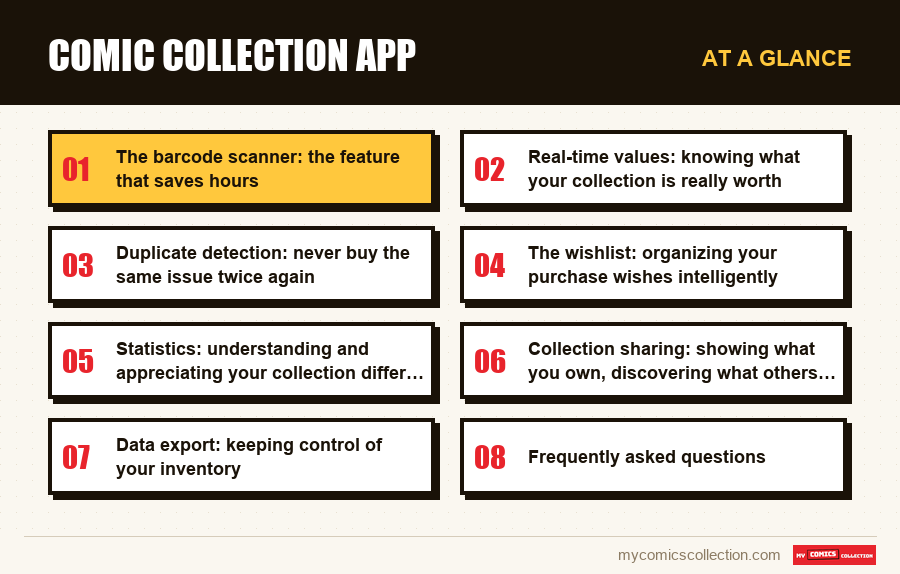
The barcode scanner: the feature that saves hours
If a single feature should justify installing an app, this is it. The barcode scanner turns adding a comic to your collection into a two-second gesture. You point your phone at the code on the bottom of the cover, the app recognizes the title, number, publisher, publication year and sometimes even the cover. No more tedious manual entry.
Concretely, imagine you come back from a flea market with thirty comics in your arms. Without a scanner, the evening is spent typing each reference by hand, searching for cover images, correcting typos. With a scanner integrated into your app, it takes twenty minutes, phone in hand, while you store your purchases in your longboxes.
Scanner quality varies enormously between apps. The best ones work even on slightly damaged or yellowed-paper barcodes, and offer a "burst scan" mode to handle multiple comics in sequence without confirming each addition.
Daily-updated values: knowing what your collection is really worth
A comic collection is also an asset. And to manage it intelligently, you need to know what each piece is worth on the market today: not in a guide published three years ago. Good collection apps integrate value data from real sales, updated regularly.
The usefulness is twofold. First for selling: before posting a listing, you check your comic's value in two clicks and set a price consistent with the market. Then for buying: at a flea market or convention, you can instantly verify whether the seller is at market rates. An Amazing Spider-Man #300 in good condition offered for $45 when the value is at $165 is not something to miss if you have this info at hand.
Values also vary by condition. A serious app lets you note each copy's condition (Near Mint, Very Fine, Fine, Good) and automatically applies corresponding discounts to the estimated value.
Duplicate detection: never buy the same issue twice again
This is one of the most classic misadventures of the somewhat-advanced collector: buying a comic you already own. It happens when the collection exceeds a few hundred copies and issues in the same series look alike on the shelf. A good app alerts you in real time as soon as you scan or search for a comic you've already cataloged.
Some apps go further: they warn you not only about exact duplicates but also about variants. If you already have cover A of an issue and you scan cover B, the app can flag both versions and let you choose whether you want both intentionally.
The wishlist: organizing your purchase wishes intelligently
A well-designed wishlist is much more than a simple wish list. It's your purchase roadmap. You add the issues missing from a series, the runs you want to complete, the rare pieces you've been watching for months. During outings in shops or flea markets, you consult your wishlist and know exactly what to look for.
The best apps let you organize your wishlist by priority or budget. They can also alert you when a comic on your list is available at a partner store or drops below a certain price. For collectors following long series with complex runs, this feature saves considerable time.
Collecting this series?
Track what you own, what you are missing and what your collection is worth. 7 day trial.
Start my trial →Statistics: understanding and appreciating your collection differently
How many comics do you have in your collection? What's the total estimated value? Which decade dominates your library? Which publishers are best represented? Statistics transform your inventory into a collector portrait. Beyond the fun aspect, they have real practical utility: they reveal your collection's trends, imbalances, gaps in certain series.
Evolution charts are particularly valuable for collectors who buy and sell regularly: seeing your collection's value grow over twelve months is a real satisfaction, and this data is useful if you ever need to insure your collection.
Collection sharing: showing what you own, discovering what others have
Collecting alone is good. Collecting with a community is better. Sharing features let you generate a link to your public collection that you can send to friends or post on forums. Some apps also let you share your wishlist, which opens the way to trades between collectors.
Sharing also has a practical aspect during transactions: showing your collection to a potential buyer or seller becomes instant, without having to sort photos or manually write a list.
Data export: keeping control of your inventory
Last feature often wrongly neglected: the ability to export your data. A CSV or PDF export lets you keep a copy of your inventory independently of the app, share your list with an insurer or work it in another tool if needed. It's also a trust question: a good app shouldn't lock you into a closed ecosystem.
All these features, together in a single fluid interface: that's what My Comics Collection offers. The app was designed with real collectors' needs in mind: those who have hundreds or thousands of copies to manage, who buy and sell regularly, and who want their management tool to be a real ally rather than an additional burden.
Frequently asked questions
Most comics published before the 1980s don't have a standard UPC barcode. For these copies, a good app offers manual search by title, number and year, or cover image recognition. My Comics Collection integrates an extensive database that also covers older comics for fast manual entry.
Values shown in collection apps are estimates based on real market data, but they remain indicative references. For an official evaluation (insurance, estate, major sale), it's recommended to consult an expert or professional grader like CGC. Daily-updated values remain excellent tools for routine transactions and for having a realistic idea of your collection's value.
Absolutely. Even for a small collection, an app brings real added value from the first comics: you avoid duplicates, you know exactly what you own, and you can organize your wishlist. Plus, starting with an app from the beginning avoids the tedious migration work when the collection grows.
Excel can serve for a small static collection, but its limits appear quickly: no scanner, no daily-updated values, no duplicate alert, no mobile interface designed for use in a shop or flea market. A dedicated app is designed specifically for collectors' needs and saves considerable time daily.