There are dozens of apps for managing a comic collection. Some are disguised spreadsheets. Others look impressive but prove unusable once your collection crosses a few hundred copies. Still others have an excellent database but a scanner that only works for recent comics.
There are dozens of apps for managing a comic collection. Some are disguised spreadsheets. Others look impressive but prove unusable once your collection crosses a few hundred copies. Still others have an excellent database but a scanner that only works for recent comics.
How do you choose? The comic collection app market has become as complex as the comic market itself. This guide gives you 5 essential criteria for evaluating any app, so you don't spend 6 months cataloging your collection in a tool that doesn't suit you.
Why a good tool makes a real difference
Before going into criteria, let's ask the fundamental question: why use an app rather than an Excel spreadsheet or a paper notebook?
The answer is simple: a comic collection's complexity quickly exceeds what a spreadsheet can efficiently manage. A comic isn't just a title and a number. It's a title, a volume number, a date, a publisher, a condition, a market value that evolves, cover variants, storage conditions, purchase information: multiplied by hundreds or thousands of copies.
An Excel spreadsheet will ask you hours of manual entry for each record. A good app reduces that to a few seconds per comic, thanks to the scanner and database. On 1,000 comics, it's the difference between a week of work and one evening.
What you lose without a good app: time (manual entry), money (poorly identified or evaluated comics), peace of mind (no reliable backup, no overall view of your collection's value).
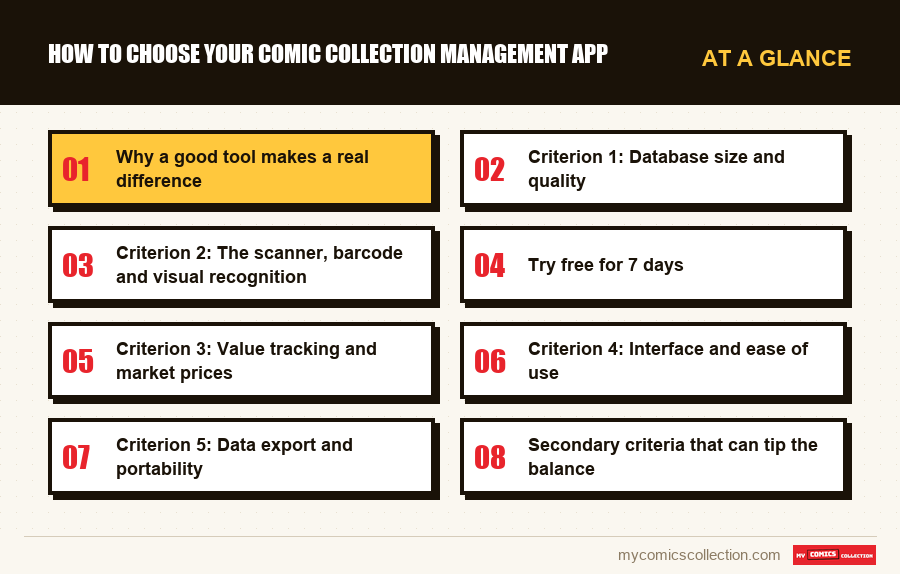
Criterion 1: Database size and quality
1 Database, the foundation of everything
The database is the heart of a comic management app. It's what lets you identify a comic in seconds rather than minutes of manual searching. An incomplete database means an unusable app for your type of collection.
Check: How many issues are indexed? Are older comics (before 1980) included? Are there international comics? Is the database regularly updated with new releases?
The absolute reference for databases is the worldwide comics database, which catalogs over 500,000 comic issues worldwide. An app connected to catalog guarantees exceptional coverage, including older comics without barcodes.
Beware of apps displaying impressive numbers without specifying sources. "200,000 comics indexed" may sound like a lot, but if these are only post-2000 publications, it's useless if you collect Silver Age.
Questions to ask about the database
- Does the database cover American Golden Age comics (before 1956)?
- Is there information on cover variants?
- Are reprints distinguished from originals?
- Does the database integrate creator information (writer, artist)?
- Are weekly new releases added quickly?
Criterion 2: The scanner, barcode and visual recognition
2 Scanner, cataloging speed
An efficient scanner reduces cataloging time by 80 to 90%. It must work for recent comics (UPC barcode) but also, and this is where apps distinguish themselves, for older comics without barcodes, via cover recognition.
Check: Does the scanner work for comics before 1980? Is cover recognition available? Is the recognition rate acceptable (over 85%)?
UPC barcodes have existed on comics since 1974-1980. For anything before that (most of the Golden Age, all of the Silver Age, much of the Bronze Age) barcode scanning is useless. You need an alternative.
Image-based cover recognition is one alternative: you photograph the cover and an algorithm compares it against an image database. A fast search by series and issue number in a complete catalog is the other, and it is the route My Comics Collection takes. Either way, this is what separates an app suited to serious collectors from one that only works for modern comics.
A good scanner must also handle real cataloging conditions: slightly deformed covers, imperfect lighting, covers partially covered by a plastic sleeve. A scanner that only works in perfect conditions isn't a real scanner.
Try free for 7 days
My Comics Collection pairs its barcode scanner with a search by series and number, both connected to the catalog base of 500,000+ issues. Test on your own comics before deciding.
Start free trial →7 days no charge during the trial, cancel in 1 click
Criterion 3: Value tracking and market prices
3 Value tracking, knowing what your collection is worth
Knowing your collection's current value isn't narcissism: it's a practical necessity for insurance, buy/sell decisions and prioritizing protection of the most valuable copies. A good app gives you this up-to-date view.
Check: Are values based on recent real sales? Is tracking regularly updated? Can you see a copy's evolution over time? Does the app factor condition into value calculation?
The comics market fluctuates. What was worth $55 five years ago might be worth $550 today if the character appeared in a Marvel film. Conversely, comics overvalued during a speculative buzz can fall brutally. An app displaying static values from two years ago has no practical use.
What value tracking lets you do concretely
- Insurance: In case of a claim (fire, flood, theft), you have a documented and up-to-date replacement value. Without it, your insurance will reimburse at "reasonable" value, far below real value.
- Sales decisions: Knowing a comic has tripled in value in 6 months helps decide if it's the right time to sell.
- Protection priorities: The most valuable copies deserve the best sleeves and storage conditions. Value tracking tells you which ones.
- Global valuation: Seeing your collection's total value evolve over time is motivating and useful information.
Criterion 4: Interface and ease of use
4 Interface, the app you'll actually use
The world's best database is useless if the app is so complicated you abandon it after two weeks. The interface must be intuitive, pleasant and suited to real-world use: standing in front of your longboxes, smartphone in hand, sometimes in difficult lighting.
Check: Is the app available on iOS and Android? Can it be used offline (important in a basement or attic)? Is navigation fast even with thousands of copies? Is the interface pleasant to use?
Simple test: launch the app and try adding your first comic in under 60 seconds. If you struggle to find the right button, if the app lags, if you have to fill 15 required fields to add a copy: bad sign. A good comic management app must be fast and enjoyable to use.
Interface features that really make a difference
- Offline mode: You often catalog in places without connectivity (basement, attic, flea market). The app must work and sync later.
- Fast search: Being able to find a specific copy in 2 seconds among 5,000 is essential.
- Advanced filters: By publisher, series, condition, value, purchase date: to analyze your collection from different angles.
- List and grid views: Depending on context, one or the other is more practical.
- Sharing: Being able to share your collection (or part of it) with other collectors or your insurer.
Collecting this series?
Track what you own, what you are missing and what your collection is worth. 7 day trial.
Start my trial →Criterion 5: Data export and portability
5 Export and portability, don't be locked in
Dozens of hours invested in a digital inventory is precious. If the app shuts down, raises its prices or stops being maintained, you must be able to recover your data easily. Export is a security feature as much as a practical one.
Check: Which export formats are available (CSV, PDF, JSON)? Does export include all data (condition, personal notes, photos)? Is export available anytime without additional fees?
CSV export is the minimum. It lets you open your inventory in Excel, share it with another app or submit it to your insurer. PDF export is useful for creating a printable document of your collection with covers. JSON export allows migration to other systems.
Beware of apps that only offer PDF export: that makes your data hard to use elsewhere. Also beware of those that place export behind an additional paywall or only allow exporting part of your data.
Secondary criteria that can tip the balance
Beyond the 5 main criteria, several additional features can be decisive depending on your specific use.
Wishlist management
A good app lets you manage not only what you have, but also what you're looking for: a wishlist or a list of missing issues in your series. Ideally, this list populates automatically when you indicate a series you collect.
Purchase and paid-price tracking
Knowing how much you paid for a copy vs. its current value is precious information. It gives you your "latent gain" on the collection and helps you make informed sale decisions.
Multi-device sync
If you have a phone, tablet and computer, you'll want to access your inventory from any device. Real-time cloud sync is now standard, but verify it's fluid and reliable.
Statistics and dashboards
Publisher breakdown, value evolution over time, condition distribution: these statistics give you an analytical view of your collection you can't have with a simple spreadsheet.
How to test an app before committing
Any serious app offers a free trial. Here's how to use those 14 trial days productively.
Test the scanner on your hardest comics
Take your barcode-less comics, your bagged copies, your poor-condition comics. If the scanner identifies them, good sign. If it only works on recent comics in perfect condition, insufficient.
Check value accuracy on known comics
Take 5 comics whose approximate value you know and compare with displayed values. If values are consistent with current market, the value database is reliable.
Test export before cataloging 1,000 comics
Add 10 comics, then export to CSV. Check that all your data is there in usable format. Critical test before committing.
Evaluate speed on your volume
If you have 3,000 comics, test the app with a few hundred entries. Is it still fluid? Is search instant? Performance on small volume doesn't guarantee performance on large volume.
FAQ
The app that checks all your criteria
catalog base of 500,000+ comics, cover and barcode scanner, daily-updated value tracking, fluid mobile interface, unlimited CSV and PDF export. My Comics Collection was designed for serious collectors: try it free.
Try My Comics Collection →7-day complete trial, no commitment