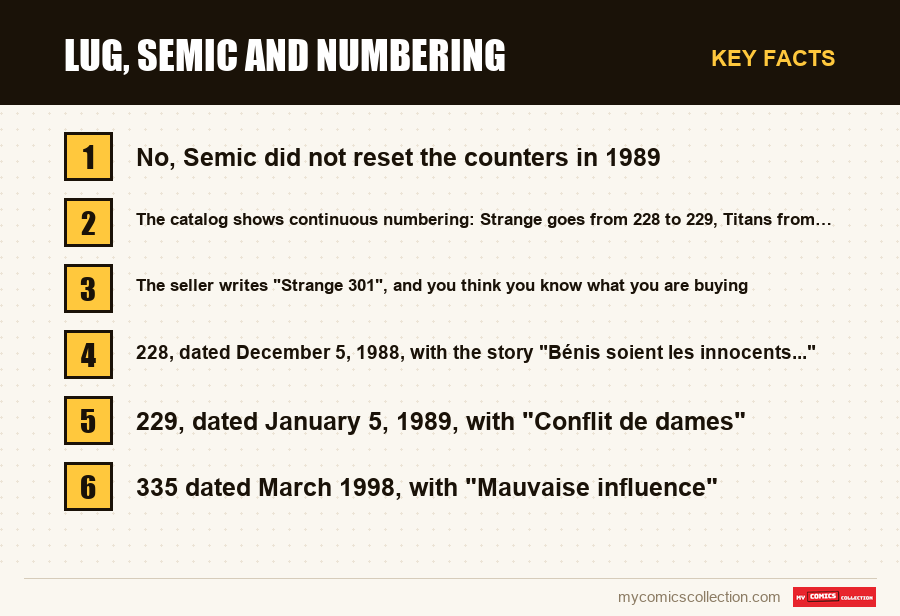
No, Semic did not reset the counters in 1989. The catalog shows continuous numbering: Strange goes from 228 to 229, Titans from 119 to 120, Nova from 131 to 132, with no break and only one month between issues. Number collisions do exist, but they come from elsewhere: special issues that borrow the number of their parent magazine, titles relaunched from scratch by another publisher, and same-name series that overlap.
You are looking for a specific number in an ad, a bin at a show or a list of gaps. The seller writes "Strange 301", and you think you know what you are buying. That is exactly where things go wrong, and not at all for the reason repeated for thirty years in collector discussions.
As always on this guide, only verified information (creators, issue numbers, dates) is stated as fact; the analysis is our own, with no reproduction of panels or protected dialogue.
The received idea: "Semic started again at 1"
It is a solid belief, repeated in good faith, and it is wrong. The catalog is clear on the most emblematic case: the last Strange issue under Lug is No. 228, dated December 5, 1988, with the story "Bénis soient les innocents...". The next one is No. 229, dated January 5, 1989, with "Conflit de dames". One month apart, one number apart.
In other words, the change of publisher left no trace in the numbering. For the newsstand reader of the time, nothing broke: he bought the next issue at the same pace. That is excellent news for anyone completing a series, and very bad news for anyone hoping to recognize an issue from its number alone.
The series also continued for a long time under the new imprint, up to No. 335 dated March 1998, with "Mauvaise influence". One title, a single sequence of numbers, two publishers: that is the correct starting point.
Three magazines that say the same thing
A single case would prove nothing. Titans behaves in exactly the same way: No. 119, dated December 10, 1988, carries "Une taupe chez les Vengeurs !", and No. 120, dated January 1989, continues with "La Malédiction d'Olphir 3ème partie". The title of that story is itself an argument: the narrative is picked up midstream, which would make no sense if a collection had been relaunched.
Nova confirms it identically. The last Lug issue is No. 131, dated December 1988, with "Le non-humanoïde !"; the next issue is No. 132, dated January 1989, with "Masques !". Again, no return to one, and no skipped month.
The phenomenon is not limited to monthlies. Spécial Strange goes from No. 59, dated November 1988 and marked "L'ombre du Grand Sphinx...", to No. 60 of January 1989, "Eternel retour !". Un Récit Complet Marvel goes from No. 20 to No. 21, the latter dated February 1989 with "La Panthère Noire". Four families of publications, four clean continuations.
What the numbering will never tell you
The immediate practical consequence: if you want to know which imprint published a given copy, the numbering is useless on its own. What tells you is the date, cross-checked against the threshold specific to each magazine. Beyond 228 for Strange, 119 for Titans, 131 for Nova, 59 for Spécial Strange and 20 for Un Récit Complet Marvel, you are in the period after December 1988.
These thresholds should be read in that direction, and not the other way round: a high number is not "necessarily a Semic" if the magazine did not yet exist in 1988. A title launched in 1992 can carry a low number and be well after the switch. The number does not date, it places within a sequence.
One case is even more telling: Spidey stops dead at No. 107, dated December 10, 1988, with "Le Surfer d'argent". No continuation takes up that title in the catalog. A title that disappears at the moment of the switch therefore tells you something, whereas a title that continues tells you nothing.
The real collision: the special issue that borrows its parent magazine's number
This is the trap that actually fools buyers, and it has nothing to do with a change of publisher. Strange Spécial Origines does not have its own sequence: it borrows that of Strange. Its first entry in the catalog bears the mention "133 bis", dated January 5, 1981, and then the numbers advance in steps of three, quarter after quarter, aligned on the monthly.
As long as the "bis" or "hors série" mention appears in the reference, you can manage. The difficulty begins when it disappears. Up to No. 298, the catalog does carry "hors série"; from No. 301, dated January 1995 with "Le défi du Surfer", the mention drops off. Yet the monthly also has a No. 301, dated January 1995, with "Indiscrétions".
Same month, same number, two different issues, two different stories. The case repeats at No. 304: "Armageddon" in the monthly of April 1995, "Prends garde... aux Frères de Sang !" in the special issue of the same month. An ad that says "Strange 304" therefore does not tell you what you are going to receive.
Why this collision goes unnoticed
Because a seller copies what he reads, and what he reads is a large figure. The special-issue mention is small, sometimes absent, and never in the same place. A lot of ten magazines photographed in a stack shows only spines: it is impossible to decide.
The oldest case is even more discreet, because the two objects come out on the same day. On October 5, 1988, the monthly offers "Haut les coeurs" under No. 226, and the special issue also carries 226, with "Fantastiques contre X-Men". Nothing in the number, nothing in the date, lets you tell them apart.
The only useful question to ask the seller is therefore not the number, but the printed mention: does the cover carry a special-issue subtitle, and which story does it announce? Ask both together, never one without the other. For Silver Surfer or Daredevil series republished in France, this habit saves a lot of time.
Do you collect this series?
Track what you own, what you are missing and what your collection is worth. 7-day trial.
Start my trial →
Second real collision: the title relaunched from scratch by another publisher
Here, the reset does exist, but not at the moment the legend places it. Hulk had two distinct French series carrying that single word as their title. The first starts in December 1976 with "Hercule", drawn by Herb Trimpe; the second starts in April 1992 with "Exposition", written by Peter David and drawn by Dale Keown.
Both series have the same number of installments in the catalog, twenty-nine, which makes the confusion perfectly symmetrical: there is no issue of one that does not have its counterpart in the other. "Hulk 1" therefore designates two objects separated by fifteen years, whose format, paper and content are not alike.
To settle it, the artist's name is far more reliable than the number. Trimpe on one side, Keown on the other: if the seller can answer, you are settled. If the cover is visible in the photo, a glance at the graphic treatment is often enough, since the two eras have nothing in common. The character hub helps place each period.
Third real collision: same-name series that overlap
Thor gives the trickiest case, because the two series do not start in the same place. The first runs from No. 1, dated August 1977, to No. 27 in September 1983. The second, in the catalog, starts directly at No. 3 and ends at No. 31. The overlap is therefore wide: from No. 3 to No. 27, every number exists twice.
The case of the first two missing installments of the recent series deserves a word, moreover: sources disagree about their status, and we do not state it. Simply retain the practical effect: do not look for a No. 1 and a No. 2 under this reference, you would lose months.
The phenomenon is not specific to Marvel comics in France, nor to the 1989 switch. Aventures Fiction offers a pure version: a series of twenty-nine issues started in March 1958, and another, fifty-seven issues, started in July 1966 under the same title and from the same publisher. Eight years apart, and two sets of Nos. 1 to 29.
When one publisher overlaps its own numbering
Big Boss pushes the logic even further. The catalog keeps two entries: one covers Nos. 46 to 70, from 1960 to July 1962; the other restarts at 1 and goes up to 59, from 1970 to 1983. The overlap, from 46 to 59, therefore concerns issues published twenty years apart by the same house.
Same family of trap, different mechanism: some series do not start at 1 in the catalog. Top BD starts at 14, in March 1989. A gap list built on the assumption that everything starts at one will send you looking for numbers that never existed under that reference, which is the surest way to believe a complete collection is incomplete.
When you inherit a pile, therefore, start by recording the lowest number actually present, and treat it as a starting hypothesis rather than as a gap. That is quicker than starting from a theoretical table.
The false marker: relying on the story title
Since the number misleads, one is tempted to hold on to the French title of the story. It is a very poor marker, because the magazines overlapped. "Fantastiques contre X-Men" appears in Titans 118 and in Spidey 106, both dated November 10, 1988, in special issue 226 of October 5, 1988, and in Un Récit Complet Marvel 20. One identical headline, four distinct references.
The same blurring plays out between close series. "La folie de Mysterio", dated 1987, appears at No. 29 of two entries with nearly identical titles, one called L'Araignée, the other Une Aventure de l'Araignée. The phenomenon repeats number after number, and it also concerns the two album entries devoted to the Fantastic Four, where No. 19 carries "Les Sortilèges de Diablo" in both cases.
One last warning on this point: the catalog gives only one story title per number, whereas a French magazine often published three or four. That title therefore does not describe the full contents, and two copies bearing the same headline can differ in everything else. Contents are verified on the copy, never on a list.
The buying method, in four questions
First ask for the printed date, not the estimated year. It is the only element that unambiguously distinguishes two issues carrying the same number, except in the case of a special issue released the same day as its monthly. A photo of the publication mention settles most disputes before the purchase.
Then ask for the exact mention printed under the title, then for the story announced on the cover, then, for relaunched series, for the artist's name. Taken together, these four pieces of information leave almost no margin for error, whereas the title-plus-number pair, the one that appears in ninety percent of ads, leaves an enormous one.
Finally, keep your own list by date as well as by number. A collection noted "Strange 229 to 335" is clear; a collection noted "Strange 301" is not. This discipline costs ten minutes at the start and avoids the duplicates you discover while tidying up three years later.
Frequently asked questions
No. The catalog shows a strict continuation: No. 228 is dated December 5, 1988, and No. 229 is dated January 5, 1989. There are therefore no two issues called "Strange 12" because of the switch. The duplicate numbers on this title come from the special issue, not from the change of publisher.
Locate the threshold of the magazine: up to No. 119, dated December 10, 1988, you are in the first period; from No. 120, dated January 1989, in the second. The number is enough here because the sequence is unique, but check the printed date anyway if the copy is damaged.
Because the original special issue always borrowed the monthly's numbering, and from that point on the distinguishing mention no longer appears in the reference. In January 1995, the monthly offers "Indiscrétions" and the special issue "Le défi du Surfer". Only the announced story separates them.
Not necessarily, because two French series carry that title and each has twenty-nine installments, one started in December 1976, the other in April 1992. A lot mixing the two looks complete. Ask for the name of the artist on the first issue to settle it immediately.
Above all, do not jump to the conclusion that something is missing. Several references start at a higher number, such as this album title whose first recorded installment carries No. 14 and is dated March 1989. Record the lowest number actually present before building your search list.