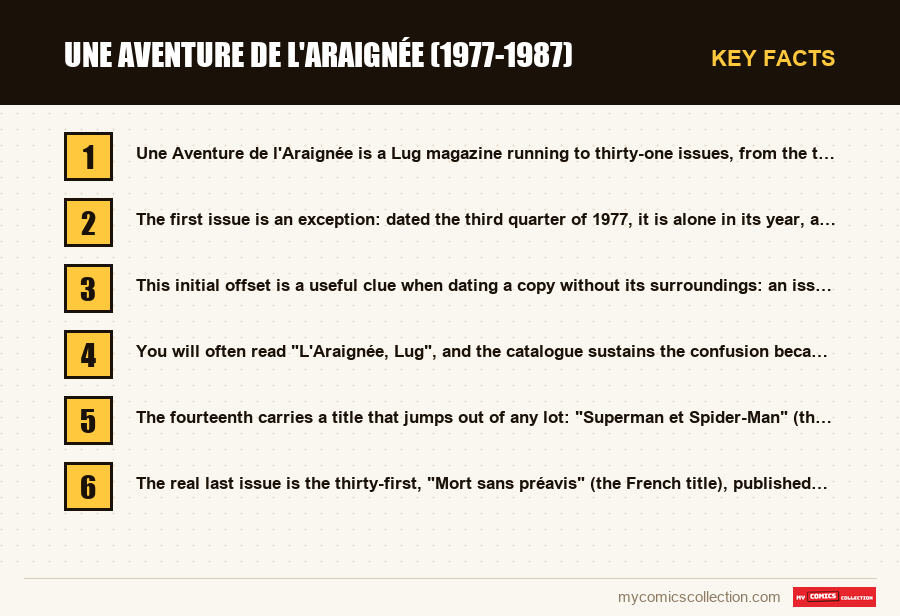
Une Aventure de l'Araignée is a Lug magazine running to thirty-one issues, from the third quarter of 1977 to 1987, with no gap in the numbering. Its real rhythm is three releases a year, never four. The catalogue holds two records of it under two different titles, which nevertheless describe the same object. And seven contents listings are documented only by a back-cover page, which means you have to cross-check before buying.
You have a pile of Lug Araignée issues and a very concrete question: how many are you missing, and which ones? The difficulty with this magazine is not its rarity, it is identifying it. Its date format changed along the way, it carries a long title that listings shorten, and its contents records have gaps that you need to learn to read.
As always on this guide, only verified information (creators, numbers, dates) is stated as fact; the analysis is our own, with no reproduction of panels or protected dialogue.
What the magazine published, according to the recorded titles
The catalogue keeps only one story title per issue, and that single title already sketches a very clear editorial line: the villain before the hero. The first issue is called "Le Bouffon Vert" (the French title). Over time come "Stegron", "Les tentacules ensorcelés", "Le triomphe du docteur Octopus", "La proie du Vautour", "La folie de Mysterio". The magazine sold on a menacing figure on the cover, and the French title served as its signboard.
These titles are those of the French publisher, not word-for-word translations. The sixth is called "Le Titan Vert" (the French title), a name that at this publisher referred to the character known today as Hulk. Searching for these titles in an American index will get you nothing: that is why a French listing is the only entry point for recognising what you hold.
Be careful, though, not to confuse a recorded title with a contents listing. These magazines stacked several episodes per issue, and the catalogue keeps only one. The title tells you what the issue contains, never everything it contains. That limit calls for caution on everything else in the purchase.
Three issues a year, never four
The cover dates are quarterly, and that is where the most common misreading happens. From the second to the twenty-second issue, they fall only in the first, second and third quarters. The fourth quarter does not appear a single time across seven consecutive years.
For a collector, the consequence is a relief: a run that seems to be missing "the winter issue" is not missing anything at all. The real rhythm is three issues per calendar year, so a lot covering four years should contain twelve to be full. Counting by quarters leads you to hunt for issues that never existed, and to pay for a lot as incomplete when it is complete.
The first issue is an exception: dated the third quarter of 1977, it is alone in its year, and the next one does not arrive until the first quarter of 1978. This initial offset is a useful clue when dating a copy without its surroundings: an issue of this magazine dated 1977 can only be the first.
One object, two records: "L'Araignée" and the long title
Listings shorten things. You will often read "L'Araignée, Lug", and the catalogue sustains the confusion because, alongside the long-title record, it keeps a second entry simply named L'Araignée and dated 1978, made up of twenty-five lines. Two distinct publications, or the same one described twice? The answer changes everything for someone reading a classified ad, and it can be measured.
It can be measured because the two records overlap on numbering and years. Nineteen of the common entries carry the same story title, allowing for capitals and accents, and the cover years match line by line. It is the same object, catalogued twice under two forms of its title.
This duplication is not noise, it is useful. Where the long-title record only recorded a back-cover page, the short record gives a real story title. The second issue thus becomes "La Nuit du lézard" (the French title), and the nineteenth "La Fureur du Rhino" (the French title). Seven silent contents listings on one side are filled in on the other, which makes the cross-check the most profitable step in the whole identification process.
The short record is, however, the poorer of the two: it reduces dates to the year, leaves the artist field empty, misspells one writer's name, and places two of its issues in square brackets, a sign of a reconstructed figure rather than one read from the cover. For a date or a signature, rely on the long-title record; for a missing story title, go to the short one.
After this cross-check, only two issues have no story title documented: the third and the fourth. If you own them, their contents can be read on the copy and nowhere else.
The issues the record makes identifiable
The first concentrates everything that makes an issue sought after without needing to invoke rarity: it opens the series, it is alone in its year, its title announces the Green Goblin, and the listing credits Jean-Yves Mitton and Steve Ditko on the art. It is also, mechanically, the one that has suffered most: a reader rarely keeps the first issue of a magazine they do not yet know they will follow.
The fourteenth carries a title that jumps out of any lot: "Superman et Spider-Man" (the French title), dated the first quarter of 1982. A French issue whose announced story brings together characters from two rival houses stands out from a distance and sells on that basis. The title is what the record asserts; the detail of the contents, however, still has to be checked on the copy.
Two others deserve to be known by their title. The twentieth, "La Veuve et le Samouraï" (the French title), is written by Chris Claremont, one of the four issues bearing his name. And the twenty-third is called "La fin de l'Araignée" (the French title), which is a perfect trap: the series continues after it, and eight more issues follow. The real last issue is the thirty-first, "Mort sans préavis" (the French title), published in 1987.
The signatures, and what the artist field mixes up
Only one signature runs through the magazine: Jean-Yves Mitton, present on twenty-three of the thirty-one entries. More to the point, he is there without interruption from the first to the nineteenth issue, then only intermittently, and not at all on the last five. That switch is a dating marker in itself: a copy without Mitton probably belongs to the last part of the series.
The handover is also identifiable. Jean Frisano appears from the second issue, then settles in from the twentieth and stays through the end of the collection. Thomas Frisano, for his part, appears on only two adjacent entries, around the turn of 1982 and 1983: a short anomaly that is worth checking against the cover if you hold those two issues.
A reading point avoids false conclusions here. The artist field stacks up to three names on a single line, placing French and American signatures side by side: it groups several roles without distinguishing them. The same blurring appears on writing, where French names turn up alongside the original author, most likely for the adaptation. Do not conclude from a name that it drew the cover you are looking at.
The most visible constant remains: Stan Lee is credited as writer on twenty entries, and on all of the last nine. The end of the magazine draws on older material at the very moment the covers change hands, which fits a publication that sustained itself rather than renewing itself.
Do you collect this series?
Track what you own, what you are missing and what your collection is worth. 7-day trial.
Start my trial →
Recognising and dating a copy
The printed date is your first tool, provided you know what it is worth for its period. A quarter mention places the copy in the first part of the series, the one running up to the twenty-second issue. From the twenty-third onward, the recorded cover dates carry only the year: 1985, 1986, then 1987 for the last three.
The second tool is the title. An issue number and a title that match the record validate the copy; a mismatch signals a misreading, or another publication reusing the same story. Note the two together, never the number alone.
A third signal, less expected: the record notes, twice, a page referring to a publisher's album collection. This is a reminder that some of this material circulated in other forms than the magazine. Before validating a purchase, make sure the object on offer is the magazine itself, not a collected edition that reprints its content.
Condition, and what really weighs on this series
On a magazine whose selling point is its signed cover, the condition of that cover weighs more than anywhere else. A copy with a rubbed spine but a crisp cover can still be defended; the reverse loses value sharply, because that is exactly what a buyer looks at. Examine the corners, the central crease and any loss of coating along the edge.
The signs of use are then very characteristic for a publication sold at newsstands and kept in a stack: a pencilled-over price, a newsagent's stamp, a reader's first name written in, a crease running vertically. None is disqualifying, all of them sell, and none can be removed without doing more damage than it costs.
Yellowing, finally, is the rule rather than the exception on this paper. What should raise an alarm is the difference between the sections of a single copy, often a sign of past moisture. On the first issue, this requirement costs more than elsewhere, and it is the only issue in the series where it is worth waiting for a beautiful copy.
The traps when buying
The first trap is the shortened title in the listing. A seller who writes "L'Araignée" is not necessarily offering something else, but they do not say what they have either. Ask for the issue number, the date printed on the cover and the title displayed.
The second is the illusion of a full contents listing. A record that keeps only one title per issue does not allow you to confirm a match with an American release, nor a character's first French appearance. Any seller promising either is claiming something the available data does not support: the only possible check is on the copy, pages in hand.
The third is the "complete" lot. Thirty-one issues, numbered without a skip: continuity can be verified in a minute, and a run that stops at the twenty-ninth is incomplete, even if it does cover ten years. Count the numbers, not the years, and be wary of a figure in square brackets in an inventory, which betrays a deduced numbering.
Completing the series, and keeping count
The series is completed in blocks, because it was published in blocks. The last three years provide coherent sets of three issues, easy to date and often offered grouped. The head of the collection, however, is hunted one at a time, and that is where patience comes in.
So secure what is plentiful first, then keep a long watch on the first issue, which does not turn up when you want it. Two issues deserve close inspection, the third and the fourth, the only ones with no documented story title: if you hold them, you are your own source.
For tracking, note for each copy the issue number, the date exactly as printed, and the title displayed on the cover. That combination will stop you from buying again an issue you already own under an abbreviated title, and it will make your inventory readable to a buyer on the day you sell. The other collecting guides apply the same discipline to neighbouring magazines.
The value today, and how to follow it
Think in ratios, never in amounts, because the value of these issues moves with condition and with the offer of the moment. The first issue sits at a clear multiple of the rest of the series. The later issues, more recent, circulate instead at the lowest price of the whole run, often in lots, which makes them the best ground for getting started.
Between two copies of the same issue, the gap in condition creates a wider price difference than the gap in rarity between two neighbouring issues. In other words, on this magazine a fine common copy is worth more than a worn copy of a reputed issue. Recognisable titles, such as the one announcing a story shared with Superman, partly escape this rule and sell on their subject.
Finally, following a value means following concluded sales rather than current listings, over a long enough period to absorb the spikes caused by adaptations.
Frequently asked questions
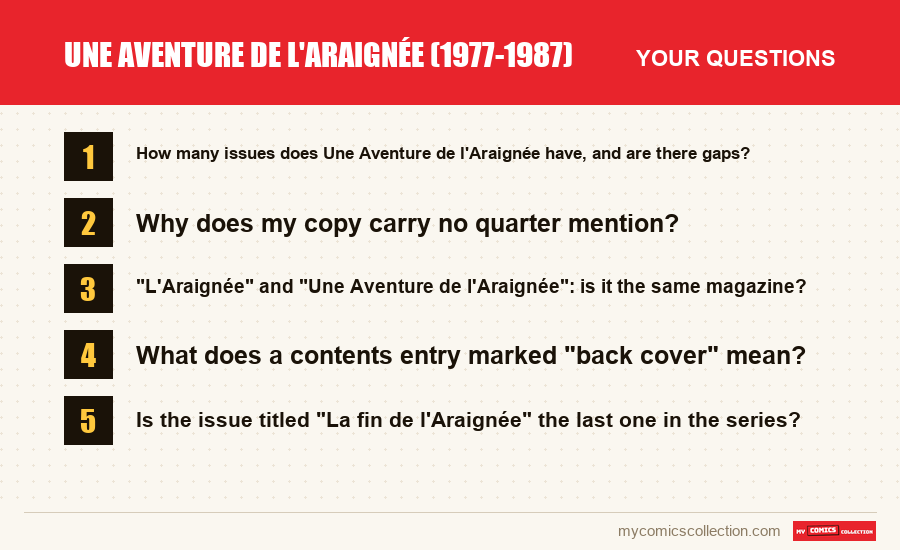
The series has thirty-one issues, numbered continuously from first to last, with no number skipped by the publisher. Any gap in your run is therefore a gap on your side, not a feature of the publication. That is good news for the inventory: continuity can be checked at a glance along the spines.
Because the date format changed during the series. The oldest issues carry a quarter, those from the later part carry only the year. The absence of a quarter is therefore neither an anomaly nor a sign of a reprint: it simply places your copy in the late portion of the collection, from the twenty-third issue onward.
Yes. The catalogue keeps two records, one under the long title and one under the short title, but the numbering and years match, and the vast majority of common story titles are identical. It is the same object described twice. Use the long record for dates and signatures, the short one for titles that are missing from it.
That the record captured, for that issue, an advertising or back-cover page instead of the main story. It is not the content of the issue, it is a gap in the description. Seven issues are in this situation on the main record, and almost all of them recover a story title thanks to the second record of the same magazine.
No, and it is the most common mistake about this magazine. That title appears on the twenty-third issue, published in 1985, while the publication continues until 1987. The real last issue is titled "Mort sans préavis" (French title). A lot presented as complete because it ends on "La fin de l'Araignée" is not complete.