
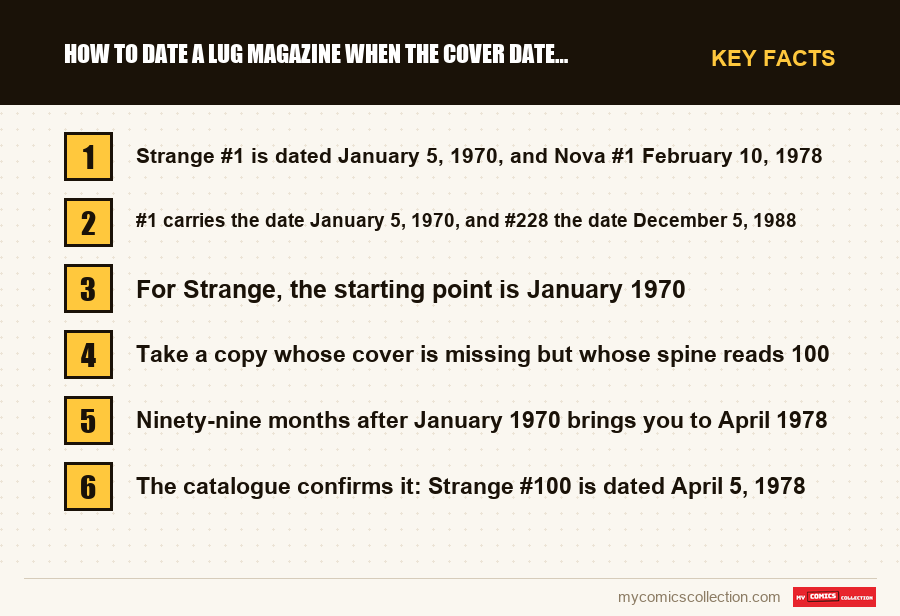
When the cover date is gone, you can rebuild it by calculation. Lug magazines came out at the rate of one issue per month: all you need is the series title, the issue number printed on the spine or the edge, and a known starting month. Strange #1 is dated January 5, 1970, and Nova #1 February 10, 1978. From there, each issue can be placed to the month, and the inside clues confirm it.
A copy bought loose in a box rarely arrives intact at the top. The upper corner suffers first, and that is precisely where Lug magazines printed their date. A missing cover, a torn banner, a price cut out by a newsstand vendor back in the day, and you are left holding a perfectly readable booklet whose year you no longer know. The good news is that a monthly magazine is an object dated by construction: its issue number is already a date in disguise.
As always on this guide, only verified information (creators, issue numbers, dates) is stated as fact; the analysis is our own, with no reproduction of panels or protected dialogue.
Why the date fades, and what remains once it has gone
Three accidents keep coming back. The first is a cover that is missing altogether: the magazine has been read and reread, the spine has split and the first signature has come loose. The second is wear on the corner, which takes the date mention without touching the rest of the illustration. The third is human intervention: a crossed-out price, a newsstand sticker stuck on, a cut-out for an inside contest.
In all three cases, something almost always remains: the issue number. It appeared in large type on the cover, but also, depending on the period, on the spine, on the edge or in the inside contents. Find it first, before any other handling. It is the single entry point of the whole method that follows, and it requires neither comparison nor a paid catalogue.
If even the number has gone, dating remains possible but becomes indirect: it then goes through the inside advertisements and the printer's marks, which we cover below. It gives a range, not a month.
Periodicity, the foundation of the whole reasoning
Before calculating anything, you need to establish the series' actual rhythm, not the announced one. This is where the catalogue of French releases is useful: by lining up the cover dates of every issue, the rhythm can be read at a glance.
For Strange, the result is remarkably regular. #1 carries the date January 5, 1970, and #228 the date December 5, 1988. Between those two points there are exactly two hundred and twenty-eight months, and exactly two hundred and twenty-eight issues. In other words, the series skipped no month for nineteen years. No interruption, no double issue that would have shifted the sequence.
This property turns the series into a calendar. It is not automatic: other French periodicals had intercalary quarterlies, double summer issues and pauses of several months. Check it series by series before applying it, because a single missing month throws off everything that follows.
The calculation rule, applied to Strange
The formula fits on one line: the month of the issue equals the month of the first issue, plus the issue number minus one. For Strange, the starting point is January 1970.
Take a copy whose cover is missing but whose spine reads 100. Ninety-nine months after January 1970 brings you to April 1978. The catalogue confirms it: Strange #100 is dated April 5, 1978. Same exercise with #55: fifty-four months after January 1970 gives July 1974, and the actual date is indeed July 5, 1974, that of an issue whose retained mention is the French magazine title "Une Aventure des Fantastiques #4: Docteur Fatalis".
Third test, on a late issue: #200 falls one hundred and ninety-nine months after January 1970, which gives August 1986, and the date printed is August 5, 1986. The method does not drift over nineteen years, because the rhythm never faltered. It is this three-point check, and not the formula alone, that justifies using it.
Changing series, changing starting point: the case of Nova
The formula is the same, but the anchor point is not. Nova begins with #1 dated February 10, 1978, and ends with #131 dated December 1988: once again, one hundred and thirty-one issues for one hundred and thirty-one months, with no gap.
A #58 without a cover therefore falls fifty-seven months after February 1978, that is November 1982, and the actual date is November 5, 1982. Applying Strange's starting point out of habit to a Nova copy would put you more than eight years off: the most common error does not lie in the calculation, it lies in the series you think you have in hand.
Hence a simple precaution before any calculation: identify the title before the number. The logo, the layout of the contents page and the list of announced heroes are usually enough. If doubt remains between two titles from the same publisher, the day of the printed month often settles it, for the reason explained just below.
The day of the month, the clue nobody checks
Lug cover dates did not mention only a month: they carried a day. And that day was not the same from one title to another. Strange came out on the 5th, Nova on the 10th at its launch. This difference is a title marker that can be used even on a cover fragment where the logo has disappeared.
Better still: it moves, and its movement can be dated. Nova keeps the 10th up to its #57, dated October 10, 1982, then switches to the 5th from #58, dated November 5, 1982. A Nova fragment bearing the 10th is therefore earlier than November 1982, with no other information needed. A fragment bearing the 5th is later.
One last observable phenomenon: the day mention eventually disappears. Strange #165 is dated "Septembre 1983", #193 "janvier 1986", and Nova drops the day from its #123 onward, dated "avril 1988". A cover date reduced to the month and the year is therefore not a sign of a faulty edition, but a sign of a late period.
Do you collect this series?
Track what you own, what you are missing and what your collection is worth. 7-day trial.
Start my trial →
The price on the cover, upper and lower bounds
The printed price is a second thermometer, and it works even when the issue number is illegible. The principle is purely comparative: you retain no absolute value, you build a scale from your own copies whose dates are still legible.
The manoeuvre is within everyone's reach. Line up the issues in your stack whose date survives, note the price of each one, and mark the steps. You obtain a series of windows: such a price corresponds to such a range of issues, and therefore to such a range of months. An anonymous copy bearing that same price necessarily falls into the matching window. On a series as long as Strange, the successive price rises cut the nineteen years into slices of a few years each.
The limit is clear: the price gives a range, never a month. It therefore serves as a check, to confirm or contradict a calculation made from the issue number, and as a fallback when the number has disappeared. Note also that some copies carried an overprint aimed at another French-speaking market, which shifts the grid: verify it on the copy before drawing any conclusion.
The inside mentions: where to look, and what to expect from them
French periodicals carried legal obligations, and these obligations leave traces inside the booklet: the printer's name, the print run number, the legal deposit mention, the joint commission number depending on the publication's status. Each of these marks can be dated, and none appears on the cover, so none disappears with it.
Let us be precise about the degree of certainty. The exact location of these marks varied from title to title and from year to year: sometimes at the foot of the contents page, sometimes on the last page, sometimes on the letters page. We do not claim where they sit in your copy, because that depends on the period: check page by page, starting with the first two and the last two.
What you can get from them: a quarter or a half-year of legal deposit, which is often tighter than the range obtained from the price. Combined with the calculation based on the number, it is the most solid confirmation you will have. If the two contradict each other, it is the number that is doubtful, not the legal mention: first make sure you do not have a copy rebuilt from two booklets.
The inside advertisements, dating by what is announced
A magazine that announces an upcoming release dates itself. Lug's promotional pages are a goldmine for this, and the catalogue makes it possible to cross-check them.
The clearest example concerns the launch of Nova. For Strange #98, dated February 5, 1978, the mention retained in the catalogue is "Ces 3 super-héros chaque mois dans Nova" ("These 3 superheroes every month in Nova"). Yet Nova #1 is dated February 10, 1978: the advert is strictly contemporary with the launch of its sister title. An anonymous copy containing this announcement therefore falls around February 1978, without needing any issue number at all.
The mechanism repeats at the scale of the month. For Strange #68, dated August 5, 1975, the retained mention is "Strange 69"; for #69, dated September 5, 1975, it is "Strange 70"; for #70, dated October 5, 1975, "Strange 71". An announcement of the next issue therefore gives you the month before its release. The same logic applies to album announcements and related titles, such as "Spécial Strange n°11" for #99 of March 5, 1978, or "Titans n°13" for #100 of April 5, 1978. Be careful, however: the catalogue retains only one mention per issue, and a magazine could contain several. The rest of the advertising section must be checked on the copy itself.
Conclusion: an acknowledged range is worth more than a false date
The full method runs in this order. Identify the title. Note the issue number. Apply the series' starting point: January 1970 for Strange, February 1978 for Nova. Check against the price, then against the inside legal mention, and finally against the advertisements. When the five clues converge, you hold a month. When they diverge, you hold a range, and it is the range that should be written down.
Record it in your inventory in a form that stays honest: "Strange #55, July 1974, calculated date, cover missing" is a useful entry. "Strange #55, 1974" is less so, and a date invented down to the day is not useful at all. A serious buyer will always prefer a stated uncertainty to an invented precision, because they know how to check. Our entries on the Spider and on Thanos, two major presences in these two titles throughout their runs, follow the same discipline.
Finally, keep track of your dated copies: they are the ones that serve as the yardstick for all the others. A stack of twenty legible issues is enough to rebuild the price scale and to place, year after year, the fifty anonymous copies from the same box.
Frequently asked questions
No, it assumes a monthly rhythm with no gaps. Strange and Nova respect it, the first over two hundred and twenty-eight issues, the second over one hundred and thirty-one. Other periodicals had quarterlies, double issues or pauses. Before applying the calculation, check on a few dated issues that the rhythm really holds, otherwise the drift accumulates.
You move on to the indirect clues. The printed price gives a range of a few years. The inside legal mention often narrows it to the half-year. An advertisement for an upcoming release, such as the announcement of Nova in Strange in February 1978, can bring you down to the month. These three clues cross-check one another, and none is sufficient on its own.
Sources differ on the exact lead these magazines had on the newsstand. What is certain is that the printed date is a withdrawal date, intended for the distributor. Treat it as a reliable and consistent sorting reference, not as the day a reader bought the copy. For an inventory, this makes no difference.
Because the layout changed late in the run. Strange carries "Septembre 1983" on #165 and "janvier 1986" on #193, and Nova drops the day from #123 of April 1988 onward. A date without a day therefore indicates neither an anomaly nor a foreign edition, but a late period of the series.
No, and this is a costly mistake. A French magazine assembled several episodes of different origins and dates, and the catalogue retains only one story title per issue. The calculated date tells you when the French booklet came out, nothing more. The full contents and their American counterparts must be checked on the copy itself.