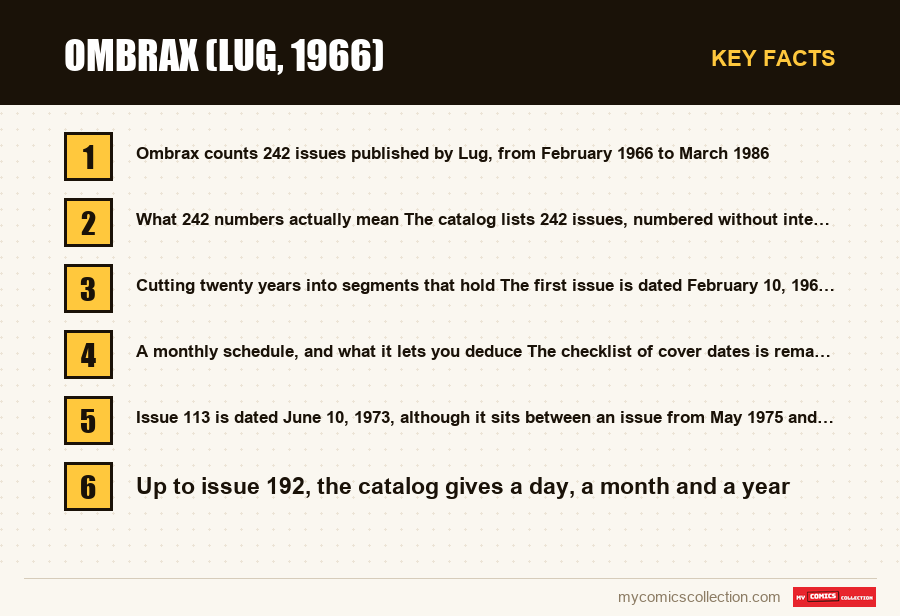
Ombrax counts 242 issues published by Lug, from February 1966 to March 1986. The numbering skips no number, but twenty years of monthly publication change the method: a list of gaps this size cannot be handled as a single block. This guide explains how to split the series into segments, where it becomes hard, and what the dates and credits let you verify on a copy.
You open a box bought at a garage sale, count some forty Ombrax issues, and discover the series has more than two hundred. This is when many give up, or worse, buy at random for months before realizing they own three copies of the same number. A series this long has to be collected differently: segment by segment, with a gap list kept up to date and a priority order decided in advance.
As always on this guide, only verified information (creators, issue numbers, dates) is stated as fact; the analysis is our own, with no reproduction of panels or protected dialogue.
What 242 numbers actually mean
The catalog lists 242 issues, numbered without interruption. It is the longest French series in our checklist, and that length is the first practical fact of the subject: at one acquisition a week, a collector starting from nothing takes nearly five years to complete the run, and only if it turns up in that order, which never happens.
The absence of holes in the numbering is good news and a trap. Good news, because every number between the two ends corresponds to a real issue: a seller who tells you a number "never came out" is wrong. A trap, because nothing lightens the list, neither special issues to set aside nor a counter reset that would let you treat the series as two separate collections.
The consequence is methodological. A list of this size has to be readable standing up, at a flea market, and sorted some other way than by ascending number. The useful sort is by publication segment, because that is how lots arrive: sellers inherit coherent stacks, rarely a sample spread across the whole run.
Cutting twenty years into segments that hold
The first issue is dated February 10, 1966, the last March 10, 1986. Nobody keeps an interval this wide in mind, but everyone can say whether a stack comes mostly from the early years, the middle or the end. Your list has to speak that language.
Four cuts stand out in the data. The first comes very early: Lucien Carton appears as writer only on the first eight issues, and Floriano Bozzi on art up to the twenty-seventh. The very first issues therefore form a separate block, that of the startup.
The other two cuts, detailed below, come from the change of team and from titles that come back. Work segment by segment and move to the next one only once the previous one is nearly complete: that is the only way to avoid a Swiss-cheese collection, with missing issues scattered across the whole run.
A monthly schedule, and what it lets you deduce
The checklist of cover dates is remarkably regular: each issue is dated the tenth of a month, except from 193 to 236, and the months follow one another without interruption from start to finish. Over twenty years, the series therefore comes out twelve times a year, with the exception of the opening year, incomplete because it starts in February, and the closing year, which stops in the spring.
This regularity is an immediate verification tool: if you know the number, you know the month, and vice versa. An issue whose date does not fall on the expected month should alert you. Another use: a continuous monthly schedule means regular print runs, so the rarity of an ordinary issue does not come from how it was made but from whether it survived.
The date anomaly, and why it matters
One irregularity deserves to be flagged, because it trips up automated searches. Issue 113 is dated June 10, 1973, although it sits between an issue from May 1975 and one from July 1975. The simplest reading: a year error, with the day and month sticking to the place of the issue.
The effect is visible as soon as you count issues per year: one year of the early seventies appears to have thirteen issues and another eleven, although the real rhythm does not change. If you build your list from a date sort, this issue will land dozens of ranks too early, and you will look for it in the wrong segment.
Another irregularity affects the precision of the dates themselves. Up to issue 192, the catalog gives a day, a month and a year; from the next one, and for several dozen issues, it gives only the month and year, before the day reappears in the last numbers. This is not information about the magazine but about the source: do not conclude from a date without a day that the publication schedule had changed.
Creators as anchors for the collection
On a series this long, creator names are more useful than dates for placing an issue you hold in your hand. Two names dominate: Maurizio Torelli, credited as writer on 176 issues, and Giancarlo Agnello, credited on art for a similar number. Both appear from issue 9 onward, and both disappear after issue 210.
This coincidence is the sharpest break in the series. At issue 211, Alfredo Castelli takes over the writing through to the last issue, with Giancarlo Alessandrini on art for thirteen issues of that stretch. A copy with an unreadable cover can therefore be placed almost without error on one side or the other of that number, from the interior credits alone.
Other names serve as intermediate anchors. Jean Frisano appears in the art credits from issue 32 to issue 228, the longest presence after Agnello's, with one peculiarity: he is absent from nearly the entire last stretch, where he reappears only once. Luciano Bernasconi, who joined in the early seventies, is still there in the last issue: he is the worst dating marker and the best witness to editorial continuity. Keep three anchor names, not thirty, and you will know which third of your list to search.
Titles that come back, and why a title identifies nothing
Here is the costliest trap of the subject, and it exists only because the series is long. Some thirty story titles appear in more than one place in the checklist, which concerns more than sixty issues in total. These repetitions are not scattered at random: a block of titles running through issues 60 to 84 reappears, almost in the same order, in issues 178 to 203.
The gap between the two occurrences is about a hundred and twenty ranks, roughly ten years of publication, and the order is not strictly kept: a few titles from the end of the first block come back displaced in the second. The most probable reading is the reuse of material already published, but our source gives only one title per issue and does not allow us to claim that the contents are identical; only comparing two copies in hand settles it. Note in passing that three issues in the checklist have no recorded title, the first of the series among them: a title search will never bring them up.
The practical consequence leaves no room for doubt: never buy an Ombrax on the strength of the title the seller gives. An ad that mentions "Le Golem" or "La recherche du Graal" without giving the number may refer to two issues a decade apart. Ask for the number, systematically, and failing that a photo of the whole cover rather than just the logo.
Do you collect this series?
Track what you own, what you are missing and what your collection is worth. 7-day trial.
Start my trial →
Serial stories in parts, and the lot that is worth little
Nearly fifty issues carry a numbered part marker, and the longest unbroken sequence runs for seventeen issues in a row, at the end of the sixties. In the last stretch, the method changes form: several titles are simply repeated over two or three issues, without any part marker, which amounts to the same thing for the reader but complicates identification further.
For a buyer, this redefines what a good lot is. A bundle of scattered issues brings checked boxes but no complete story; a bundle taken as one unbroken run from a sequence with continuing stories is often worth more, and gaps in the middle of a run are the hardest to fill. All else being equal, prefer the continuous lot.
Condition of a copy, across a series that spans two decades
Twenty years between the first and the last issue means papers that are not the same from one end of your collection to the other. A copy from the mid-sixties and a copy from the mid-eighties do not share the same yellowing or spine strength: grading them on a single scale overrates the recent ones and condemns the older ones.
The rule we apply: judge an issue against copies from the same segment, not against the whole series. Blunted corners and a browned edge are acceptable on an early issue, whereas the same appearance on a late issue signals a mistreated copy. The points to check do not change: staples, central fold, cover edge without loss, and presence of every page, advertisements and letters page included. Since fine copies are rarer in the first third, that is where patience pays off most.
Buying traps specific to a long series
The first trap is the giant lot sold in bulk. An ad promising "more than a hundred Ombrax" with no list is a lottery: it almost always contains duplicates, and nothing says it covers the segment you are missing. Ask for the numbers, or failing that photos where the numbers are readable on the spine.
The second trap is the reassembled copy: on a stapled magazine that has been handled for decades, a cover is sometimes put back on a different interior block. The test costs nothing: check that the date matches the expected month for that number, then that the interior credits fit the segment. A block credited to Castelli under a seventies cover is spotted in seconds.
The third trap is the invisible duplicate. With more than two hundred numbers, nobody keeps the list in memory, and that is how the same issue gets bought twice.
Completing the series, and knowing where it gets hard
Three zones stand out by difficulty. The hardest is the first segment: the oldest issues, the least well preserved, and those that circulate least in lots. This is where a decent copy is worth waiting for rather than taking whatever comes along.
Next comes the very end, after the change of writer: the last issues of a magazine that is stopping are less distributed than those of its peak and end up at the bottom of bins. The advantage is that they are instantly identified by their credits.
The long middle, finally, is the easy part: lots are plentiful there, and it pays to buy in bulk rather than one at a time. The order of work is therefore counterintuitive: first build the middle through lots, then go after both ends one by one and without rushing. Other tracking methods are covered in our guides to French magazines.
Today's value, and what moves it
On a series this long, value does not follow the number. Three factors weigh more than anything else: condition relative to the segment, the continuity of the lot, and unambiguous identification of the number. An early issue in fine condition far outweighs a worn mid-series issue, and a continuous run trades better than the same number of scattered issues.
The fourth factor is completeness: a full run of 242 issues is a rare object in itself, and its value is not the sum of its parts. Conversely, an almost complete collection is worth little more than a partial one as long as the gaps are not identified, since the buyer has to redo your inventory. Hence the closing advice: on a series of this size, the list you keep is part of the value. Document every number, every condition, every gap, and you turn a stock into a collection. For a point of comparison with the superhero magazines published in France at the same time, our character profiles, such as the one for Thor, open another angle.
Frequently asked questions
The catalog lists 242 issues, numbered continuously with no missing number. Every number between the two ends therefore existed. That continuity makes a list easier to check, but it also means no shortcut lightens the collection: there is no parallel numbering and no counter reset to exploit.
The first issue carries a cover date of February 1966 and the last one March 1986, that is twenty years and one month. The recorded rhythm is monthly from start to finish, most issues being dated the tenth of the month. Only the opening year, which starts in February, and the closing year, which stops in the spring, have fewer than twelve installments.
Because a block of titles from issues 60 to 84 reappears, almost in the same order, roughly ten years later. The most probable reading is reuse of material, but our data gives only one title per issue and does not prove the contents are identical. In practice: always require the number, never the title alone.
By the interior credits. Maurizio Torelli as writer and Giancarlo Agnello on art cover almost the entire series up to issue 210; Alfredo Castelli then takes over and carries the magazine to the end. Two names are enough to place a copy on one side or the other of that break, before you even look at the date.
Start with the long middle of the series, in continuous lots: it is the most available part and the cheapest to complete. Then tackle the early issues, the rarest in fine condition, and then the last stretch, which is less distributed and often relegated to the bottom of the bins. Buying at random across the whole series is the worst strategy.