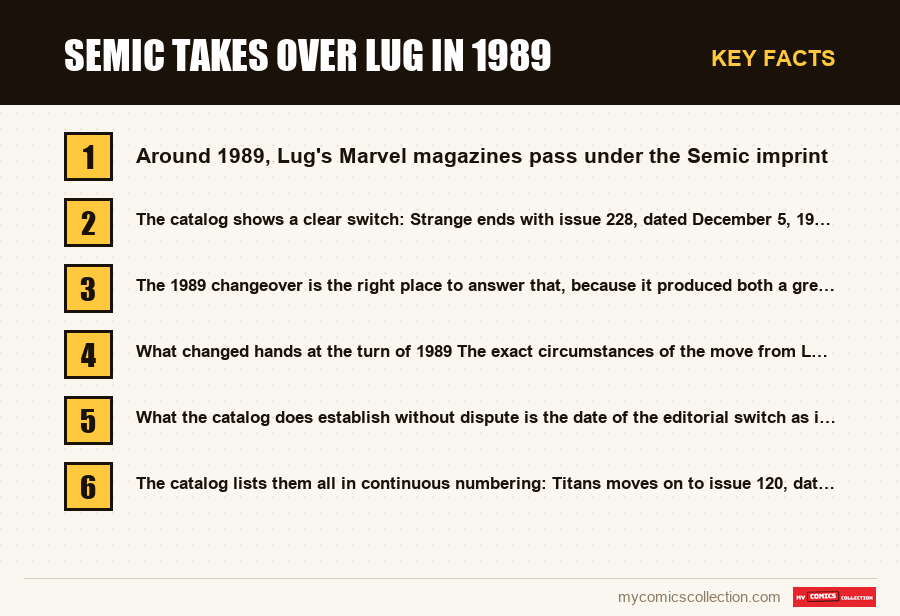
Around 1989, Lug's Marvel magazines pass under the Semic imprint. The catalog shows a clear switch: Strange ends with issue 228, dated December 5, 1988 at Lug, and resumes with issue 229, dated January 5, 1989 at Semic. The numbering of the major titles was therefore not reset to zero. The real numbering ambiguities come from elsewhere: from special issues and from titles relaunched under another publisher.
You have a pile of magazines on your desk, all with the same logo on the cover, and you want to know which ones are worth setting aside. The question that comes up most often when sorting, or when buying a missing issue, is the publisher: who printed this issue, and does its number designate one object or two. The 1989 changeover is the right place to answer that, because it produced both a great deal of continuity and a few very precise traps.
As always in this guide, only verified information (creators, issue numbers, dates) is stated as fact. The analysis is ours, with no reproduction of panels or protected dialogue.
What changed hands at the turn of 1989
The exact circumstances of the move from Lug to Semic remain disputed, and sources disagree on the legal timeline as well as on how the deal was structured. We therefore assert nothing on that ground. What the catalog does establish without dispute is the date of the editorial switch as it reads on the issues themselves: the last Strange under the Lug imprint carries the date of December 5, 1988, and the first of the next series carries January 5, 1989. One month apart, with no visible interruption for the reader of the time.
The same mechanism appears in the other monthly titles of the house. The catalog lists them all in continuous numbering: Titans moves on to issue 120, dated January 1989, and Nova to issue 132 from the same month. Two numbers, one lesson: the new imprint picked up the counters where they stood, and the newsstand reader had nothing to recalculate.
The numbering of the major titles was not reset to zero
It needs saying plainly, because the opposite idea circulates widely: no, the 1989 takeover did not create a second Strange number 1. Anyone looking for Strange number 12 will not run into two different issues, because that number was printed only once, in the early 1970s, under the former imprint. The confusion found in listings concerns the publisher, not the number, which is a different problem and an easier one to resolve.
This choice of continuity has a concrete consequence for how you build a collection. A single series runs from number 1, dated January 5, 1970, to number 335 dated March 1998. Between those two limits, the only break is the name of the publisher, which does not appear on the issue itself. In other words, your tracking table does not need two numbering columns, but it does need a "publisher" column if you want to answer the question at a glance.
Where double numbering really exists
Number collisions do exist, but they are not where you would expect them. The clearest case in the catalog is Hulk, a title for which two distinct magazines carry a number 1: one dated December 1976, published under a different imprint from those we are discussing here, and the other dated April 1992 under the Semic imprint. Sixteen years separate these two first numbers, and a listing that reads "Hulk number 1" without further detail therefore designates nothing definite.
The two objects have almost nothing in common, however. The 1976 issue opens with a story titled "Hercule" (Hercules), drawn by Herb Trimpe, in keeping with the magazines of the period that mixed series together. The 1992 one opens with "Exposition", written by Peter David and drawn by Dale Keown: a publication tied to a single contemporary American series. A well-meaning seller can easily confuse the two; you will not, once you know what to look at. The hub devoted to the character helps place the two publication periods.
The same phenomenon affects Thor, with a partial overlap rather than a collision on number 1. The catalog gives a first magazine that started in August 1977 and ran to number 27, and a second whose recorded numbers begin at number 3, in 1989, and run to 31. The whole range between these two low bounds is therefore ambiguous: a "Thor number 10" can be an issue from the late 1970s or one from the late 1980s.
The trap of special issues numbered on the parent magazine
Here is the most costly ambiguity, and the least known. Some special issues had no counter of their own: they took over the number of the monthly magazine they were attached to, with a mention added. The catalog gives a perfect example under the title Strange Spécial Origines, one issue of which is recorded as "229 hors série" (special issue) and dated January 5, 1989.
Read that date again: it is exactly that of the first monthly Strange under the new imprint. Two different issues, published the same month, therefore carry the same number 229. One opens with "Conflit de dames", the other with "Que la lumière soit", credited in particular to Jim Starlin. If a listing offers you a "number 229" without the full title, you do not know which of the two you are buying, and a monthly collection can end up with a number duplicate that is not an object duplicate.
This system predates 1989, and it explains the numbers that surprise you when you come across them in a list. Under the former imprint, the same title produced an issue recorded as "133 bis" and dated January 5, 1981, with a story titled "L'incollable". The mention "bis" or "hors série" is part of the number; it is not a comment by the seller. Removing it from a collection record means manufacturing the very ambiguity you were trying to avoid.
The special case of the complete stories
One last title deserves a separate mention, because it combines several difficulties. The catalog lists, under the name of the Marvel complete story (récit complet), two sets each starting at number 1 under the former imprint, one dated 1982, the other February 1984, before a relaunch under Semic that begins at number 21, in February 1989. Sources disagree on how to divide these series, and the catalog itself reflects that uncertainty.
The practical conclusion: on this title, and only on this one among those we examined, the number alone is never enough. You must add the year and, better still, the title of the story printed on the cover. The first issue of February 1984 opens with "Le prix de l'honneur", credited to Chris Claremont; the number 2 from the same period offers "Hercule l'Olympien", credited to Bob Layton. It is these headings, not the numbers, that identify the copy beyond dispute.
Do you collect this series?
Track what you own, what you are missing and what your collection is worth. 7-day trial.
Start my trial →
Recognizing the publisher on a copy in your hands
The most reliable method does not start with the cover, which kept a strong graphic resemblance for a long time, but with the legal notices. Look for the block of small print, most often at the foot of one of the first pages or at the end of the issue: it carries the publisher's name, the legal deposit and the joint commission number. That is where the imprint is written in black and white, and nowhere else.
The second marker is the date printed on the cover, and its form is worth noting. Issues from the earlier period often show a date to the day, such as December 5, 1988 or March 10, 1976, a legacy of newsstand mechanics. The catalog shows that this precision was gradually lost after the switch: the issues at the end of the run carry only a month and a year, such as March 1998. A date to the day therefore almost always places you in the earlier period, but the reverse is not immediately true, since the very first issues of 1989 still kept the mention of the 5th of the month.
A third marker, looser: the content. An issue whose cover announces an American series from the 1990s is necessarily late. If you recognize, for example, a Wolverine story under its period French name, you are probably in the first half of the 1980s. This marker does not replace the legal notices; it lets you sort a pile quickly before checking each item individually.
Writing or reading a listing without ambiguity
A complete reference has four elements, and none is optional: the exact title as printed on the cover, the number with any mention, the date printed on the issue, and the publisher as read in the legal notices. "Strange number 229, January 5, 1989, monthly" and "Strange Spécial Origines number 229 special issue, January 5, 1989" designate two different objects, and both formulations are readable by anyone.
On the buying side, the useful reflex is to ask for a photo of the legal notices block when the listing does not state the publisher and the title is one of the ambiguous cases. It is an ordinary request that offends nobody, and it costs less than a return. If the seller cannot supply it, at least ask for the cover date: on overlapping titles such as Thor, it settles the matter immediately.
Completing a series that straddles the two imprints
Continuity of the counter has a side effect that few collectors anticipate: it inflates the goal. A monthly series running for nearly three decades has more than three hundred numbers, and trying to close it in one go is the surest way to buy badly. The approach that works is to cut it into coherent slices, for example one slice per decade, and to move on to the next only once the previous one is clean and properly recorded.
For special issues, aim for completeness last, never first. Their numbering, borrowed from the parent magazine, makes lists hard to keep, and the classic mistake is to buy the same issue twice because the tracking sheet did not distinguish the monthly from the special. A dedicated column for the mention "bis" or "special issue" solves the problem for good.
What the changeover does to the value of a copy
There is no automatic premium attached to either imprint. What counts, in order, is the condition of the issue, the demand for its specific contents, and the real scarcity of that number on the market. A late issue in very fine condition can sell above an old, worn one, and the reverse is equally true: the dominant variable is not the date, it is preservation.
Finally, be wary of reasoning by approximate ratios. Comparing one number with another from the same title only makes sense if both are in comparable condition and on the same market. The character hubs, such as the one for Daredevil, give an idea of current demand for the series concerned.
Keeping a collection so the doubt does not come back
Once the sorting is done, the challenge is not to repeat the work in two years. Four fields are enough: full title, number with mention, cover date as printed, and publisher. If you enter your issues into a digital collection, fill in these four fields at the very first entry rather than returning to them later, because verification requires having the issue in hand.
Add a free-text note for the contents. The catalog gives only one story title per number, whereas these magazines contained three or four: the structured information exists for the main story, and the rest is in your copy and nowhere else. This is precisely why you should never assert, on the basis of a list alone, that a French issue contains a given first appearance or corresponds to a given American issue. Verification is done page by page.
Frequently asked questions
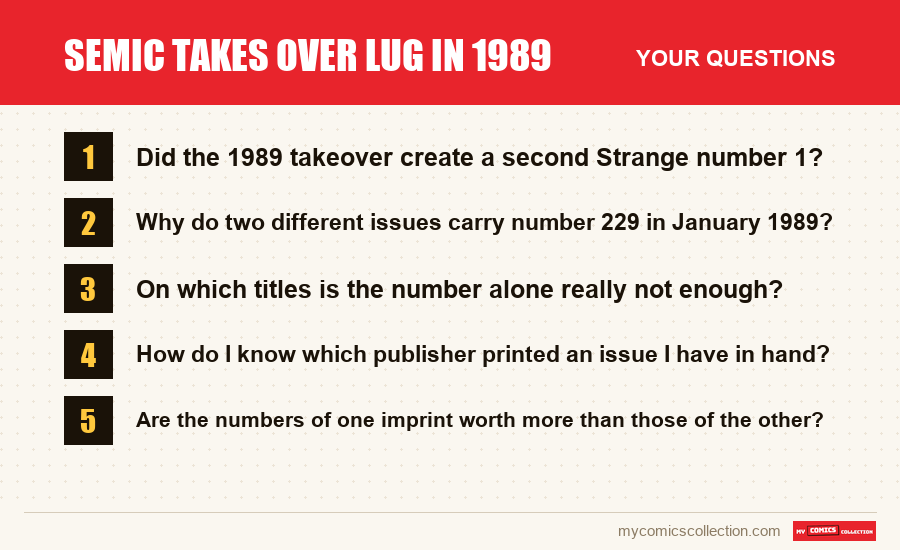
No. The catalog shows continuous numbering: the last issue under the former imprint carries number 228, dated December 5, 1988, and the next carries number 229, dated January 5, 1989. There is therefore only one Strange number 1, published on January 5, 1970. The ambiguity you encounter in listings concerns the publisher, not the number.
Because the special issue took over the number of the monthly magazine it was attached to. The catalog records a "229 hors série" (special issue) dated January 5, 1989, the same month as the monthly number 229. The two open on different stories. To tell them apart, always cite the full magazine title along with the number.
On Hulk, where two different magazines carry a number 1, one dated December 1976 and the other April 1992. On Thor, where a magazine starting in August 1977 overlaps a second one whose recorded numbers begin at number 3. And on the complete stories, whose division varies according to the sources. On these titles, always add the cover date.
Through the block of legal notices, in small print on one of the first pages or at the end of the issue: it names the publisher and gives the legal deposit. The cover does not always make it clear, since the graphic resemblance remained strong after the switch. Failing that, the cover date to the day points to the earlier period, without ever proving it on its own.
No, there is no premium linked to the imprint. The value depends on the condition of the issue, the demand for its specific contents and the real scarcity of the number. A late issue in flawless condition can sell above an old, damaged one. Judge the spine, the corners, the central fold and the staples before looking at the date.