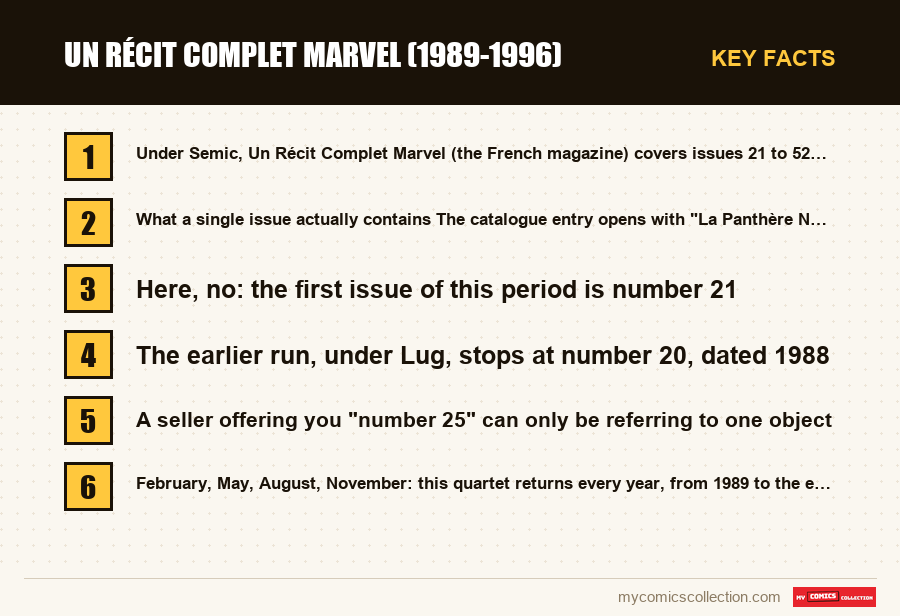
Under Semic, Un Récit Complet Marvel (the French magazine) covers issues 21 to 52, from February 1989 to November 1996. Thirty-two issues, four a year, with no gap in the numbering. The point that matters most for a buyer: the series does not restart the count, it continues the numbering already under way. And the promise of the title, one finished story per issue, has exceptions that the catalogue titles make visible.
You have a stack of these large square-spined issues, and the question is not "which ones are nice" but "where does what I hold begin and end". That is the whole challenge of this series: its name stays the same for more than ten years, the publisher changes along the way, and the numbering only helps you if you know what it tells you. This guide sticks to the issue numbers, cover dates and signatures recorded in the catalogue, then draws what a collector can take from them.
As always on this guide, only verified information (creators, numbers, dates) is stated as fact; the analysis is our own, with no reproduction of panels or protected dialogue.
What a single issue actually contains
The catalogue entry opens with "La Panthère Noire" (the French title), dated February 1989, written by Peter B. Gillis, drawn by Denys Cowan. It closes with "Et elle vous détruira" (also the French title), credited to Warren Ellis and Terry Dodson. Between those two markers the editorial logic does not change: one issue, one title, one long story promoted by the cover.
The recorded titles make clear how the magazine was sold. Sometimes a character's name serves as the title, "Venom", "Thanos", "Gambit", and sometimes a phrase sums up the situation, "Niveau Zéro", "Posséder un lycaon", "Espèces menacées". In the first case the publisher relies on the character's fame; in the second, on the plot. For you, the practical consequence is this: an issue whose title is a proper name can be spotted at a glance in a box, the others require knowing the list.
One point is worth stating precisely rather than approximating: the catalogue records only one story title per issue. These magazines could carry extra pages, an editorial text, sometimes a second story. The full contents can only be checked on the copy itself, not in a database. When a seller describes an issue by its cover title alone, you do not yet know everything it contains.
The numbering does not restart at 1, and that changes everything
This is the most common mistake on this series, and it costs money. People naturally assume that a change of publisher means a fresh start, and so a "number 1" to look for. Here, no: the first issue of this period is number 21. The earlier run, under Lug, stops at number 20, dated 1988. The sequence continues without a break in the count.
In other words, there are never two issues that could carry the same number in this collection. A seller offering you "number 25" can only be referring to one object. That is good news, because other French magazines from the same family had numbering restarts that make listings ambiguous and force you to ask for a photo of the cover before buying.
In practice, this means your collection is one continuous line, not two series to reconcile. If you sort by number, the change of publisher does not show in the shelving, only in the mention printed on the issue. Many collections described as "incomplete" are so only because their owner was looking for a starting point that never existed.
A quarterly rhythm kept without a miss for eight years
The cover dates reveal a rare regularity. February, May, August, November: this quartet returns every year, from 1989 to the end of the recorded run. No year has three releases, and none has five.
For a collector, this regularity is an immediate verification tool. An odd or even number tells you nothing by itself, but the month is constrained: if someone offers you an issue dated in a month other than these four, there is either a reading error or a confusion with another magazine from the same publisher. You can also work out the date of a missing number in your head, which helps you judge a lot sold in bulk.
This regularity contrasts with the earlier period, where the recorded dates are much looser, sometimes reduced to a year alone, sometimes given as quarters. The move to a strict calendar is therefore the real marker of this second half of the magazine's life, more than any detail of the layout.
"Récit complet": the promise and its exceptions
The magazine's title is a commercial commitment: you buy an issue and read a finished story. The recorded titles show that this commitment was kept in the vast majority of cases, but not everywhere, and that is exactly what a buyer needs to know before paying the price of a sought-after issue.
Four issues carry a part marker in their own title. The most obvious is the block written by Jim Starlin around Thanos: the catalogue records a "2ème partie" (part 2), then a "4ème partie" (part 4), then a "6ème partie" (part 6). The odd-numbered parts do not appear under these titles in the series. If you buy these three issues hoping for a continuous story, you will have half a story.
This is not an isolated case: an issue from February 1994 is titled "De chair et de fer, 2ème partie" (French title), written by Fabian Nicieza, drawn by John Romita Jr. Once again, the part marker is carried by the title itself, so it is not our interpretation. Other titles suggest membership of a larger arc without saying so as openly, "Dossier Serval Phase 3", "Épilogue", "Dénouement". Before buying one of these issues on its own, ask the seller: does the story stand alone when read?
The signatures that structure the series
Three names are enough to divide the chronology, and none covers the whole run. Chris Claremont appears as writer on the first sequence of the listing, from 1989 into the following years, then drops off the list. Jim Starlin occupies a short, dense block, concentrated over two consecutive years, that of Thanos. Howard Mackie is the man of the end: five issues under his name, the first in 1991, the last in 1996, which makes him the most present writer of the whole period.
On art, the most telling recurrence is Ron Lim, credited on five issues spread across most of the run. Another name deserves attention: Ciro Tota, credited on three issues close together at the start of the period. His presence is a useful clue when you are trying to place an issue with no readable date, since his work is concentrated on the very first issues of this sequence.
There are also signatures that appear only once but weigh heavily with buyers: Todd McFarlane, Alan Davis as writer and artist on the same issue, George Pérez, Jim Lee, Mike Mignola, Kevin Maguire. These one-off appearances explain a large share of the differences in demand between issues, far more than the actual scarcity of print runs.
Do you collect this series?
Track what you own, what you are missing and what your collection is worth. 7-day trial.
Start my trial →
The issues that matter, and why
The number 25, dated February 1990, is the one you will be asked for most often: the title is "Venom" (French title), written by David Michelinie, drawn by Todd McFarlane. This combination of character and artist alone brings together two very popular collecting motives, and a French issue that combines them stands out from the rest.
The number 31, dated August 1991, is simply titled "Thanos" (French title), with Jim Starlin on writing and art, joined by Ron Lim. The bare title, with no subtitle or part marker, is information in itself: it signals an entry into the subject rather than an intermediate episode. It is the logical starting point if you are building a set around this character.
Three other issues trade on their own for reasons of proper names: "La Panthère Noire" opens the period, "Gambit" draws demand linked to that character, and the last issue, from November 1996, is worth something for its closing position as much as for its creators. A final issue of a series is always harder to find than its neighbours, because print runs tightened and readers had often dropped away before then.
Recognising and dating a copy
Dating this series is more subtle than it looks. The listing shows four consecutive issues, around 1990 and 1991, whose month is given in square brackets by the catalogue. This convention signals a date reconstructed from the issue's place in the series, not a date read on the object.
The consequence is direct: on these issues, do not expect to find a printed month on the cover. If a seller states a precise month for one of them, ask where it appears. They may have taken it from a list, which is legitimate, but then it is not a mention found on the copy. For all the other issues, the recorded month matches the quarterly calendar, and the trio of month, year and number should be consistent.
One last point of honesty: an issue from November 1992 has no story title recorded in the catalogue, although its creators are, Peter David on writing and Andy Kubert on art. That gap is not an anomaly of the object, it is a gap in the data. If you hold this issue, the cover title is in front of you and nowhere else, and that is precisely the kind of check that only a copy in hand allows.
Condition of a copy, and what the format demands
These issues are thick and bound with a square spine, which shifts the weak points compared with a stapled magazine. The spine shows wear at the first hard reading, and a spine crease cannot be corrected. It is the first place to look, before even the corners.
Next, check the flatness of the cover and the condition of the inner block: a poorly glued square spine comes apart by whole signatures, and a page that detaches drops the value much faster than a slightly rubbed cover. The paper of this period yellows at the edges; even yellowing is normal for the age, while a localised halo points to moisture exposure and should lower your offer.
Finally, be wary of lots stored upright without support: the weight of the issues makes them warp, and the curvature shows in a side photo. Ask for a view of the spine edge.
The traps when buying
The main trap follows from everything above: buying an issue carrying a part marker while believing you are buying a complete story. Listings often shorten the title and the part marker disappears. Read the full title, and if the seller does not give it, ask for a photo of the cover.
The second trap is confusion with other magazines of the same family published at the same time: a single issue is easily described as "a Marvel complete story" in the generic sense. The exact name of the series and an issue number within the range covered here are the only reliable criteria.
The third trap is the "complete" lot that is not complete. Since the numbering continues an earlier sequence, a well-meaning seller may call "complete series" what only covers the second half. Count the numbers, check the lower bound, and for the upper bound remember that the last issues are the ones most often missing from resold sets.
Completing the series and tracking your collection
The target is perfectly defined: thirty-two issues, no gap in the count, no variant to tell apart. You know exactly how many you are missing, which is far from the case with the monthly magazines of the same period.
The effective strategy is to secure first the issues carrying a character in high demand, because they are the ones that drift away from the rest over time, and then pick up the bulk of the series in lots, where the unit prices fall. Pieces linked to Venom and Thanos do not come down, while issues with a descriptive title trade much more calmly.
For tracking, keep one line per issue with the cover date, the recorded title, the condition of the spine and the provenance. Sets around the X-Men or Gambit overlap from one French series to another, and without a written inventory you will end up buying the same issue twice.
Frequently asked questions
No. The first issue of this period is number 21, and the earlier sequence ends at number 20. The numbering therefore carries on without a reset, which rules out any risk of two different issues carrying the same number in this collection. A buyer never has to ask which of two you are offering.
Thirty-two issues, from number 21 in February 1989 to number 52 of November 1996. No number is missing from the sequence, which makes the goal easy to follow. Be careful, however, with what a seller means by "complete": it sometimes refers only to this range, and sometimes to the whole series since its origin.
Almost always, but not systematically. Four recorded titles carry a part marker themselves, three of them around the Thanos cycle written by Jim Starlin, where the odd-numbered parts do not appear under these titles. Before buying an issue on its own, read the full title and ask whether the story stands alone when read.
The square brackets signal a month reconstructed from the issue's place in the series, not a printed date. Four consecutive issues from the early 1990s are in this situation. If a listing gives a precise month for one of them, ask where it appears on the object: it most likely comes from a list, not from the cover.
The one titled "Venom", dated February 1990, with David Michelinie on writing and Todd McFarlane on art. The issue devoted to Thanos, by Jim Starlin, follows closely. In both cases the demand comes from the pairing of character and artist, not from scarcity of print run, which means the condition of the spine weighs very heavily on the price obtained.