A publisher's binding is a hardcover volume assembled by the publisher from magazines that were already printed but never sold. It is recognized by its cloth spine, by the block of magazines sewn or glued inside, and by inner covers that are sometimes trimmed. Its difficulty lies elsewhere: two volumes carrying the same number do not always contain the same issues, which makes it an object your list of gaps handles poorly.
In an inherited lot or on the table of a swap meet, a large hardcover that resembles none of your magazines: a number on the spine, and inside, the covers of digest-format issues you already own as single copies. The question always arrives in the same order. Am I just buying again what I already have, or acquiring an object I will never find again? This article does not decide for you; it gives the method for deciding, and it is candid about what the data allows us to say.
As always on this guide, only verified information (creators, issue numbers, dates) is stated as fact; the analysis is our own, with no reproduction of panels or protected dialogue.
What "publisher's binding" really designates
The principle is industrial before it is editorial. A digest-format publisher prints a run, puts it on the newsstand, and gets back unsold copies. Rather than destroying them, it can make a secondary product: several issues are stacked, assembled, and fitted with a rigid cover, and the volume goes back out through a sales channel other than the newsstand. The object was therefore not designed as a book: it was made from what was left, at the moment something was left.
That origin explains the rest. A book is conceived before it is printed, so its content is stable from one copy to the next. A volume made from unsold stock depends on the stock available that day, and stock is a warehouse accident, not a bibliographic datum. Keep this in mind, because it governs everything that follows: here, the composition is a consequence, not an intention.
The vocabulary, for its part, is loose. "Collection", "publisher's binding", sometimes simply "hardcover": the same words are also used for albums conceived as such, printed on purpose, with intended pagination. Sources differ on where the line falls between these families, and a seller acting in good faith will use the word he was given rather than the one that describes his piece.
The necessary admission: the catalog lists issues
Let us say it right away, because it is the most useful piece of information on this page. The catalog on which this guide rests describes magazines issue by issue: a number, a cover date, a story title, a writer, an artist. It is built for the object that comes off the newsstand. It has no line for a volume assembled after the fact, and it does not claim to have one.
The practical consequence: we cannot give the number of bound volumes produced, the period of assembly, or the contents of any given issue. Not because the information is secret: the tool is not designed to carry it. Any page announcing a precise count of collected volumes should say where it got that figure.
What we did, however, was search it for any trace of a hardcover volume, collection or album. There are some, and they do not say what one would expect.
The traces found, first family: advertising pages
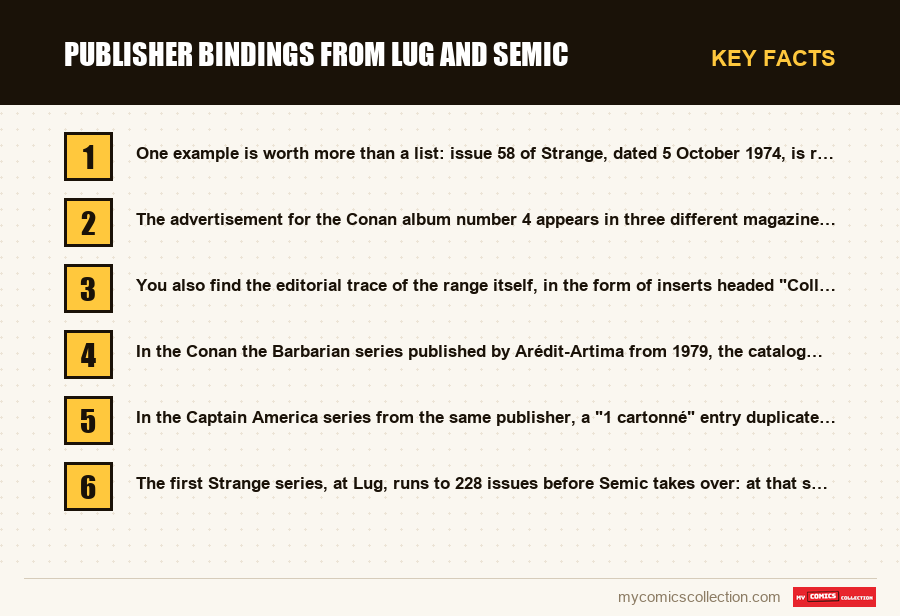
Most of the album mentions in the catalog do not describe an album: they describe an advertising page printed inside a magazine. The field that should carry a story title then carries the title of the insert. One example is worth more than a list: issue 58 of Strange, dated 5 October 1974, is recorded with the mention "Album les Fantastiques numéro 4: Dr. Fatalis". That is not the contents of the issue; it is the page promoting an album sold elsewhere.
These inserts repeat, and their repetition is in itself informative. The advertisement for the Conan album number 4 appears in three different magazines during the same autumn, including issue 93 of Strange dated 5 September 1977. One title pushed at the same time in several magazines from the same house is the signature of a campaign, not of a rare product: at the time these pages were running, the volumes they advertised were on ordinary sale, not sold as collectors' pieces.
You also find the editorial trace of the range itself, in the form of inserts headed "Collection albums Super Héros Lug" or "Albums déjà parus", the last recorded one dating from May 1986 in an issue of Strange. We refuse to draw a production period from them: an advertisement proves that an offer existed on the day of printing; it does not bound its beginning or its end. Sources disagree on the opening and closing dates of these collections, and the catalog does not allow us to settle them.
Second family of traces: two objects, one number
The most telling finding comes down to a few lines. In the Conan the Barbarian series published by Arédit-Artima from 1979, the catalog contains issue 8 dated April 1981, and separately an entry noted "8 cartonné" carrying exactly the same date. The same goes for the next step, with a 9 and a "9 cartonné" dated the same month. In the Captain America series from the same publisher, a "1 cartonné" entry duplicates the first issue in the same quarter of 1979.
Now look at what these hardcover entries contain: nothing. No story title, and for two of them neither writer nor artist. The catalog therefore records the existence of a hardcover version without being able to say what is inside. This is the exact illustration of the problem: the object is identifiable by its number, not by its contents, and whoever cataloged it stopped where his certainty stopped.
Two cautions about these lines, because they are tempting to over-interpret. First, these mentions concern a digest-format publisher that is neither Lug nor Semic: nothing guarantees that assembly practices were the same from one house to another, and sources differ on this point. Second, these numbers are written in brackets, and in this catalog a bracket signals a datum held at a distance, reconstructed rather than read off the object. The same device elsewhere frames uncertain publication months. A bracketed mention is a serious clue, not a proof.
Recognizing a publisher's volume when you have it in hand
Start with the spine, then the fore-edge, then the gutter. A volume assembled after printing almost always shows that it is made of several blocks: the fore-edge does not come from a single run, you can make out the signatures of each magazine, and the trim may bite differently depending on the titles stacked. A book printed as a book, by contrast, has a uniform fore-edge and a regular margin.
Next, open each magazine it contains at the middle. If the original covers have been kept inside the volume, you have a valuable marker: you read the number and date of each included magazine, and you can establish the actual composition of your copy. If the covers were removed during assembly, you lose that marker and must identify the issues by their content, which is slow and uncertain. This difference, whether the inner covers were kept or removed, is the first thing to check and the last thing people think to look at.
Finally, look at the advertising pages: they are datable, since an insert announcing a release for a given quarter could not have been printed earlier. In a silent volume whose title page is missing, these inner advertisements are often the most talkative witness.
Do you collect this series?
Track what you own, what you are missing and what your collection is worth. 7-day trial.
Start my trial →
The decision that counts: does it replace the issues in your gaps?
This is the real question, and it has no universal answer. A bound volume contains issues, but it does not give them back: you can no longer leaf through them separately, sort them in order, or present each one by its cover. If your collection is about the magazine as a newsstand object, the volume fills no gap and even creates an ambiguity in your inventory.
Conversely, if you collect in order to read, the volume does the job very well, often better than tired issues. Many advanced collections adopt a hybrid rule: the volume counts as a reading, not as ownership of the number. Decide once, write it down, and apply it everywhere. A doctrine that changes midway produces an inventory you can no longer query.
If your search covers long series, the question becomes especially acute. The first Strange series, at Lug, runs to 228 issues before Semic takes over: at that scale, deciding that one bound volume is worth five ticked issues changes the number of gaps your list displays, and therefore your search budget. The Silver Surfer hub and that of Captain America give an idea of how many leads such a series opens.
Cataloging an object whose contents vary
The trap in inventorying is to treat the volume's number as an identifier. It is not one, since two volumes with the same number may not contain the same thing: an assembly depends on the unsold stock available, and two assembly runs separated by a few months do not draw on the same leftover stock. The number identifies a series of volumes, not a content.
The method that holds up over time is therefore to record the copy, not the title. Create one entry per physical volume, note inside the exact list of numbers it contains as you have read them, and date your reading. If an inner cover is missing, write that down instead of filling the gap by deduction: an honest inventory is worth more than a complete one. In the application, the copy's note is the natural place for this record, and it is what you will rely on the day you compare two volumes with the same number.
Finally, plan for the partial duplicate: two volumes that overlap on two or three issues without being identical. This is neither a duplicate nor a unique piece, and no checkbox describes it. The only solution is a free, dated comment, less elegant than a tick box and far more useful two years later.
What the binding protects, and what it has already damaged
The hardcover volume is a good keeper. The rigid spine holds the pages flat, the thick cover absorbs handling, and issues that would have warped in a tight stack pass through the decades lying flat. On thin, acidic papers, this steady constraint is worth more than a cardboard box.
But assembly is a destructive operation, and it was carried out at a time when no one was concerned about that. Trimming removes a few millimeters of margin and can cut into the printed area. The glue or the sewing of the spine often prevents the volume from opening flat, which over time causes clean breaks along the center fold. And above all, in many cases the original covers were discarded: the volume gains solidity at the cost of the magazines' identity.
So ask two questions separately: the condition of the volume as an object, and the condition of the magazines it contains. One does not predict the other. A flawless hardcover can house magazines trimmed right to the edge of the art, and a rubbed spine can protect interiors in perfect shape.
Checking before you buy, and knowing where the scarcity lies
Before any purchase, ask the seller three things: photos of the spine and of both fore-edges, a photo of the first interior page, and the list of numbers contained as he reads it on the object. If he answers with the volume number only, treat the composition as unknown and decide accordingly. This is not distrust of him; it is the nature of the object: he cannot guarantee a content that only his copy defines.
Beware of two confusions. A hardcover volume that looks old is not necessarily of its period: private bindings, made by a craftsman for a careful reader, also circulate, sometimes very successfully. And a publisher's volume is not automatically rare: the advertisements noted above, repeated from one magazine to the next, are a reminder that these ranges were sold commercially.
As for what drives value, reason in ratios rather than figures. A volume whose composition is fully legible trades better than a silent one, because the buyer knows what he is buying. A volume containing early numbers in the series interests more people than one from the end, because that is where searches concentrate. And a volume whose inner covers have been kept holds its value better over time, because it remains identifiable without expertise. For an item you are hesitating over, an outside opinion based on precise photos costs less than a mistake.
Frequently asked questions
Because assembly uses the issues available in stock at the moment it is carried out. Two assembly runs separated in time do not draw on the same leftover stock. The number then designates a series of volumes and a format, not a fixed composition. That is why the contents must be recorded copy by copy.
No, and it is important to say so. The catalog describes newsstand magazines, issue by issue, with their date and creators. It has no line dedicated to volumes assembled after printing. The traces found in it are advertising pages and a few hardcover mentions, never a count.
The bracket signals a datum reconstructed rather than read directly from the object, and the same device is used elsewhere for uncertain publication months. A "8 cartonné" entry placed beside issue 8 and dated the same way therefore indicates a probable parallel version, without guaranteeing its exact nature. Check it on the actual copy.
This is a rule to choose once and for all. If your collection targets the newsstand magazine, do not tick them and record the volume as a separate item. If it targets the content you read, tick them and state the source. The mistake is not choosing a side; it is changing the rule midway.
The two objects do not meet the same expectation. The volume keeps better and reads comfortably, but it has often cost trimmed margins and sometimes the loss of the original covers. Separate issues keep their identity and presentation, at the cost of real fragility. Decide according to what you collect, not according to what looks best on the shelf.