
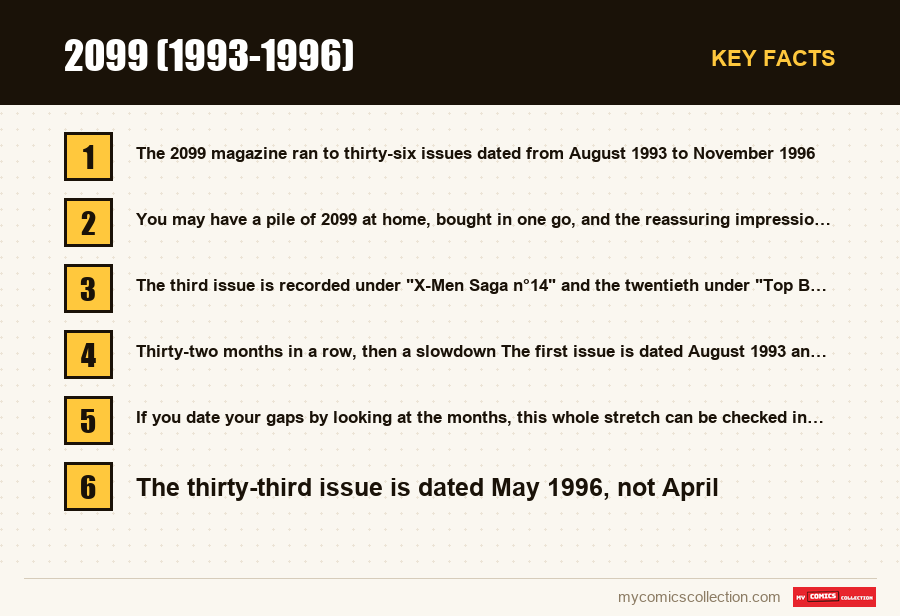
The 2099 magazine ran to thirty-six issues dated from August 1993 to November 1996. The first thirty-two follow one another month after month without a break, then the last four are spaced one issue every two months until it stopped. The numbering, for its part, skips no slot. For a collector, the difficulty is therefore not the paper, which is recent and often well kept, but the end of the run: that is the part that goes missing from lots.
You may have a pile of 2099 at home, bought in one go, and the reassuring impression that it is complete: the covers follow one another, the dates too, and the spines line up neatly on the shelf. This is exactly the series where that impression is hard to verify. Thirty-six issues take up little space, the publishing rhythm changes once without warning, and the visual clue you rely on elsewhere, the gap in the numbering, does not help here. This article measures the series instead of describing it, and points to the exact place where your set is likely to stop without anything signalling it.
As always on this guide, only verified information (creators, numbers, dates) is stated; the analysis is our own, without reproducing any panel or protected dialogue.
What the titles listed in the contents tell us about the magazine
The catalogue records only one story title per issue, whereas a magazine of this format stacked several. What you read below is therefore one entry per issue, not a full table of contents, and that is a limit to keep in mind before drawing any conclusion about the content of a specific copy.
That said, the list of these entries is enough to set the tone. "La traque" opens the first issue, "La brèche" and "Voyage intérieur" follow in the months after, and "Neuropolitique" and "Déconstruction" arrive much later. Between the two ends, the vocabulary slides from pursuit and action towards abstraction and the machine. "Deus in machina" in the ninth issue and "Tranches d'irréalité" in the thirty-second frame this shift quite well. A motif also recurs three times in close forms, with "Muses de feu !", "Le feu répond au feu" and "Règne de feu", spread across the first two years.
One last point drawn from the titles, and the one that matters at the point of purchase: two entries are not story titles at all. The third issue is recorded under "X-Men Saga n°14" and the twentieth under "Top BD N°37". These are publication labels, not story titles. We come back to them below, because these two numbers are the ones whose actual content requires the most checking on the copy in hand.
Thirty-two months in a row, then a slowdown
The first issue is dated August 1993 and the thirty-second March 1996. Between these two dates, each issue is dated the month after the previous one, without a single gap: thirty-two issues for thirty-two consecutive months. That is a rare regularity, and it has an immediate practical consequence. If you date your gaps by looking at the months, this whole stretch can be checked in a few seconds: there should be no empty month between summer 1993 and spring 1996.
Then the rhythm changes. The thirty-third issue is dated May 1996, not April. The following ones carry July, September and November 1996. Four issues are thus spread over eight months, one every two months, until it stopped. The switch is announced by nothing other than the cover date, and that is where the trap lies: the months of April, June, August and October 1996 are empty because no issue was ever dated for them, not because yours are missing.
The numbering skips no slot, and that is misleading
The issues carry the numbers 1 to 36 without interruption. No missing number, no duplicate, no restarted count. On paper, this is the most comfortable setup there is: you line up your copies, you read the numbers, and anything missing is visible.
Except that this comfort takes away the collector's usual reflex. On a series with a messy numbering, the gap jumps out and you know you have to look for it. Here, nothing jumps out, and it is the end that quietly disappears. A set that stops at the thirty-second issue looks perfectly continuous on the shelf, a covered period that seems complete, with no visible sign of what follows. Many lots offered as complete are complete up to that point and not beyond it.
Hence the only check that really counts on this magazine: do not look at whether the sequence is regular, look at whether the last issue present carries the thirty-sixth number. The rest of the series is easy to check, this last handful is the real effort.
Three hand-offs on the script, readable in the credits
The writing credits recorded issue by issue sketch out three fairly clear periods. One name runs through almost all of it: Peter David is credited on thirty-one of the thirty-six issues, from the first to the thirty-fourth, missing only five. He is the backbone of the magazine, and that is also why a reader does not really feel a break as they move through the pile.
Around him, the other writers follow one another. Stan Lee is credited on the first eight issues and on none after them, which clearly isolates the opening of the magazine. Pat Mills takes over and appears in the credits of ten strictly consecutive issues, from the eighth to the seventeenth, a stretch of ten numbers that his name alone is enough to delimit. Len Kaminski arrives with the eighteenth and stays until the last. Warren Ellis joins later, with the twenty-seventh, and signs nine of the last ten issues.
For someone buying issue by issue rather than by lot, this chronology is a useful targeting tool. If you want the opening, the first eight form a homogeneous block in the credits. If you are aiming for the magazine's final manner, the composition really changes from the twenty-seventh onwards, and those are precisely the issues that are the hardest to gather.
The art changes by thirds
The art credits shift more clearly than the writing credits, and they give a dating clue to the eye. Rick Leonardi is by far the most frequent artist, on twenty issues, but he stops dead: from the first to the twenty-fourth, and never again after that. A copy whose page bears his signature therefore necessarily belongs to the first two thirds of the series.
The other markers can be read in the same way. Paul Ryan appears on the first seven issues and on no other. Ron Lim joins with the eleventh and stays until the thirty-sixth, which makes him the only artist credited both in the middle and at the very end. Ashley Wood appears only on the last four, from the thirty-third to the thirty-sixth, exactly the stretch that moved to the bimonthly rhythm.
This coincidence is worth noting for a concrete reason: the four issues that are hardest to find are also the only ones where this name is credited. If you come across a broken copy and the signature looks familiar from the rest of the series, you probably have a regular issue in hand. If it belongs to that last group, check the number before putting the issue back down.
Do you collect this series?
Track what you own, what you are missing and what your collection is worth. 7-day trial.
Start my trial →
The two issues whose content needs the most checking
Let us return to the third and twentieth issues, recorded under the French magazine titles "X-Men Saga n°14" and "Top BD N°37". For these two entries, the catalogue keeps a publication label where it keeps a story title elsewhere. In other words, what we know of their contents is even more partial than for the others, and no deduction about their content would hold up.
Good practice is simple, and it is worth saying clearly, because it protects against a regretted purchase: for these two issues, ask the seller for a photo of the table of contents rather than a photo of the cover. You are not trying to check a condition, you are trying to find out what is inside, and that is information the catalogue does not carry for you.
Condition, and why it does not settle the matter
The series is dated 1993 to 1996, which makes it one of the most recent a French magazine collector could look for. Only three years and a few months separate the first issue from the last, and the whole set is barely three decades old. In practice, you will come across many very presentable copies, often from collections kept by their first buyer and stored flat.
This changes the logic of the trade-off. On an older magazine, condition is the first criterion because fine copies are scarce. Here, fine condition is common, so it discriminates little: rejecting an issue for a blunted corner only makes sense if you know you can replace it, which is true for the first thirty-two and much less so for the last four. For those last four, take the correct copy that comes along, and upgrade later if the opportunity arises.
The points to check remain classic and quick: how the staples hold, whether the spine lies flat, the absence of damp at the foot of the cover, and whether the issue is complete, inside pages included. On a magazine of this period, an incomplete copy is mainly detected by its thickness, not by its outside appearance.
Buying pitfalls, and an ending that looks like a beginning
The first pitfall has already been named: the lot sold as complete that stops at the thirty-second number. Check from the end, never from the beginning, and ask for a photo of the last issue rather than of the pile.
The second concerns the interpretation of the ending itself. The last issue, dated November 1996, carries the catalogue entry "Nouveau départ". We cannot state what that issue contains beyond this title, and we will not do so. But the observation deserves to be put in front of the reader, because it guides a search: the title recorded for the close of a magazine announces a beginning, not a resolution. The previous issue, from September 1996, is recorded as "Spider-Man face à... Venom !", a confrontation, not a conclusion either.
Add the bimonthly slowdown that precedes it, and you get a coherent picture: the series does not come to a close, it stops. The collector hoping for a story ending in the last issue risks disappointment, and one who wants to understand where the narrative breaks off has no resource other than the copy itself. Put differently, the thirty-sixth issue is to be sought to complete the series, not to conclude a reading.
Buying the complete series without wasting time
The method that works on this magazine comes down to three moves. First, buy the bulk as a lot: the monthly portion, which makes up the overwhelming majority of the series, circulates in groups, and it is inefficient to assemble it issue by issue. Next, treat the last four numbers as a separate search, with a dedicated alert, because they do not travel with the rest and do not appear in the same listings.
Finally, keep a record by number and not by month. This is the advice most specific to this series, and it follows directly from the change of rhythm in 1996: a record by month will have you searching for issues that do not exist, a record by number will tell you exactly where you stand. The lists on the character page and those on the blog can serve as a starting point, but the document that counts is your own.
On value, think in ratios rather than figures. The gap widens where supply dwindles, so between the plentiful monthly portion and the last bimonthly handful, and it widens little between two neighbouring conditions since a nice copy is common. A set that is truly complete up to the thirty-sixth number is priced differently from one that stops earlier, and that is the only difference worth documenting when you sell.
Frequently asked questions
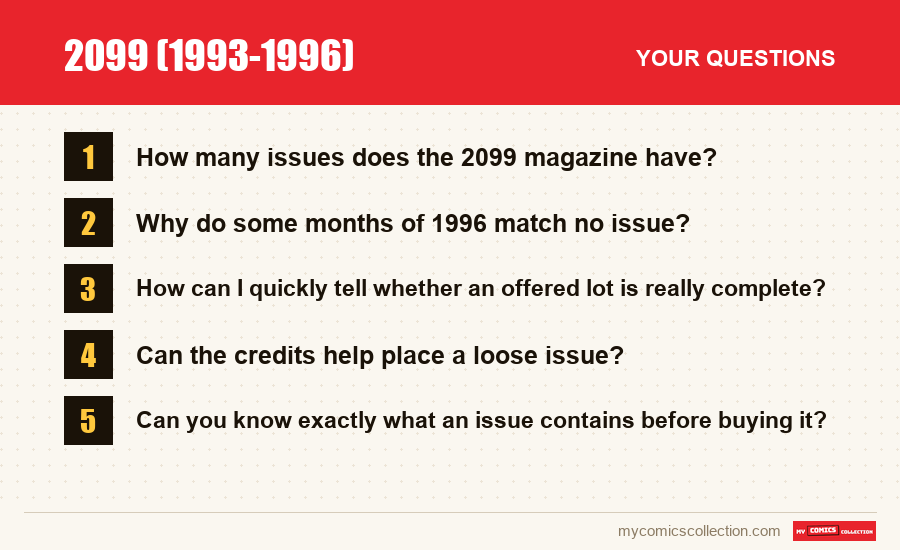
Thirty-six issues, numbered from 1 to 36 with no missing number. The first is dated August 1993 and the last November 1996, a little over three years of publication. A set is only complete if it goes up to the thirty-sixth, which is less often the case than sellers think.
Because the magazine moved to a bimonthly rhythm towards its end. The last four issues are dated May, July, September and November 1996, and the months in between were left empty. If you date your gaps by reasoning by month, you will search for issues that never existed. Reason by number instead.
Look at the end, not the beginning. Ask for a photo of the last issue in the pile and check that it carries the thirty-sixth number. Since the series is numbered without a gap, a set that stops earlier looks perfectly continuous: this is the only check that tells a complete lot from a regular one.
Yes, roughly. Stan Lee is credited only on the first eight, Rick Leonardi stops at the twenty-fourth, Len Kaminski appears only from the eighteenth, and Ashley Wood only on the last four. These markers are enough to place a copy with no readable cover in the right third of the series.
Not entirely. The catalogue keeps only one entry per issue, whereas each issue published several. For the third and the twentieth, that entry is even a publication label and not a story title. In those cases, ask for a photo of the table of contents rather than the cover.