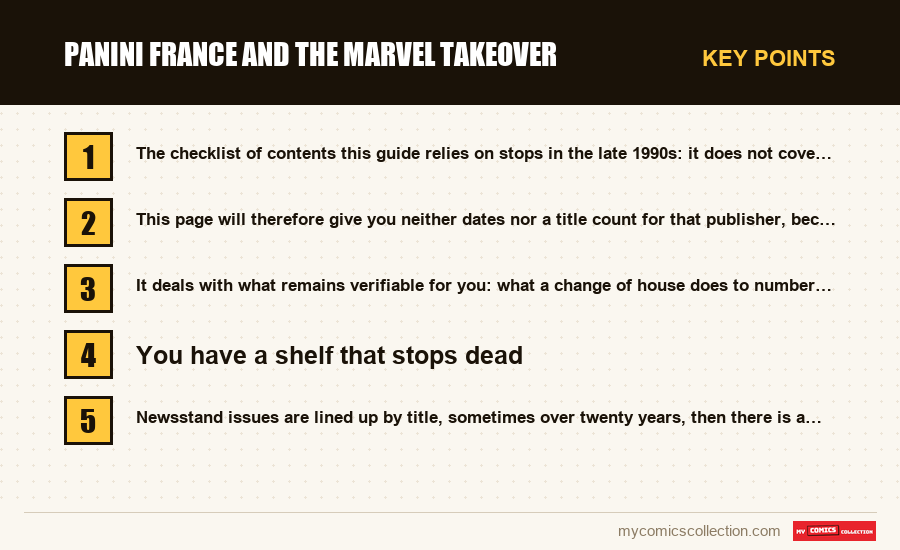
The checklist of contents this guide relies on stops in the late 1990s: it does not cover the period opened by Panini France. This page will therefore give you neither dates nor a title count for that publisher, because the sources disagree and we will not invent them. It deals with what remains verifiable for you: what a change of house does to numbering, to the object, to storage, and to the way a list is kept.
You have a shelf that stops dead. Newsstand issues are lined up by title, sometimes over twenty years, then there is a gap, then thicker, stiffer objects, bought elsewhere and at another time in your life as a collector. The question this page raises is not "when did the takeover happen", which we cannot answer with certainty, but "how do you keep the two halves of this shelf together".
As always on this guide, only verified information (creators, issue numbers, dates) is stated as fact; the analysis is our own, with no reproduction of panels or protected dialogue.
What the checklist covers, and exactly where it stops
Let us say it before anything else: the catalog of contents we work from for this series of entries describes the French magazines of the newsstand era, and nothing beyond it. The latest entry it contains is a publication launched in 1997 by Semic, which ran to twenty-four issues. After that line, the checklist falls silent.
This boundary is not a methodological detail, it is the subject of this page. Every other page in this guide can cite a cover date, a story title, or an artist's name, because that information is read, not guessed. Here we have nothing of the kind. Writing a numbered history of the takeover anyway would mean fabricating facts, which we refuse to do: an honestly empty entry on one point is worth more than a false one.
We can, however, do something useful, and that is the whole purpose of what follows: look at what the earlier period taught us in measurable terms, and deduce the right reflexes for the next one. A change of publishing house always produces the same effects on a collection, even when its date is unknown.
Why a publisher's entry does not need dates to be useful
The questions you actually ask yourself in front of your piles almost never concern a chronology. They concern objects: do this issue and that one belong to the same series? Is this gap in the numbering real, or an artifact of my list? Should these two rows be filed together or apart?
None of these questions requires knowing which company held the license in a given year. They require knowing how to read a copy, how to tell a continuation from a restart, and how to keep a list that survives a change of hands without corrupting. These are skills, not dates, and they can be passed on without asserting anything we do not know.
As for the chronology itself, the sources disagree, including on the order and the overlap of the periods. If that precision matters to you, look for it in the legal notices printed on your own copies: the imprint of an issue is a first-hand source, whereas a forum copied from one site to another is not.
What a change of publisher does to the numbering
The checklist documents one precedent, and that precedent is instructive. For the flagship title of the period, the numbering did not restart when it passed from one house to the other: the inherited counter kept running, so that the two sets form one continuous sequence of numbers, not two homonymous series.
The immediate practical consequence: faced with an isolated issue, the number printed on the cover does not suffice to say who published it. You have to look at the imprint, the logo, the layout. A collector who sorts mechanically by number obtains a tidy row, which is pleasant, but he loses track of the editorial boundary, which eventually gets in his way the day he wants to complete the run.
Nothing guarantees that the next takeover behaved the same way, and that is precisely why the precedent must not be turned into a rule. Check on your copies whether the counter continues or restarts, and note the answer in your list rather than in your memory.
The opposite case: one title, several counters
The checklist contains a counterexample that is worth more than a long discussion. A collection of complete stories appears there three times, under three distinct entries, two launched in the 1980s and one relaunched in 1989, each with its own numbering starting again from one.
If you own issues from these three waves, your list therefore contains several No. 1s, several No. 2s, and so on, without a single real duplicate. An inventory that records only the title and the number will flag imaginary duplicates and nonexistent gaps: a third column is needed, the launch year of the series, for the lines to become distinct again.
This is the lesson most transferable to the recent period. As soon as a title has lived under several houses, the identifier of an issue is never the number alone: it is the triplet of title, series and number. Any collection that spans a relaunch needs this level of detail, and it needs it from the very first entry, not once the piles have been mixed together.
The object changes, and it does not keep the same way
A newsstand issue and a recent issue are two different physical objects, and that is where the takeover becomes tangible. Paper, printing processes, binding methods and formats did not follow the same evolution from one house to the other, and we will not detail here what we have not measured. What you can do, on the other hand, is observe it on your own copies.
Take an old issue and a recent one, lay them flat, and look at four things: the thickness of the spine and how it is assembled, the stiffness and sheen of the cover paper, the tint of the interior pages at the edge, and the presence or absence of advertising pages. These four observations will guide your storage far more reliably than any contract date.
A stapled spine and a glued spine do not age the same way, and they do not tolerate the same prolonged vertical storage. A glossy coated paper shows rubbing more visibly than an aged matte paper, which in turn becomes brittle where the other resists. Mixing the two generations in the same box without thinking means making each one work against the other.
The buying route leaves its mark on the copy
An issue that has spent time on a newsstand rack almost always carries something of that stay: a handling crease, wear on the top edge, sometimes a labeling mark. A recent copy bought from a specialist shop may have gone straight from the till into a sleeve, and its original condition is statistically better.
This is not a value judgment, it is a basis for comparison. Judging an old issue by the criteria of a recent copy leads you to downgrade perfectly normal pieces for their generation; judging a recent copy with the indulgence due to an older one leads you to overpay for an avoidable defect. Each generation is graded against its own peers.
If you resume a collection after years of interruption, expect a visual break on your shelf that reflects not a difference in your own care, but a difference in the object and in the path it traveled before reaching you.
Do you collect this series?
Track what you own, what you are missing and what your collection is worth. 7-day trial.
Start my trial →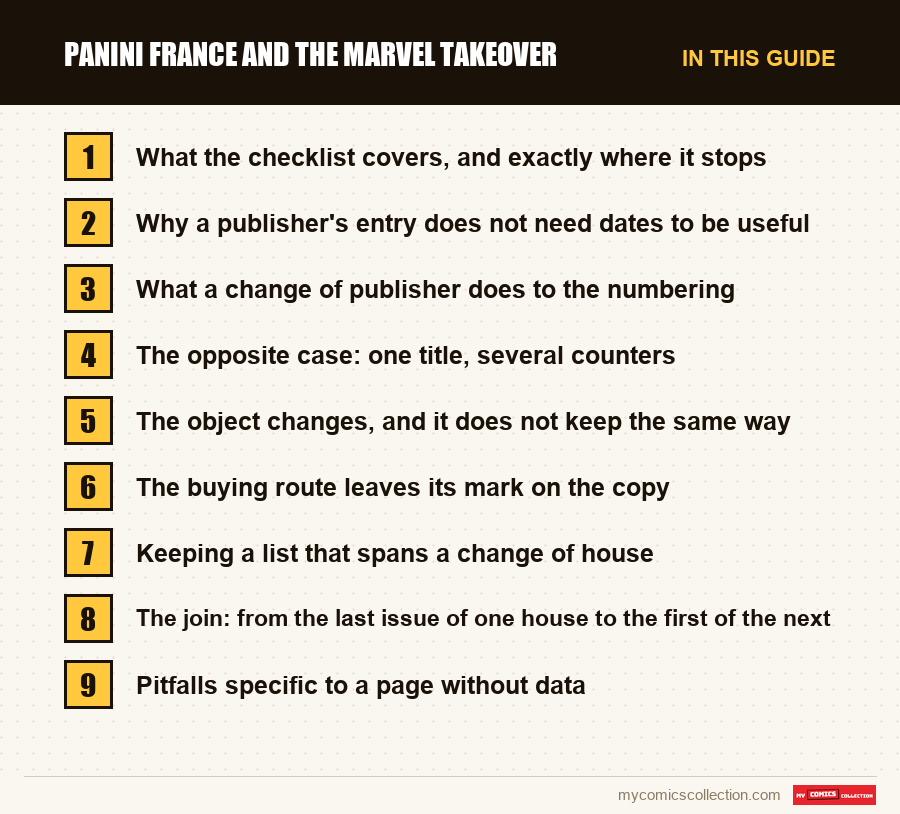
Keeping a list that spans a change of house
A useful list for this kind of collection rests on four minimum columns: the title as printed, the launch year of the series concerned, the number, and a free line where you note what you observed on the copy. The first three identify the issue; the fourth saves you from pulling it out of the box to answer a question.
You may add a publisher column, but treat it as secondary information, filled in by reading the imprint, never deduced from a supposed date. A column filled by deduction then propagates through your searches and exchanges as if it were reliable data, when it was only a hypothesis.
Finally, mark explicitly the line where your collection passes from one house to the next. It is at that line that you will make your future buying decisions, and it is that line you will show a potential buyer to explain in one sentence what your lot contains.
The join: from the last issue of one house to the first of the next
The delicate moment in a collection that crosses a takeover is not the bulk of the catalog, it is the join. The last numbers of a series before it changes hands often circulate less well than the rest: final-period print runs are generally shorter than those of the good years, and readers who had dropped off before the end never had them in hand.
Symmetrically, the first issues of a new period may have been bought by a partly different audience, one that did not own the earlier part. The result is a funnel: many lots on offer cover either the heart of the old series or the start of the new one, and few cleanly span the join.
The right tactic is therefore to handle this join first, rather than last as one naturally does. Complete the handful of numbers on either side of the border first, then return to the bulk of the catalog, which will remain available for longer. We observed this on the older series in the checklist, and there is no reason the logic should reverse afterwards.
Pitfalls specific to a page without data
The first pitfall is apparent authority. On a subject where nobody holds the complete checklist, claims circulate with a confidence inversely proportional to their basis. A title count, the length of a contract, a list of collections: all of that is copied quickly and rarely verified. Ask what the figure rests on before repeating it.
The second pitfall is false continuity. An identical title on either side of a takeover guarantees neither the same publication rhythm, nor the same format, nor the same division of content. Never describe an issue you have not opened by relying on what its namesake did under the previous house.
The third pitfall is the reverse of the second, and it costs you money: concluding that a title restarted at one is a new series unrelated to the previous one, and abandoning the first because the second replaces it. These are two distinct collectible sets, and you choose which one you aim for, but it is a choice, not an obvious fact.
Evaluating a recent series calls for a different method
On older magazines, scarcity does part of the work: print runs are dispersed, the surviving copies in good condition are a minority, and the gap between a worn copy and a healthy one is stark. On recent production, clean copies are the norm, and the completeness of the set carries the value far more than the condition of any single issue.
For an older issue, the description of a specific copy makes sense. For a recent run, what matters is the list: which numbers, over what range, with or without the join, and with which gaps. A continuous set that crosses an editorial border is a noticeably more interesting object than the sum of its parts, and it should be presented as such.
We will not give any figure here: price levels move, and a page that fixes one becomes wrong without warning. The method, on the other hand, remains valid: identify, describe, list, then ask for an appraisal on a complete basis rather than on memory.
Conclusion: a stated limit is worth more than false knowledge
This page will not have taught you anything about the takeover itself, because the data we hold stops before it. It will have given you, we hope, what you need to keep together a collection that crosses this break: identify an issue by its triplet rather than its number, measure the object instead of assuming its format, store each generation according to what it is, and tackle the join before the rest.
The day a checklist of contents covers the recent period with the same precision as the newsstand magazines, this page will be rewritten with dates and story titles that are read rather than guessed. Until then, the safest service we can offer is to name the boundary of our knowledge rather than cross it in silence. You can continue with the pages devoted to the character's series, or go back to the full set of guides.
Frequently asked questions
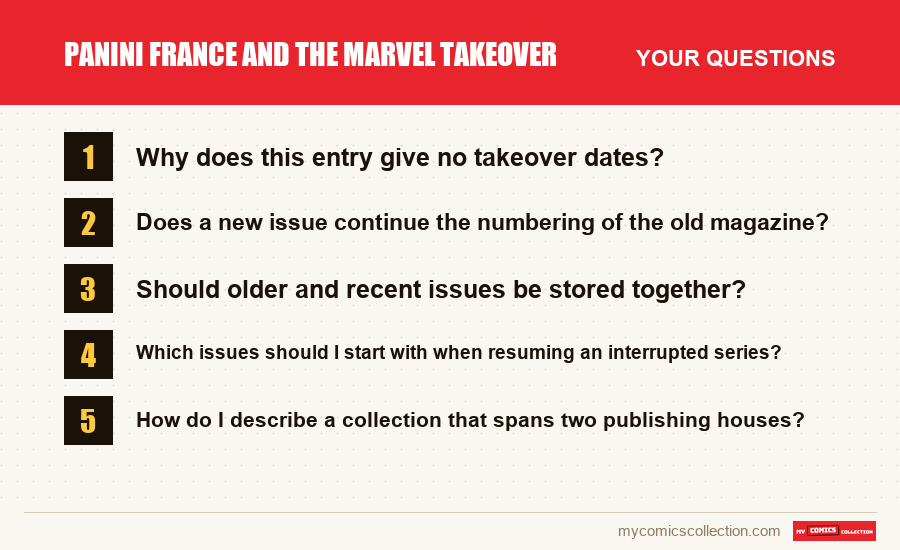
Because the checklist of contents this guide relies on stops in the late 1990s and holds nothing about this publisher. The sources disagree, and we prefer to say so rather than repeat a figure we could not justify. For the chronology, the imprint printed on your own copies remains the best available source.
It depends on the title, and it must be checked case by case. The checklist shows both behaviors for the earlier period: a flagship title whose counter kept running through the change of house, and a complete-stories collection relaunched several times from one. Do not transpose either case without looking at your copies.
Store them separately, not for aesthetic reasons but for mechanical ones. A stapled spine and a glued spine do not tolerate the same vertical storage, and a glossy cover paper does not mark the way an old matte one does. Two boxes, two storage conditions, and one shared list that links them.
With those on either side of the change of publisher. The last issues of a series before it changes hands and the very first of the following period are the least present in the lots on offer, since few collectors lived through both sides. The heart of the catalog will stay findable for longer.
In four pieces of information per line: the title as printed, the launch year of the series, the number, and what you observed on the copy. Mark the boundary line between the two periods explicitly, and say whether the join is complete. A continuous set presents and is valued far better than a pile described as a whole.