
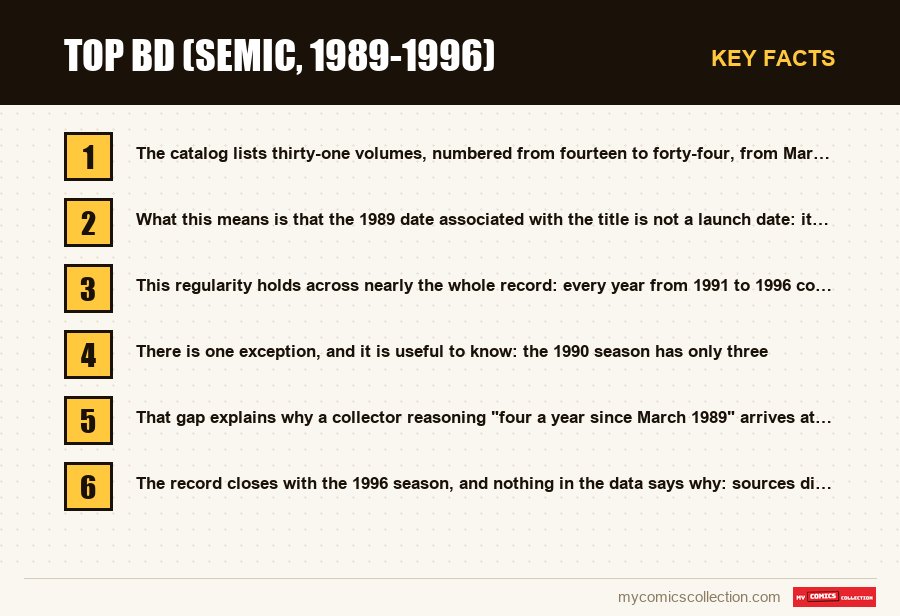
Top BD is an album collection published by Semic S.A. The catalog lists thirty-one volumes, numbered from fourteen to forty-four, from March 1989 through the 1996 season, on a quarterly schedule. Each volume carries a long story, credited to a named team and sometimes to a single author for both script and art. Watch out: the record does not start at the first number, which invalidates any list of missing issues built directly from it.
You inherit a box of Top BD, you line them up on a shelf, and the count never comes out round. One volume carries a number you thought you had, two volumes show the same story title, and half the covers give only a year. This collection stands upright like a bookstore series even though it came from a magazine publisher, and that very mismatch is what complicates the work of anyone who wants to complete it cleanly.
As always on this guide, only verified information (creators, issue numbers, dates) is stated as fact. The analysis is ours, with no reproduction of panels or protected dialogue.
What the collection gathers, volume by volume
The record does not describe a magazine with scattered contents but a sequence of albums, each carried by an identified long story. The French title chosen for volume fourteen, "Maudit par les dieux," already sets the tone: this was not a weekly issue, it was a self-contained story that the buyer was meant to be able to set down on a table.
The spread of credits confirms it. Across thirty-one volumes, the catalog credits thirty-two different writers, and even more on the art side. In other words, there is no house team: each volume is a separate editorial purchase, chosen for what it was, not to fill a slot. For you, this means no volume is interchangeable with its neighbor, and a gap in the series shows up immediately.
Six volumes stand out: the writer and the artist are the same person. Bob Layton for "Hercule Dieu de l'Olympe," Charles Vess for "Esprits de la Terre," Barry Windsor-Smith for "Avant Serval il y eut... L'Arme X," Jim Starlin for "Les jeux sont faits." These single-handed volumes are the ones the market most often treats as author objects rather than series episodes, and they are therefore the first to disappear from lots sold in bulk.
The record starts at volume fourteen, and that changes your list of gaps
This is the point to verify before anything else, and it can be verified: the recorded numbering starts at volume fourteen and ends at forty-four. Between the two, there is no gap and no skipped number.
What this means is that the 1989 date associated with the title is not a launch date: it is the date of the first volume the catalog keeps a trace of. Earlier volumes are not described here, and this guide will not state anything about them.
The consequence is very concrete. If you draw up your list of missing issues by copying a record that starts at volume fourteen, you will end up with a series declared complete when all of its beginning is missing. Make a habit of writing your source's lower bound next to your total: "complete from fourteen" is not "complete," and a well-meaning seller can make exactly the same mistake.
A quarterly rhythm, and the year with one volume fewer
The rhythm reads directly from the cover dates of the first recorded year: March, June, September, December. Four releases, evenly spaced, which is the pace of a collection designed to last rather than to saturate a rack. This regularity holds across nearly the whole record: every year from 1991 to 1996 contains exactly four volumes.
There is one exception, and it is useful to know: the 1990 season has only three. That gap explains why a collector reasoning "four a year since March 1989" arrives at a wrong total and goes looking for a volume that never existed. Before chasing a ghost, count by year rather than by multiplication.
The record closes with the 1996 season, and nothing in the data says why: sources disagree about how these collections ended in that period. What is certain is that the upper bound sits at volume forty-four, and that any copy offered beyond it deserves close examination.
Dates in brackets, and how to sort without error
Here is the most useful statistic in the record, and nobody ever mentions it: only six volumes carry a month and year that can be read without reservation. The first four, then the one from December 1990, then "Futur imparfait" in September 1993. Everything else is either reduced to a bare year or noted in brackets.
The brackets apply to seventeen volumes, more than half of the collection. A bracket signals a date reconstructed by cataloging, not a date printed on the object. This means that if you turn one of these volumes over looking for the month, you will probably not find it: it is not there.
In practice, stop sorting this collection by date and sort it by number. It is the only reliable key from one end to the other. And when a seller announces a precise month for a volume in the second half of the series, ask on what basis: a printer's colophon, a legal deposit, an interior notice. If they cannot say, the date is an estimate, and you record it as one in your inventory.
When a title comes back: the false duplicate on your shelf
Two story titles each appear twice in the record, and that is the most frequent source of error for this collection. "Triomphe et tourment," credited to Roger Stern as writer and Mike Mignola as artist, appears in volume eighteen and again in volume twenty-eight. Same title, same creators, two numbers separated by several years.
The second case is tighter: "Daredevil l'Homme sans Peur," drawn by John Romita Jr., occupies two consecutive volumes, thirty-five and thirty-six. The writing credits differ slightly from one volume to the next, which is consistent with a story split into two parts.
In both situations, the reflex "I have a duplicate, I'll resell it" is a mistake. Check the number on the spine before anything else: two volumes with the same story title are not the same object twice, and giving up one of them leaves a gap that will take you a long time to refill. The reverse is true too: a seller may offer you "the" Triomphe et tourment without specifying which of the two.
Do you collect this series?
Track what you own, what you are missing and what your collection is worth. 7-day trial.
Start my trial →
Signatures that recur, and their bounds in the record
Three writers each appear three times. Jim Starlin first, credited on "Le retour," then on two volumes where he also handles the art, which places his stretch on the collection between the 1992 and 1993 seasons. Fabian Nicieza next, from "Jeux de miroirs" to "Parents et alliés," a presence spread over a longer period.
The sequence most useful to spot is that of D. G. Chichester with Scott McDaniel on art. It covers three volumes, two of which carry explicitly numbered titles: "Chapitre 3 : confrontation" and "Chapitre 6 : le rachat des damnés !" A chapter three and a chapter six with no intermediate chapters in the collection tell you that these volumes take slices from a longer whole. Do not look for the missing chapters in this series: they are not there.
On the art side, Scott McDaniel is the only artist to sign three volumes; Mike Mignola, John Buscema, Bob Layton, Bill Reinhold, Jim Starlin and John Romita Jr. each sign two. A collector who organizes by artist rather than by series can therefore aim for coherent pairs, and that is often how these albums leave lots: by signature, not by number.
One name deserves a separate mention. "Demain... les monstres," in the nineteenth volume, is credited to Jean-Yves Mitton as writer and artist. The presence of a French author creating a full work in a collection otherwise devoted to translated stories is a peculiarity of the record, and it alone makes this volume a piece that researchers of editorial curiosities spot before the others.
An album from a magazine publisher: what the object demands
The whole practical difficulty of this collection comes from here. The object presents itself as a bookstore album, with a printed spine and a single continuous pagination, but it was born in a house whose trade was periodicity. The two logics do not call for the same care, and the owner pays the difference if they get it wrong.
A printed spine means the title and number can be read on the edge, so the volume stands upright rather than lying in a pile. That is the good news: the series can be inventoried at a glance, without pulling a copy off the shelf. It is also the risk: the spine edge is the only part exposed at all times, and it takes all the wear, light and dust included, while the cover stays protected. You will therefore have volumes whose front is fresh and whose spine has aged: compare the two before describing a condition.
Keeping a bound volume, and the handling that saves it
A block of pages glued into a spine ages differently from a stapled booklet. The glue hardens and loses its flexibility, and the gesture that kills the volume is forcing it flat to read a double-page spread or to photograph it. The white crease that then appears along the spine cannot be repaired, and it shows in every resale photo.
Three habits are enough. Open to a right angle and no further. Store upright without packing too tightly, because a volume squeezed between thicker neighbors bends and keeps the curve. And support the block with one hand when you leaf through it, rather than letting its weight pull on the binding.
For volumes signed by a single hand, those of Charles Vess or Barry Windsor-Smith, the care is doubly justified: these are the ones that circulate the most and will be compared most closely with other copies during a sale. A sleeve fitted to the album's height, not to that of a magazine, protects the spine without squeezing it.
Recognizing the edition, and the traps when buying
First trap, and the most common: taking the story title for the table of contents. The catalog keeps only one title per volume. When that title is "4ème de couverture," as in the twenty-ninth volume, you have proof that this field describes what was cataloged, not the full content of the album. Two volumes do not even have a title recorded. The actual contents can only be verified in hand, page by page, and nowhere else.
Second trap, that of correspondences. You will see listings claiming that a given volume reprints a given American issue, or that it contains a given first publication in French. The available data allow neither confirming nor refuting such claims, so we will not assert them. Treat these mentions as the seller's hypotheses, to be checked against the interior credits of the copy.
Third trap, the announced numbering: a "complete lot" must specify from which number to which. Ask for a photo of the spines lined up: it shows the numbers, the condition of the spines and the uniformity of the lot in one image. It is also the photo to take for your own inventory.
Completing the series, and reading its value without fooling yourself
The strategy follows from what we have established. The sequence being continuous from volume fourteen to forty-four, each missing number can be identified without ambiguity, and that is a rare advantage: you do not have to choose between variants or reprints to know what is missing.
On the other hand, the volumes are not worth the same on the market. Those carrying a single signature, those whose story continues across two numbers, and the one credited to Jean-Yves Mitton trade at a premium over the general run of the collection. Volumes with several artists, by contrast, circulate more easily in lots. So reason in ratios: a sought-after volume is worth several common volumes, and that ratio widens when the condition of the spine is flawless.
One last method tip. Build your inventory with four columns: the number, the date as it actually appears on the object, the condition of the spine recorded separately from that of the cover, and the contents verified by your own hand. That fourth field is what, in ten years, will give your collection its documentary value, because it contains what no catalog provides today. The Hulk, Sabretooth and Loki hubs will help you place the stories your volumes announce.
Frequently asked questions
The catalog describes thirty-one, with no missing number between the two bounds. But these thirty-one volumes begin at fourteen, not at one. A set matching the record is therefore complete relative to the record, not relative to the whole collection. Always note your lower bound next to your total.
No. It simply means the record you have does not cover the beginning of the collection. We will not state anything about those earlier volumes, for lack of verified data about them. Keep the copy, describe it from the object itself, and treat your list of gaps as open at the bottom.
Very probably not. Two titles repeat in the collection, including "Triomphe et tourment," credited to the same creators on two distant volumes, and a Daredevil story split across two consecutive numbers. Rely on the number printed on the spine, never on the title. Reselling one of the two would create a lasting gap.
In many cases you cannot, and that is fine. Only six volumes carry an attested month; more than half the collection is dated only by reconstruction. Look for a printer's colophon or a legal deposit inside, and if you find nothing, record the year alone rather than an invented approximation.
Nothing allows you to say so. The catalog keeps only one title per volume, and in one case that title even refers to a back cover. Two volumes have none. The full content can only be determined with the copy in hand, by listing each story and its credits: that is the work most lacking on this collection.