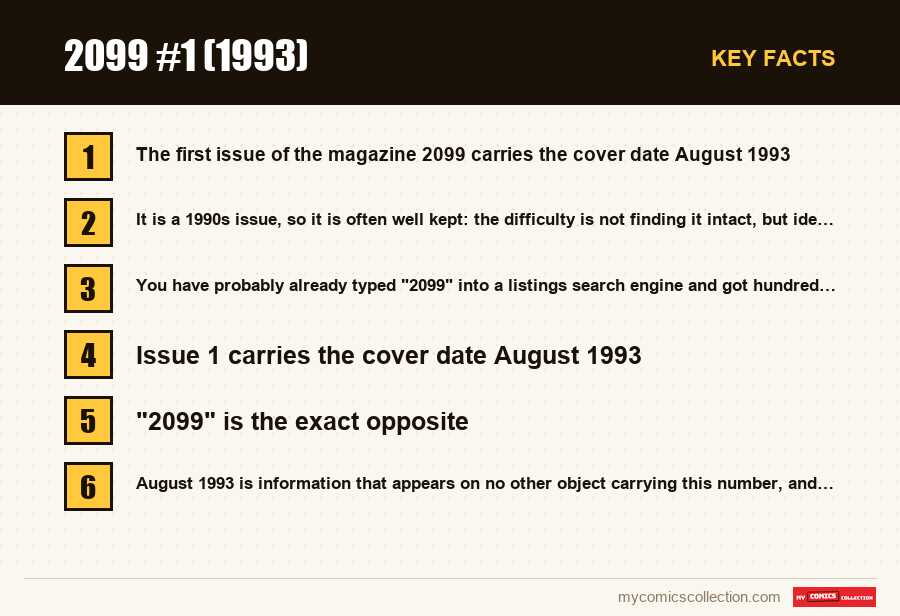
The first issue of the magazine 2099 carries the cover date August 1993. The catalogue records for it the story title "La traque", credited to Peter David and Stan Lee on writing and to Rick Leonardi and Paul Ryan on art. It is a 1990s issue, so it is often well kept: the difficulty is not finding it intact, but identifying it in listings where the word "2099" means anything but this magazine.
You have probably already typed "2099" into a listings search engine and got hundreds of results with no link to the magazine you are looking for. This is the particular problem with this issue: its title is a number, and a number turns up everywhere, in album descriptions, in American titles, in presentation texts, sometimes even in sellers' internal references. For a French collector who wants the first issue, the obstacle is therefore neither the condition nor the price, but how the search is phrased.
As always on this guide, only verified information (creators, numbers, dates) is stated; the analysis is our own, without reproducing any panel or protected dialogue.
What the catalogue records for this first issue
The entry is short and should be read for what it is. Issue 1 carries the cover date August 1993. The story title recorded is "La traque". On writing, two names appear side by side, Peter David and Stan Lee. On art, also two, Rick Leonardi and Paul Ryan. That is what is established, and nothing more.
This double credit is worth pausing on, because it says something about how the issue was put together. When one issue carries two writers and two artists whose styles and generations have nothing in common, it is generally not because they worked together on a single story: it is because the issue contained several. The record gives only one title per issue, "La traque" in this case, so that title does not cover the whole contents. The episodes that accompanied it have to be read on the copy itself.
Why a title reduced to a number complicates everything
A magazine title such as Spécial Strange or Une Aventure des Fantastiques (both French magazines) is an unlikely string of characters: it only comes up when you are talking about that magazine. "2099" is the exact opposite. The number appears in original titles, in character names, in reprint album titles, in lot descriptions, and it can even surface by accident, in a seller's reference or a listing number.
The practical result is familiar to anyone who has searched for this issue: the search brings back bound volumes, foreign editions, collected editions published much later, and buries the few copies of the magazine in considerable noise. This is not a flaw of the platforms, it is a property of the title. You do not get around it by searching harder, but by searching for something other than the title alone.
Phrasing the search that actually finds this issue
The method is never to search for the number alone, and always to pair it with an element that belongs only to the French magazine. The most discriminating is the publisher: combining the number with the name Semic immediately brings the search within the scope of French magazines of the period. Then add a format word, "revue", "magazine" or "fascicule", which filters out albums and bound volumes.
The second lever is the cover date. August 1993 is information that appears on no other object carrying this number, and many serious sellers copy it into their listings. Searching for the number with "1993" is often enough to shrink the list dramatically. You can narrow down by month when the platform accepts a free-text query.
The third lever is the story title. "La traque" is a short string which, combined with the number, targets this issue's contents very precisely. It only works with sellers who detail the contents, so they are a minority, but they are precisely the ones whose listings are reliable. The artists' names, Rick Leonardi and Paul Ryan, serve as a fallback: a seller who cites them has the copy in front of them.
Conversely, a few words should be excluded from your queries or treated as warning signs in the results: "intégrale", "recueil", "album", "tome", "TPB", "reliure", all of which point to an object that is not the original issue. And if the listing is written in English, it almost never concerns the French magazine.
Checking that you really hold the first issue of this magazine
Once you have found the listing, the check comes down to four points, in this order. First, the date printed on the cover must be August 1993. It is the marker that is hardest to fake by inattention, because it is printed and visible in the photo.
Second, the issue number must be 1, with no mention of a special, a one-shot or an album. Many magazines of this period had parallel releases whose numbering restarted at 1: a "1" on a cover does not, on its own, guarantee that it is the first issue of the monthly magazine.
Third, the contents. If the seller agrees to photograph the table of contents, look there for the title recorded for this issue, "La traque", and check that the issue does contain several episodes: an object with only one is probably not the magazine, but an offprint or an album. Fourth, the publisher named in the imprint, in small print, usually at the end of the volume or at the foot of the first inside page. It is the driest and most reliable proof.
A recent issue, so the buying criteria shift
Between a magazine from 1968 and one from 1993, the gap is not only a matter of years. An issue from the early 1990s was often bought by a reader who was already a collector, who kept it instead of stacking it under a bed, and the paper of that period holds up better over time than that of the small formats of the 1960s. The concrete consequence: the copies circulating today are frequently in good condition, sometimes very good.
This changes the nature of the buying decision. On an old issue, the question is binary and concerns integrity: does the cover hold, is the spine complete, are all the pages there. On this issue, integrity is the general case, and the criterion shifts to detail. It is the corners of the cover, the crispness of the spine fold, the absence of a name written in pen at the top right, the flatness of the issue, the residual gloss of the cover ink that make the difference between two equally complete copies.
In other words, you are no longer buying a "readable" copy, you are choosing between several intact ones. That gives you real bargaining power and allows you to say no, which would be unreasonable on a magazine thirty years older. Ask for photos of all four corners and of the spine laid flat: on an object from this period, a seller who does not provide them is often hiding a minor but real defect.
Do you collect this series?
Track what you own, what you are missing and what your collection is worth. 7-day trial.
Start my trial →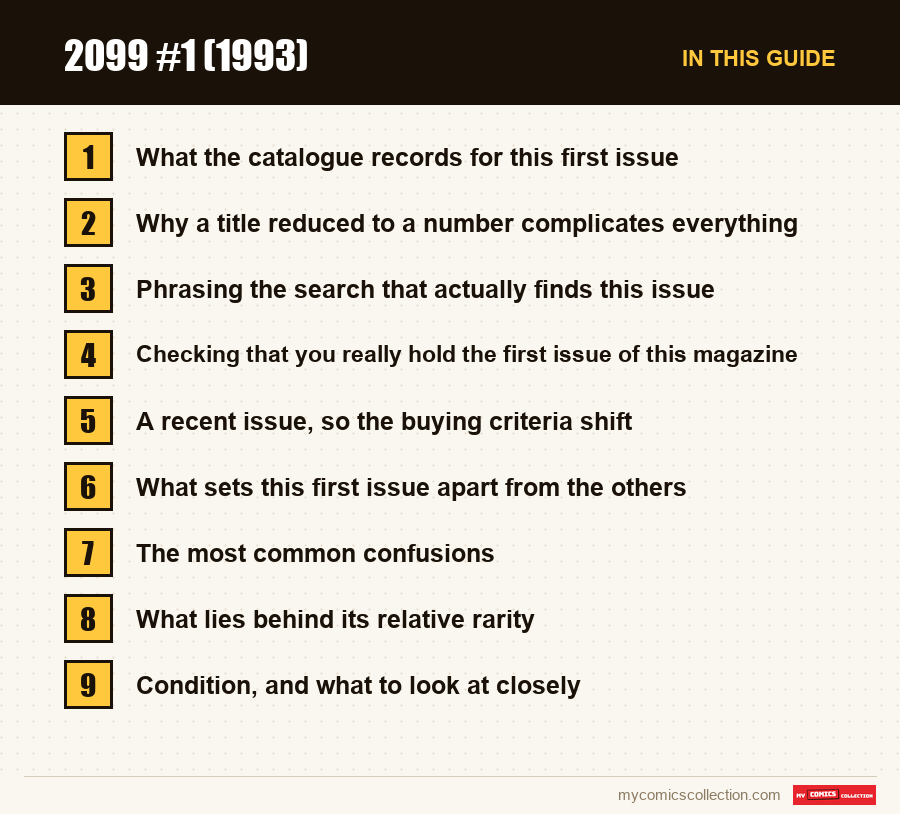
What sets this first issue apart from the others
The record of the thirty-six issues of the magazine lets you place this issue within a trajectory, and that is where it becomes interesting. Publication is monthly at the start, and it stays so for a long time: the cover dates run on without a gap from August 1993 to the start of 1996. Then the rhythm breaks, the last issues are spaced two months apart, and the magazine ends with an issue dated November 1996 whose recorded title, "Nouveau départ", has the slightly bitter flavour of a series coming to an end.
Issue 1 is therefore the only one that belongs to a magazine nobody yet knew how long would last. You can read that in the object: a first issue is designed to attract, and it sometimes carries launch material, an insert or a presentation of the line, that later disappears. Check that these are present before buying: an issue missing an insert still looks complete to a seller and incomplete to you.
Another oddity of the record, useful precisely because it is strange: for two issues of the series, the recorded story title is not a story title at all but the reference to another magazine from the same publisher. This means the records sometimes capture an advert printed in the pages rather than an episode. Issue 1 is not affected, its recorded title is a genuine title, but keep the principle in mind: a label that looks like an editorial reference must be checked on the copy, and never copied as is into a collection list.
The most common confusions
The first confusion concerns bound editions. Collected volumes gathering several issues of the magazine circulate, and their spine sometimes carries its own numbering. A collected volume "n°1" is not issue number 1, it contains several, and its reference follows a different logic. At a glance, the thickness immediately gives away the collected volume.
The second confusion concerns American series carrying the same number in their title. They have their own numbering, and an "n°1" there means something else. We cannot assert any correspondence between the content of the French issue and a specific American issue, because the record does not allow it: an issue of the French magazine mixed several series, and establishing the match requires the copy in hand. On this point, the sources diverge, and we do not settle it.
What lies behind its relative rarity
It is worth being honest on this point, because intuition almost always gets it wrong. A first issue from 1993 is not rare in the physical sense. It was printed for a launch, so in quantity, and it has been kept. What circulates least in this magazine are, on the contrary, the very last issues, those of the bimonthly phase: when a title slows down, the print run follows, the points of sale become scarce, and there are few readers still buying. A collector who wants to complete this series will run into the end, not the beginning.
The rarity of issue 1 is therefore a rarity of demand rather than supply. It is sought after because it opens the run, because a first issue always resells better, and because many buyers want only that one. This creates pressure on copies in very good condition, which go quickly, while correct copies wait. The practical consequence is simple: take your time over condition, not over the copy. Another will come along.
Condition, and what to look at closely
On an issue of this age, three defects dominate, and all of them are visible in a good photo. The first is whitening along the folds, that pale line which appears on the spine when the issue has been opened flat; it cannot be repaired and it permanently caps the value. The second is wear on the corners, subtle but decisive when comparing two copies. The third is yellowing of the page edges, linked to storage rather than reading.
Two points are specific to this type of magazine and deserve a dedicated check. The staples first: make sure they are not rusted and are not pulling at the paper, because a staple that has begun to work will eventually tear the central gathering. The advertising pages next: they were printed on the same paper as the rest, and some readers tore them out. An issue with incomplete pagination because an advert was removed is still described as complete by many sellers.
If you are torn between two copies that everything separates except price, have both descriptions assessed rather than guessing.
Tracking this issue in a collection
For a magazine whose title is a number, cataloguing discipline matters more than for any other. Always record the magazine's title together with its publisher, never the number alone: in six months, a line "2099 n°1" in your inventory will not tell you whether you own the French issue or something else. Add the cover date, August 1993, which is the only identifier that is truly unambiguous.
Finally, if the character Spider-Man 2099 is your way in, know that the record of the last third of the magazine brings up other figures in high demand, since issue 35 carries a title in which Venom is named. Details like this shift demand onto issues you thought were anonymous, and that is one more reason to read the contents before reselling a pile.
Frequently asked questions
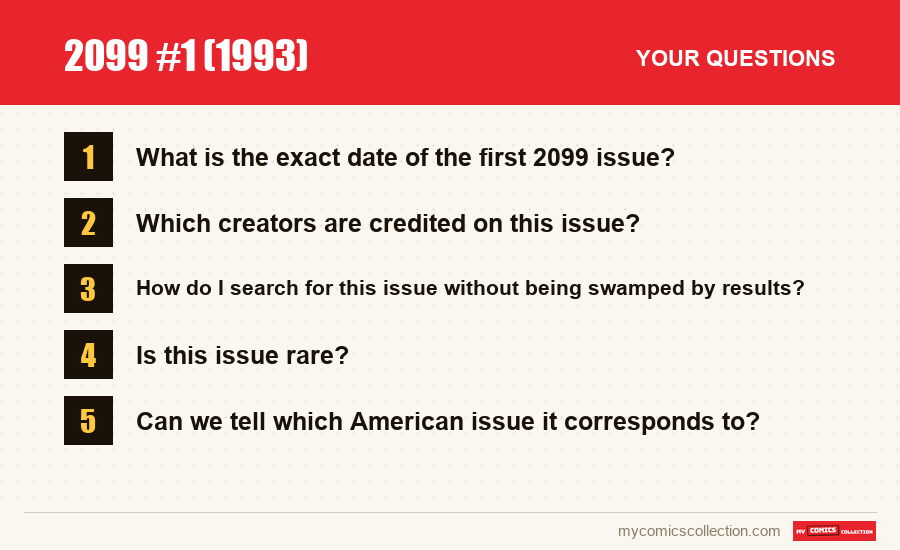
The recorded cover date is August 1993. That is the mention to look for in the photo of a listing, because it is printed and appears on no other object carrying the same number. It immediately rules out a collected volume, an album or a foreign edition.
The record lists Peter David and Stan Lee on writing, and Rick Leonardi and Paul Ryan on art, for a story title recorded as "La traque". This double pair of credits points to an issue containing several episodes, of which the record names only one. The rest of the contents has to be checked on the copy.
Never use the number alone. Pair it with the publisher's name, a format word such as "revue" or "fascicule", and the year 1993. If the platform accepts free-text queries, add the recorded story title. Exclude results containing the words "intégrale", "album", "tome" or "reliure".
Not in the physical sense. Printed for a launch in 1993 and often kept, it remains accessible. In this magazine, the hard-to-find issues are the last ones, published every two months until November 1996, when the print run had fallen. The pressure on issue 1 comes from demand, not from scarcity.
Not from the data available, and we will not claim it. A French magazine of this period grouped several series under a single cover, and the record keeps only one title per issue. Establishing a match requires the copy in hand and the contents in front of you. On this question, the sources diverge.