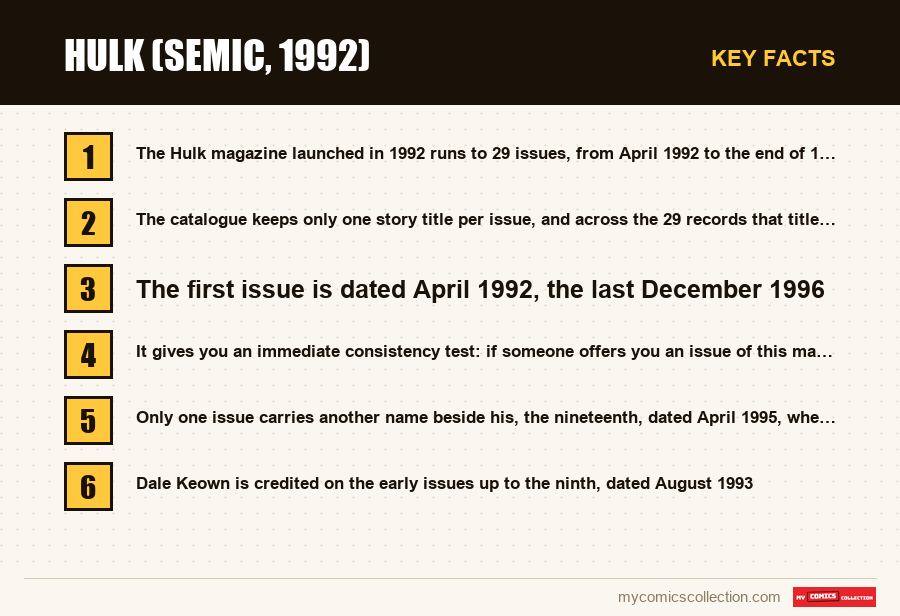
The Hulk magazine launched in 1992 runs to 29 issues, from April 1992 to the end of 1996 at one issue every two months, without a single missing month. The record credits Peter David as writer throughout, with a succession of artists that divides the series into four visible stretches. For a collector this changes everything: it is a continuous serial, not an anthology in which a gap can be filled later.
You have a stack of issues with the Hulk logo, dated the early 1990s, and you wonder how many are missing and which ones to look for first. The answer is clearer than with most French magazines of the same decade: this series can be counted, dated and checked almost without ambiguity. You still need to know what you are holding, because one magazine name has served more than once in France.
As always on this guide, only verified information (creators, numbers, dates) is stated as fact. The analysis is ours, with no reproduction of panels or protected dialogue.
A magazine devoted to a single character
The first point to grasp is not a date but a format. This magazine does not work like an anthology where several heroes share the pages: it bears a character's name and follows him issue after issue. The catalogue keeps only one story title per issue, and across the 29 records that title always refers to the same serial. There is no rotation of stars, and no identifiable back-up series in that column.
This editorial monogamy has an immediate practical consequence. In an anthology, a missing issue deprives you of one episode out of three or four, and the rest of the contents keeps its meaning: you can read around the hole. Here the hole is in the story itself. A reader who skips an issue loses a link, and a collector who resells an incomplete series sells an object whose incompleteness shows in the reading, not only on a list.
It also changes the order in which you buy. On a serial, buying in contiguous blocks is better than buying scattered opportunities: two runs of five consecutive issues can be read, ten scattered ones cannot.
A bimonthly rhythm kept from start to finish
The cover dates in the catalogue all fall on an even month: April, June, August, October, December, then February of the following year, and so on. The first issue is dated April 1992, the last December 1996. Between the two, no even month is missing.
Such regularity is collection information, not an anecdote. It gives you an immediate consistency test: if someone offers you an issue of this magazine dated an odd month, or dated a year after 1996, you are not dealing with the same title. It also lets you work out from memory the expected date of a missing issue, and so spot a listing whose number and date do not match.
Finally, the rhythm explains the duration. A little under five years separate the first issue from the last, for a series short in number. A short bimonthly series is far easier to finish than a long-running title, and it is a realistic goal for anyone who wants a complete series at home.
A single writer, and what that guarantees
Peter David writes the script for every issue in the record. Only one issue carries another name beside his, the nineteenth, dated April 1995, where the catalogue adds Barry Dutter. It is the only exception across the whole run.
This writing continuity has an indirect market value. Single-writer series resell better in a block, because the buyer knows he is buying one voice and not an assembly of styles. It has above all a value for identification: if you find an issue under the same logo whose script is credited to someone else, check the edition before checking the catalogue. You probably hold another title, or a neighbouring publication that reused the layout.
Four successive hands on art, four stretches to recognise
The art, however, changes, and this is where the series divides into segments. Dale Keown is credited on the early issues up to the ninth, dated August 1993. After a transitional issue with no identifiable regular artist, Gary Frank takes over from the eleventh, dated December 1993, and remains credited up to the twenty-third, in December 1995. This is the longest stretch under a single artistic signature.
Next comes Liam Sharp, whose name first appears second on that same twenty-third issue, then alone or first up to the twenty-seventh. The last two issues carry Angel Medina. Between these blocks, the catalogue mentions occasional reinforcements: Paul Pelletier accompanies Gary Frank over four consecutive issues during 1994, and isolated names appear on a single issue, such as Travis Charest or Darick Robertson.
For the collection, these boundaries are worth more than a list. They give you four natural lots to look for on the second-hand market, and four selling points if you sell in bundles. They also mark the hinge issues, where two signatures coexist: fans of a given artist look for them in addition to their block, so they circulate a little less easily.
One name deserves a separate mention: Ciro Tota, credited on three issues spread over the first two years. The catalogue field does not distinguish roles: it does not say whether a signature covers interior art, covers or inking. If that detail matters to you, check it on the copy in hand, not on a record card.
What the story titles reveal, and what they conceal
The French titles in the record are telling. "Exposition" opens the series, and "Nouvelle personnalité" closes it, which says much about how the magazine ends: not on a conclusion, but on a turn. In between, titles such as "Entracte" or "Six mois plus tard..." signal breaths and an openly assumed time jump in the serial.
But these titles also show the limit of the available information, and it must be said frankly. The ninth issue is titled "Fantôme du passé, 2ème partie : Trahisons !", while the previous issue carries an unrelated title. Conversely, the twenty-second announces "La chute du Panthéon, 1ère partie : Le procès" with no numbered continuation appearing afterwards.
The explanation is simple: the catalogue keeps only one title per issue, and a French magazine often contains several. The missing first and second parts are therefore very probably present in neighbouring issues, but at another place in the contents. This is why no correspondence with an American edition can be asserted from this data, and why an issue's full contents must always be checked on the object. This caution protects you from a purchase made on a list that looks too good.
The issues that really matter
In a continuous series, the hierarchy of issues does not follow the same rules as in an anthology. The first issue is sought for what it is, number one, and because it launches an unusual format for the time. The last is sought for a symmetrical reason: end-of-series print runs are often more modest, and a collector who has gathered 28 issues readily accepts paying more for the twenty-ninth than its rank justifies.
Between these two ends, the issues to watch are the graphic hinges noted above, in particular the tenth and the twenty-third, where the credits overlap. Their interest is not narrative but documentary: these are the issues that let you date a change of team without relying on a card.
Do you collect this series?
Track what you own, what you are missing and what your collection is worth. 7-day trial.
Start my trial →
Recognising the right magazine, and avoiding the namesake
Another French title of the same name existed in 1976, which is enough to muddle keyword searches. We do not develop the comparison here, but keep the reflex: on a listing, the cover date decides, not the logo.
So apply the even-month rule. Every copy of this series carries a date between April 1992 and December 1996, on an even month. A listing that shows a low number without a legible date, or that gives a decade instead of a month, calls for an extra photo before any commitment. Ask for the cover date and the issue number in the same image: together they resolve the ambiguity in a second.
The condition of a bimonthly issue from the 1990s
Issues of this period and format have recurring weak points, and knowing them keeps you from overpaying for a copy photographed head-on. The glued spine wears badly when the magazine has been read flat: look for vertical reading creases near the binding, which only show in a photo taken at an angle. Cover corners blunt in stacks, and the four corners do not age at the same rate depending on the issue's position in the pile.
The cover paper, often glossy, shows fingerprints and micro-scratches under direct light. A seller who photographs with flash hides these flaws without meaning to: ask for a view in raking light. And reserve your demand for condition for the issues you target as key pieces, because aiming for flawless across 29 issues costs several times what a homogeneous series in good condition costs.
Finally, check that the issue is complete with its editorial and letter pages. They disappear first, and their absence does not show in a cover photo.
Pitfalls at purchase
The first trap is spelling. The catalogue itself carries, on the twenty-fourth issue, two close spellings of the same artist's name in the same field. If a careful database hesitates, private listings hesitate even more. So search for a series like this one by title and number, never by creator name alone, lest you miss lots whose seller misspelled the signature.
The second trap is the "complete" lot announced without a list. On a bimonthly serial, a well-meaning seller may believe his run is complete because it looks dense and continuous to the eye, when an issue is missing in the middle. Ask for the list of numbers, not the quantity: a stack of 28 issues presented as complete is costly to finish if the missing one is a hinge.
The third trap concerns the format. Devoted to a character rather than to a catalogue of heroes, the magazine was less often filed in a followed collection than general-interest anthologies: intact series circulate in fits and starts, and when one comes up, it goes quickly.
Completing the series and tracking progress
The most effective method follows from the rhythm. Build your want list not by number but by pair of number and expected date, since the correspondence is mechanical across the whole series. You can then check a listing without opening your inventory.
Then work by graphic blocks rather than in ascending order. Looking for the Gary Frank period's issues on one side and the Liam Sharp period's on the other puts you in front of different sellers, often collectors who followed an artist rather than a magazine. It is a gateway that a strictly numerical search does not open for you.
For the rest, keep a card per copy with its condition, provenance and acquisition date. On a short series this discipline costs no effort and makes the difference on the day you insure the set.
Today's value, and what to take from it
No amount makes sense here, for a structural reason: the value of an issue in this series depends more on its rank in the serial and its condition than on its own content. Reason in ratios. A first issue in fine condition trades at a multiple of an equivalent middle issue; a complete series trades above the sum of its parts, because the buyer pays to avoid having to search. Conversely, an isolated middle-of-series issue in reading condition remains a very affordable purchase.
So follow two indicators rather than one price: the time a complete series takes to sell, and the gap between a reading copy and a carefully kept copy of the same number. When that gap widens, condition becomes the real subject. To place this title among the publications linked to the character, the Hulk hub gives the neighbouring references, and the Thor hub sheds light on the crossovers that some story titles hint at.
Two reflexes sum it up. Date before you buy, because the even month and the publication window rule out any confusion of title. And buy in contiguous blocks, because a serial with holes cannot be read.
Frequently asked questions
The catalogue lists 29, from the first dated April 1992 to the last dated December 1996. It is a short series by French magazine standards, which makes it genuinely finishable. No intermediate number is missing from the recorded numbering, and the series does not restart under a new numbering after its last issue.
Every two months, on even months only: April, June, August, October, December, then February. This regularity has no exception across all the recorded cover dates. It gives you a simple test: an issue of this series dated an odd month does not exist, and a listing that shows one has the wrong title.
Peter David is credited as writer on all issues, with a single occasional co-credit, that of Barry Dutter on a 1995 issue. On art, four signatures follow one another: Dale Keown at the start, Gary Frank over the longest period, Liam Sharp next, and Angel Medina for the end of the series.
Because the catalogue keeps only one story title per issue, whereas a French magazine often publishes several. The first part very probably appears in the neighbouring issue, but elsewhere in the contents. No full reconstruction of the contents is possible from this data: it is done on the copy in hand.
By the cover date, never by the logo or the issue number alone. A French namesake title existed in 1976. If the date read on the copy falls between April 1992 and December 1996 on an even month, you are in the right series; otherwise, ask for a photo where the number and the date appear together.