
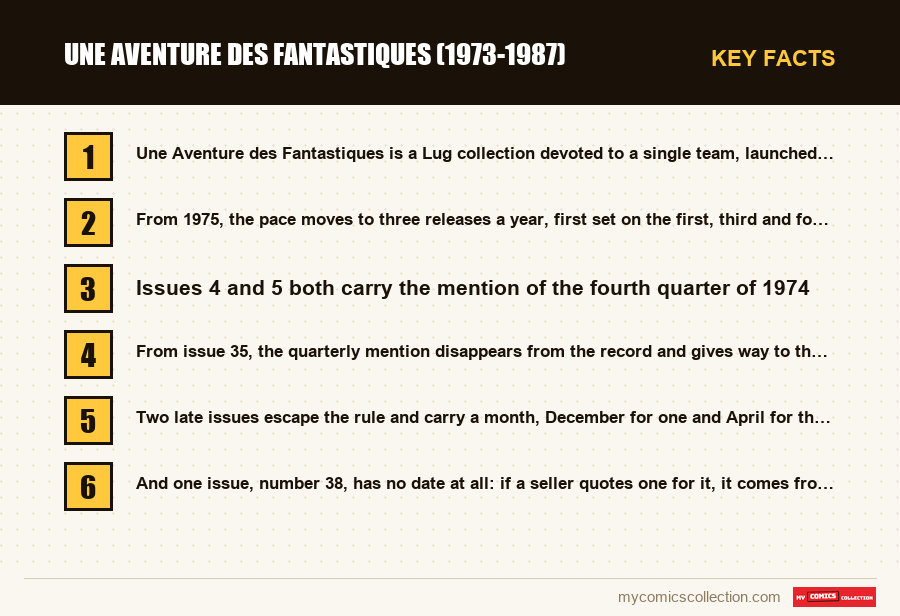
Une Aventure des Fantastiques is a Lug collection devoted to a single team, launched in the second quarter of 1973 and stopped in 1987 after forty-three issues. It appeared two, then three times a year, with no printed month on most covers. Two of its late issues announce a second edition themselves. It is a format halfway between the anthology magazine and the album, and that is what makes it so hard to identify in a lot.
You open a box bought at a flea market, and among the usual anthology magazines you come across an issue thicker than the rest, with the Fantastic Four alone on the cover and a one- or two-digit number. Neither album nor monthly: you probably hold a copy of Une Aventure des Fantastiques, and the next question is always the same, which one, since nothing on the object gives you a publication month.
As always on this guide, only verified information (creators, numbers, dates) is stated as fact; the analysis is our own, with no reproduction of panels or protected dialogue.
A collection for one team, alongside the major magazines
The dominant model at Lug was the anthology magazine: one title, and inside it three or four series sharing the pages. Une Aventure des Fantastiques took the opposite approach. All the space went to the same team, issue after issue, from the first to the last. For a reader of the time, this changed the relationship to the object: you no longer bought a basket of series hoping the episode you wanted was in it, you bought an appointment with the Fantastic Four.
For you, as a collector, the consequence is different and less comfortable. A single-subject collection is not recognised by its magazine logo but by its subject, and a hurried seller will describe the object by what they see on the cover, not by the exact title of the issue. That is the root of almost all the identification problems described below.
The catalogue record also shows that the French title of the featured story does not always exist. For the first six issues, it carries only the name of the collection itself, with no title of its own. In other words, the start of the series is the least documented part, even though it is the part people look for first.
Two a year, then three, then nothing readable
The first two years run on a very slow rhythm: second quarter, then fourth quarter, and then the cycle starts again the following year. From 1975, the pace moves to three releases a year, first set on the first, third and fourth quarters, then shifted to the second, third and fourth as the early 1980s begin. This calendar drift is not a scholar's detail: it explains why two consecutive issues can appear six months apart here and three months apart there.
One anomaly deserves attention. Issues 4 and 5 both carry the mention of the fourth quarter of 1974. Two issues announced for the same quarter means either a catch-up on a delay or an approximate cover mention, and in both cases it stops you rebuilding the chronology from printed dates alone. Sort by number, never by quarter.
The end of the run is worse. From issue 35, the quarterly mention disappears from the record and gives way to the year alone, sometimes repeated on two consecutive issues. Two late issues escape the rule and carry a month, December for one and April for the other, which incidentally confirms that the collection did run until 1987. And one issue, number 38, has no date at all: if a seller quotes one for it, it comes from their own estimate.
The issues that matter, and those whose title tells you nothing
The record of story titles reveals a hierarchy that the numbering alone does not show. One title recurs five times across the whole collection: the one for Doom, in variations of robots, impostor, micro-world and scheme. A villain who occupies the cover or the main contents at that rate is the editorial backbone of the series, and these are the first issues that buyers ask for individually.
Three other issues put the Sub-Mariner forward, one of them a title announcing his return, which places the series within the logic of the team's great historical antagonists rather than that of new creations. One issue announces the arrival of Galactus, another a confrontation with the X-Men. These are the two titles that, on a sales list, will draw attention beyond the circle of enthusiasts of the Richards family, because they bring in characters with their own public.
Conversely, beware of silent entries. On several issues, the recorded title is not a story but a piece of printed matter: a back cover, or an announcement for the publisher's album collection. This does not mean the issue is empty, it means the usable contents listing was never captured. Adding up these silent entries and the first six issues with a generic title, more than a third of the collection has real contents that can only be known from the copy in hand.
The thread of the artists, and what it reveals about the publishing
Two French names run through the whole collection: Jean Frisano and Jean-Yves Mitton, credited on art from the first issue to the last. At Lug, this constant presence points to the cover and graphic adaptation work, and it gives you a useful authenticity reference: an issue of this collection without either of them in the credits is an exception, not the rule.
The exceptions, precisely, are rare and localised. A single issue, number 34, features Christian Goussale, and Frisano does not appear on it. Another handful of issues do without Mitton, including one where Steve Ditko appears on art. If you are building a complete collection, these four or five atypical issues are the ones to check against the credits rather than assume they match the others.
On the American side, Jack Kirby dominates the record on art, which places most of the collection within the founding material of the team. But the series does not stop there: John Buscema and then Sal Buscema appear on three neighbouring issues at the turn of the 1970s, George Pérez and Keith Pollard later, and John Byrne on a late issue. A collector buying this series for Kirby's art should therefore know that some of the issues owe him nothing.
French names on writing, and why they confuse searches
The writer record mixes two different things. Stan Lee appears on the great majority of issues, alongside, depending on the issue, Archie Goodwin, Bill Mantlo, Len Wein, Alan Kupperberg, Marv Wolfman or Doug Moench. And French names also appear: Geneviève Coulomb on three issues, Yves Chantereau on one, and Jean-Yves Mitton himself credited on writing for another.
These French credits most likely correspond to the adaptation and rewriting work specific to the Lug edition, whose practices are well known to enthusiasts even though sources differ on the exact extent of the reworking. What matters for a purchase is practical: a search engine queried on one of these names will not bring up the American series you expect, and the absence of results does not mean the seller got it wrong.
Do you collect this series?
Track what you own, what you are missing and what your collection is worth. 7-day trial.
Start my trial →
Why these issues get lost in lots
The title begins with an indefinite article. As a result, the same object gets filed under A, under F, under "Fantastiques", or described as a special issue of anthology magazines it never belonged to. In a hastily written listing it becomes "Fantastiques Lug album", which mixes it up with genuine bound albums, and the buyer discovers a soft-cover issue where they expected a square spine.
The second cause is the missing month. A lot of French magazines is usually sorted by cover date, and here the date stops at the quarter for three quarters of the collection, then at the year alone towards the end. Issues without a readable date slide naturally to the bottom of the pile, where nobody describes them. That is unpleasant for the seller and advantageous for you: the late issues are precisely the ones that sell at the price of the lot.
The third cause is the short numbering. Forty-three issues over fourteen years means covers where the number fits in a single box, easy to confuse with that of another Lug collection of the same size. Always check the full title, not just the number.
Recognising an edition, and spotting the second one
Two issues from the end of the collection carry the mention of a second edition in their own title, one devoted to the Black Panther and the other to Doctor Doom. This is the most useful piece of information in this article, because it tells you in plain terms that the series partly ends on republished material, and that the same content can therefore exist under two presentations.
In practice, a copy described only by its content is never enough. Ask for a photo of the whole cover, price and edition mentions included, and a photo of the imprint page if there is one. A late reprint does not have the same rarity as an original print run, even when the interior pages look alike.
The same reasoning applies to issues whose catalogue entry keeps only a back-cover page. The indexed element is advertising printed matter, which changes from one reprint to another: if it matches what the photo shows, you have a dating clue that the cover does not give you.
Condition, buying traps, and how to complete the run
A quarterly issue thicker than average suffers first at the spine. The staples work harder, the central crease shows, and a copy that does not stay flat has almost always been read several times. Next, look at the corners of the cover, which on these formats stick out slightly from the block of pages and take the knocks first in a pile.
Three traps recur in listings. You are sold an issue presented as the first French appearance of a character: nothing in the available documentation allows that to be claimed, since the full contents of the French issues are not documented and a magazine of this format published several episodes. You are offered a precise match with an American issue: same answer, to be checked page by page on the copy. And you are offered a "complete" set that stops before issue 43: the collection does run that far.
To complete the run, work in publication blocks rather than isolated numbers. The early 1970s, with two releases a year, cover few issues and are found mostly with specialists. The heart of the 1980s, at three releases a year, is the most plentiful part and the cheapest per issue. The tail of the collection, the one without a printed quarter, is the easiest to miss and must be ticked off issue by issue on an up-to-date list. An adversary such as Doctor Doom also gives you a convenient thread for prioritising purchases.
The value today, and how to track your collection
The value of these issues rests on three levers, and none of them is an amount. The first is the condition of the spine and corners, which on a thick stapled format makes all the difference between a reading copy and a collecting copy. The second is the cover subject: issues with a major antagonist structurally sell better than those with a generic title. The third is the edition status, since an original print run is not comparable with a late reprint.
Tracking, for its part, requires a discipline particular to this series. As the dates are not usable, your list must be organised by numbering and record, for each entry, the condition, the edition mention read on the cover, and what you have actually read in the contents. That is the only way to know, two years later, whether the issue you hold is the one you think it is. One record per copy, with a cover photo, is worth more than any approximate table.
Finally, think of your collection as a set rather than a sum of pieces. A continuous run of this series, in a uniform condition, tells fourteen years of French publishing policy around a single team, and that coherence has its own value on the market. It is lost as soon as the issues featuring strong adversaries are resold separately.
Frequently asked questions
The collection has forty-three issues, from the second quarter of 1973 to 1987. A set announced as complete that stops before number 43 is therefore incomplete, and that is the most common error in lot listings. Always check the upper bound before buying a set presented as full.
Because the collection was dated by quarter, and only by year from issue 35 onward. Two late issues exceptionally carry a month, December and then April. One issue has no recorded date at all. If a seller gives you a precise month for the others, they worked it out rather than read it.
Two issues near the end explicitly carry this mention in their title, one around the Black Panther and the other around Doctor Doom. It signals a republication rather than new content. A reprinted copy does not gain value like an original print run: ask for a photo of the whole cover.
Not reliably at a distance. The available documentation keeps only one story title per issue, whereas this format published several. Any claimed match with an American issue is a hypothesis. The only safe method remains to leaf through the copy and note the episodes one by one.
Those whose title features a major adversary. Doom comes back five times across the collection, the Sub-Mariner three times, and two single issues announce Galactus and the X-Men. These issues appeal to a wider public than enthusiasts of the team alone, and they become scarcer faster when bought one at a time.