Strange Spécial Origines is a quarterly special from Lug, launched in January 1981 and kept going for eight years. It runs to thirty-two issues, and its particularity governs the whole collecting approach: its numbers do not follow one another, they borrow the number of the monthly Strange released in the same month. A collector who reasons in a continuous sequence will believe in gaps that do not exist, and risks confusing two very different issues bearing the same figure on the cover.
There is a category of magazines that resists collection charts: those whose number does not indicate a place in a series. This Lug special belongs to it, and it is the first thing to understand before buying anything. As long as you look for a sequence, you chase issues that never existed, and you let slip the ones you really lack. This guide therefore starts from the labelling of the issues, because everything else follows from it: the list of gaps, the reading of an advertisement, and even the idea you have of rarity.
As always in this guide, only verified information (creators, issue numbers, dates) is stated as fact; the analysis is ours, with no reproduction of artwork or protected dialogue.
What this special put under the word "Origines"
The title announces a programme: going back to the beginnings. Several catalogued titles confirm it without ambiguity, from "C'est ainsi que tout commença..." to "A la recherche de Steve Rogers !", including "Un homme dans une fourmilière !" or "La Torche rencontre Iceberg !". One reads the vocation of a collection that traces the thread back, and that addresses the reader who joined midway as much as the one who wants to reread the beginnings.
But the same catalogue reveals a second layer, and it is surprising: "Qui inventa le microscope ?", "Comment fonctionne un moulin ?", "Depuis quand le ski existe-t-il ?", "Folklore et mysticisme : la semaine sainte à Séville". These titles are not episode titles; they are documentary features, of the kind Lug slipped between the stories. Their presence at the head of a record indicates that the issue was not a pure anthology, but a complete magazine, with its apparatus of non-narrative pages.
For a collector, this dual nature has an immediate practical consequence. A copy is also judged on these ancillary pages, because they are what gets damaged, filled in or cut out. We come back to this below, and it is one of the reasons why a copy of this special does not have the same condition expectations as a hardcover collection.
Numbers borrowed from the monthly Strange
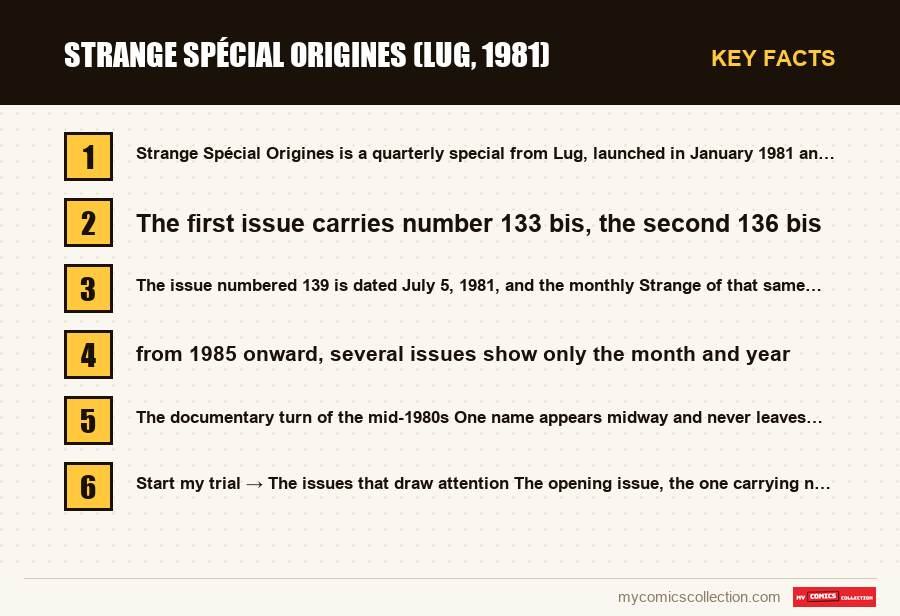
Open the list, and the anomaly jumps out. The first issue carries number 133 bis, the second 136 bis. From the third onward, the mention disappears and the bare figure remains, then it progresses in steps of three until the end of the collection, never starting again from one.
Comparison with the parent magazine settles the question. The issue numbered 139 is dated July 5, 1981, and the monthly Strange of that same month also carries this number, on this same date. The phenomenon holds throughout: each time, the special borrows the figure and the year of the monthly that came out at the same time as it.
In other words, this number is not a rank, it is a calendar marker. It does not say "I am the twelfth of my collection", it says "I came out with the monthly of that month". The difference seems theoretical, but it is formidable in practice: it means that one same figure designates two distinct objects from the same publisher, on the same date, and that nothing in the figure itself allows them to be separated.
The "bis" mention had precisely this function, and it was only used at launch. From the third issue onward, Lug dropped it. You therefore cannot rely on this suffix to identify a special: it is the exception to the first two, not the rule of the collection.
A quarterly rhythm kept for eight years without a hitch
The detail of the cover dates gives a rare regularity. Eight issues in January, eight in April, eight in July, eight in October: the collection kept its quarter throughout its existence, without a skipped quarter or catch-up. This is exactly why the step of three exists, one quarter of the monthly being worth three of its numbers.
This regularity is good news for anyone who wants to build their list. It makes the catalogue predictable: knowing the first label and the rule, you reconstruct all the entries by calculation, without relying on a list copied elsewhere. And above all, it tells you that a hole in the arithmetic sequence is a real gap in your pile, never an accident of publishing.
One reservation, however, on the precision of the dates. The early years show a day of publication at the head of the month; from 1985 onward, several issues show only the month and year. So do not make the day a criterion of authentication: its absence on a later copy is normal, and a seller who omits it is hiding nothing.
The French signatures that give the collection its face
The creator listing holds a surprise for anyone who expected an American list. Jean-Yves Mitton appears in the artist credits of twenty-seven of the thirty-two issues, that is, almost everywhere. Jean Frisano signs sixteen of them, and Thomas Frisano appears on four.
What this changes is concrete. The French share of these issues is not decoration, it is their visual identity, and the easiest to authenticate when you have the object in hand. A collector who learns to tell Mitton's hand from Frisano's gains a useful reflex, because these covers are very often the only element that distinguishes a special from the monthly with the same number.
On the writing side, Stan Lee is credited on twenty-seven entries. The figure is telling about the nature of the reused material, but it permits no conclusion about a specific story: the catalogue aggregates the credits of the issue, it does not attribute them page by page.
The documentary turn of the mid-1980s
One name appears midway and never leaves: Mark Gruenwald, credited for the first time on the issue numbered 181, dated January 1985, then on fourteen entries in total. Eliot R. Brown accompanies him on several of them.
This duo is the mark of an encyclopaedic style, that of the technical sheets and character profiles that became the norm in the 1980s. Their arrival in a French special indicates that the formula was enriched along the way: the documentation no longer covers only the real world, it also covers the published universe itself.
General features did not disappear, however, since "Comment naît une chute d'eau ?" still appears in the final years. The late issues are therefore mixed objects, and they often appeal to a different reader than the one looking for the early stories. If you buy in lots, mentally separate these two periods before negotiating a set.
Do you collect this series?
Track what you own, what you are missing and what your collection is worth. 7-day trial.
Start my trial →
The issues that draw attention
The opening issue, the one carrying number 133 bis and the date January 5, 1981, concentrates interest for a structural reason more than a narrative one: it is the only moment when the label still shows its nature as a special. Its catalogued title, "L'incollable", moreover belongs to the register of game pages, which confirms that the record does not summarise the contents.
At the other end, the last entry is dated October 1988, and its catalogued title is "Fantastiques contre X-Men". It falls at the moment the parent series also ends, at the close of the same year. This is no collecting coincidence: the special was tied to the monthly, and it stops with the Lug period, the continuation of the story belonging to another house.
In between, a few titles clearly announce superhero content: "Daredevil et la Veuve Noire" for autumn 1981, "L'énigme de Fatalis", or again "L'arme secrète de la Reine Blanche : Firestar la jeune mutante". These are good research markers, and subjects that cross the hubs of this site, on the side of Black Widow as well as Ant-Man.
What the catalogue does not say about each contents
One must be clear about a limit, because it protects your money. The catalogue keeps a single title per issue, whereas a magazine of this format stacked several. The record therefore gives one entry of the contents, and sometimes, as we have seen, a feature rather than a story.
The direct consequence: none of these records allows us to claim that an issue contains a given first French appearance, nor that it corresponds to a specific American episode. Whoever claims it is extrapolating. The only source that settles the question is the contents page of the copy, and that is exactly what you should ask for as a photo before a remote purchase.
This caution is not a weakness of the guide, it is the real difficulty of the subject. The contents of French magazines were reconstructed late and unevenly, and a cover figure borrowed from another magazine has not helped. An honest inventory is better than an invented correspondence.
Building a gap list that holds up
The method follows from everything above, and it comes down to three moves. Start from the opening label, apply the step of three, and stop at the last recorded label: you obtain all the entries, from 133 bis to 226, without inventing any.
Second move, note the corresponding date next to each entry, since it is that of the monthly of the same month. You get a double criterion, and it is what saves you when an advertisement is imprecise: if the figure and the month do not agree under this rule, one of the two is wrong, and you should ask for a photo before going further.
Third move, the most counter-intuitive: re-check your pile of monthlies before ticking anything off. Many collections contain an apparent duplicate that is not one, and an invisible gap right next to it. As long as your inventory merges the two objects into a single line, it overstates what you own.
Reading an advertisement without mistaking the issue
An advertisement that says "Strange 151" tells you nothing. It may refer to the monthly of summer 1982, or to the special that carries this figure on the same date. The year does not settle it either, since both objects share it, and that is precisely what makes this case more tricky than an ordinary homonymy.
The deciding elements lie elsewhere. Ask for the full cover, with its complete title line, and compare the page count with that of a monthly you already own. A quarterly special does not have the format of a monthly issue, and this difference shows on the spine as well as to the touch. The contents page, finally, settles every doubt in one photo.
Be wary too of the suffix used out of context. A seller who writes "bis" for a high figure is copying a habit and not their copy: their label is an approximation, not proof. Conversely, the absence of "bis" proves nothing at all, since Lug dropped it very early. In both cases, go back to the object.
Condition, buying pitfalls and value
The apparatus of features discussed above weighs on the condition of copies. Where the catalogue notes "Jeux" or "Retrancher une lettre", there are grids, boxes and answers to fill in, and many readers filled them in. A copy annotated or cut down by a game page changes category, even if its cover is flawless: check this part before the spine.
The other checkpoints are those of any flexible magazine that has aged in a cellar or an attic: the spine, which whitens at the first firm flick through, the staples, the folded corners, the yellowing of the paper. On a quarterly, the print run is by construction more modest than that of the monthly that accompanied it, and truly fresh copies are therefore rare at both ends of the collection.
On value, reason in ratios rather than amounts. A complete lot sells better than a holed lot, an opening copy better than a mid-run issue, and a special complete with its game pages better than a played copy. And keep in mind the bias specific to this title: an offer that mixes monthlies and specials under the same figure often sells fewer distinct pieces than it claims.
Frequently asked questions
The catalogue lists thirty-two, from the January 1981 launch to the last quarter of 1988. The figure is modest, but it covers eight full years, at one issue per quarter. A complete collection is therefore an attainable goal, provided you start with the right list of entries.
Because their figure was already taken by the monthly of the same month, and the publisher first wanted to remove the ambiguity. The practice was dropped from the third issue, without the principle of borrowing changing. You will therefore come across two suffixed labels, then thirty bare figures that nonetheless designate the same situation.
No, and this is the most common mistake on this title. Two figures out of three are not assigned to this special, simply because the step follows the quarter and not the month. Those labels belong to the monthly magazine. Do not enter them in your gap list, or you will search indefinitely.
Not entirely. The record keeps a single title, sometimes that of a documentary feature rather than a story, whereas the issue stacked several. It guides you, but it does not stand in for a contents list. For a remote purchase, ask for a photo of the contents page: it is the only reliable answer.
Fully, and more so than on a magazine without features. The recorded titles show that these issues included games to complete, and therefore pages often written on or cut out. A copy untouched by these interventions stands out clearly, and this check is made page by page, not from a photo of the cover.