At Lug, the cover date marks a newsstand sales window, not a printing date. It reads at three levels: the day designates a distribution slot specific to the title, the month sets the rhythm, and the year alone signals a mention missing from the copy. A publication pattern is measured by counting the intervals between neighboring issues, never on an isolated line. And a gap in the numbering is not always a missing issue.
You take a magazine out of the pile and the same question comes back: where exactly does it sit, and what is missing around it? The cover date is your only instrument, and it is poorly graduated. Depending on the title and the era, it gives a precise day, a month, a quarter, a bare year, or nothing at all. Knowing how to read these four levels of precision is worth more than a checklist of issue numbers.
As always on this guide, only verified information (creators, issue numbers, dates) is stated as fact; the analysis is our own, with no reproduction of panels or protected dialogue.
What the cover date says, and what it does not say
The date printed on the cover announces the period during which the issue occupies the rack. It therefore has thickness: an issue dated March stays on sale part of April, and its successor already carries April. For you, the consequence is practical more than theoretical. This date is used to order a series, not to timestamp an object.
It reads at three nested levels. The year places the issue in an editorial period. The month places it in a rhythm. The day, when it appears, indicates the title's place in the house's internal calendar. Each of these levels can be missing, and it is precisely the absence that carries the most information.
The catalog from which the records cited here are drawn reproduces the mention as it appears on the copy. An entry reduced to a year is therefore not a data-entry oversight: most often, the cover itself bore nothing more. Confusing sparse data with missing data leads you to look for a precision that never existed.
The day of the month, a title's signature more than a date
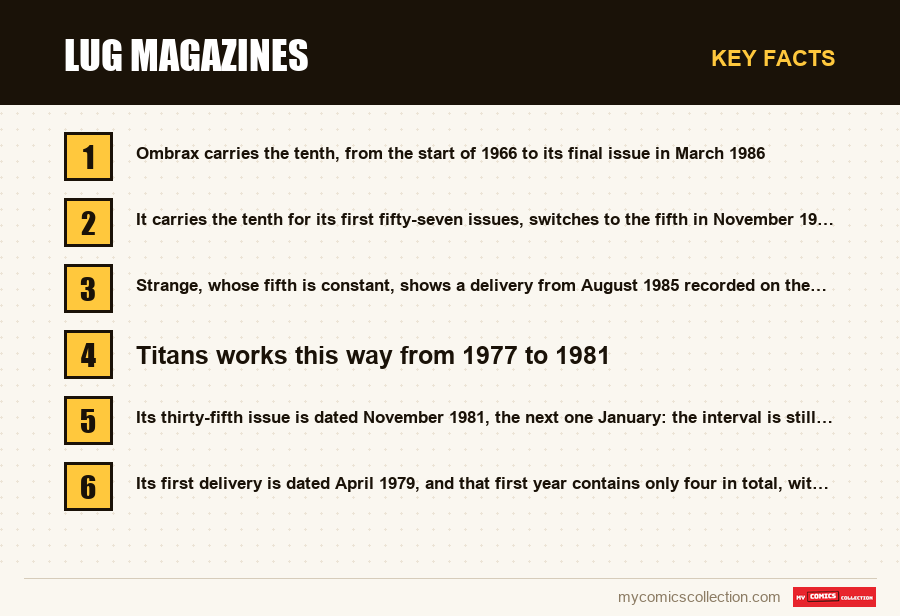
The house's titles do not share the same day. Strange carries the fifth of the month, from its first delivery to its last. Ombrax carries the tenth, from the start of 1966 to its final issue in March 1986. This choice is not decorative: it corresponds to a position in the distribution schedule, and it holds for years without moving.
For dating a loose copy, this day is the first usable clue. An issue dated the tenth does not belong to the same newsstand slot as an issue dated the fifth, even when both carry the same month. And when the day changes within a single series, the change is a dated landmark, more reliable than a visual impression of the layout.
Nova provides the demonstration. It carries the tenth for its first fifty-seven issues, switches to the fifth in November 1982, and never moves again. Holding a Nova dated the tenth is therefore enough to place it before that switch, without having to read its number or open the issue.
Be wary, however, of isolated accidents. Strange, whose fifth is constant, shows a delivery from August 1985 recorded on the tenth. A single day in the middle of a long run of identical days should be treated as a recording error, not as the trace of a second printing or a regional variant.
The publication patterns that can actually be measured
Four patterns can be measured without ambiguity in this catalog: monthly, bimonthly, quarterly, and a three-issues-a-year cadence specific to the slower collections. They are not inferred from a notice on an inside page, which may remain a dead letter, but from the number of issues actually dated within the same calendar year.
Strict monthly publication does exist, and it is rarer than one might imagine. Strange ran twelve issues in every full year of its career under this publisher, without a single skipped month. Ombrax did the same over a comparable span. Only in these two cases does an issue missing from your pile count as a gap, without discussion.
Bimonthly is recognizable by six issues a year, that is two months between neighbors. Titans works this way from 1977 to 1981. Quarterly gives four deliveries, and the slowest collections of the house give three. Before counting your gaps, identify which of these four patterns governs the span of years you are interested in.
Between these patterns lie hybrid cadences that no label describes. Spécial Strange alternates for years between intervals of three and four months: December, March, June, August, then December again. Four deliveries a year, then, but never in the same months from one year to the next. A calendar grid copied from a previous year will mislead you.
Spotting a change of rhythm with no announcement
A change of frequency is announced nowhere in the data. It is read in the gap between two consecutive issues, and it is clear-cut when it happens. Titans, which hosted the long-running teams, gives the clearest example.
Its thirty-fifth issue is dated November 1981, the next one January: the interval is still two months. But the issue after that is dated February, then the next March, then April. The gap has become one month and will never revert. No other trace marks this switch.
Spidey shows the reverse transformation, at the start. Its first delivery is dated April 1979, and that first year contains only four in total, with gaps of three and four months. The second year brings seven. The third moves to twelve and stays there to the end. A series can therefore be monthly without always having been so.
The practical use is direct: establish the pattern of the period concerned, not that of the entire series. Looking for a Titans dated in an even month during its early years is a waste of time, because the series then appeared only in odd months. The gap you were tracking did not exist.
When the day mention disappears, then returns
In several series, the day fades all at once and for good. Nova loses it in April 1988 and never recovers it: its last nine deliveries carry only the month. Spécial Strange loses it at the exact moment it becomes clearly bimonthly, in September 1987, with publications in odd months until the end.
Elsewhere, the disappearance is intermittent. Strange loses its day over a few deliveries in 1983, recovers it, loses it again in 1986, then recovers it. Spidey does the same on several occasions, over sequences of a few issues. These eclipses follow no pattern and coincide with no change of rhythm.
They therefore say nothing about the issue itself: they say that the mention was not printed, or could not be read. They have no value for distinguishing two editions, and no value either as a condition criterion. A seller who uses them as an argument is telling you a story that the date does not support.
A permanent disappearance, concurrent with a change of interval, is on the other hand a readable editorial signal: when the day goes and the cadence loosens in the same movement, you are looking at the end of a title.
Do you collect this series?
Track what you own, what you are missing and what your collection is worth. 7-day trial.
Start my trial →
Dates by quarter, and why they do not sort
Some collections carry no month but a quarter. These are the slow publications: Une Aventure des Fantastiques and Une Aventure de l'Araignée fall almost entirely into this group across most of their runs. The date loses in precision what the series loses in cadence, which is consistent and carries no adverse consequence.
The difficulty lies in the spelling. The mention appears in incompatible forms: you read "2e trimestre" and "2ème trimestre" on the same series, and the abbreviation of the first also varies across entries. Alphabetical sorting and chronological sorting therefore never coincide, and a binder sorted on the character string will mix up your issues.
The real trap lies elsewhere. Two neighboring issues can carry the same quarter: Une Aventure des Fantastiques has two in the fourth quarter of 1974. Their order is given by their numbering, not by their date, and neither one is a variant of the other.
Brackets, bare years, and silent entries
When the cover carries no month indication, the record shrinks to a year. In L'Araignée, every issue is dated this way, without exception across the whole collection. Un Récit complet Marvel is also dated this way. This is not a data-entry defect; it is the maximum precision the object allows.
Brackets mark one step further. A month in brackets is a reconstructed date, deduced from its neighborhood, and not read off the copy. An issue number in brackets has the same status: in L'Araignée, two entries carry a reconstructed number, and it would be pointless to search for them in that form on a cover.
At the time of purchase, the consequence is clear. A date in brackets supports no argument of rarity or limited printing: it tells you the sequence remains coherent, nothing more. A listing that presents it as printed on the issue is mistaken, and a single look will settle it.
Bare years have another unpleasant effect: they hide reprints. In Les Fantastiques, one and the same issue appears under two different years, six years apart. This is not a recording duplicate; it is a second printing, and the mention of a second edition appears plainly in the story titles of a neighboring collection.
Two issues, one month: what to make of the doubt
It happens that a record assigns the same month to two distant issues. In Ombrax, a delivery from the mid-seventies carries a June dated two years earlier, whereas the issues before and after it cleanly frame that month within the expected year.
The reading rule is that of the neighborhood. Between an isolated line and two agreeing neighbors, the neighbors win. Apply it without hesitation: on a monthly series that has never skipped a month, an issue cannot sit two years away from its immediate neighbors without its date being wrong.
Spécial Strange offers the same case in a non-monthly pattern. Two of its issues carry December 1978 although three deliveries separate them, one of them dated March 1980. Here again, the numbering decides and the date is corrected, not the other way around.
When the numbering is not a sequence
The most confusing case is that of Strange Spécial Origines. Its issues carry no numbering of their own: they reuse the numbering of the monthly magazine the collection is attached to, and the first ones even add a "bis" mention that says a lot about the process.
The result is a sequence with gaps by construction. One delivery appears, the next carries a number three units higher, and the interval between the two dates is three months. The collection is quarterly, and its numbering step follows the monthly's step, not its own. Four deliveries a year, over eight years, with the same gap every time.
Keep the order of reading in mind: the date first, the number second. On these collections, it is the date that gives the real sequence, and the number that misleads. The same reflex applies to the guides devoted to Doctor Strange or Thor, whose French titles went through several successive formats.
Sorting a pile: real gap, imaginary gap
Proceed in three passes, in this order. First pass: group by title and note, for each span of years, the number of deliveries per year. You obtain the pattern, and therefore the list of months in which an issue could have existed. This list is your only legitimate reference when speaking of a gap.
Second pass: deal with the anomalies. An isolated date that contradicts its neighbors is corrected by the neighborhood. A date in brackets is noted as approximate and is not used as an argument. The same number under two distinct years is filed as a reprint and deserves a separate line in your inventory rather than a hasty merge.
Third pass: the silences. Un Récit complet Marvel gives the example of a blank year, a collection that starts and then has no delivery dated in the following year. There are also silent records: Spidey has one entry with no date at all, and so does Une Aventure des Fantastiques. For these copies, the position comes from the neighbors and from nothing else.
What this reading changes in practice: you stop looking for what was never published, you date a loose copy from its day and its cadence rather than from its look, and you present a lot with dates that the buyer can verify. That is also what separates a pile from a documented collection. The hubs devoted to Serval usefully extend this tracking work.
Frequently asked questions
That day corresponds to a distribution slot assigned to the title, and it remains stable over long periods. Strange keeps the fifth, Ombrax keeps the tenth. A title can change slot along the way, as Nova did when it moved from the tenth to the fifth in November 1982. The day is therefore a dating clue, not a layout detail.
Only if the series was monthly at that time. A bimonthly title appears only every other month, and Titans came out only in odd months before its switch. Before declaring a gap, count the deliveries dated in the year concerned. The pattern is measured by span of years, never across an entire career.
It is a date reconstructed from neighboring issues, not a date read off the cover. It is useful for ordering a sequence and worthless for anything else. It supports no argument of rarity, and if a listing presents it as printed on the issue, a glance at the copy is enough to refute it.
By quarter, accepting the imprecision, and certainly not by alphabetical sorting of the mention. Spellings vary within a single series, so a sort on the text mixes up the years. When two issues share a quarter, as in Une Aventure des Fantastiques, the numbering gives the order.
Because this collection borrows the numbering of the monthly magazine it is attached to. Each quarterly delivery advances by three units, and the intermediate numbers never appeared under this title. The gap is in the numbering, not in your collection. Read the date before the number, and the sequence becomes continuous again.