
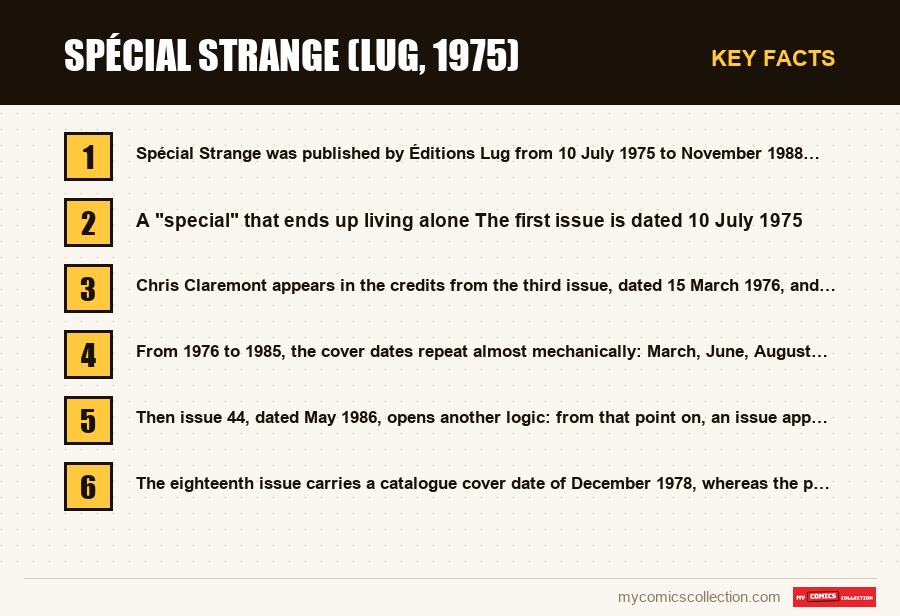
Spécial Strange was published by Éditions Lug from 10 July 1975 to November 1988, and stopped at its fifty-ninth issue. Its name suggests a special edition of the monthly Strange, but the credits recorded in the catalogue tell a different story: a stand-alone title, built around the mutant team written by Chris Claremont, which drops its loose quarterly rhythm along the way for a bimonthly schedule fixed to the month.
You have a pile of large-format Lug issues in a box, and the cover says "Spécial Strange" with no readable series number at first glance. The question that follows is always the same: is this a supplement to the monthly, and therefore an optional bonus, or a series in its own right that must be completed for its own sake? The answer changes everything about how you sort, how you hunt for the missing issues, and how you describe your copies if you ever sell them.
As always on this guide, only verified information (creators, issue numbers, dates) is stated as fact. The analysis is our own, with no reproduction of any panel or protected dialogue.
A "special" that ends up living alone
The first issue is dated 10 July 1975. The title the catalogue records for this inaugural issue, "Le Penseur Fou" (The Mad Thinker), has nothing mutant about it, and the credited writers are Gerry Conway, Len Wein and Steve Gerber. In other words, at the start the contents look like what a publisher puts into a filler format: an assembly, not an editorial line.
The shift can be read in a single name. Chris Claremont appears in the credits from the third issue, dated 15 March 1976, and then in those of every issue from the sixth to the last. Across the whole series, his name appears fifty-five times: no other writer comes close to that continuity. It is no longer a filler format, but a title tied to a single long-running American series.
The word "Spécial" therefore describes an origin, not a content. It says that a large format was launched alongside the monthly, with a different page count and price. It does not say that you hold a compilation of the parent magazine. For the collector, the consequence is clear: you do not complete Strange by completing this one, and the reverse is also true. They are two distinct lists of missing issues.
The rhythm: what the dates really reveal
Between launch and end, thirteen years and four months pass. A monthly would have published more than a hundred and fifty issues over that span; this one counts fifty-nine. That is the sign of a title conceived as a spaced-out appointment, and it explains why the most followed storylines reach readers with a delay the monthly never had.
The interesting detail is that this rhythm is not stable. From 1976 to 1985, the cover dates repeat almost mechanically: March, June, August, December. Four a year, but unevenly spaced, with two months between the second and third issues and four between the third and fourth. A quarterly on paper, an unsteady rhythm in practice.
Then issue 44, dated May 1986, opens another logic: from that point on, an issue appears every two months, in the odd months, and the regularity does not waver again until the end. This switch to a bimonthly is the most useful piece of information in the whole chronology: it tells you that the second half of the series was produced faster, that the copies from this period are statistically more numerous, and that the relative scarcity concentrates on the years of slow publication.
An aberrant date, and what it should teach you
One isolated case deserves mention because it traps automatic sorting. The eighteenth issue carries a catalogue cover date of December 1978, whereas the previous one is dated August 1979 and the next March 1980. The sequence does not hold: the issue clearly belongs at the end of 1979, in the place the quarterly rhythm of the time assigns to it.
What should you take from this? First, never sort a Lug series on the cover date alone. Second, use it as a safeguard when a seller describes a lot as "complete from one year to another": if the count of issues and the count of years do not match up, it is often an error of this kind, not an unknown edition. Finally, remember that French date listings for this period contain known errors, and that sources disagree on several of them.
In-house features, or why the contents are so hard to reconstruct
This is the most striking feature of this title, and it only shows up when you read the data line by line. Across a long block of the series, the title the catalogue associates with an issue is not a superhero episode: it is "Une source d'énergie : le Soleil" (A source of energy: the Sun), "La révolution chimique" (The chemical revolution), "Au Niger les peuls Bororos" (The Bororo Fulani in Niger), "Un four solaire dans votre cour" (A solar oven in your yard), "Terre de Feu archipel des naufragés" (Tierra del Fuego, archipelago of castaways), or simply "Mots croisés" (Crossword).
These entries are not errors. They flag the in-house editorial matter the publisher slotted between episodes: documentary pages, popular science, geography, games. The credits confirm their French origin, with names such as Yves Chantereau, Patricia Chantereau, Pascal Vanzato, Alain Moulet, Michel Morin or Emmanuel Menard, which sit in the same field as the American writers.
For you, this has two practical effects. First: an index that keeps only one title per issue may well give you a crossword where you were looking for an episode, which makes any title-based search unreliable on this series. Second: these feature pages were the first to be torn out or coloured in by children who handled the copies, and their absence is a real defect that shows in the page count.
The issues that matter in a collection
The first issue matters for what it is: the starting point, with its date of 10 July 1975 and a cover signed by Jean Frisano. Lug magazine launches were almost always printed and then kept in worse condition than what followed, because nobody yet knew the series would last.
Next come the changes of artist, which are the real structure of the series. Dave Cockrum holds the art credits on twenty-two issues, in discontinuous blocks, from No. 6 of December 1976 to No. 44 of May 1986. John Byrne holds them from 1979 to 1984. John Romita Jr. takes over from issue 47, dated November 1986, and stays to the final issues. Spotting these three turning points gives you a much more useful target list than a hunt for issue one.
Finally, three issues read together: the two parts announced as "Dans les profondeurs" (In the depths), plus the "congrès des couronnes" (congress of crowns) that concludes them, spread across issues 41 to 43. A serial story stretched over seven months of publication, at the time of the slow rhythm: exactly the kind of triptych that turns up broken up on the market, because the original buyer had not necessarily bought all three.
Do you collect this series?
Track what you own, what you are missing and what your collection is worth. 7-day trial.
Start my trial →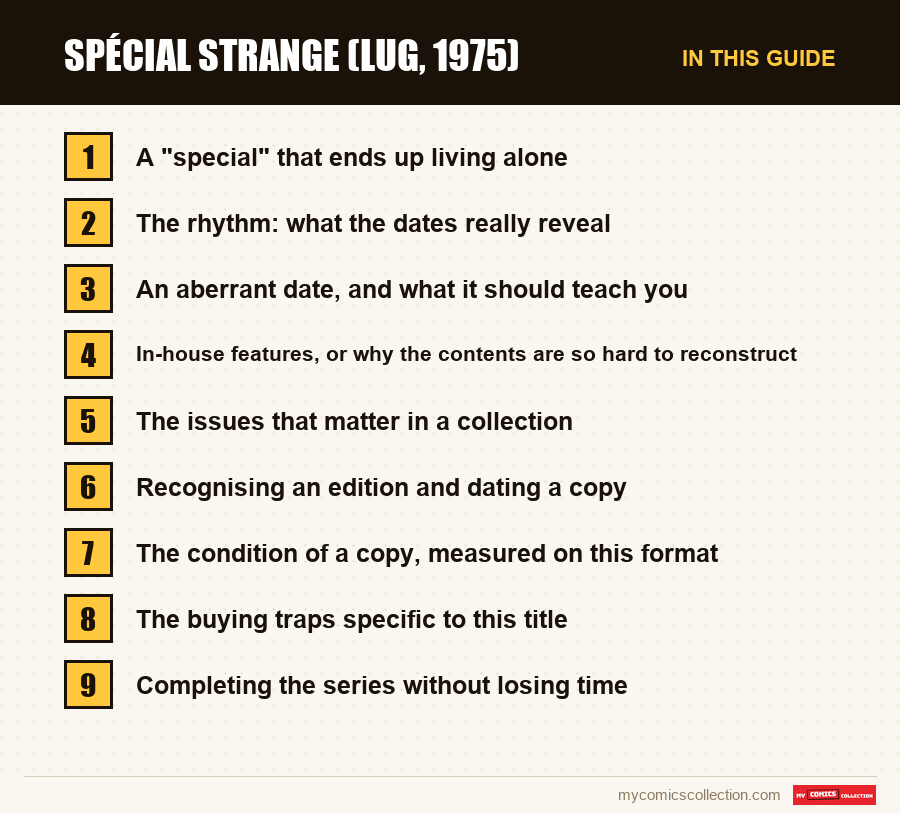
Recognising an edition and dating a copy
The cover dates of this series follow a mechanism that serves as an identification tool. For almost all of the first half, the day shown is the tenth of the month. Around the mid-1980s, a few issues switch to the fifth. Then, from No. 52 of September 1987, the day disappears entirely: only the month and year remain. If you hold a copy with no publication day, you are in the last dozen issues, which you can check in two seconds.
The second marker is the name of Jean Frisano, present in the art credits of fifty of the fifty-nine issues. His last mention falls on the January 1988 issue; the four final issues do without him, and Ciro Tota appears on the last two. A cover without his hand, on a copy that carries no day, is therefore necessarily late.
Third point: the hardbound collections that reprint contents from large formats do not have the same pagination and do not replace a newsstand issue in a followed series. Compare the page count before recording a copy.
The condition of a copy, measured on this format
On a large, paperback-bound format of this thickness, the defects are not those of a stapled American comic. The glued spine splits, and it splits first at the bottom, where the thumb presses when you hold the magazine open flat. Check the spine under raking light: a clean split, even a short one, changes the category in which you file the copy.
Next comes the interior block. Open at the middle and check that the central leaves are holding. On the issues where the catalogue notes a games feature, look at that page in particular: a crossword filled in with a pen is irreversible, and it is better to have noted it yourself than to have a buyer point it out. Finally, photograph the spine, the edge and all four corners, because yellowing shows on the edge before it shows when the copy is laid flat.
The buying traps specific to this title
The first trap is the namesake. Several titles from the publisher carry the word "Strange" in their name, and online listings constantly confuse them. Read the full logo, not just the first word. A lot advertised as "Strange complete" may perfectly well contain no issue of the series discussed here.
The second trap comes from listings built on the title of an episode. As we have seen, an index that keeps only one title per issue can present a documentary page or a games page as the content of the issue. A well-meaning seller who relied on such an index will describe a contents page that is not the one they have in hand. Ask for a photograph of the contents page rather than a copied list.
The third trap is the most costly: claiming that a French issue contains the first French appearance of a given character. The available data does not allow it, because it records only one entry per issue while these magazines published several episodes. A copy sold with that promise is priced above its value, and the check can only be done on the copy itself, contents page in hand. This caution is not a weakness of the guide: it is precisely what separates an informed collector from a buyer who repeats a listing.
Completing the series without losing time
Fifty-nine issues is a series you can finish, and that is its main appeal compared with the monthlies from the same house that run to hundreds of issues. The classic mistake is to start buying from the first issue. The right method is the reverse: first acquire lots from the bimonthly period, which are plentiful and therefore not much fought over, then hunt the rest down one copy at a time.
Draw up your list of missing issues by publication block rather than by isolated issue. The years with four issues a year fill slowly, the last years fill quickly. Knowing which block a missing issue falls in tells you whether to wait for an opportunity or grab the first one that comes along.
Value, and how to track it over time
No fixed value makes sense here. What drives the price gap, in order, is the integrity of the glued spine, the completeness of the interior block including the features, the position of the issue in the publication chronology, and finally the cover signature. A late copy in very fine condition and an old, worn copy can cross each other: age alone does not decide, it is the ratio between rarity of publication and condition that does.
The useful habit is to document your collection while you build it, not afterwards. For each copy: the issue number, the date read on the cover with its day if there is one, the name of the cover artist if it is legible, and three photos. The hubs devoted to the characters of the period, such as Jean Grey or Rogue, help place what you read within the American continuity, but the copy in your hand is the authority.
And there is the simple pleasure of the thing, which is after all the reason for the exercise. Thirteen years of publication, one writer present from beginning to end, three artists taking turns, and popular-science pages on geothermal energy wedged between two superhero episodes: this series tells as much about French publishing of its time as about the comics it translated. It is a coherent whole, and it looks good on a shelf.
Frequently asked questions
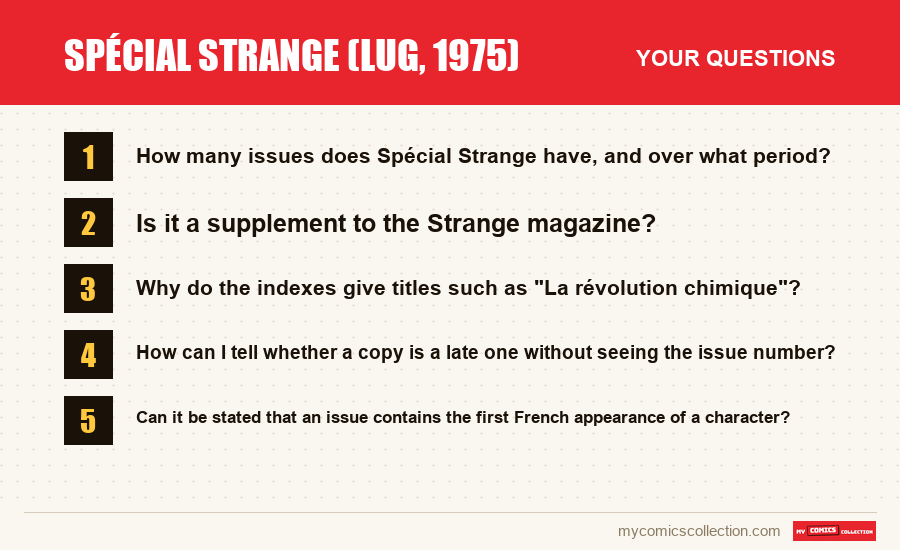
The series has fifty-nine issues. The first is dated 10 July 1975, the last November 1988, a span of thirteen years and four months. That is few issues for such a span, and it is explained by a quarterly rhythm during the first decade, before a switch to bimonthly towards the end.
The name suggests so, the data contradicts it. From the third issue, dated March 1976, a writer takes his place in the credits and stays to the end, which gives the title an editorial line of its own. Treat it as a stand-alone series: completing one does not complete the other, and the lists of missing issues are distinct.
Because the publisher slotted documentary pages and games between the episodes, and an index that keeps only one entry per issue sometimes lands on these features. The associated credits carry French signatures, which confirms their origin. The consequence: searching for an issue by episode title is unreliable on this series.
Look at the cover date. For a long time it shows an exact day, usually the tenth of the month. From the September 1987 issue onwards, the day disappears and only the month and year remain. A copy without a day therefore necessarily belongs to the last dozen issues.
No, not on the basis of the available listings. These magazines published several episodes per issue, and the catalogue records only one title: the full contents are missing. The only possible check is to open the copy and read its contents page. A listing that promises this exclusivity should be verified before it is paid for.