Quicksilver: French magazines contained series that never existed in the United States
A Quicksilver collector who follows the French trail comes across an object that does not resemble anything described in the American bases: a booklet which stacks several series in the same volume, some of which bear titles not found in the contents of publications across the Atlantic. The statement of August 30, 2026 on the French market (and therefore in euros, which changes from the statements in dollars usually published here) counts 177 advertisements for the query "Titans Lug Marvel", with a minimum of €2.90, a median of €9.90 and an isolated maximum of €79.90. None of these 177 announcements concerns a copy passed by an independent verification body. These amounts are those that sellers display on that date, not completed transactions, and a measurement taken on a single day says absolutely nothing about an increase or a decrease.
Most collection reasoning starts from an implicit postulate: each issue corresponds to a series, to each series a catalog, to each issue a line. This postulate holds as long as we remain in the American editorial area. It cracks as soon as you open a French magazine from the 1980s and 1990s. The labels noted on August 30, 2026 show this without needing to go further: the same ad cites three series for a single issue, another cites two, none of which corresponds to an American series identified in my report. The fascicle is not the translation of a fascicle; it is a container, and its content obeys a local editorial logic.
For those who follow Quicksilver, the consequence is concrete. The character circulates a lot, he belongs to several teams, he appears in a supporting role much more often than as a star. Looking for its appearances in a journal with multiple contents is like looking for a third of a volume, not a volume. And when part of this volume does not exist anywhere else, there is simply no American reference to which to attach the inventory line. It is this void of correspondence, more than the price, which makes these numbers unique.
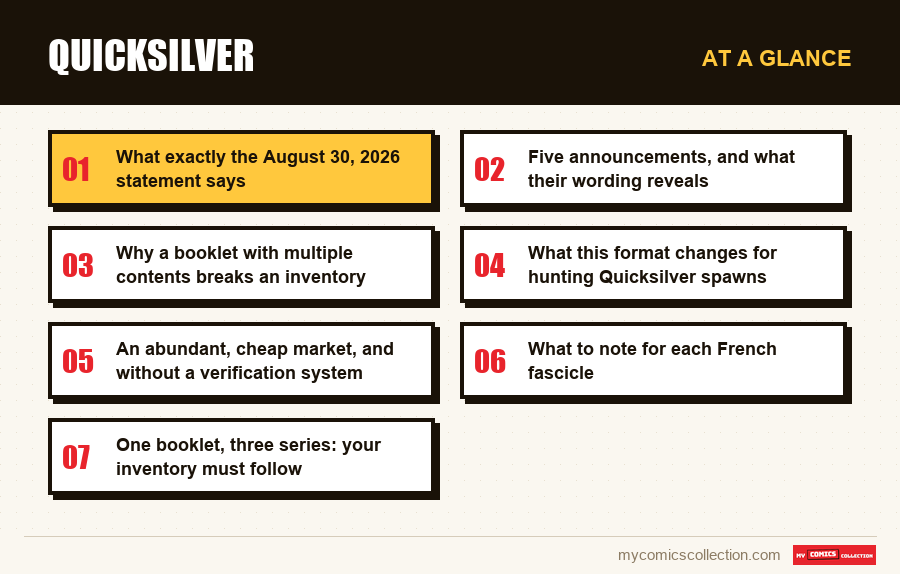
What exactly the August 30, 2026 statement says
The starting point is a single query, “Titans Lug Marvel”, queried on August 30, 2026 on the French market. It goes back to 177 advertisements. The distribution of amounts claimed ranges from €2.90 to €79.90, with a median of €9.90. This last figure is the only one that honestly describes the bulk of the offer: half of the ads ask for less, half ask for more. The maximum describes nothing other than the ambition of a seller; a price posted high by a single person is not a market level, it is a proposition waiting for a buyer.
It is necessary to emphasize a point that the statements on this site usually address in dollars. Here, everything is in euros, on French platforms, from French sellers, for objects printed in France. No conversion has been made and none would make sense: these booklets do not circulate on the American market, where they have no referenced equivalent. Comparing €9.90 to an American price would be like comparing two different objects.
Second point, the one that structures the rest of this article: out of 177 advertisements, zero concerns a copy verified by an independent organization. Not a single one. This is not a low number that we would hesitate to interpret, it is a total absence in a sample of correct size. Certification is a system built around the American booklet: its format, its pagination, its scale of references. She has never encountered these objects, and the French market apparently does not demand them.
Finally, a reminder of the method: these 177 lines are requests, not sales. No one paid €9.90. Someone wrote €9.90 in a form. And as the measurement was taken on a single date, it contains no information on a movement: neither increase, nor decline, nor stability. To speak of evolution, we would need at least a second survey, conducted in the same way, on another date.
Five announcements, and what their wording reveals
Titans n° 91, août 1986-2,90 €
The full wording is "TITANS N° 91 2086 EPSILON LUG MARVEL SUPER HEROS COLLECTION: AUGUST 1986". Two titles appear there in addition to the magazine itself, and neither corresponds to an American series identified in my statement. However, the seller mentions them as sales arguments, which presupposes a readership that recognizes them. This is the cheapest ad of the lot: €2.90 for a booklet of which part of the summary has no American anchorage.
Titans n° 174, 1993-3,00 €
“Titans n°174 (Warlock, Avengers, Excalibur): LUG 1993 - Marvel VF”. This time, the three series announced are indeed of American origin, including the team to which Quicksilver belonged. The issue illustrates the other side of the problem: even when all the content is translated, it remains divided into three summaries. A reader who buys this issue for the Avengers is also paying for two series they weren't looking for.
Titans n° 45-3,50 €
« TITANS, N° 45 - MARVEL COMICS, LUG », without mention of summary. The ad with the poorest information of the lot: it gives a number and a publisher, nothing about the content. For a collector who is tracking a specific character, this ad is unusable as it stands, and this is a common case when the seller does not know the details of what he is selling.
Titans n° 78 (1985) and n° 46 (1982): €3.50 and €3.90
These two announcements share almost identical wording: "MARVEL: LUG SUPER-HEROS", then a licensed science fiction series, then an additional title that is not American. Two issues separated by three years therefore display the same summary architecture. The formula was not a one-off accident, it was the format of the review.
Put end to end, these five labels reveal three titles which recur without corresponding to known American series in my survey. I stop at this observation: I see names mentioned by sellers, and I cannot find an American series opposite. I assert nothing further about their origin, their author or their editorial status: the statement does not allow this.
The useful conclusion is not “these series are French”, it is “these series cannot be referenced by American means”. The nuance looks scholastic; it is decisive for an inventory. In the first case, we are still looking for a line to check. In the second, we know that there will not be any and we describe the object differently.
This difference in posture avoids wasted hours querying a catalog which, by construction, will never contain the answer.
Why a booklet with multiple contents breaks an inventory
A comic inventory is based on a simple relationship: a physical object, an entry. The multiple summary booklet breaks this relationship in three places at once, and it is cumulative.
Which series should it be placed under?
Issue 174 contains three series. Classifying it under one of them is wrong two times out of three. Classifying it under three creates three entries for a single physical object, therefore three times the same item in the counters. Neither solution is satisfactory, and we must consciously choose which of the two errors we prefer.
Quelle date retenir ?
The review bears a French publication date: August 1986 for number 91. The stories it contains were published elsewhere on other dates, staggered. An inventory sorted chronologically will therefore mix two temporalities which do not overlap.
What is the title?
The title printed on the cover is that of the magazine, not that of the stories. Looking for a character by the cover title will never turn up anything. The summary must be indexed, which no automatic data provides for these objects.
Un objet, plusieurs collections
The same issue can legitimately belong to three different thematic collections. A collector who follows a character and another who follows a series will claim the same copy for opposite reasons.
The numbering does not refer to anything
Number 45, 46, 78, 91, 174 are French magazine numbers. They do not correspond to any American numbering and cannot be used as a reconciliation key. Building a correspondence on it would produce false equivalences.
Some of the content does not exist elsewhere
When a portion of the summary does not have an American equivalent, there is no sheet to import, no reference cover, no summary. This portion must be described by hand or remain undescribed.
These six frictions are not tooling defects that a better base would solve. They arise from the nature of the object. A review designed to offer several readings in the same volume cannot be reduced to one line, whatever the finesse of the catalog surveyed.
Collecting this series?
Track what you own, what you are missing and what your collection is worth. 7 day trial.
Start my trial →What this format changes for hunting Quicksilver spawns
Following a character who circulates between teams is already an exercise in attention. Quicksilver crosses several editorial contexts, and most of his appearances are in series in which he is not the star. This reality is documented on the American side, where l'histoire des Vengeurs et celle des X-Men constitute the two large reservoirs to explore.
Transposed to the French format, the difficulty multiplies. Issue 174 shows it: the Avengers are announced there in the middle of two other series. A collector who checks "appearance found" based on the wording does not know how many pages the character occupies, or even if he appears in the translated episode: the announcement cites the team, not its members. The sales wording is a clue, not proof.
The method that works is to reverse the usual order. Instead of starting from a list of apparitions and looking for the corresponding fascicles, we start from the available fascicles and document what they actually contain, once in hand. It's slower, and it's the only way to get reliable data when no source describes the summary for you. THE crossover episodes involving the character require the same discipline in their American version, for a similar reason: a story spread over several titles also resists classification by series.
One detail is worth noting in passing. The reasoning applies to any rapid character that we follow through fragmented summaries, and the reader who compares editorial traditions will find a useful ground for comparison on the side of l'histoire éditoriale de Flash, where the question of continuity between titles arises in other terms. But the French specificity remains intact: elsewhere, the content exists somewhere in another form. Here, a part only exists here.
An abundant, cheap market, and without a verification system
One hundred and seventy-seven ads for a simple query is a comfortable offer. At a median of €9.90, the financial obstacle is low: some issues cost less than a recent American issue. This combination (lots of supply, low prices) makes these magazines an accessible entry point into an editorial history that few collectors explore, without committing a significant amount of money.
The total absence of verified copies, however, changes the nature of the purchase. In an American market, certification plays several simultaneous roles: it authenticates, it notes the condition, and above all it standardizes the vocabulary between buyer and seller. None of this is available here. The condition advertised is that which the seller describes, with his own words and his own criteria. The photographs become the only objective source, and the questions asked before the purchase replace the seal.
This absence should not be read as a negative sign on the objects. It more simply reflects the fact that the verification system was designed for another market, another format and another reference scale. A booklet with multiple contents, part of the content of which is not referenced across the Atlantic, does not fit into a grid designed for a single title per volume. Zero out of 177 is not a statistical accident: it is the measure of structural incompatibility.
Practically, this shifts the verification work to the buyer. It is feasible precisely because the amounts are low: at this price level, errors cost little, and learning is done on real parts rather than on descriptions. The risk/price ratio clearly leans on the positive side, which is rarely the case when tackling a poorly documented segment.
What to note for each French fascicle
The complete list of series contained in the booklet. Not the first, not the one that interests you: all, in the order of the summary. Issue 174 contains three, issue 91 announces two in addition to the review. Without this list, you will never know, six months later, if you already have the episode you want in another ad.
Those which have no American equivalent. Explicitly mark them as such. These are the only pages in your collection that no database will be able to describe for you, and therefore the only ones that require a handwritten description from you. Distinguishing them from the rest saves you from endlessly searching for a file that doesn't exist.
The title and number of the French magazine. That is to say "Titans No. 91", and not the title of one of the stories it contains. This is the identifier that appears on the cover, the one that sellers use, and the only one that will allow you to find the same item in another ad or to check that you are not buying it twice.
L'éditeur et l'année. Lug for the five ads noted, with years ranging from 1982 to 1993 depending on the numbers. The year of the review is not that of stories; note it as the French publication date and keep it separate from any American dates you add elsewhere.
The price paid, shipping included. In a market where the median is €9.90 and the floor is €2.90, shipping costs often weigh as much as the item. A booklet for €2.90 shipped for €5 actually costs almost three times its displayed price. Recording only the ad price permanently distorts the value of your collection.
In practice, by reading the summary once the copy is in hand, then searching for each title on the American side. If no series matches, you are probably holding one of these contents. This is exactly the approach that I followed on the five labels noted: three titles appear there without any correspondence identified in my report, and I stick to this observation without extrapolating on their origin.
No, and that's important. The median describes all 177 advertisements for a general query, all numbers combined. It says nothing about the level expected for a specific number, for which the number of announcements would be much lower. On an isolated issue, with a handful of ads, no price level can be honestly established.
Because these objects do not circulate elsewhere. They were printed in France, sold in France, and the secondary market that trades them today is French. Converting the amounts to align with US statements would produce a comparison between two objects that have neither the same format nor the same content.
She needs to change her method, not worry him. Out of 177 announcements, none carries independent verification: the system was built for single American issues and does not apply to journals with multiple contents. The buyer therefore judges on photographs and on the seller's responses what the price level makes reasonable.
Absolutely not. Everything described here was observed on August 30, 2026, at one time. A photograph taken at a moment in time contains no direction. Furthermore, these are amounts claimed by sellers, not sales concluded: the gap between the two can be considerable, and nothing in this statement makes it possible to measure it.
One booklet, three series: your inventory must follow
Journals with multiple contents are exactly the case that issue lists cannot handle. Record each booklet with its complete summary, its unparalleled series, its publisher, its year and its price including shipping, and find in one search all the volumes where your character appears, even when he only occupies a third of the pages.