When a French ad specifies “kiosk edition”, it tells you something that the title and number do not say: this booklet circulated through a specific distribution channel, and there is therefore another version passed through another channel. The survey carried out on August 30, 2026 on the French market, in euros, revealed only one advert bearing this mention, at €3.00 (“ASTONISHING A single announcement allows absolutely no conclusions about a price level, and this article does not draw any. What it authorizes, on the other hand, is to name an identification variable that the French guides ignore: the distribution circuit.
The Sabretooth collector who buys in France quickly encounters an identification problem that the American market learned to formulate a long time ago and that the French market has never really codified. Two copies can bear the same publication title, the same number, the same date, the same content, and yet not be exactly the same subject. They are distinguished by the path they took to arrive in the hands of a reader. This path leaves marks on the item itself, and the best organized sellers mention this in their wording. Others don't talk about it: not because the distinction doesn't exist, but because they've never seen it named anywhere.
This article takes a deliberately modest statement and treats it for what it is. This is not a price statement: it is a vocabulary statement. What was measured on August 30, 2026, was the presence or absence of a mention in the ad descriptions, on the French market, with amounts expressed in euros: which changes from the usual American statements on this site, where everything is in dollars. This currency precision is not cosmetic: it prohibits any direct comparison with the figures that you will find in the other statements published here, and it must be kept in mind throughout the reading.
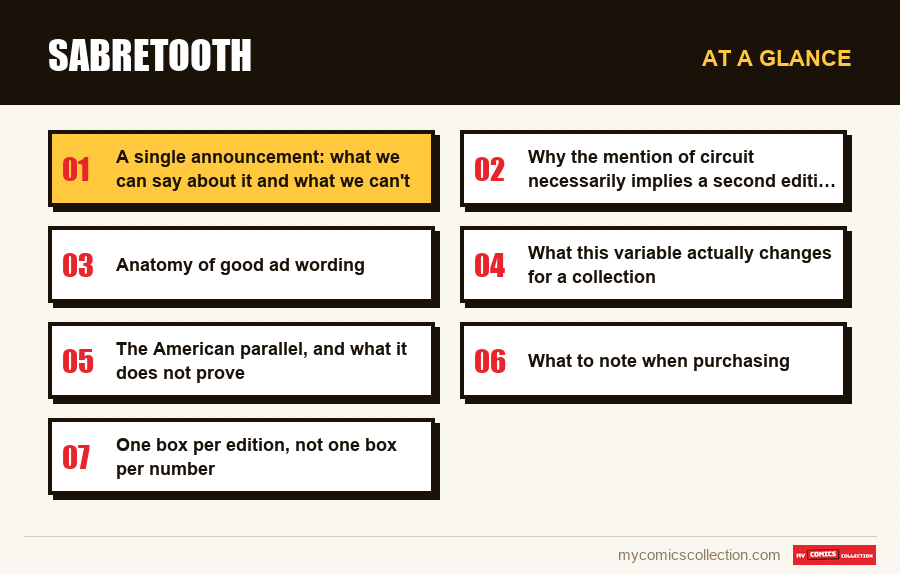
A single announcement: what we can say about it and what we can't
Let's start with the limit, because it governs everything else. The request for variants and cover mentions from the French publisher brought up an announcement. A. The amount claimed was €3.00, and a parallel search for verified copies turned up nothing at all. Under these conditions, claiming that “the newsstand edition is worth so much” or “negotiates less than the other” would be pure fabrication. A single amount does not draw a market, a gap, or a trend: it indicates the price a seller hoped to obtain on a given day, which is not the same as a completed transaction. And as the reading was taken on a single date, it does not show any movement, either upwards or downwards.
We must therefore say things frankly: this article describes a variable, it does not quantify it. This is precisely the point of the exercise. Data that is too meager to support a price conclusion may remain perfectly sufficient to support a vocabulary conclusion. No one needs a hundred announcements to establish that a word exists and means something. You only need one, provided you only ask her for what she can give.
Why the mention of circuit necessarily implies a second edition
A qualifier does not qualify anything if it is unique
Specifying the distribution channel of a booklet only makes sense if there are at least two. No one writes “newsstand edition” for an object for which that is the only possible form: the mention would be redundant and the seller would not waste characters typing it. Its presence is therefore sufficient to establish that another edition of the same issue existed, intended for another sales network.
It's an identification variable, not a sales argument
The distinction says nothing about rarity or value: the survey allows for neither. She says that two objects deemed identical are not completely identical, and that they must therefore be described separately. This is exactly the role of an identification variable: to decide between two candidates whose title and number leave them tied.
The US market formalized the same earlier
The same day, on the American side, the mention designating one of the two distribution circuits appeared in several statements, on issues from 1978, 1981, 1988 and 1992. The vocabulary has therefore been established there for a long time and covers several decades of publication. What France calls differently, it also knows.
None of these statements quantify the difference
It must be repeated, including on the American side: the presence of the mention in several advertisements did not make it possible to isolate any price difference between the two circuits. The vocabulary is documented, the pricing consequence is not. Confusing the two would be exactly the mistake that this statement invites us not to make.
The logic is in one sentence, and it does not require any additional data: we only name a circuit if there is a choice. The whole value of the mention is there. It doesn't tell you about the price, it tells you about the existence of a twin brother. And an unidentified twin brother, in a collection, is an unknown duplicate or a box that remains empty when we thought it was filled.
The question to ask the seller is short and can be answered by looking at the object: from which circuit does this item come? It requires no expertise, no equipment, no prior research: just that someone has the booklet in hand.
It separates two editions that nothing else distinguishes in a classic announcement. Until it's asked, a title and a number describe two items at once, and you don't know which one you're buying.
Anatomy of good ad wording
The announcement noted deserves to be looked at for its form as much as for its content. In one line, it stacks five distinct pieces of information, which is well above the average of what we read on the French market. Each of these five pieces of information answers a different question asked by the buyer, and together they allow the object to be recognized without having to write to the seller. This is what distinguishes an actionable ad from one that requires you to negotiate before you even know what you're looking at.
The title of the publication
The name of the magazine or collection in which the story was published in France. This is the entry point for any search, and it is also what is most often missing when an ad simply names a character.
Publication date
Here a month and a year. It serves as an arbiter when the same title has been relaunched under a numbering that starts again, a common situation in French comic publishing and a classic source of confusion between two homonymous issues.
La mention de circuit
Indication of the distribution channel. This is the variable that concerns us: it separates two editions of the same issue and only appears in a minority of announcements, although it potentially applies to many issues.
The declared state
Expressed in abbreviation according to French usage. It is a declaration by the seller, not a third-party evaluation: it establishes an intention rather than guaranteeing a result, and it requires confirmation by photographs.
The issue number
The basic coordinate, the one without which nothing is identifiable. It is almost always present, but it is never enough alone: this is precisely why the other four pieces of information count.
The episode title and its rank in the arc
The name of the story, followed in parentheses by its position in the following. This parenthetical immediately tells you where you are in the story: information that American covers don't carry.
This little number in parentheses is worth paying attention to. It transforms an isolated fascicle into a recognizable fragment of a whole. Without it, the buyer who comes across a random number does not know whether he is catching a beginning, a middle or an end, and he often discovers afterwards that he is missing the framing episodes. With him, the question is resolved in a second. This is a French editorial convenience which has no systematic equivalent on the other side of the Atlantic, and it makes the reconstruction of an arc clearly simpler than it is on the original market: a point which is equally valid for the long periods X-Men only for solo series.
Collecting this series?
Track what you own, what you are missing and what your collection is worth. 7 day trial.
Start my trial →What this variable actually changes for a collection
A personal catalog that records only the title and number treats two different objects as one. As long as the collection remains small, it doesn't show. The problem appears at the time of resale, insurance, donation, or simply verification: you think you own one box, and you own another, or both, or only one of the two without knowing which one. The circuit mention, when it is available, resolves this vagueness for no registration cost: you just have to copy it when you enter the purchase.
The Sabretooth case illustrates the mechanism well, because the character has circulated in many different French publications over the decades, often as a guest rather than a headliner. The same episode could therefore have been available in several forms, and the collector who reconstructs a reading journey finds himself choosing between copies that nothing distinguishes in the advertisements. This is exactly the ground where an additional identifying variable makes the difference between a reliable list and an approximate list.
We must resist the temptation to deduce a purchasing strategy from this. Nothing in this statement says that one circuit is rarer, more sought after or more expensive than the other. A single ad, no verified copy: these are the typical conditions under which no conclusion is reached. The right posture consists of recording information without giving it value, then letting it accumulate. The day when the number of observations allows it, the question of price can be asked. Today she can't.
This caution is not theoretical. Many unfortunate purchasing decisions come from conclusions drawn from a sample of one or two ads, then generalized into a rule. The useful reflex is to count the observations before believing what they seem to say, and to consider that below ten, we are describing an isolated case and not a market. It is a habit that protects the one who buys as well au meilleur prix possible than the one who sells.
The American parallel, and what it does not prove
The comparison carried out on the same day on the American market provides useful insight, provided you read it for what it is. The mention designating one of the two American distribution circuits appeared in several statements, relating to issues from 1978, 1981, 1988 and 1992. The spread of these years is in itself information: the vocabulary is not a recent fashion phenomenon, it accompanies several generations of publications. Sellers use it spontaneously, which implies that it is part of the everyday language of this market.
But none of these surveys made it possible to isolate the price difference between the two circuits. They establish the existence and age of a distinction, not its economic consequence. This is a nuance that must be held firmly, because the opposite temptation is strong: noticing that a word comes up often and concluding that it weighs on the amounts. The first observation is documented, the second is not.
What the parallel establishes above all is that France has nothing exotic in this matter. It too has its multiple channels for the same number, it too has sellers who point it out, it simply has not installed it as a reference category in its descriptive works. The difference is one of codification, not of nature. This kind of gap between what the market knows and what the guides write is found elsewhere, notably on the most republished publications, where the number of forms that a single story took eventually exceeded what a standard entry could describe.
What to note when purchasing
The distribution circuit, when it is mentioned. Copy the statement as it appears in the ad, without translating or standardizing it. It will remind you later that another edition of the same issue exists, and it will prevent you from accidentally repurchasing a copy that you think is missing. If the advert says nothing, note the absence: it is better than an empty box which suggests you forgot to type.
The rank in the arc, as indicated in parentheses. This is the information that will tell you, in six months, whether you are missing the episode before or the one after. Without it, you will have to rebuild the reading order from scratch each time you check. With it, the list of holes can be read at a glance, and subsequent purchases can be planned without prior research.
The title of the episode. It is distinct from the title of the publication and serves as a search key when the numbering becomes ambiguous: a frequent case when a title has been relaunched or when the same story has been taken up elsewhere. This is often the only element that makes it possible to recognize content already possessed under another editorial style.
The title of the publication and its number. Together, and never one without the other. The number alone means nothing apart from its title, and the title alone does not locate anything. It is the basis of identification, the one from which all other information removes the remaining ambiguities.
The price paid, shipping included. Record the amount actually paid, including shipping, and not the displayed price. This is the only honest basis for later evaluating what your set cost you, and it is also what will allow you to compare purchases made under very different shipping conditions. On the French market, where the amounts are in euros, this detail often changes the classification of two apparently equivalent offers.
This indicates the channel through which the booklet was distributed. The mention would have no use if there was only one channel: its presence therefore establishes that another edition of the same issue circulated via another route. This is all that we can deduce with certainty, and it is already an identification variable which does not appear anywhere in the French guides.
The statement of August 30, 2026 does not allow us to say this, and this article therefore does not say it. Only one advertisement bearing the mention was found on the French market, at €3.00, without any copy verified in parallel. On the American side, the equivalent mention appeared in several statements without any price difference between the two circuits being able to be isolated. The question remains open.
Because the reading was carried out on the French market, unlike the usual American readings on this site which are expressed in dollars. This currency difference prohibits any direct comparison with the other figures published here. Furthermore, these are amounts claimed by sellers on a given date, not concluded transactions.
By asking the seller. The question is answered by looking at the object, without expertise or special equipment, and it only costs one message. If the seller does not know how to answer, ask for clear photographs of the entire cover: this is the only way to decide from a distance between two editions that the title and number leave equal.
For a price, no, and it must be said bluntly: below ten observations, we are describing an isolated case and not a market. For a fact of vocabulary, on the other hand, yes: it is enough for a mention to exist and be used by a seller to establish that the distinction it designates is real. This is the only thing this survey demonstrates, and it is the only thing this article affirms.
One box per edition, not one box per number
As long as your inventory only retains the title and number, two different editions occupy the same line and you do not know which one you own. Record the route, the rank in the arc and the price including shipping upon purchase: these three fields are enough to make a list verifiable, and they cost nothing to enter at the time.