
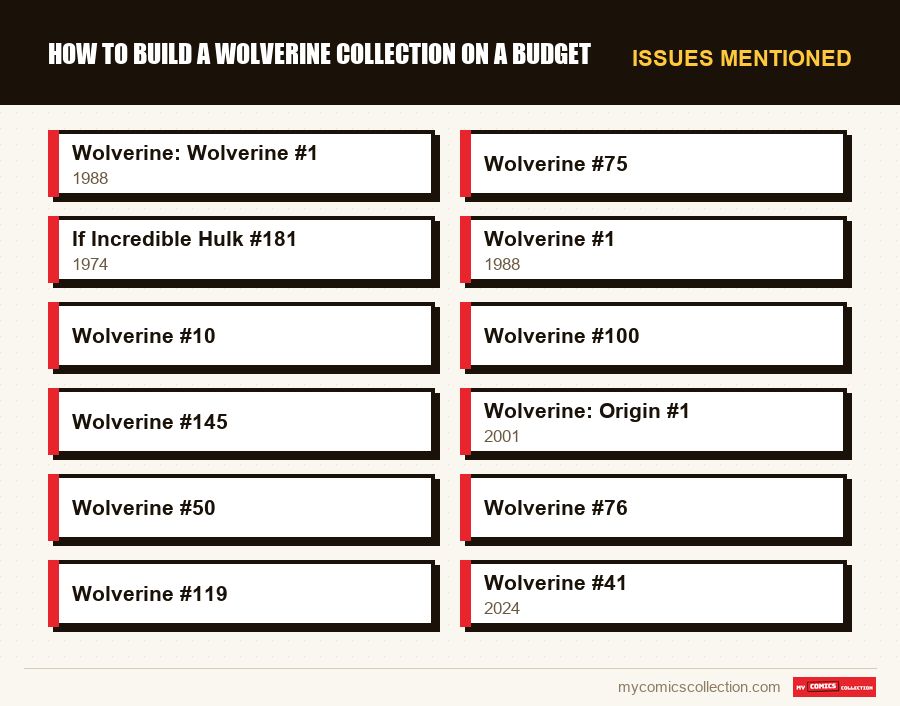
The best budget entry points for Wolverine: Wolverine #1 (1988, ongoing series, €10-20), Wolverine #75 (adamantium-free bones, €5-12), and the post-#100 run at €1-3 per issue. Logan's solo catalog is immense and most of the run is accessible under €5.
Wolverine is one of the most popular Marvel characters, with a solo series that has exceeded 300 issues (vol. 1 alone) plus dozens of miniseries and spinoff series. Despite this popularity, the market for Wolverine back issues is very favorable to the budget collector: print runs were massive in the 90s and supply far exceeds demand for current issues.
If Incredible Hulk #181 (first complete appearance, 1974) reaches thousands of euros, the solo series launched in 1988 and its sequels offer hundreds of accessible issues. Here's how to build an impressive Wolverine collection without blowing your budget.
Affordable Wolverine key issues
The 1982 Wolverine miniseries (Claremont/Miller, 4 issues) and key spinoffs from the ongoing series offer excellent historical entry points without reaching the prohibitive prices of early X-Men appearances.
Key numbers under €25
- Wolverine #1 (1988, ongoing series): €10-20 in mid-grade (Buscema coverage)
- Wolverine #10 (first Sabretooth in the solo series): €8-15
- Wolverine #75 (adamantium torn off by Magneto): €5-12
- Wolverine #100 (holographic cover): €5-12
- Wolverine #145 (return of adamantium): €5-10
- Wolverine: Origin #1 (2001, true origin revealed): €8-15
Find our complete guide to Wolverine key numbers for all the early appearances and defining moments of Logan's career.
Underrated Runs to Grab
Larry Hama's initial run (#31-118) is considered definitive for the character, but current issues from this period can still be found at very low prices. Only a few key issues exceed €10.
Particularly accessible periods
- Wolverine #50-74 (Larry Hama, pre-Fatal Attractions): €2-5 per issue
- Wolverine #76-118 (bone claws period): €1-3 per issue
- Wolverine #119-189 (end of vol. 1): €1-3 per issue
- Wolverine vol. 3 #1-74 (2003-2010, Millar then Aaron): €2-5 per current issue
Underrated miniseries
- Wolverine/Gambit: Victims (1995, 4 issues): complete series €8-12
- Wolverine: The End (2004, 6 issues): complete series €10-15
- Wolverine MAX (2012-2014, 15 issues): €2-3 per issue
Where to find Wolverine cheap in France
Wolverine has been widely published in French (Semic, Panini) and back issues VO are among the most common in convention bins. The available stock is considerable.
- Agreements: the €1-2 bins are full of Wolverine vol. 1
- eBay.com: lots of 20-30 VO numbers under €30, very common
- Flea markets: Semic/Panini magazines with Wolverine at €1-3
- Mile High Comics: frequent promotions on the Wolverine run
Budget strategy for Wolverine
The volume of Wolverine material is overwhelming (main series + X-Men + mini-series + teams). The key is to define a clear scope before you start buying.
Advice : Start with the Larry Hama run (#31-118) which is the narrative backbone of the solo character. Common issues cost €1-3, or a full run for around €100-150. Then add the Claremont/Miller mini-series (1982, 4 issues, €30-50 per set) for the origins of the modern Wolverine.
Modern keys Wolverine under €20
- Wolverine vol. 7 #1 (2020, Benjamin Percy): €5-10
- X Lives of Wolverine #1 (2022): €4-8
- X Deaths of Wolverine #1 (2022): €4-8
- Wolverine #41 (2024)(Sabretooth War): €4-8
- All-New Wolverine #1 (2015, Laura Kinney/X-23): €10-18
All-New Wolverine #1 (Laura Kinney takes up the mantle) is a modern key that risks increasing in value with the growing interest in legacy characters. To grab while it remains under €20.
Buying a Wolverine lot well: method and warning signs
With a catalogue this large, the best saving comes from method, not only from the price per issue. Before the first purchase, set a scope: for example Larry Hama's run (#31-118), the 1982 mini-series by Claremont and Miller, then Wolverine: Origin #1. These three cover most of the character's origins and narrative backbone, and they keep you from scattering across spin-offs.
Check the condition before paying
On common issues, condition is the difference between a copy that will resell and one that stays in a box. Examine the spine (white creases, splits), the corners, the staples (rust) and the yellowing of the pages. Ask for photos of the spine and of the inside cover, not only the front. For Wolverine #100, the holographic cover must be inspected from several angles: a scratched or lifting film shows immediately in the light.
Newsstand and direct editions
For the 1980s and 1990s, the same issue exists in two versions: the newsstand edition (with a barcode) and the direct edition (with a box in its place). They are not always valued the same way, and it helps to know which one you are buying, especially if you aim for a uniform complete run. Get in the habit of checking the upper left corner of the cover before you commit.
Lots: useful checks
- Count the issues and compare them to the announced list: a lot of thirty issues with five duplicates only fills twenty-five gaps.
- Check that all issues belong to the same series and the same volume: Wolverine volumes look very much alike.
- Look for issues that came with an insert or a card, which are sometimes missing from lots.
- Avoid lots where most issues have detached covers: restoration costs more than buying a clean copy.
Original or French edition?
The French editions published by Semic and then Panini are ideal for reading the story cheaply, but they often gather several original issues into a single booklet. For an issue-by-issue collection, the original English edition remains the reference, because each box on your want list corresponds to a precise issue. A good compromise is to buy the French edition to read and the original only for the key issues listed above.
Store and track
Put each issue in a suitable bag and board, flat or slightly inclined, away from direct light. Note the condition, the version (newsstand or direct) and the series as you go. An up-to-date want list avoids the most common trap for Wolverine collectors: buying an issue you already own.
Frequently asked questions
Wolverine #1 from 1988 is the logical entry point, followed by Larry Hama's run (#31-118), whose common issues remain very affordable. Then add the 1982 Claremont and Miller mini-series for the character's origins.
Wolverine #10 (first Sabretooth in the solo series), #75 (adamantium ripped out by Magneto), #100 (holographic cover) and #145 (the adamantium returns) are among the most accessible landmarks. Wolverine: Origin #1 (2001) is also a must.
Yes, several are undervalued: Wolverine/Gambit: Victims (1995), Wolverine: The End (2004) and Wolverine MAX (2012-2014). They offer complete stories in few issues.
Conventions, with their bins of common issues, and flea markets, where Semic and Panini magazines turn up, are the best sources. Lots of original-language issues are also very common, because supply far exceeds demand.
All-New Wolverine #1 (2015, Laura Kinney) is the most cited, as interest in legacy characters is growing. Wolverine vol. 7 #1 (2020), X Lives of Wolverine #1 and X Deaths of Wolverine #1 (2022) deserve a look too.
Tame the Wolverine catalog
With over 600 issues between the main series and spin-offs, tracking is a daunting challenge. My Comics Collection organizes everything and shows you your missing items by series.
🚀 Free trial 7 days, No obligation