
Key issues from the Wolverine solo series include #1 from 1988 (valued between $150 and $2,500 depending on CGC grade), the legendary #10 featuring Sabretooth (up to $800 in 9.8), and the #50 die-cut which reaches $300 in high condition.
Wolverine is one of the most collected Marvel characters since the late 1980s. His ongoing solo series, launched in November 1988 by Chris Claremont and John Buscema, produced over 180 issues and some of the most sought-after key issues on the modern market. Whether you are a beginner collector or an experienced investor, knowing the key issues from this series is essential to building a cohesive and valuable collection.
This guide details the essential issues from the Wolverine solo series, with their current market values, narrative significance, and investment potential. From the first mini-series in 1982 to the 1988 ongoing series, each key issue is analyzed to help you prioritize your purchases and understand market dynamics.
Wolverine #1 (1988). The launch of the ongoing series
Published in November 1988, Wolverine #1 marks the beginning of the character's first ongoing solo series. Written by Chris Claremont with art by John Buscema, this issue features Logan in Madripoor in an adventure that established the mature tone of the series. The iconic cover shows Wolverine with claws out against a black background.
In terms of market value, a CGC 9.8 copy trades between $2,000 and $2,500 in 2025. A 9.6 grade hovers around $600 to $800, while a 9.4 remains accessible between $250 and $350. The high print run of this issue (estimated at over 500,000 copies) makes grades below 9.0 relatively affordable, often under $100.
The CGC census shows approximately 4,200 graded copies, with only 850 in 9.8. The relative scarcity of perfect grades maintains a significant premium for high-quality copies.
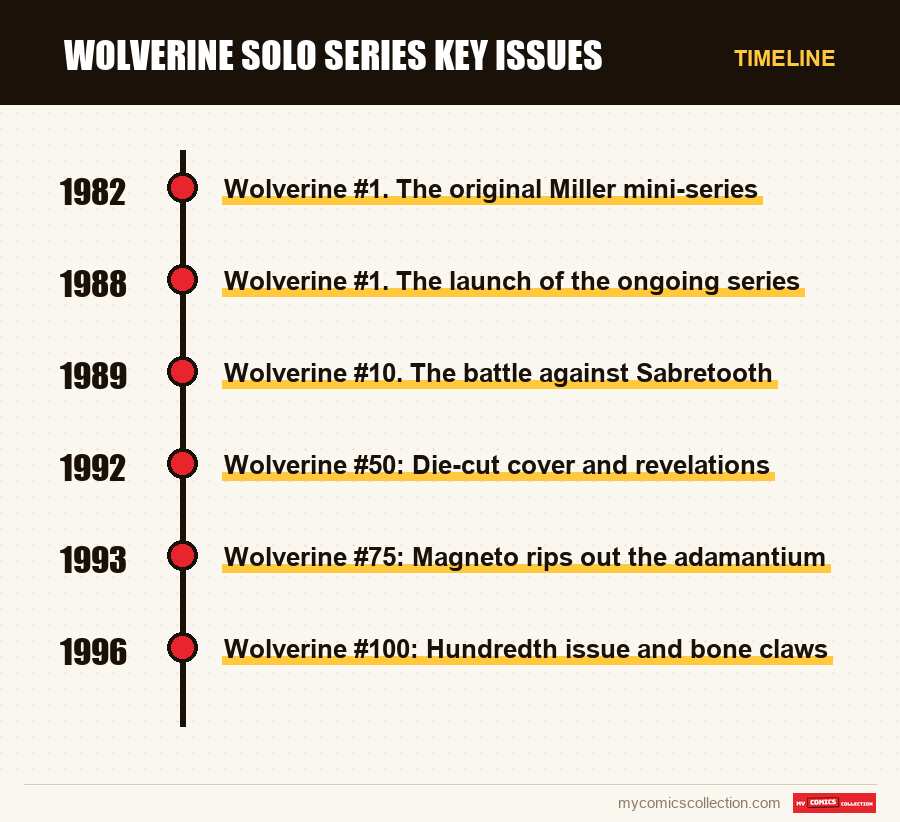
Wolverine #10 (1989). The battle against Sabretooth
Wolverine #10, published in August 1989, is considered one of the best Wolverine vs Sabretooth confrontations ever drawn. This classic issue illustrates the brutal rivalry between the two mutants and remains a collector favorite for its narrative and visual intensity. The script is by Chris Claremont, with Bill Sienkiewicz on art.
The current value of a CGC 9.8 sits around $700 to $900. Copies in 9.6 can be found between $200 and $300, and a 9.4 remains very accessible at $80-120. This issue is particularly sought after by thematic collectors targeting the Wolverine/Sabretooth rivalry.
Why is this issue special?
Beyond the physical confrontation, #10 explores Logan's psychology as he faces his sworn enemy. It is a pivotal issue that establishes Sabretooth as Wolverine's ultimate nemesis, a status that would endure for decades in Marvel continuity.
Wolverine #50 (1992): Die-cut cover and revelations
The anniversary issue Wolverine #50, published in January 1992, is famous for its die-cut cover that reveals an interior image. Written by Larry Hama with art by Marc Silvestri, this issue explores Wolverine's implanted memories and his past with the Weapon X program.
A CGC 9.8 copy sells for between $250 and $350 currently. The die-cut cover makes grading tricky: the cutouts are fragile and often damaged, which makes copies in perfect condition scarce. A 9.6 runs around $100-150.
Wolverine #75 (1993): Magneto rips out the adamantium
Wolverine #75 is a major event in the character's history: Magneto violently rips the adamantium from Logan's skeleton during the Fatal Attractions crossover. This traumatic moment redefined the character for the following years. The holographic cover of this issue (November 1993) makes it a prized collectible.
CGC 9.8 copies reach $200 to $300. The main challenge is the holographic cover which scratches easily, making high grades relatively rare. Approximately 1,800 copies are listed in the CGC census, with only 450 in 9.8.
Wolverine #100 (1996): Hundredth issue and bone claws
Wolverine #100, published in April 1996, celebrates the hundredth issue with a chrome cover. This issue marks the return of adamantium to Logan's skeleton after three years without it. Larry Hama's script concludes a major story arc that began in #75.
The value of a CGC 9.8 ranges between $150 and $250. This issue exists in several cover variants (standard chrome and holographic), with the holographic version commanding a premium of approximately 30% over the standard version.
Wolverine #1 (1982). The original Miller mini-series
Although technically a mini-series (Limited Series) and not the ongoing series, the Wolverine #1 from September 1982 deserves its place here as the absolute starting point of the character's solo career. Written by Chris Claremont and drawn by Frank Miller, this issue transformed Wolverine from a simple member of the X-Men into a hero in his own right.
A CGC 9.8 copy trades between $3,500 and $5,000 based on recent sales. In 9.6, expect $800 to $1,200. In 9.4, prices are more accessible at $400-600. This issue is often considered the true entry point for any serious Wolverine collection.
Investment guide by budget
For a budget under $200, target #50, #75 and #100 in grade 9.4 or below. These anniversary issues offer excellent value for money and good diversification. For a budget of $500 to $1,000, #10 in 9.8 or #1 (1988) in 9.4-9.6 represent solid acquisitions. Above $2,000, #1 (1982) in 9.6+ or #1 (1988) in 9.8 are the priority targets.
Tips for grading and protecting your copies
Wolverine issues from 1988-1996 often feature special covers (die-cut, holographic, chrome) that are fragile. Handle them with cotton gloves and store them vertically in bags with acid-free boards. For copies worth more than $300, CGC or CBCS grading is strongly recommended to secure and authenticate your investment.
Issues with holographic covers (such as #75) must be protected from direct sunlight which can tarnish the holographic effect and reduce the potential grade. Use opaque storage boxes for long-term preservation.
Own Wolverine comics? Estimate the value of your collection for free to find out their current market prices.
Frequently asked questions
In November 1988, with Wolverine #1 by Chris Claremont and John Buscema, which presents Logan in Madripoor. The series passed 180 issues, after a first miniseries in 1982.
Its print run is very high, estimated at more than 500,000 copies. Only the very highest grades keep a premium, since perfection remains relatively rare in the census.
It features the fight against Sabretooth, considered one of the best clashes between the two mutants. It establishes Sabretooth as Wolverine's ultimate nemesis, a status that has lasted for decades.
The anniversary issue of January 1992, by Larry Hama and Marc Silvestri, explores Wolverine's implanted memories and the Weapon X program. Its die-cut cover is fragile: the cutouts are often damaged, which makes perfect copies scarce.
In the Fatal Attractions crossover (1993), Magneto rips the adamantium from Logan's skeleton. That traumatic moment redefined the character.