The Shazam comics history starts with Billy Batson, a young orphan who says a magic word and turns into an adult hero. He first appears in Whiz Comics #2, cover-dated February 1940, from Fawcett, written by Bill Parker and drawn by C. C. Beck, under the name Captain Marvel. DC took the character over in 1972, then renamed him Shazam in 2012. Today he is defined as a kid in a giant's body, surrounded by a family of heroes.
Few characters have changed names, publishers, and tone as often as Billy Batson. This page follows his life from 1940 to today, era by era, so you know which Shazam you are holding when you open a single issue.
As always in this guide, only verified facts (creators, issues, dates) are stated as fact; the analysis is ours, with no reproduction of protected panels or dialogue.
His first appearance
In 1939, Fawcett Comics is looking for a hero for its new anthology. Bill Parker writes and C. C. Beck draws a boy, Billy Batson, to whom an old wizard, the sorcerer Shazam, hands the power to become Captain Marvel. The story runs in Whiz Comics #2, whose cover is dated February 1940. Dr. Sivana, an ambitious scientist, shows up right in this debut and will become a lifelong enemy.
The premise is so simple that it explains the success: the kid does not need to grow up to act, he only needs one word. Where other heroes rest on a loss or a destroyed planet, Billy rests on an exchange with a kindly adult. That choice gives the character his tone, light without being silly, which every modern retelling tries either to recapture or to contradict.
For the collector, Whiz Comics #2 belongs to the most demanding corner of the Golden Age: rare copies, frequent restoration, plenty of reprints. Before hunting for this issue, browse our Golden Age collecting guide, which covers the pitfalls of this segment.
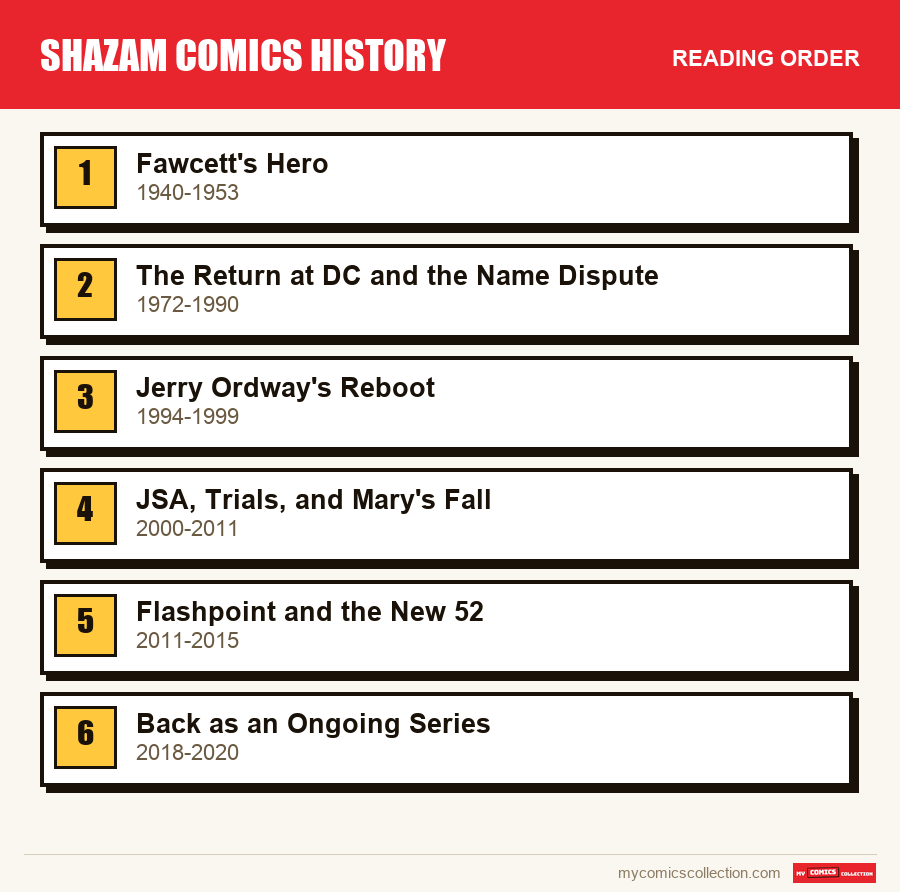
Era 1: Fawcett's Hero (1940-1953)
Captain Marvel quickly takes off. The hero gets his own series in March 1941: Captain Marvel Adventures #1 is the work of Joe Simon and Jack Kirby. Otto Binder then becomes the chief architect of the universe, with C. C. Beck on the definitive art. During this period the character outsells Superman, which explains what follows.
The family is built piece by piece. Mary Marvel arrives in Captain Marvel Adventures #18, dated December 1942. The Monster Society of Evil serial, written by Binder, starts in #22 and runs through #46; its leader, Mister Mind, a telepathic worm, finally shows himself in #26. That serial remains, decades later, the benchmark for the Fawcett tone. In 1945, Binder and Beck also invent a rival with the same powers: Black Adam debuts in The Marvel Family #1.
Superman's publisher sues Fawcett as early as 1941, arguing that the character copies its own. After a 1952 ruling that sends the case back to trial, Fawcett settles on August 14, 1953: it stops publishing the characters. The series ends with issue 150, in November 1953. The hero vanishes from newsstands for almost twenty years.
Era 2: The Return at DC and the Name Dispute (1972-1990)
On June 16, 1972, DC obtains a license to use the Fawcett characters. The new title arrives with an issue #1 dated February 1973 and is called Shazam!, because Marvel has meanwhile taken the Captain Marvel trademark for another hero. That is the origin of a confusion that still lasts: the character is Captain Marvel in his story, but Shazam on the cover.
Denny O'Neil is the main writer of the launch, later joined by Elliot S. Maggin and E. Nelson Bridwell. C. C. Beck, who had created the look thirty years earlier, draws the first ten issues; Bob Oksner and Kurt Schaffenberger take over afterward. A subtitle, "The Original Captain Marvel," is blocked by a cease-and-desist letter, and starting with #15, in December 1974, the cover adopts the line "The World's Mightiest Mortal."
In 1987, Shazam!: The New Beginning, a four-issue miniseries by Roy and Dann Thomas, drawn by Tom Mandrake, attempts a first reboot across the DC universe. It sets up the next one, which is more decisive: Jerry Ordway's. For collectors, this era offers affordable Bronze Age single issues, a reminder that the paper hero survived the editorial silence.
Era 3: Jerry Ordway's Reboot (1994-1999)
In 1994, Jerry Ordway writes and paints a 96-page graphic novel, The Power of Shazam!, which wins a Comics Buyer's Guide fan award for best original graphic novel of the year. The regular series follows in March 1995 and ends with issue 47, in March 1999. Ordway writes every story; Peter Krause, Mike Manley, and Dick Giordano take turns on art.
The origin story gets darker without losing its tenderness. Billy's archaeologist parents are murdered in Egypt by Theo Adam, who kidnaps Mary, and the orphan is left to fend for himself in Fawcett City, where he survives by selling newspapers. The wizard then entrusts him with his role. Mary returns as an adult, and Captain Marvel Jr. is renamed "CM3."
Black Adam reappears in the present day: he learns that he is the reincarnation of Teth-Adam, seizes the scarab in Sivana's trophy room, then is defeated and stripped of his voice and his memories. This version gives the villain a depth that explains his presence in nearly every adaptation. The collected editions of this period let you read it without hunting for the 1995 single issues.
Era 4: JSA, Trials, and Mary's Fall (2000-2011)
In the 2000s, the hero moves to the background of his own mythology. In JSA, a series by Geoff Johns and David S. Goyer, Black Adam becomes a central character and Captain Marvel briefly joins the team.
The twelve-issue maxiseries The Trials of Shazam! (2006-2008) is written by Judd Winick. Howard Porter draws the first eight issues, Mauro Cascioli the last four. Heads up, spoiler: Captain Marvel takes the wizard's place there and Freddy Freeman becomes "Shazam." This swap explains why the single issues of the period carry names the public does not recognize.
In Final Crisis (2008-2009), Mary Marvel, possessed by DeSaad, becomes an adversary. For a collection, these series form a coherent block but one far from the general public's idea of the hero. They mostly interest the reader who wants to follow the Marvel Family through the contemporary DC universe.
Do you collect this series?
Track what you own, what you are missing and what your collection is worth. 7-day trial.
Start my trial →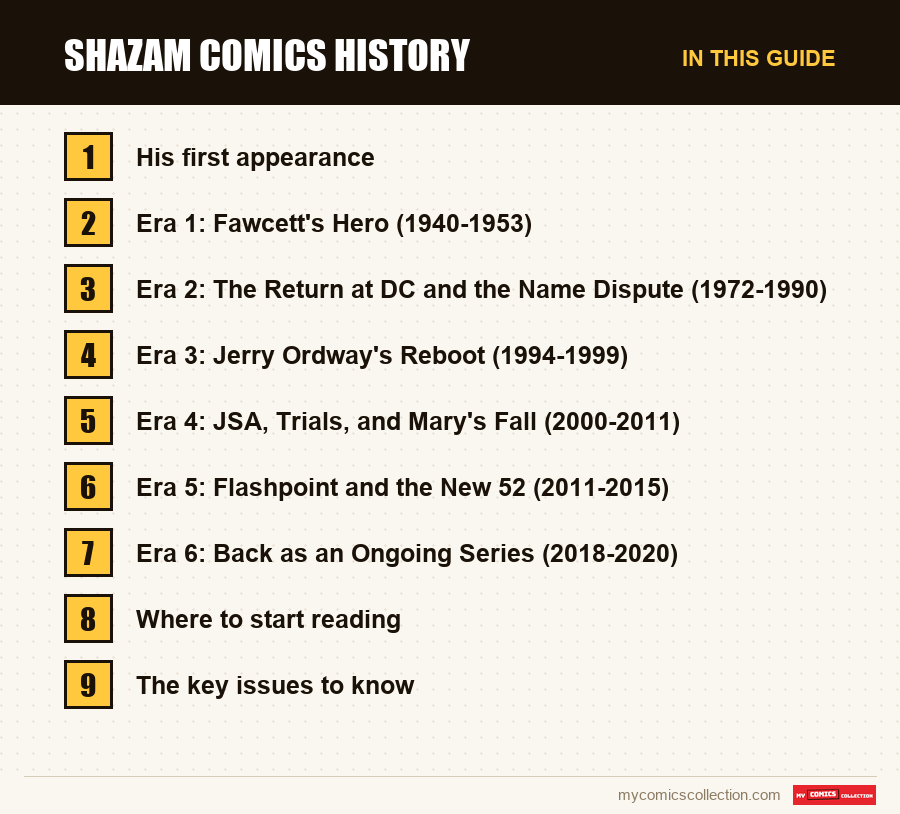
Era 5: Flashpoint and the New 52 (2011-2015)
In 2011, the Flashpoint event presents an alternate timeline where Billy, Mary, and Freddy, joined by Eugene Choi, Pedro Peña, and Darla Dudley, form the "S! H! A! Z! A! M! Family." It serves as a preview of the reboot. Its collecting milestones are gathered in the key issues of Flashpoint.
The real relaunch comes in Justice League (volume 2), where a backup story by Geoff Johns and Gary Frank begins in #7, dated March 2012. It offers a revised origin, and the character officially takes the name Shazam. Johns explained this choice by saying that everybody already thinks that is his name.
In 2015, Convergence: Shazam!, a tie-in to the Convergence event, returns to Earth-S, the family's home world. For the collector, the period is short but easy to follow: the Johns and Frank backup story remains the most obvious modern entry point.
Era 6: Back as an Ongoing Series (2018-2020)
Geoff Johns writes the Shazam! series launched with an issue dated December 5, 2018, drawn by Dale Eaglesham, with Marco Santucci and Scott Kolins. It ends with issue 15, in November 2020. Jeff Loveness writes two guest issues, #12 and #15, with Brandon Peterson.
The series follows in the wake of the 2019 film, whose sources we compare in Shazam! (2019) vs. the comics, and extends the 2012 reboot. It reads in fifteen issues, which makes it easy to complete.
To follow what comes next on screen, our page on Shazam! Fury of the Gods describes what the film takes from the comics.
Where to start reading
- The reader curious about the genre's history: archive volumes collecting the Binder and Beck stories, to see a kids' comic at its peak.
- The reader who wants a complete, serious version: The Power of Shazam! by Jerry Ordway, a 1994 graphic novel followed by the 1995 series.
- The modern reader in a hurry: the Justice League backup story by Geoff Johns and Gary Frank, then the 2018 Shazam! series.
- The reader who wants a standalone take: Shazam! The Monster Society of Evil (2007), by Jeff Smith, which retells the origin outside DC continuity.
- The Johns reader: our Geoff Johns, where to start guide places these stories within the writer's body of work.
The key issues to know
The method is simple: sort first by role, then by how hard they are to find.
- Whiz Comics #2 (February 1940): first appearance of Captain Marvel, Billy Batson, and Dr. Sivana, by Parker and Beck.
- Captain Marvel Adventures #1 (March 1941): launch of his own series, by Simon and Kirby.
- Captain Marvel Adventures #18 (December 1942): arrival of Mary Marvel.
- Captain Marvel Adventures #22 and #26: start of the Monster Society of Evil serial, then appearance of Mister Mind.
- The Marvel Family #1 (1945): first appearance of Black Adam, by Binder and Beck.
- Shazam! #1 (February 1973): the return at DC, by O'Neil and Beck.
- Justice League (volume 2) #7 (March 2012): the Johns and Frank story that sets the name Shazam.
Golden Age issues call for strict condition checks, 1970s issues turn up in lots, and 2012 and 2018 issues are bought as complete runs. To tell a certified copy from a raw one, read the whole label on the slab and not just the grade.
Frequently asked questions
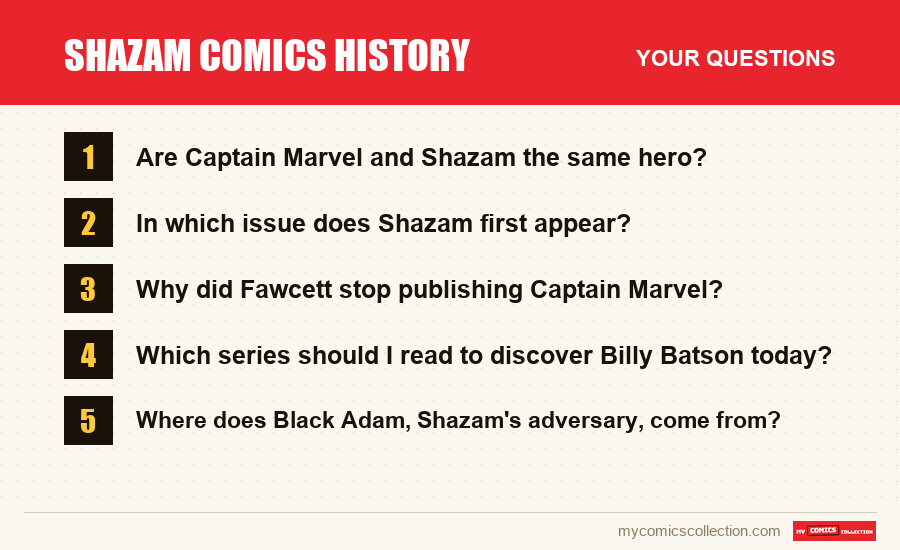
Yes. At Fawcett in 1940, Billy Batson is called Captain Marvel. DC titles its series Shazam! in 1973 because Marvel holds the Captain Marvel trademark for another hero, then makes the name Shazam official for the character in 2012, in Justice League. Older single issues therefore carry one name or the other.
In Whiz Comics #2, dated February 1940, published by Fawcett. The character is created there by writer Bill Parker and artist C. C. Beck. Dr. Sivana, his recurring enemy, appears in the same issue. It is a Golden Age book, so its condition needs careful checking.
Superman's publisher filed a lawsuit in 1941, arguing that Captain Marvel copied its hero. After a 1952 ruling sending the case back to trial, Fawcett reached a settlement on August 14, 1953 and stopped publishing the characters. Its Captain Marvel Adventures series ended with issue 150.
Two entry points stand out. Jerry Ordway's The Power of Shazam! offers a complete, serious origin. The Geoff Johns and Gary Frank story in Justice League from 2012, then the 2018 Shazam! series, offer the modern version, closer to the 2019 film.
Otto Binder and C. C. Beck launch Black Adam in 1945 in The Marvel Family #1, as a rival with identical powers. Jerry Ordway reintroduces him in The Power of Shazam!, and Geoff Johns makes him a central character in JSA with David S. Goyer.
Is a Shazam or Captain Marvel Adventures single issue sitting in your boxes? Get an estimate based on its issue number and condition.
Estimate my comic