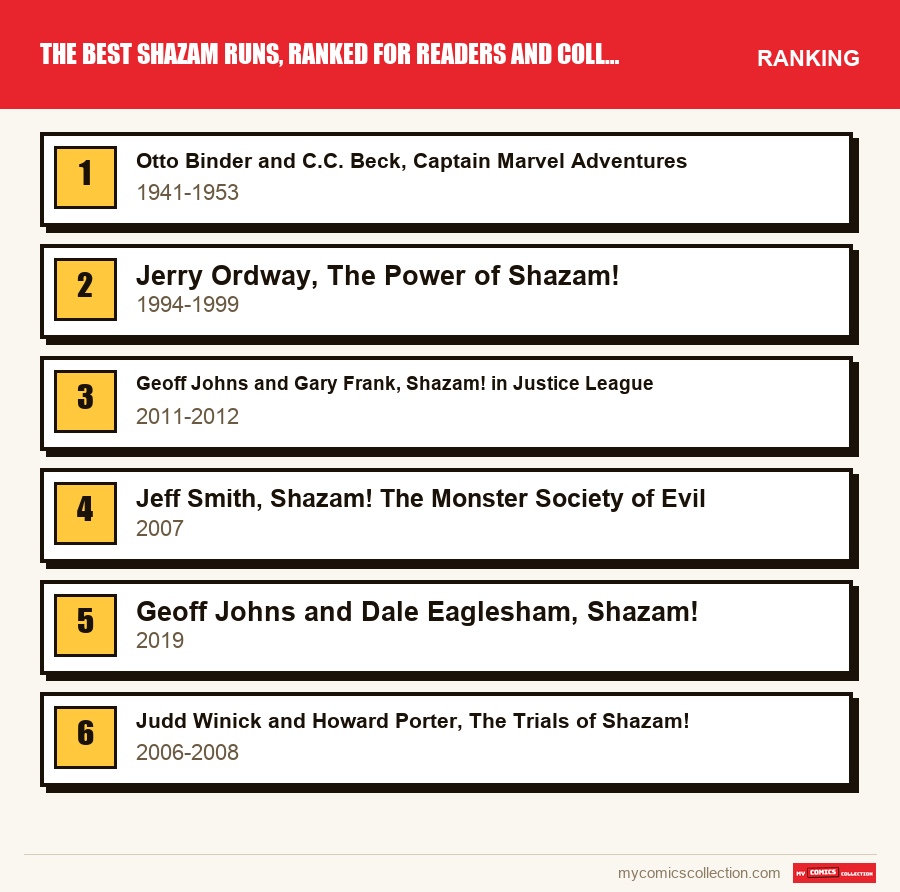
The best Shazam run is the one by Otto Binder and C.C. Beck in Captain Marvel Adventures (1941-1953), ahead of Jerry Ordway's The Power of Shazam! (1995) and the stories by Geoff Johns and Gary Frank (2011). Six sets are ranked here, with the starting issues when they are certain, the target reader and the format to choose between original single issues and collected editions.
Shazam is a special case in DC's library: a hero born at another publisher, renamed, reinterpreted by each generation of creators, and whose working name long differed depending on whether you speak of Fawcett or DC. Ranking him means separating what belongs to the golden age of children's publishing from what belongs to modern rereading work.
As always on this guide, only verified information (creators, issue numbers, dates) is stated as fact; the analysis is our own, with no reproduction of protected pages or dialogue.
How to rank a hero with two editorial identities
A simple count of issues would flatten the subject: a series of a hundred and fifty issues from the 1940s does not have the same status as a four-issue miniseries. We therefore weighed what each run brings to the myth, its ability to be read on its own, and its influence on later versions. A cycle that only served as a backdrop to an event was set aside, whatever its quality.
You also need to know the history of the name. The hero is born in Whiz Comics #2, in 1940, at Fawcett, under the name Captain Marvel, from the hands of Bill Parker and C.C. Beck. A lawsuit brought by National, the publisher of Superman, ends with a settlement in 1953 and the halt of Fawcett's production. DC then obtains the right to use the character and relaunches him in 1972 with a title that takes up the magic word: Shazam!, whose number 1 is dated February 1973. The name Captain Marvel had meanwhile belonged to another series, at Marvel.
Top 1: Otto Binder and C.C. Beck, Captain Marvel Adventures (1941-1953)
Captain Marvel Adventures appears from 1941, with C.C. Beck as the reference artist and Otto Binder, a prolific writer, as the main architect of the universe. The hero faces Dr. Sivana, who appeared as early as Whiz Comics #2, and an unexpected adversary, the laboratory worm Mr. Mind, who becomes the center of a long serial from 1943: "The Monster Society of Evil," designed to run across many issues.
This run takes first place because almost everything associated with the character is invented or refined there. Binder fleshes out the Marvel family, including Captain Marvel Jr. as early as 1941, as well as Mary Marvel, and invents with Beck a tone of tender humor that becomes the hallmark of the Fawcett house. Black Adam, for his part, is born in The Marvel Family #1, in 1945, with Binder and Beck.
It suits the reader curious about the history of the genre and anyone who wants to see what a children's comic was at its peak. For the collection, the original single issues are golden age pieces, with the constraints of that segment: very uneven condition, restored copies, reprints. For reading, bound archive volumes reprint selections of stories. Our golden age collecting guide details these pitfalls.
Top 2: Jerry Ordway, The Power of Shazam! (1994-1999)
In 1994, Jerry Ordway signs a graphic novel titled The Power of Shazam!, which serves as a modern overhaul of the character, then launches the regular series in 1995. Ordway writes and draws at first, with the help of other artists along the way. Billy Batson is an orphan following a tragedy that touches his archaeologist parents, and the Marvel family regains coherence after a long period of pure comedy.
Why second place: the series takes the founding material seriously, without mocking or betraying it, and draws from it a hero that later adaptations still recognize. Ordway reintroduces Black Adam in the present and gives him new depth, which explains why he appears in most later versions. The series runs, depending on the listings, to a little under fifty issues.
It suits the adult reader who wants a faithful version without being naive, and the 1990s collector, a period when demand for single issues remains measured. For reading, collected editions have reprinted the graphic novel and part of the series, though coverage is not complete; check the range of issues. Ordway's name is often absent from mainstream catalogs, hence a reason to search by title as well.
Top 3: Geoff Johns and Gary Frank, Shazam! in Justice League (2011-2012)
As part of DC's 2011 relaunch, Geoff Johns writes complementary stories published as backups to the Justice League series, drawn by Gary Frank. They are later gathered in a collected edition titled Shazam!. Billy Batson is a wary teenager there, placed in foster care, far from the little boy of 1940. The wizard entrusts him with his powers, and the story explores how the young boy can share them with other children.
This run matters because it fixes the most widespread version of the hero for the cinema: the 2019 film takes up the foster family, the siblings and part of the mythology. Gary Frank gives the characters a very expressive presence, and Johns drives a story in a few chapters, accessible and with no prerequisites. Our Geoff Johns reading path places this volume among the writer's other works.
This volume suits the film viewer, the newcomer to DC comics, and anyone who wants a complete story in a single book. For the collection, the single issues belong to the modern era: the value is not established, and we cite no ratio or print run. It may depend on the attention that adaptations revive, on the presence of the stories in reprints, and on the possible scarcity of certain Justice League issues that contain them. The collected edition remains the most economical choice.
Top 4: Jeff Smith, Shazam! The Monster Society of Evil (2007)
Jeff Smith, author of Bone, writes and draws alone a four-issue miniseries at DC, in 2007. Smith takes up the idea of the 1940s Mr. Mind serial, but reworks its content for a young reader: Billy Batson is a street kid, Captain Marvel a kind and slightly clumsy protector, and the threat comes from an adversary who unites several of the hero's enemies. The result is a short, sunny story that reads immediately.
It matters because it shows what the character gives at his best when left with his original simplicity: humor, wonder, kindness without silliness. For a reader who likes children's humor without condescension, it is probably the warmest entry in the ranking. The Jeff Smith reading path says more about the other works.
It suits families, readers of Bone and anyone who wants to give a DC comic to a child. The single issues are quick to gather, but reading is readily done in a bound volume or collected edition. Make sure the edition really contains all four issues and not a selection.
Do you collect this series?
Track what you own, what you are missing and what your collection is worth. 7-day trial.
Start my trial →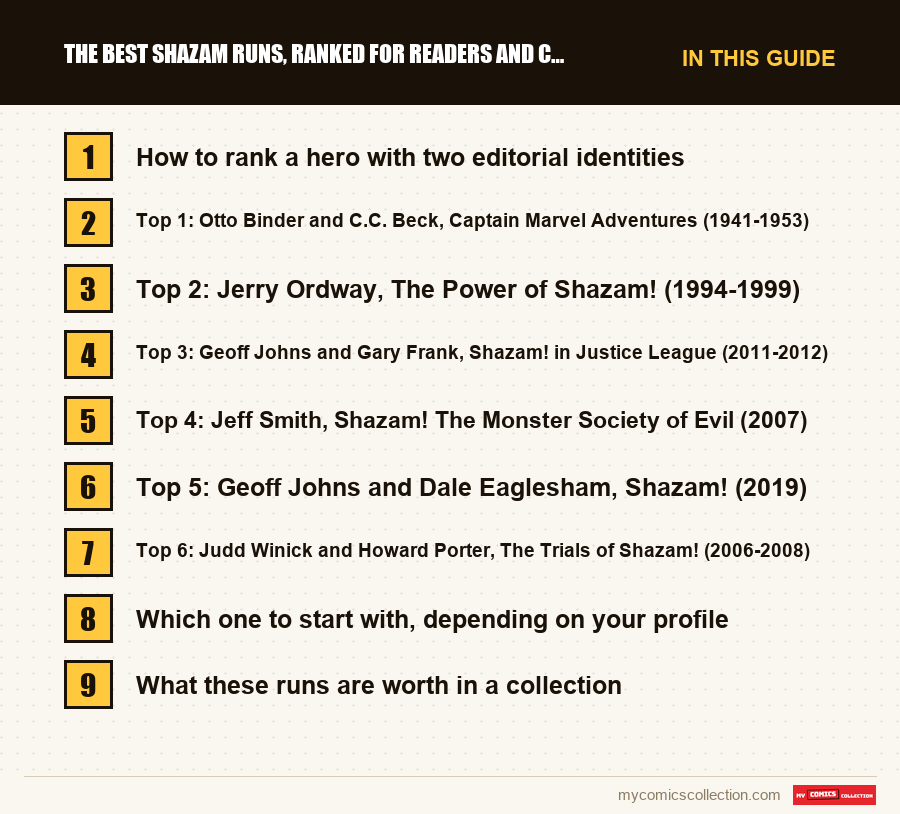
Top 5: Geoff Johns and Dale Eaglesham, Shazam! (2019)
To accompany the 2019 film, DC launches a new Shazam! series, again written by Geoff Johns, with Dale Eaglesham on art. The plot continues the 2011 version: Billy and the siblings who took him in learn to live with their powers, while magic opens onto a pantheon larger than expected. The tone stays family-friendly, with moments darker than you would expect.
Fifth place comes from its role as a sequel: it rests on earlier material and benefits less from an inaugural momentum. It remains pleasant to read, even more so for the film's audience, and illustrates how DC adapts its characters to an audience widened by the cinema.
For the collection, these are recent releases. No value is established; the cautious approach is to buy what you read and not to speculate on the first issues. Alternate covers are mentioned here only if you have them in hand: we give no ratio, for lack of certainty on each issue.
Top 6: Judd Winick and Howard Porter, The Trials of Shazam! (2006-2008)
After the events tied to Infinite Crisis, DC entrusts Judd Winick, with Howard Porter on art, with a twelve-issue series that renews the status of the Marvel family characters. The character of Freddy Freeman, long called Captain Marvel Jr., moves to the foreground and goes through trials drawn from the ancient gods whom the magic word brings together.
This cycle closes the list because it requires some familiarity with the continuity of the time, and because it left fewer traces than the other five. It nevertheless interests the completist and the reader curious to see another member of the family become the main hero.
It is aimed at the reader already sold on the characters and at the collector of the 2006-2008 period. The single issues are generally little sought after; the series has been reprinted in a collected edition, whose coverage should be checked. Sources differ on certain calendar details: rely on the date printed on the copy.
Which one to start with, depending on your profile
If you have seen the film and want the most direct starting point, take the Johns and Frank collected edition: in one volume, you get the foster family and Dr. Sivana revisited. If you prefer a warm version with no prerequisites, Jeff Smith's miniseries can be read in one evening.
The adult reader looking for a version that respects the legacy will read Ordway, first the 1994 graphic novel, then the series. The reader curious about the history of the genre will go straight to Binder and Beck, through an archive volume rather than fragile single issues. And if you like the antagonist, our article on Black Adam gives the context of his origins.
What these runs are worth in a collection
The structure of demand is unusual. The Fawcett single issues belong to a golden age market, where condition and restoration weigh more than numbering. DC's releases after 1972 are Bronze Age and modern pieces, often accessible. The 2011 and 2019 versions belong to the recent era: what will move their value remains open, and depends more on adaptations than on the single issues themselves.
As a method, never compare a Fawcett to a Bronze Age copy, and always use completed sales in the same condition. A well-chosen collected edition, often bound, is enough to read the essentials of the period. To place a copy you own, the free estimate serves as a starting point before any sale or additional purchase.
One last note of vigilance: the name Captain Marvel covers several characters published by different publishers. A listing that gives neither the publisher nor the year may refer to the Fawcett series, a Marvel single issue or a recent reprint. Check the cover, the printed publisher and the date before paying.
Building a Shazam collection without mixing up characters
A coherent collection is built in three tiers. The reading base includes a golden age archive volume, Ordway's graphic novel and the Johns and Frank collected edition. The core of single issues depends on your budget: a copy of the 1973 series, a few issues of The Power of Shazam! and, for the most seasoned, a Fawcett in modest condition.
Finally, the extras: Smith for pleasure, Winick for completeness, 2019 for the link with the film. Keep an inventory with the publisher, date and condition of each piece. This habit avoids buying the same story twice under two covers, and attributing to one series the characteristics of another. The page on the 2023 film sequel also reminds you of what the big screen does not take up.

Frequently asked questions
The one by Otto Binder and C.C. Beck in Captain Marvel Adventures, between 1941 and 1953, for historical importance. For a modern read, the Geoff Johns and Gary Frank collected edition or Jerry Ordway's The Power of Shazam! are more accessible. The best choice depends on the era that attracts you.
Yes, originally. Billy Batson is born under the name Captain Marvel at Fawcett in 1940. After DC takes over, the 1973 title adopts Shazam!, and the hero gradually carries that name. Beware: Captain Marvel also refers to several Marvel Comics characters, with no connection.
The Power of Shazam! by Jerry Ordway, starting with the 1994 graphic novel, offers a serious and faithful version. If you want the hero as the cinema has taken him up, the Geoff Johns and Gary Frank collected edition is more direct and reads in one sitting.
In The Marvel Family #1, published by Fawcett in 1945, written by Otto Binder with C.C. Beck. He is reintroduced in the present by Jerry Ordway in the 1990s. The 2022 film draws on this lineage; our dedicated article compares the two versions.
For reading, archive volumes, much easier to find and to store. To own the object, Fawcett single issues are judged on condition, possible restoration and printed publisher. Compare several completed sales before buying, because the gaps from one copy to another are large.
A Captain Marvel or Shazam single issue at the bottom of a box? Check the publisher and the year before estimating its value.
Estimate my comic