Start with a collection, never with an isolated issue, and in the market, the only number that matters is the rank of the print run. As of August 29, 2026, the numbers in the series ask each other 9,99 $ de médiane out of 149 ads, but the first number goes up to 23,00 $in gross and especially 525,00 $of certified median out of 37 advertisements. However, advertisements commonly mention third and sixth printings: Same title, same number, unrelated price.
It is the best-selling self-published work of its generation, and the one where misidentification costs the most.
We will see here in what order to approach the work, why successive reprints completely confuse prices, how to establish the rank of a copy, and which version to choose according to the intended reader.
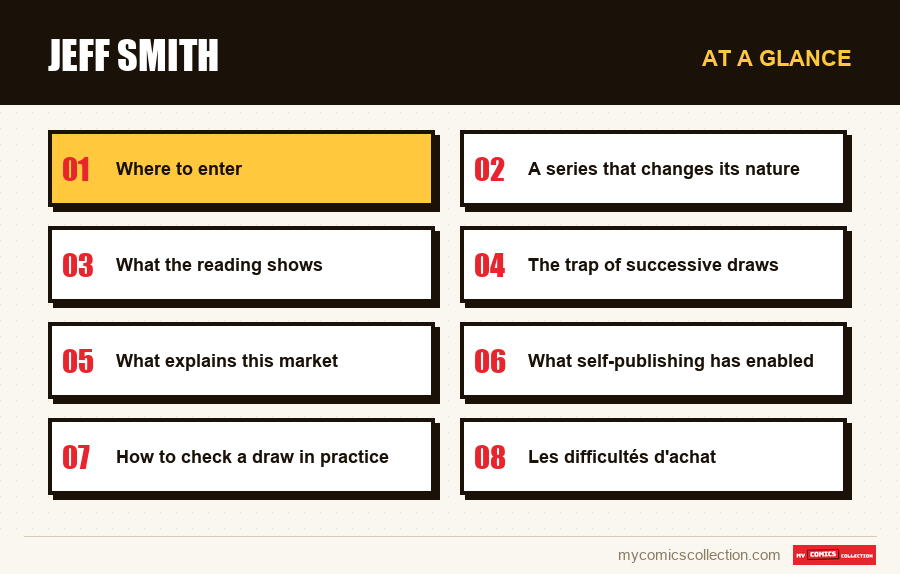
Where to enter
The answer is clear and it applies to almost all readers.
The first collection, not the first issue. The work is a continuous epic of several dozen numbers; an isolated issue only gives a fragment without beginning or end, and teaches nothing about what the series becomes.
The format doesn't matter at this point. Original black and white or later colorized version: both tell the same thing, and the choice is one of taste rather than accuracy.
Read at least three volumes before judging. This is the most important point: the series completely changes register along the way, and stopping early gives a false idea of what it is.
This last recommendation requires explanation, because it contradicts the impression given by the first pages.
A series that changes its nature
This is the most disconcerting feature of the work, and you should know it when entering.
It begins like a comedy: round characters, visual gags, misunderstandings, light tone and fast pace. Everything indicates a humorous series for all audiences, and many readers are left with this impression.
It gradually becomes something else. The story darkens, the stakes widen, and the whole thing unfolds into an epic with deaths, betrayals and a major threat: without ever abandoning humor, which coexists with the rest.
This transformation is gradual and deliberate. She explains why opinions differ so much: two readers who stopped at different times did not read the same work.
It also explains why it is recommended to opposite audiences. It is really readable by a child and really interesting for an adult, which is rare and rarely obtained by the same means.
What the reading shows
The following table summarizes a survey carried out on August 29, 2026: prices asked for fixed price advertisements, raw and certified being counted separately. These are sellers' hopes and nothing more.
The body of the series
149 ads brutes, de $1.75 to $2,950.00 requested, median $9.99. Certified: 16 ads, median $185.00.
Current numbers remain very accessible.
The first number
Raw : 73 annonces, median 23,00 $. Certified: 37 ads, $55.00 to $9,999.00, median 525,00 $.
Thirty-seven certified announcements: this is an organized market, rare in self-publishing.
The successive draws
The advertisements explicitly mention troisièmes et sixièmes tirages at $1.99 and $2.00 requested, for numbers whose first draws are worth multiples.
Les valeurs extrêmes
A gross maximum at $2,950.00 and a certified maximum at $9,999.00, both isolated. They do not describe a market price.
The trap of successive draws
This is the decisive particularity of this work for a buyer, and it arises directly from its mode of publication.
The series was self-published, with limited resources and a demand that grew gradually. The first issues were therefore printed in small quantities, then reprinted as the audience grew: sometimes many times.
The same number therefore exists in several draws bearing the same title and the same number., of which only the first is rare. The statement shows sixth draws asking for $2.00 where a certified first draw asks for three figures.
Serious sellers indicate this: the advertisements noted carry explicit mention of the draw rank. But many do not mention it, and the absence of a mention does not mean “first printing”.
The rule is therefore absolute here: on this series, a low price does not indicate a deal but a late draw. And a seller who does not specify the rank must be questioned before any purchase.
This trap is structurally different from an anniversary reprint. A commemorative reissue is distinguished by its date and presentation; a second period print is materially almost identical to the first.
The distinction comes through printing details: mentions in small print, differences in coverage that are sometimes minimal. This explains the unusual number of certified copies: certification is here the only simple way to establish rank.
What explains this market
Thirty-seven certified announcements on a self-published title deserve an explanation, because it is very unusual in this circuit.
Un succès public considérable. The work went beyond the circle of comic book readers and was sold in general bookstores, particularly to a young audience. This creates a broad demand.
A truly rare first print. Unlike the series from the big houses, the first printing was confidential: the demand did not yet exist.
Un besoin d'authentification. The draw trap makes certification useful rather than decorative, which explains why it is used so much.
These three factors reinforce each other. This is the clearest case of this campaign where certification responds to a real problem and not a simple logic of prestige.
What self-publishing has enabled
The mode of publication is not a biographical detail: it conditions what the work could be.
An epic of several dozen issues, in black and white, mixing comedy and fantasy, without a licensed character or connection to an existing universe, would not have been accepted by any major house at the time of its launch. It didn't fit any commercial box.
Publishing oneself was therefore the condition of existence of the project, not an ideological preference. This is also what made it possible to bring it to its conclusion, over a duration that few publishers would have guaranteed.
The counterpart was a confidential start: hence the rarity of the first print noted above. The work built its audience issue after issue, which explains the long series of reprints and, in turn, the identification problem that buyers encounter today.
There is a fairly accurate circular logic in all this: the current difficulty of collecting is the direct trace of a success obtained without editorial support.
Collecting this series?
Track what you own, what you are missing and what your collection is worth. 7 day trial.
Start my trial →How to check a draw in practice
The question deserves an operational answer, since the entire price gap depends on it.
Look at the bear, not the cover. Printing notices appear in the credit block in small print, generally at the bottom of the first or last page.
A first print often bears no mention. This is the trap: the absence of an indication can signal a first printing as a printing negligence. It does not prove anything on its own and must be cross-checked.
Ask the seller for a photograph of the bear. This is the only reliable remote verification, and a request that the sellers of this series immediately understand as it is so frequent.
For a significant purchase, the third-party certified copy settles the matter in a definitive and verifiable way: that's precisely the function the certification serves here, and it serves it better than on almost any other series in this campaign.
Les difficultés d'achat
The draw rank not mentioned
Its absence in an ad does not mean first printing. You have to ask systematically.
Deux versions colorimétriques
Original black and white and later colorization coexist, without the announcements always specifying this.
Plusieurs lignes de recueils
The work has been brought together according to successive divisions which do not overlap.
Misleading extreme values
A maximum of $9,999.00 in isolation distorts any quick reading of a page of results.
Quelle version choisir
The question of black and white versus color arises here more than anywhere else, and the answer depends on the reader.
Black and white is the original version. The design was designed for her, with contrasts and readability designed without color. This is the form most faithful to the intention.
Subsequent colorization was approved by the author and targets a younger audience, in general bookstores. It is not a betrayal but a supportive adaptation.
For a child, color. It makes it easier to enter and follow characters over a long epic.
For an adult, try black and white. The drawing shows better what he does: the simplicity of the shapes, the precision of the comic gesture, the use of blacks in the dark sequences.
Ce qu'il faut enregistrer
Only one piece of information really matters here, and it disappears forever if no one writes it down at the time of purchase.
The draw rank of each number, noted upon purchase. It's the only thing that separates a $2.00 copy from a triple-digit copy, and it's in the fine print where no one thinks to look. Once the copy is put away, the information is lost, and finding it requires reopening each issue.
This is also what allows you to sell honestly later: a seller who does not know his print ranks will sell off his first prints or oversell his reprints, in both cases out of ignorance.
La version colorimétrique, since two editions of the same story coexist and nothing on a sheet constructed by number distinguishes them.
What print, what version: in this series, everything else in the file is secondary to these two mentions.
Questions fréquentes
By the first collection, not by an isolated issue: the work is a continuous epic and a single issue only gives a fragment. And read at least three volumes before judging: the series completely changes register along the way.
It is really readable by a child and really interesting for an adult, which is rare. It begins as a comedy then gradually darkens (deaths, betrayals, large-scale threats) without abandoning the humor. Two readers arrested at different times have not read the same work.
These are late draws. As the series was self-published with demand growing gradually, the first issues were reprinted numerous times: the statement shows third and sixth printings at $1.99 and $2.00. On this series, a low price signals a draw rank, not a deal.
Because the certification here responds to a real problem: a second vintage print is materially almost identical to the first, and the distinction is made through mentions in small print. Thirty-seven certified announcements on the first issue, at a median of $525.00, which is very unusual for self-publishing.
Both tell the same thing and the coloring has been approved by the author. For a child, color makes it easier to follow the characters over a long epic; for an adult, the original black and white better shows what the drawing does: precision of comic gesture, use of blacks in dark sequences.
What draw rank?
That's what separates a $2 copy from a triple-digit copy, and it's in the fine print.