In short
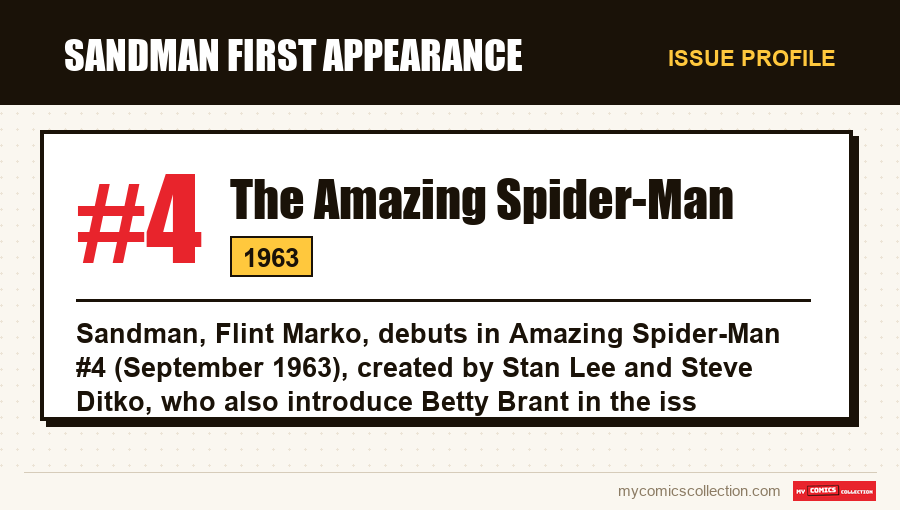
The fourth issue of The Amazing Spider-Man, dated September 1963, is where Flint Marko turns up as the Sandman. Writer Stan Lee and artist Steve Ditko built the book around a convict whose body can become sand, and Ditko drew the cover too. Betty Brant, the Daily Bugle secretary, arrives in the same pages, so one back issue holds two debuts for a Silver Age shelf.
Issue #4 sits in an unusual place on a Silver Age shelf. It follows the Vulture in #2 and Doctor Octopus in #3, so a collector who owns those two already holds the gallery of villains Lee and Ditko were assembling, and Marko is the third name in that line. This guide treats the issue as an object to examine: its credits, its cover, what the pages contain, what to look at on a copy, and which later appearances are worth pairing with it.
Our fact-checking here covered the creator names, the cover month, the lead story's title and Betty Brant's arrival, all compared with encyclopedia entries and issue listings. Everything about tone, design and condition is our own opinion, and nothing from the pages is quoted.
The issue at a glance: date, title and credits
The Amazing Spider-Man #4 carries a September 1963 cover date. Stan Lee supplies the script and Steve Ditko the art for the lead feature, "Nothing Can Stop...The Sandman!" Ditko drew the cover as well, by the same hand as the interior. Wikipedia's account of the series adds that Ditko pencilled issues 1 through 38, with Lee scripting and Ditko plotting more as the run went on.
That last point matters for how you describe the book to another collector. When you list #4, the creators are a pair, not a single author with a hired illustrator. Ditko is a co-creator of Flint Marko in the sense that the character's look, a heavy silhouette that dissolves and reforms, comes from the page design, not from a script alone. Both names belong on a label, a listing or a shelf card, and a seller who credits only one of them is working from a thin description.
The cover is worth a moment of its own. It puts the villain's shifting body at the center, which was a reasonable choice for a character whose whole premise is a body that does not hold one form. Compare it with the cover of issue #3 on the next shelf slot and you will see how quickly the series was building a house style: bold lettering across the top, Spider-Man in motion, a villain who dominates the frame.
What happens in Amazing Spider-Man #4
The story introduces Flint Marko as an escaped convict who has gained the ability to turn his body into sand. Early in the plot he comes into contact with Peter Parker's world at Peter's high school, and Wikipedia's entry on the character records that Spider-Man defeats him there with a vacuum cleaner. That detail tells you a great deal about the book's tone. Lee and Ditko were not yet writing cosmic stakes. They were writing a teenager's problem with an enormous physical threat, and the solution is an improvised domestic object, not a superpower.
The lead story is built as a chase and a puzzle. Marko can pass through gaps, harden into a fist, and scatter when struck. Spider-Man cannot out-punch that, so the reader watches Peter think his way around the opponent. This is the template that made the early Ditko issues feel different from the superhero books beside them on the stand: the hero wins by observation, not by being stronger.
Peter's civilian life continues in the same pages. The issue is also the debut of Betty Brant, who is introduced as J. Jonah Jameson's secretary at the Daily Bugle and who meets Peter when he starts working there as a freelance photographer. The Betty Brant entry on Wikipedia credits Lee and Ditko as her creators and cites issue #4 for that meeting. In collecting terms, #4 therefore carries two debuts, one villain and one supporting character who becomes central to the early Peter Parker stories.
How Lee and Ditko built Flint Marko
A useful way to read Marko is as a villain designed for a black-and-white inking style. Ditko's line work favors hard shadows and broken contours, and sand gave him a reason to draw a body made of grain, drifting edges and dense mass. The costume, in the sense of a distinctive suit, matters less than the texture. The silhouette alone identifies the character, which is why the design has survived more than sixty years with few structural changes.
The editorial context is just as important. By the fourth issue, the series had already used a flying criminal in the Vulture and a scientist with mechanical arms in Doctor Octopus. Marko offered a third kind of problem, a physical one with no technology and no suit, only a body that behaves as a material. Each new villain in the sequence tested a different part of Spider-Man's toolkit, and #4 tests whether quick thinking can beat a body that cannot be hurt in the usual way.
The design also proved flexible. Marko later joins the original Sinister Six, a team Lee and Ditko staged in the first Amazing Spider-Man annual in 1964, where he stands beside Doctor Octopus, Electro, Kraven, Mysterio and the Vulture. A character who could be written as a menace, a henchman or a reluctant ally was a gift to later writers, and that range is part of why the debut keeps its place on collector lists.
Why issue #4 is a key issue
The case for #4 rests on three supports that can be stated without any market claims. It is the debut of a character who has appeared across more than six decades, it is the debut of Betty Brant, and it sits inside the run of early issues by the creators who defined the series. Those supports are structural, which is different from a temporary spike caused by a film or a trend.
The second point is placement. The early numbers of the series form a natural block for collectors: the Vulture arrives in #2, Doctor Octopus in #3, Sandman in #4, and Mysterio follows in #13, covered in our guide to Mysterio's debut in issue #13. A collector working through the villain debuts of the Ditko era meets #4 as a required step. For the first number of the title, see the separate issue #1 key issue guide.
The third point is the long tail. Sandman's presence in team-ups, annuals and ongoing storylines means that new readers keep asking where he began, and every time a new adaptation or a new series gives him screen time or page time, the question returns. The demand for the origin issue is therefore renewed by the character's endurance, not by a single event. We make no claim here about how any copy trades. The point is why the issue stays on checklists.
Do you collect this series?
Track what you own, what you are missing and what your collection is worth. 7-day trial.
Start my trial →
Reprints, collected editions and look-alikes
The story has been reprinted many times, which is good news for a reader who only wants the material. Reprint comics and collected volumes of the Silver Age run have brought the issue back into print on a regular basis. If you want to read Lee and Ditko's story, a reprint does the job and costs a small fraction of what an original demands in effort to find.
The trouble starts when a reprint is described loosely. A reader scanning listings sees "Sandman first appearance" and may not notice that the item is a later printing, a facsimile edition or a collected volume. The reliable distinction is the cover date and the printed issue number on the item. The original reads The Amazing Spider-Man #4 with a September 1963 date and the period's cover design. Anything that says otherwise on the cover or in the indicia is a different object, which can be a perfectly good one to own, but it is not the debut printing.
Look-alikes also occur between nearby numbers. Issue #3, the Doctor Octopus issue, and issue #2, the Vulture issue, share a cover style with #4 closely enough that a quick glance at a thumbnail can mislead. Read the number in the title box, then the date. Our page on the best Amazing Spider-Man covers shows how consistent the early design language is, which is exactly why a careful check pays.
What to check before buying a copy
An early Silver Age book from 1963 has had a long time to accumulate problems, and the checks are the same ones used for any comic of the period. Start with the spine. Look for stress lines, color breaks along the fold, and any place where the staples have pulled. Staples on a book of this age may show rust; a little discoloration at the staple points is common, while spread rust that has marked the paper is a different matter.
Next, check the corners and edges for chipping, the cover gloss, and the centering of the print. Then look for restoration. Color touch on the spine, replaced pieces at the corners, tape and cleaning marks can all change the way a copy should be described. A listing that states a grade without mentioning restoration is not complete, and a copy that has been restored is a legitimate purchase only if it is sold as one.
If the copy is certified, read the label with attention. Confirm that the issue number, title and date on the label match the book in the case, and look at the notes line, which is where restoration or other qualifiers are recorded. Our grading guide explains how to read those labels. The best method for any purchase is to compare several copies of #4 on the same day, rather than to accept the first listing, and to record what you saw in your collection records so that you can document the book's condition later. Our free comic valuation page is a useful place to start the paperwork.
The Sandman appearances that matter after #4
Once you hold the debut, the next purchases are guided by role. These are verified appearances that change how you read the character:
The Amazing Spider-Man Annual #1 (1964) is the annual in which Lee and Ditko assemble the Sinister Six with Marko among its six members. Pair it with #4 if you care about how loose villain debuts became a team, and use our Sinister Six reading guide for the group's later stories.
Fantastic Four #36, cover-dated March 1965, shows Sandman as part of the Frightful Four, which places him outside Spider-Man's own series. It is the issue that shows how far a Ditko villain could travel into other Marvel books.
Marvel Team-Up #1, cover-dated March 1972, uses Sandman as the villain in the series' opening issue; the issue is credited to Roy Thomas and Ross Andru. It is a good example of the character being used as a dependable opponent for a new series.
The Amazing Spider-Man #217 and #218 are listed among his later appearances in the main title, the issues where an accident fuses him with Hydro-Man into the Mud-Thing, and "Sandblasted" in Friendly Neighborhood Spider-Man #17 to #19 (2007) is a story that puts Marko himself at the center. For a ranked reading path, use our guide to the best Sandman comics.
These recommendations are meant for building a sensible set: debut, team origin, a crossover, a new-series issue and a character study. A collector can stop at any step and still hold a coherent group of books. Keep note of the title Sandman by Neil Gaiman as well, which is an unrelated comic with the same name, so that a listing for one is never mistaken for the other.
Frequently asked questions
Open The Amazing Spider-Man #4 from September 1963, the book in which the convict Flint Marko becomes the Sandman. Stan Lee and Steve Ditko are the creators, and the lead story carries the title "Nothing Can Stop...The Sandman!" Betty Brant also debuts there.
Stan Lee and Steve Ditko created Flint Marko. Lee wrote the story and Ditko drew the interior and the cover. Both names should appear when you describe the issue, since Ditko's design of a body made of sand is central to the character.
No. Flint Marko, the Spider-Man villain, is a Marvel character who debuted in 1963. The comic titled Sandman by Neil Gaiman is a different property with a different publisher line. When you search or buy, check the title, the publisher and the date on the item before you commit.
Yes, he is among the original six. The team appears in the 1964 Amazing Spider-Man Annual #1 by Lee and Ditko, alongside Doctor Octopus, Electro, Kraven, Mysterio and the Vulture. That annual is a sensible companion purchase to issue #4 for a villain-focused shelf.
Read the cover date and the issue number printed on the book. The original is dated September 1963 and shows the period cover design. Reprints and collected editions carry their own dates and indicia. When a book is certified, also confirm that the label matches the book, and read its notes line for restoration.
Holding a copy of The Amazing Spider-Man #4 or another early Ditko issue? Get a quick estimate of what it is worth.
Estimate my comic