
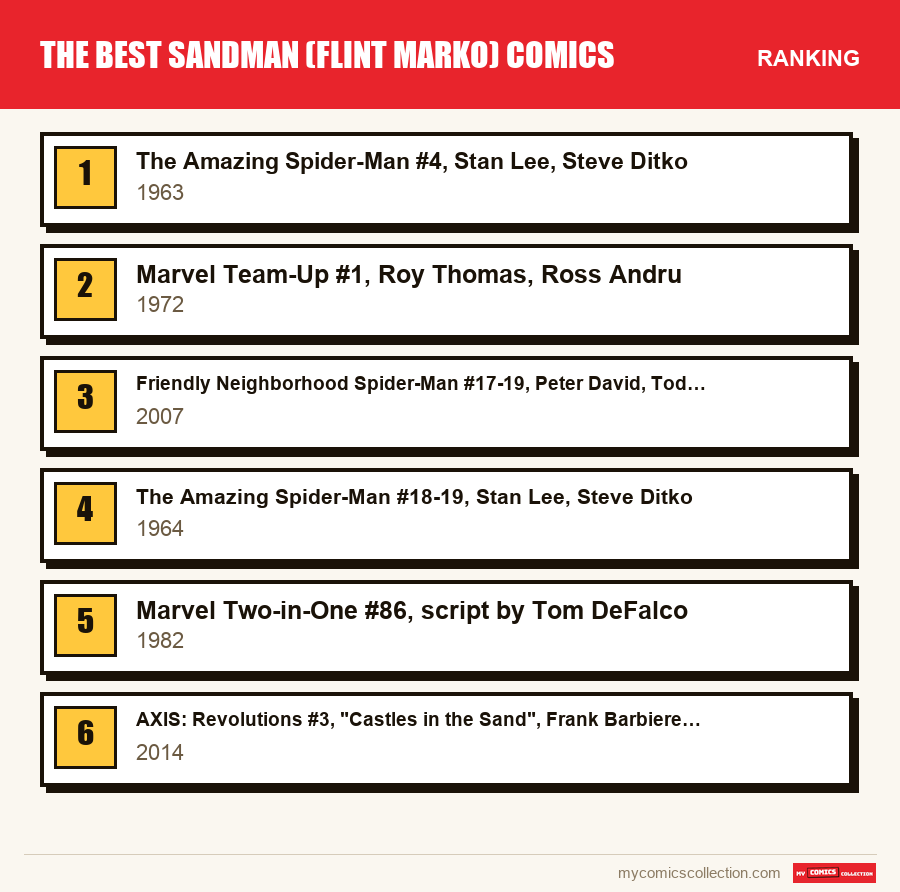
The best Sandman (Flint Marko) comics start with his debut in The Amazing Spider-Man #4 (September 1963), by Stan Lee and Steve Ditko. Read that issue, then Marvel Team-Up #1 (1972) by Roy Thomas and Ross Andru, which softens the character, and finally "Sandblasted" in Friendly Neighborhood Spider-Man #17-19 (2007), by Peter David. Six ranked reads, with the key issues.
Flint Marko is a criminal whose body turns to sand: he hardens, stretches, scatters and re-forms. His career follows an unusual arc among Spider-Man's villains, because he goes from pure threat to reluctant ally, then sometimes drifts back to crime depending on the writer. This page only covers stories where he is at the center of the plot.
As always in this guide, only verified facts (creators, issue numbers, dates) are stated as fact; the analysis is our own, with no reproduction of panels or copyrighted dialogue.
His first appearance
Sandman is born in The Amazing Spider-Man #4, cover-dated September 1963. Stan Lee writes and Steve Ditko draws: the issue follows the Vulture (#2) and Doctor Octopus (#3) and extends the gallery of recurring foes facing the young Peter Parker. Flint Marko is an escaped convict whose body turns to sand after an atomic test, which makes him an opponent that fists alone cannot stop.
This issue matters for two reasons. It establishes a villain whose power is visual and easy to grasp, and it puts him, as early as 1963, in the gallery that will form the Sinister Six the following year: Sandman is one of the six original members of the group. If you want landmarks for the period, the Silver Age guide describes how the series' issues follow one another and what to know about their condition.
How we ranked the six reads
Sandman is a character who changes from one decade to the next, so we favored the stories that move his position, from outright criminal to a man trying to redeem himself. The order puts the must-know material first, then what changes how you see the character, then the more recent or shorter reads. We left out stories where he is just one member of a villain team, except in the key issues section.
1: The Amazing Spider-Man #4, Stan Lee, Steve Ditko (1963)
This is the obligatory starting point: Stan Lee and Steve Ditko introduce Flint Marko to a series only a few months old. The issue is cover-dated September 1963 and opens a career of more than sixty years.
For Flint Marko, these pages set down all the essentials: a body of sand, a massive silhouette, and an opponent that ordinary blows do not stop. The nuances will come later, from other pens.
Who is it for? Anyone who wants to know where Marko comes from before reading his returns, as well as anyone assembling the early issues of the series. How should you read it? In a standard edition or a collected volume, then continue with our ranking of the best Spider-Man runs to place this issue in the bigger picture.
2: Marvel Team-Up #1, Roy Thomas, Ross Andru (1972)
Issue #1 of Marvel Team-Up is cover-dated March 1972. Roy Thomas writes it and Ross Andru draws it. Spider-Man teams up with the Human Torch against Sandman, and the villain is shown in a more ambiguous light than in 1963. Roy Thomas has said he hoped the character might one day redeem himself, which gives this issue the value of a seed planted.
For Sandman, it is a quiet turning point: the story does not turn him into a hero, but it opens the door to what other writers will develop later. For the reader, it is a typical 1970s team-up issue, with two heroes helping each other rather than an isolated duel.
Who is it for? Anyone who wants to see how a classic villain slides toward ambiguity. How should you read it? As a single issue, after Amazing Spider-Man #4. Our page on Marvel Team-Up #1 details what the issue means to collectors, and the one on the Human Torch places his partner in his own trajectory.
3: Friendly Neighborhood Spider-Man #17-19, Peter David, Todd Nauck (2007)
The "Sandblasted" arc runs through issues #17-19, cover-dated April to June 2007. Peter David writes and Todd Nauck draws. The story is one of the Back in Black tie-ins, the period when Spider-Man wears his black costume after Aunt May's shooting, and it makes Sandman the protagonist: he is trying to clear his father's name.
It is the read that gives him the most depth: the criminal of 1963 becomes a son who wants to right an injustice. The arc reads without heavy preparation, even though a few decades of backstory feed the stakes.
Who is it for? Anyone who wants a human Sandman, away from the big crossovers. How should you read it? In the three issues, or in a collected volume from the Back in Black period. For the writer, see the Peter David hub.
Do you collect this series?
Track what you own, what you are missing and what your collection is worth. 7-day trial.
Start my trial →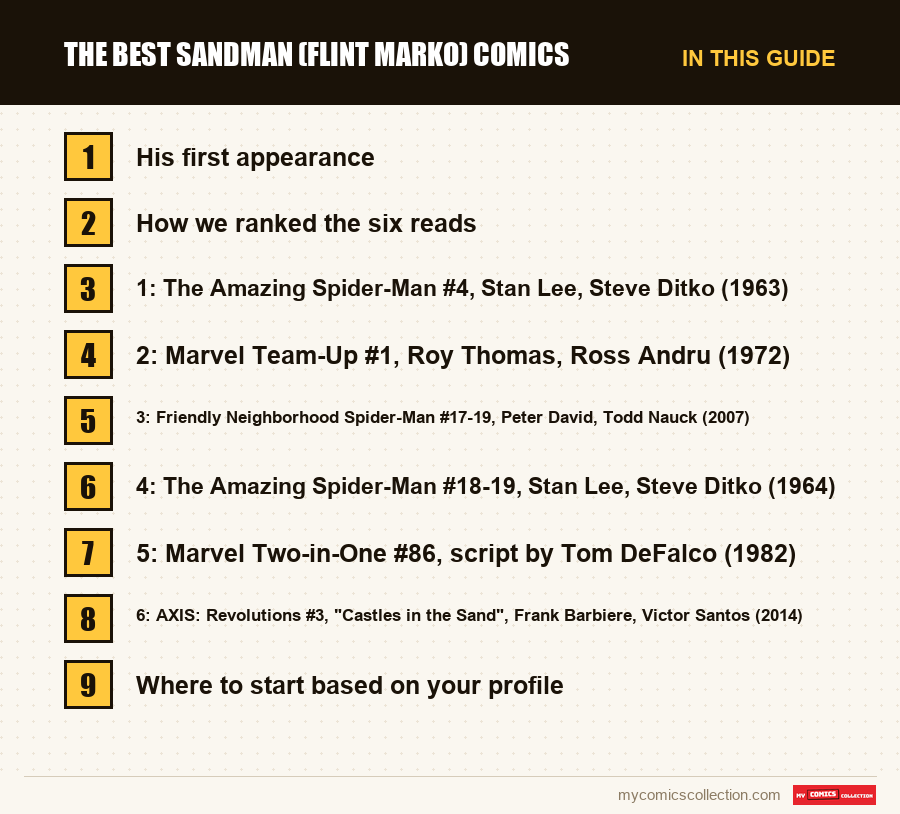
4: The Amazing Spider-Man #18-19, Stan Lee, Steve Ditko (1964)
A year after his debut, Sandman returns in issues #18 and #19 of the series, cover-dated 1964. Stan Lee and Steve Ditko remain at the helm for this stretch. The interest lies less in a new power than in confirming the character as a recurring adversary: he does not fade away after a first duel.
This run matters because it shows the establishment of a rhythm the series will follow for a long time: a beaten enemy comes back better prepared, and the reader meets familiar faces again. It is also the backdrop to the birth of the Sinister Six that same year.
Who is it for? The Silver Age reader who wants to follow the series issue by issue. How should you read it? By continuing the series after issue #4, without trying to isolate the arc: the period is built as a flow. The Stan Lee hub gathers the other landmarks of this writing.
5: Marvel Two-in-One #86, script by Tom DeFalco (1982)
Issue #86 of Marvel Two-in-One, cover-dated April 1982, gives Sandman the spotlight alongside the Thing of the Fantastic Four. Tom DeFalco writes the script. This co-starring role is a sign: the character is established enough to carry an issue of a team-up series, and the period is one of gradual rehabilitation.
For the character, it confirms a trajectory: the criminal of 1963 shares the billing with a major hero of the Marvel universe, which would have been hard to imagine twenty years earlier. The issue reads in one evening.
Who is it for? Fans of the Thing and the Fantastic Four looking for an entry point to Sandman. How should you read it? On its own, or in a collected volume of the series. For the team's context, see the Fantastic Four hub.
6: AXIS: Revolutions #3, "Castles in the Sand", Frank Barbiere, Victor Santos (2014)
"Castles in the Sand" is a chapter of AXIS: Revolutions #3, cover-dated December 2014. Frank Barbiere writes and Victor Santos draws. The story is a tie-in to the AXIS event and follows Sandman as he breaks into Ryker's Island prison.
It is a short read that helps you see how the character works as the lead of a heist story, outside the frame of a duel against Spider-Man. It serves as a counterpoint to the earlier entries.
Who is it for? The reader who already knows Sandman and wants a recent story centered on him. How should you read it? As a standalone chapter in issue #3 of the series, without needing to read the full event.
Where to start based on your profile
You are new to the character. Read The Amazing Spider-Man #4, then "Sandblasted": two landmarks that show the starting point and a possible destination for the character.
You love the Silver Age. Follow The Amazing Spider-Man #4, then #18 and 19, and save Marvel Team-Up #1 for the end of the period.
You like duo series. Pick Marvel Team-Up #1 and Marvel Two-in-One #86: two team-up issues where Sandman shares the spotlight or faces two heroes.
You read modern stories. "Sandblasted" and "Castles in the Sand" are enough, with a little context on the earlier years.
You collect. Go for the first appearance first, then the issues that mark a turning point, and save the recent tie-ins to complete a theme.
The key issues to know
- The Amazing Spider-Man #4 (September 1963): the debut of Flint Marko, by Stan Lee and Steve Ditko.
- The Amazing Spider-Man Annual #1 (1964): Sandman is among the original members of the Sinister Six.
- Fantastic Four #36 (March 1965): the birth of the Frightful Four, of which Marko is a member, written by Stan Lee, with Jack Kirby on pencils and Chic Stone on inks.
- Marvel Team-Up #1 (March 1972): the villain of the opening issue, in a more ambiguous version.
- Marvel Two-in-One #86 (April 1982): Sandman co-starring with the Thing.
- The Amazing Spider-Man #280-281 (1986): Sandman helps Spider-Man and Silver Sable against the Sinister Syndicate, and Silver Sable recruits him.
- The Amazing Spider-Man (vol. 2) #4 (1999): written by Howard Mackie, the issue shows Sandman returning to crime; after reader reactions, Marvel explained this reversal as the work of the Wizard's mind-control machine.
- Friendly Neighborhood Spider-Man #17-19 (April to June 2007): "Sandblasted".
As for buying method, always check the cover date, compare the condition of several copies, and cross-check completed sales before trusting a single listing. If you are aiming at a specific period, our page on Amazing Spider-Man key issues and the one on Silver Sable extend the study of issue #280.
Frequently asked questions
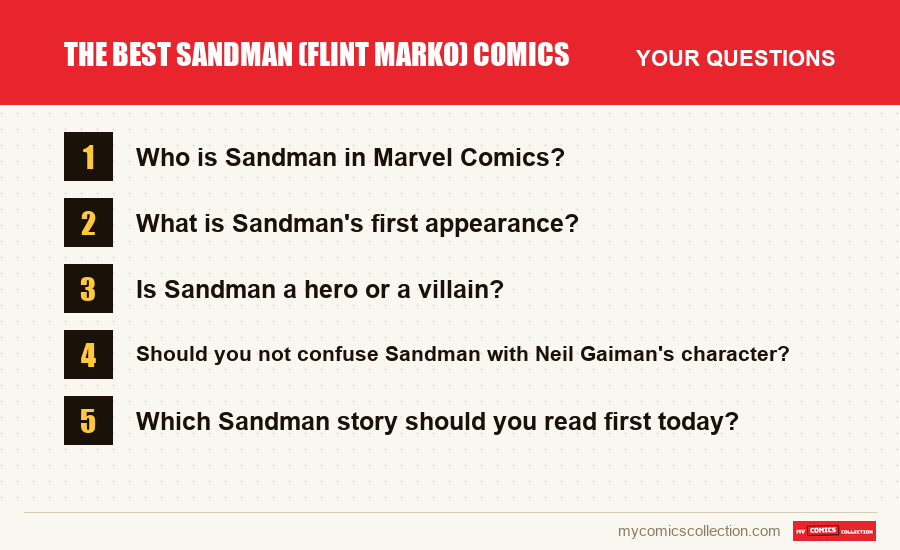
Flint Marko, a criminal whose body turns to sand, and an enemy of Spider-Man. He debuts in The Amazing Spider-Man #4 (1963), by Stan Lee and Steve Ditko, then joins the Sinister Six and the Frightful Four. He later moves between criminal, ally and hero depending on the writer.
He bursts onto the scene in the fourth issue of the series, in September 1963, in a story by Stan Lee and Steve Ditko. That issue is the collectors' reference for the character. It comes after the Vulture and Doctor Octopus issues and precedes the formation of the Sinister Six the following year.
Both, depending on the era. He is born a villain in 1963, becomes more ambiguous in Marvel Team-Up #1 (1972), then flirts with the heroes' side, notably from the 1980s with Marvel Two-in-One #86. Some writers later steer him back toward crime, hence a winding trajectory.
Yes, they are two distinct characters. Flint Marko is an enemy of the web-slinger, born in 1963 in the pages of Amazing Spider-Man. Neil Gaiman's Sandman belongs to a series from another publisher, with no connection to the Spider-Man universe. This article only covers the former.
Start with The Amazing Spider-Man #4 for the origin, then read "Sandblasted" in Friendly Neighborhood Spider-Man #17-19 (2007), by Peter David and Todd Nauck, which shows the character in a more human light. The two reads complement each other and do not require knowing the whole series.
Do you own The Amazing Spider-Man #4 or a 1970s issue featuring Sandman? Get your copy appraised based on its cover date and condition.
Appraise my comic