
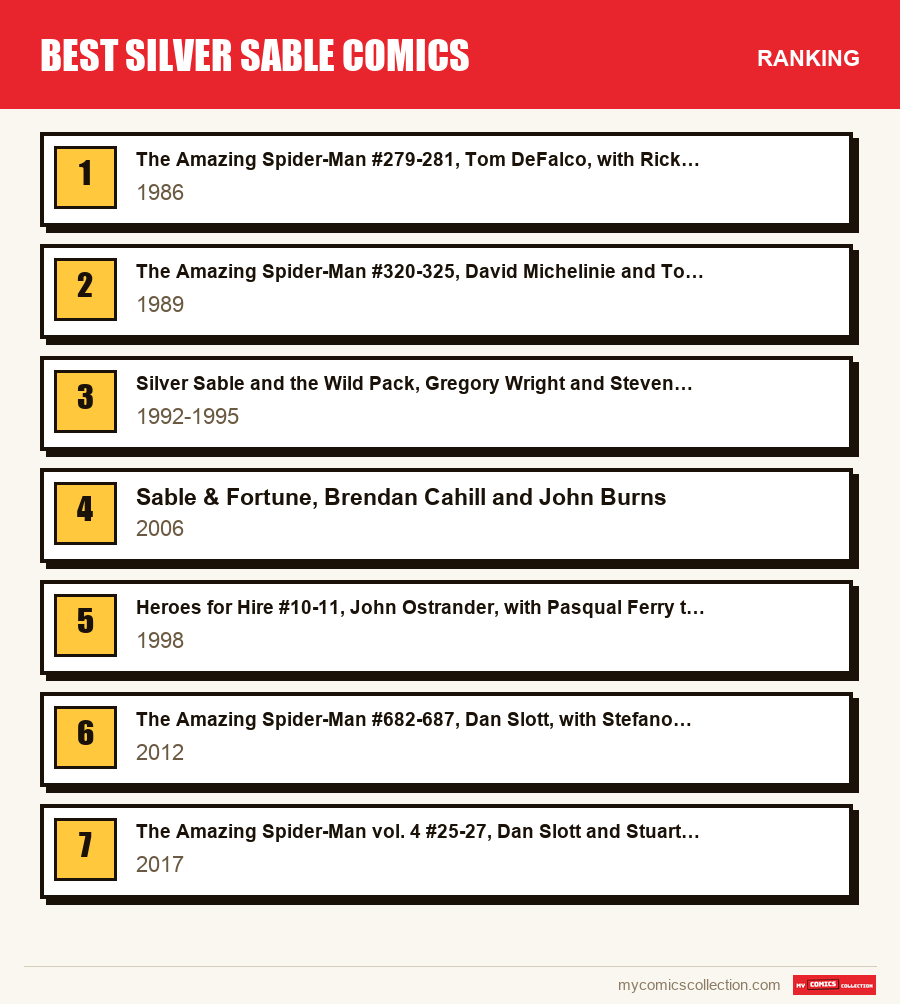
To find the best Silver Sable comics, first read her meeting with Spider-Man in The Amazing Spider-Man #265 (June 1985), her first appearance, then the #279 to #281 trilogy of 1986. Continue with the #320 to #325 arc of 1989 by David Michelinie, and finally the Silver Sable and the Wild Pack series by Gregory Wright (1992 to 1995), which at last gives her the lead.
Silvija Sablinova runs a mercenary company on behalf of a small imaginary Central European country, Symkaria. She has no powers, only a team, the budget of a private army, and one rule: a contract is honored. Seven reads are ranked here, with the audience for each, so you can follow a mercenary who, since 1985, has mostly moved through other characters' series.
As always in this guide, only verified information (creators, issue numbers, dates) is stated as fact; the analysis is ours, with no reproduction of protected pages or dialogue.
Her first appearance
Silver Sable bursts onto the scene in The Amazing Spider-Man #265, dated June 1985. Tom DeFalco writes the issue, Ron Frenz draws it, and Josef Rubinstein inks it. In this story, she pursues the thief Black Fox to recover stolen gems, and it is Spider-Man who, without meaning to, foils her plan. The character thus introduces herself as the opposite of what you expect from an ally: she arrives as an obstacle on the hero's path, with her own clients and her own logic.
That detail matters for what follows. For years, Silver Sable will be less a friend of Spider-Man than a partner of circumstance whose interests cross his. The creators set up in #265 the tension that will feed the best stories: a professional who bills for her services against a hero who refuses to work for money.
Her story, as the comics tell it, goes back to her father, Ernst Sablinov, who led a group of Nazi war criminal hunters and trained her. At his death, she takes over the Wild Pack, which he had built, and founds Silver Sable International, whose operations weigh on Symkaria's economy. The context of the parent series at that date can be found in our Spider-Man reading guide.
1: The Amazing Spider-Man #279-281, Tom DeFalco, with Rick Leonardi then Ron Frenz (1986)
These three issues from August to October 1986 form a major story of their own. In #279, the South African state hires her to neutralize Jack O'Lantern. In #280, she recruits Spider-Man against the Sinister Syndicate. In #281, she teams up with Sandman. Tom DeFalco writes all of it, Rick Leonardi draws #279 with Vince Colletta on inks, then Ron Frenz takes over the pencils on #280 and #281 with Brett Breeding.
What these issues give the character is her mercenary grammar. Silver Sable accepts a contract there that puts her on the wrong side of ordinary morality, then bends her judgment once the mission becomes clearer. You also see how the hero and she negotiate: he sets limits, she points out that her men did not choose them. Sandman, for his part, becomes an ally rather than an adversary, which foreshadows the shifting alliances of the Wild Pack.
Who is this entry for? Readers who want the source of the relationship with Spider-Man and fans of the DeFalco era. How should you read it? As three consecutive single issues, in order. The three episodes follow one another with almost no prerequisites, and they serve as the base for everything else on this list.
2: The Amazing Spider-Man #320-325, David Michelinie and Todd McFarlane, with other artists (1989)
This six-issue arc, collected as a trade paperback under the title The Assassin Nation Plot, brings together Spider-Man, Captain America, Paladin, Solo, and Silver Sable in a hunt for the assassin Sabretooth, with the Red Skull's manipulation in the background. David Michelinie is the writer and Todd McFarlane the main artist, with other artists stepping in on some issues. Silver Sable's fight against Sabretooth takes place in Mexico in #324, and #325, "Finale in Red!", names the Red Skull as the architect of the plot.
This story changes the scale of the character. Until then mostly tied to Spider-Man's affairs, Silver Sable moves here among the major figures of the Marvel universe and leads part of the operations. She is not the star, since the story belongs first to Spider-Man and his allies, but her role as team leader is drawn better here than in earlier years.
Who is this entry for? Fans of the Michelinie and McFarlane era, readers of espionage stories, and anyone who enjoys crossovers between series. How should you read it? With the trade paperback, or issue by issue starting at #320. To place the era, see our page on the key issues of Amazing Spider-Man.
3: Silver Sable and the Wild Pack, Gregory Wright and Steven Butler (1992-1995)
Launched in June 1992 and ended in 1995 after 35 issues, this series puts Silver Sable at the center of the title for more than three years. Gregory Wright writes the script and Steven Butler the pencils. Issue #1, titled "Personal Stakes", pits her against the Hydra organization: a private school is occupied and Sable's niece, Anna, is targeted. Spider-Man and Sandman come to lend a hand, which makes the opening a crossover with the regulars of the parent series.
The series gives the character what occasional guest spots could not: a stable team, colleagues, a small nation's economy to defend, and missions that follow one another without Spider-Man. It shows what it really means to run a private military company on behalf of a tiny country, with the compromises that entails. The inkers change over the course of the run, which gives the collection a somewhat patchwork look, but the spirit of the series stays constant.
Who is this entry for? Readers who want to follow Silver Sable day to day, fans of Marvel's 1990s, and collectors of complete runs. How should you read it? From #1, in order, without rushing: the series is enjoyed by episodes more than by big arcs. It is the read to save for last, once the Spider-Man stories are behind you.
4: Sable & Fortune, Brendan Cahill and John Burns (2006)
This miniseries, published starting in March 2006, was meant to run six issues; the publisher cut it down to four. Brendan Cahill writes it, John Burns draws the first three issues, and another artist takes over the last. The plot pairs Silver Sable with the adventurer Dominic Fortune in a joint operation: unmasking a suspected traitor within the Wild Pack.
The appeal of these four issues is that they flip the usual perspective. Instead of being a guest in a Spider-Man story, Silver Sable is the subject of an investigation that touches her team and her own authority as leader. The betrayal within the group makes her pay the price of her method: you do not run a mercenary company without trust being a contract like any other. Dominic Fortune, an older adventure hero, gives her a partner with a different tone.
Who is this entry for? Readers who like short espionage stories and the curious who want a quieter Marvel. How should you read it? In four issues, after the 1992 series, whose team and stakes it picks up. It requires no prerequisite other than basic knowledge of the character.
Do you collect this series?
Track what you own, what you are missing and what your collection is worth. 7-day trial.
Start my trial →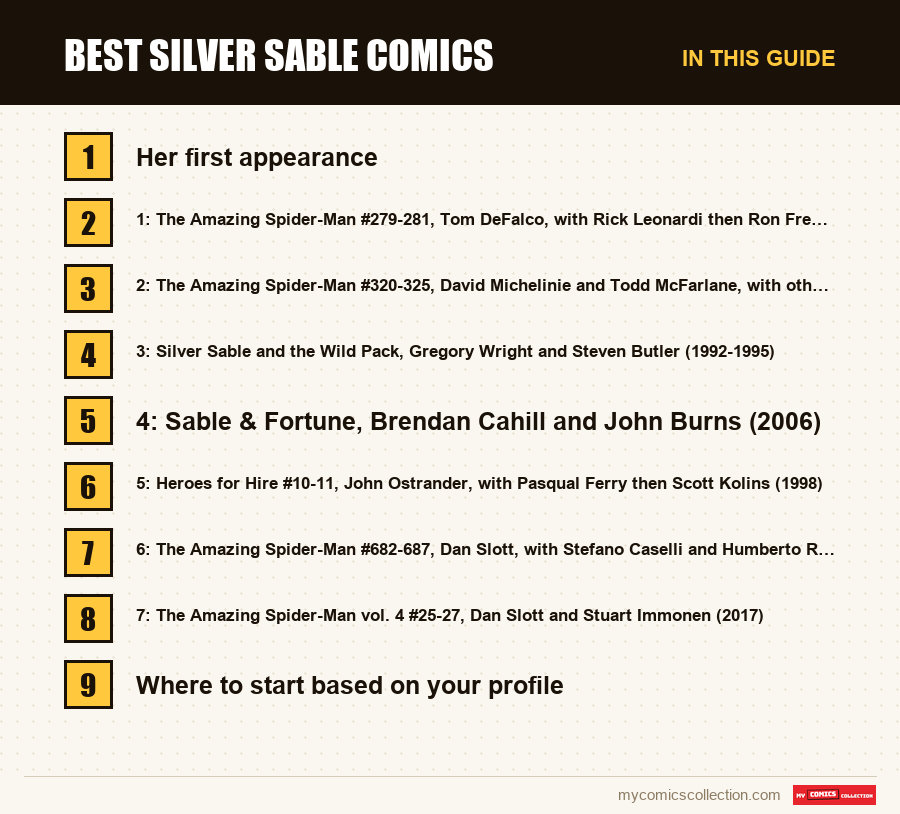
5: Heroes for Hire #10-11, John Ostrander, with Pasqual Ferry then Scott Kolins (1998)
In these two issues from April and May 1998, Silver Sable finds herself on the opposite side from the heroes: she hires a team to protect Professor Wolfgang Hessler, and that team fights the Heroes for Hire. She is therefore not the star of the series, whose title belongs to others, but the adversary in a covert-operations story. John Ostrander writes both episodes, Pasqual Ferry draws #10, and Scott Kolins draws #11.
What this entry offers is a reminder: Silver Sable is a professional whose clients do not always share the heroes' values. She plays the contract antagonist there, with a logic that holds up, which extends the ambiguities of the 1986 and 1989 stories in a drier register, handled by a writer known for his field-level stories.
Who is this entry for? Readers who already know Silver Sable and want to see her in opposition, as well as fans of John Ostrander. How should you read it? In two issues, once the character is understood. Keep in mind that the story belongs first to the Heroes for Hire.
6: The Amazing Spider-Man #682-687, Dan Slott, with Stefano Caselli and Humberto Ramos (2012)
During the "Ends of the Earth" arc, in 2012, Dan Slott makes Silver Sable an ally of Spider-Man and Black Widow against the forces of Doctor Octopus. Stefano Caselli draws the first issues, Humberto Ramos the rest. Silver Sable suffers an apparent death there, blamed on Rhino; Madame Web will later reveal that she is alive.
This entry does not put her in the foreground: the story belongs above all to the duel between Spider-Man and Otto Octavius, and the mercenary is reinforcement in a large-scale tale. It is nonetheless among her most notable passages, because it shows Symkaria and the Wild Pack facing an adversary beyond their ordinary means.
Who is this entry for? Readers of the Slott period and those who want to see Silver Sable in a big event. How should you read it? As part of the complete arc, keeping in mind that her role remains secondary. See also our page on Dan Slott to get a sense of this writer.
7: The Amazing Spider-Man vol. 4 #25-27, Dan Slott and Stuart Immonen (2017)
From May to July 2017, Dan Slott and Stuart Immonen, with Wade von Grawbadger on inks, bring her back to center stage. Silver Sable reveals that she survived by concealing her suit, then asks for Spider-Man's help against a coup aimed at Symkaria, orchestrated by Norman Osborn. The story makes her country the arena of the tale, which gives the mercenary a personal reason to act.
What these issues give the character is a return to her original stakes: the fate of a small nation, the loyalty of her men, and an adversary who mixes economic power with violence. It is also proof that you can bring Silver Sable back into full action without having read the 1990s, since the story stands on its own.
Who is this entry for? Modern readers discovering the character, and those following the Slott period. How should you read it? In the ongoing series of the time, starting at #25, with no major prerequisite other than knowing Norman Osborn.
Where to start based on your profile
You want to understand who Silver Sable is: read Amazing Spider-Man #265, then #279 to #281. These four issues lay out the essentials.
You like espionage stories and crossovers: the #320 to #325 arc, with Sabretooth and the Red Skull.
You are looking for an entire series to follow: Silver Sable and the Wild Pack, starting with #1 of June 1992.
You want a short, standalone story: Sable & Fortune, in four issues.
You follow Spider-Man through his recent stories: the 2017 issues by Dan Slott and Stuart Immonen, then the 2012 event.
You like antagonists who are half right: the two issues of Heroes for Hire. For other figures from the same universe, our page on Black Cat explores a thief who flirts with the hero, as Silver Sable does with the law.
The key issues to know
Collecting landmarks are best read in order of appearance. The Amazing Spider-Man #265 (June 1985) is her first appearance. #279 to #281 (1986) are her joint missions with Spider-Man. #320 to #325 (1989) place her in a big team arc. Silver Sable and the Wild Pack #1 (June 1992) opens the series under her name. These are the issues to hunt for first, in that order.
For these issues from 1985 to 1992, two checks matter before any purchase: that the series is indeed the original volume and not a relaunch, and that the photographs clearly show the spine and the corners. An ordinary, complete copy is better than a rare copy in poor shape. To establish price benchmarks, use our free estimate tool.
One last point concerns internal chronology. The 2012 and 2017 issues belong to the same continuity as those of 1985, but they are not direct sequels: they pick the character up in a new context. You can read them without knowing the details of the 1990s, which explains their popularity with recently arrived readers.
Frequently asked questions
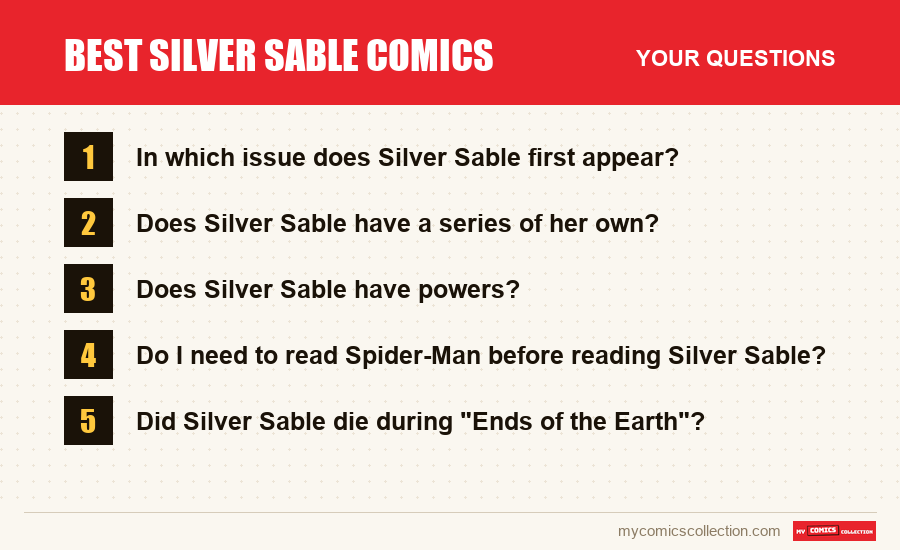
It is The Amazing Spider-Man #265, dated June 1985, that introduces her to the public. The script is by Tom DeFalco, the art by Ron Frenz, and the inks by Josef Rubinstein. She chases Black Fox there, and Spider-Man unintentionally disrupts her operation.
Yes, Silver Sable and the Wild Pack ran from June 1992 to 1995 and totals 35 issues, written by Gregory Wright and penciled by Steven Butler. A miniseries, Sable & Fortune, followed in 2006 and is limited to four issues, by Brendan Cahill.
No. Silvija Sablinova is a fighter trained by her father, Ernst Sablinov, who led a group of Nazi war criminal hunters. Her assets are her training, her suit, her weapons, and above all the Wild Pack, the mercenary team she commands on behalf of Symkaria.
Not necessarily. #279 to #281 of Amazing Spider-Man can be read with no prerequisites, and the 1992 series picks up the useful elements. A few notions are enough: Spider-Man, Sandman, and the Sinister Syndicate. Dan Slott's 2017 stories explain themselves, with a reminder about Norman Osborn.
She suffers an apparent death in 2012, in Dan Slott's issues devoted to Doctor Octopus, where Rhino seems to kill her. Madame Web then reveals that she is alive, and in 2017 Slott and Stuart Immonen explain that she had concealed her suit in order to survive.
Do you have a copy of Amazing Spider-Man #265 or of the 1992 series? Get its condition and resale value estimated.
Estimate my comic