
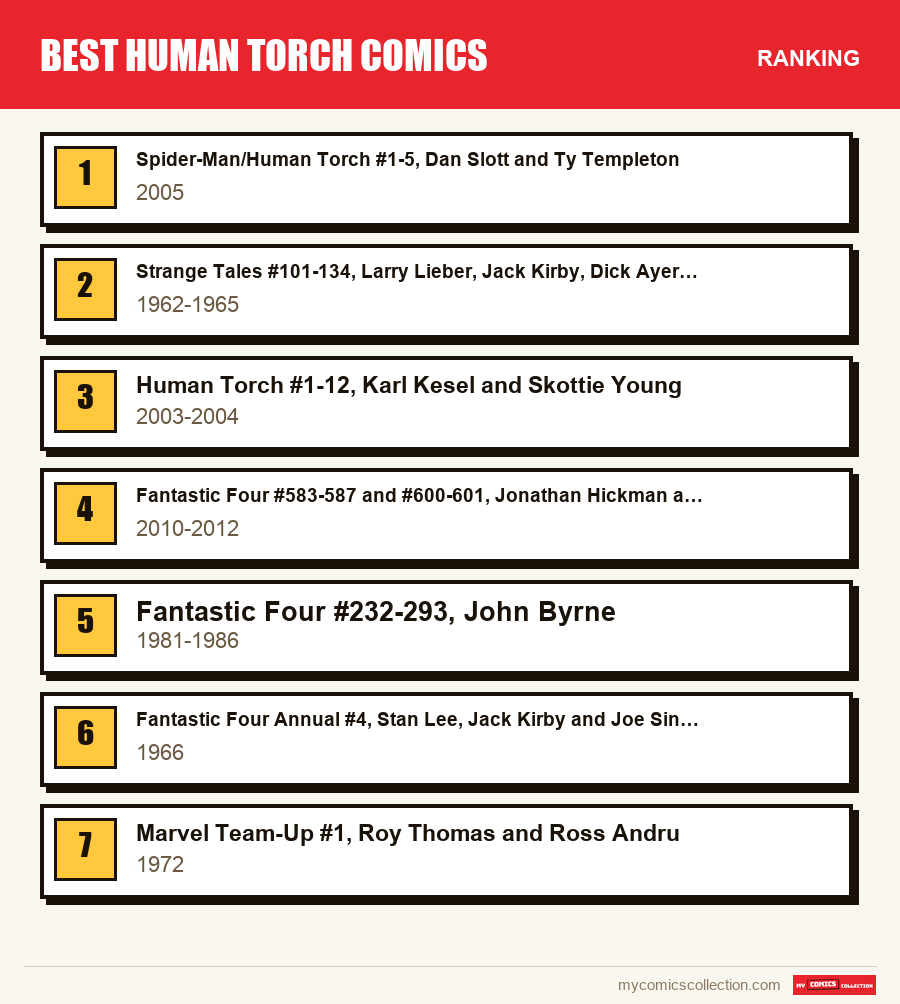
To find the best Human Torch comics, start with Spider-Man/Human Torch (five issues, 2005) by Dan Slott and Ty Templeton, then go back to Johnny's feature in Strange Tales #101 to 134 (1962-1965). The young Storm himself bursts onto the scene in the launch of the Fantastic Four series, an issue from late 1961 scripted by Stan Lee and drawn by Jack Kirby. Don't confuse him with Carl Burgos's android from 1939: two characters, one name.
The Human Torch has an identity problem before you even open an issue: the name belongs to two heroes. The 1939 one is an android; the 1961 one is a Long Island teenager exposed to cosmic rays, Sue Storm's kid brother. This guide ranks the stories that tell Johnny's tale, with what each one brings, which reader it suits and how to approach it.
As always in this guide, only verified facts (creators, issue numbers, dates) are stated as fact; the analysis is our own, with no reproduction of protected art or dialogue.
His first appearance
Johnny makes his entrance with the series itself: Fantastic Four #1, cover-dated November 1961, with Lee on the script and Kirby on the pages. Four passengers on an experimental rocket are hit by cosmic rays; Johnny comes out of it able to set his body ablaze and fly. Issue #4, dated May 1962, gives him a detective's role: he is the one who tracks down an amnesiac Namor, and the encounter brings a major rival of the team into the series. The context of that launch is covered in our page on the team's debut, first appearance of the Fantastic Four. The series' Annual #1, in 1963, also reprints the start of issue #1 with a redrawn Torch, more human and matched to his later look: a handy detail for telling the original from its reprint.
The other Torch goes back to Marvel Comics #1, cover-dated October 1939, at Timely, the forerunner of Marvel. Carl Burgos writes and draws him: he is an android built by Professor Phineas Horton, who bursts into flame on contact with air and goes by Jim Hammond. Lee and Kirby borrowed the name and the power in 1961 for an entirely new character. The two meet in Fantastic Four Annual #4, in November 1966, which brings the android back into modern continuity.
1: Spider-Man/Human Torch #1-5, Dan Slott and Ty Templeton (2005)
This is the most accessible way in for anyone discovering Johnny today. The miniseries runs five issues, published from March to July 2005. Dan Slott writes, Ty Templeton draws; the inking changes from issue to issue. Each chapter is a complete adventure set at a different point in the friendship between Johnny and Peter Parker, and the trade paperback carries the subtitle I'm With Stupid, a nod to the T-shirts the two boys put on at the end.
The tone is comedy: two young men who bicker, bail each other out and start over. The series suits the reader who wants a short story with no prerequisites, and the one who already knows that Johnny is above all a funny character. It reads in one sitting in the trade paperback, in issue order.
2: Strange Tales #101-134, Larry Lieber, Jack Kirby, Dick Ayers and others (1962-1965)
Johnny gets his own feature in Strange Tales starting with issue #101, dated October 1962, and it runs through issue #134, from July 1965. Larry Lieber writes the opening issue, which Jack Kirby draws; Dick Ayers takes over the pencils after about ten issues, and Carl Burgos, creator of the 1939 Torch, is among the artists who follow. Jerry Siegel, the co-creator of Superman, writes issues #112 and #113 under the pen name Joe Carter. The Thing joins the feature from issue #123, in August 1964, and the feature gives way to Nick Fury with issue #135, in August 1965.
The appeal of these pages is that they turn Johnny into a feature star: impulsive, vain, always ready to answer a challenge, he builds himself apart from the rest of the team. Reading a collected edition is enough to feel the contrast with the more solemn tone of the flagship series.
These twelve- to fourteen-page stories show a high-school Johnny, still living with his sister, facing short-format enemies. These pages are aimed at the reader drawn to the Silver Age and to how a feature star gets made out of a team member. The easiest way to read them is through reprints: the 1974-1975 series The Human Torch, in eight issues, reprints these solo episodes. Our page on Strange Tales #110 shows how Doctor Strange came to share the same issue in 1963.
3: Human Torch #1-12, Karl Kesel and Skottie Young (2003-2004)
The solo series of the 2000s runs twelve issues, from June 2003 to June 2004. Karl Kesel writes; Skottie Young draws the opening, in a round, highly stylized line, while other artists, including Howard Porter and Paco Medina, handle the final issues. A complete collected edition of the whole run exists, which saves you from chasing twelve single issues.
It is for the reader who prefers Johnny outside his team: the series gives him the lead, a light tone and an art style that stands apart from the Fantastic Four of the day. The change of artist near the end makes for a visually uneven series, but the whole thing reads with no preparation beyond knowing the character.
4: Fantastic Four #583-587 and #600-601, Jonathan Hickman and Steve Epting (2010-2012)
This is the big modern turning point. In issue #587, published in January 2011, Johnny stays behind in the Negative Zone to seal a passage against Annihilus's troops, and he vanishes. Jonathan Hickman writes the whole thing, Steve Epting draws issues #583 to 587 as well as #600 and 601. Issue #600, published for Marvel's fiftieth anniversary and dated January 2012, shows that he has been revived by Annihilus and forced to fight for him; issue #601 supplies the explanation. Hickman writes issues #570 to 588 and then #600 to 611 of the series in all, from 2009 to 2012, which makes this stretch the conclusion of a long-term plan rather than an isolated event.
Here, Johnny carries a drama, and the story targets the reader ready to follow him into it. It asks that you know the team and its ties to the Negative Zone, but Hickman sets up the essentials within the issues themselves. To place the writer within his body of work, our page Jonathan Hickman: where to start offers a complete reading path.
Do you collect this series?
Track what you own, what you are missing and what your collection is worth. 7-day trial.
Start my trial →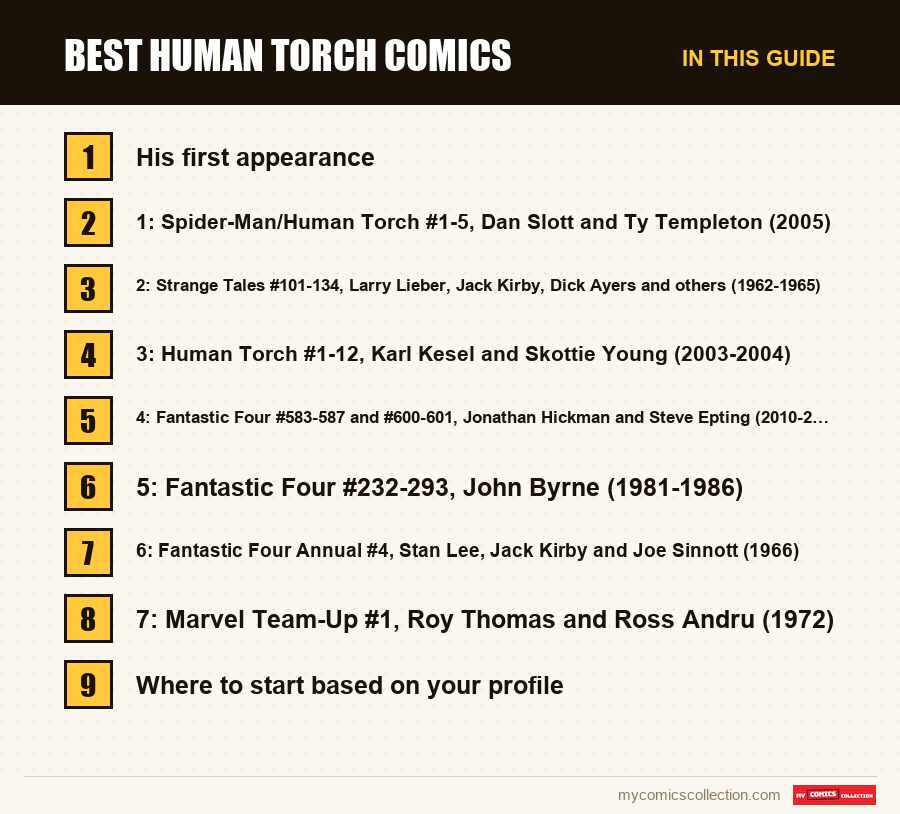
5: Fantastic Four #232-293, John Byrne (1981-1986)
John Byrne handles script, pencils and inks on the series from issue #232, dated July 1981, through issue #293, in August 1986. For Johnny, the period features a relationship with Frankie Raye, which ends in issue #244 (July 1982), when she agrees to become a herald of Galactus. The whole run is a benchmark for anyone who wants to read the Fantastic Four in tight writing, and Johnny shares the spotlight there with the three other members.
Note: this entry ranks a team run, not a story devoted to Johnny. It suits the reader who has already sampled the Silver Age and wants a denser next step. To place this work in context, see John Byrne: where to start or the creator's hub.
6: Fantastic Four Annual #4, Stan Lee, Jack Kirby and Joe Sinnott (1966)
This November 1966 annual brings the two Torches together. The Mad Thinker reactivates the body of the 1939 android and turns it against the team; the fight pits the old Torch against Johnny. The story ends when the android regains control of himself. The issue also introduces Quasimodo and reprints a Thing versus Hulk story.
It is aimed at the collector and at the reader curious about the lineage of the name: it is the meeting that clears up the ambiguity between 1939 and 1961. The story is self-contained and assumes no follow-up reading. Annuals form a collection of their own, detailed in our page on the key Fantastic Four annuals and specials.
7: Marvel Team-Up #1, Roy Thomas and Ross Andru (1972)
The series launch, dated March 1972, pairs Spider-Man and the Torch for a Christmas Eve adventure against Sandman, in New York and New Jersey. Roy Thomas writes, Ross Andru draws. Johnny is one of the two heroes of the issue, but the formula does not last: the series soon gives up a fixed co-star, after three issues with Johnny, in favor of a different guest in each episode.
This read is for the Bronze Age reader and for anyone who likes team-ups. It also serves as a collecting benchmark: our page on Marvel Team-Up #1 explains why this issue matters even though it introduces no new character.
Where to start based on your profile
You want to laugh and move fast: read Spider-Man/Human Torch in the trade paperback. You are after the Silver Age sources: take Strange Tales #101 to 134, then Fantastic Four #1 to 4. You prefer a modern drama: aim for Fantastic Four #587 and its follow-up in issues #600 and 601. You like offbeat solo series: the 2003 series by Kesel and Young is made for you.
If you want to understand both Torches before buying anything, open Fantastic Four Annual #4: in a single story, it puts the 1939 android face to face with the 1961 hero. To widen out to the team afterward, our best Fantastic Four runs rank the eras worth reading.
The key issues to know
For the lineage of the name, remember Marvel Comics #1 (October 1939), Fantastic Four #1 (November 1961) and Fantastic Four Annual #4 (November 1966), which ties the two together. Fantastic Four #4 (May 1962) marks the meeting with Namor, and Strange Tales #101 (October 1962) opens Johnny's solo feature. On the Spider-Man team-up side, it is Marvel Team-Up #1 (March 1972).
The modern turning points are Fantastic Four #244 (July 1982) for the end of the relationship with Frankie Raye, #587 (January 2011) for Johnny's disappearance and #600 for his return. For each one, proceed as follows: note the cover date on the issue, identify the original print run and its reprints, then cross-check several completed sales. For 1962, physical condition weighs most; for 2011, it is the exact identification of the printing.
Frequently asked questions
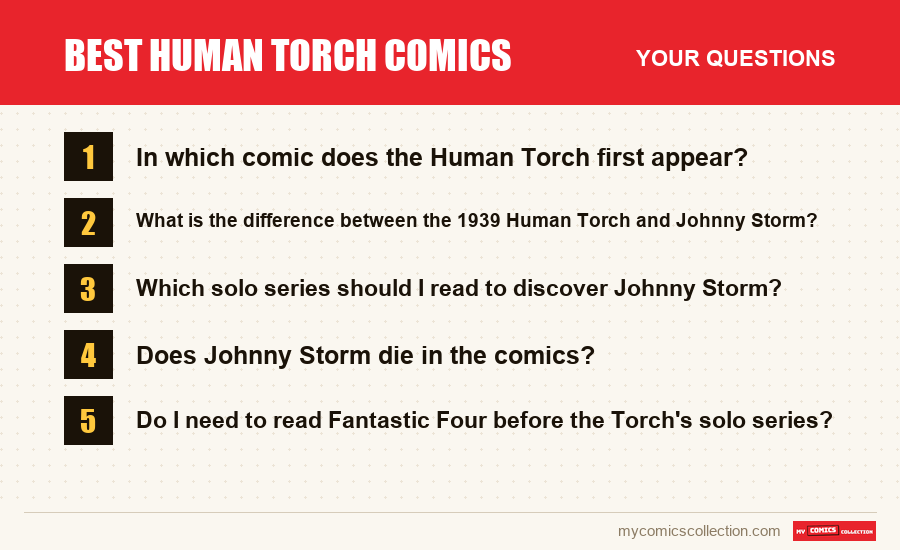
It depends on which one. Carl Burgos's android appears in Marvel Comics #1, cover-dated October 1939. The Fantastic Four hero, Johnny Storm, is born in issue #1 of their series (November 1961), the work of Lee on the script and Kirby on the art. The two characters share a name, not an origin.
The 1939 Torch is an android created by Professor Phineas Horton, known as Jim Hammond. Johnny Storm is a human given powers by cosmic rays, a member of the Fantastic Four. The two cross paths in Fantastic Four Annual #4, dated November 1966.
For a short, modern read, take Spider-Man/Human Torch by Dan Slott and Ty Templeton, in five issues (2005). For the sources, read the Strange Tales feature in #101 to 134. For a full series, there is Human Torch by Karl Kesel and Skottie Young, in twelve issues (2003-2004).
He disappears in Fantastic Four #587, published in January 2011, written by Jonathan Hickman and drawn by Steve Epting, while defending a passage in the Negative Zone. He returns in issue #600, revived by Annihilus, and issue #601 supplies the explanation.
No. Spider-Man/Human Torch and the 2003 series read with no preparation beyond knowing the character. If you want the sources, Fantastic Four #1 to 4 introduce the team and Namor in a handful of issues from 1961 and 1962, before the Strange Tales feature.
Do you own a Strange Tales from the Torch era or an early Fantastic Four? Get it appraised before you shelve it.
Appraise my comic