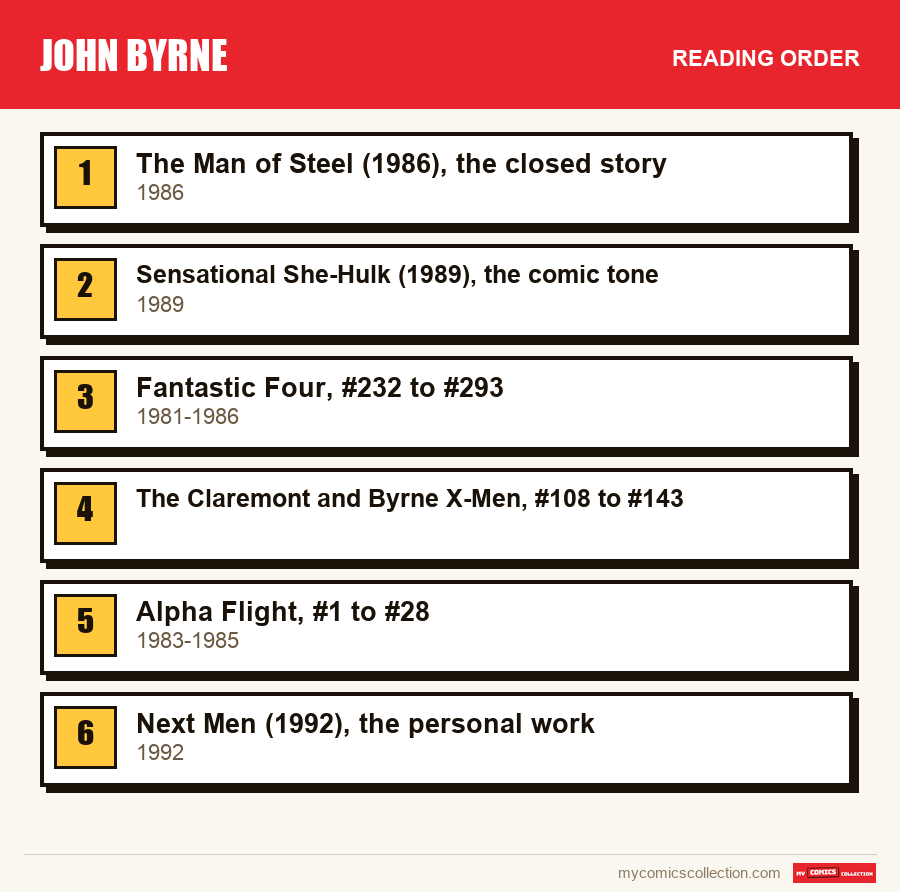
To read John Byrne, start with the 1986 miniseries The Man of Steel, six issues that tell a complete story, then move on to the comic tone of Sensational She-Hulk (1989). Next come Fantastic Four (#232 to #293), the Claremont and Byrne X-Men (#108 to #143), Alpha Flight (#1 to #28) and finally Next Men (1992), Byrne's most personal work. The path has six steps, ordered from easiest to most demanding.
John Byrne has written and drawn for almost every major American publisher, sometimes working on unrelated series within the same decade. The catalog is huge, so the question is not whether Byrne is worth reading, but where to enter without drowning in series that assume years of continuity knowledge. This guide offers a route: a reading order that moves from the self-contained story toward the most demanding work.
As always in this guide, only verified information (creators, issue numbers, dates) is stated as fact; the analysis is ours, with no reproduction of protected pages or dialogue.
What sets Byrne apart as a read
Before choosing an entry point, it helps to know what to look for in this creator, because three traits run through the whole output. The first is readability: Byrne draws with a clarity of storytelling that lets you follow an action scene without rereading it. The second is a taste for continuity: on the series Byrne writes, the past of the character gets revisited, origins get reorganized, and old episodes are called back. The third is the drive to control everything: whenever possible, Byrne writes, draws, sometimes inks and lays out the covers, which gives the series a very personal tone.
These traits explain the order proposed here. We put first the works that can be read cold, then those that assume a minimum of genre literacy, and last the projects where Byrne rules alone, at full risk. If you are looking for a biography, this guide is not one: we preferred reading order to career chronology.
Step 1: The Man of Steel (1986), the closed story
Six issues, one creator, one complete story. The October 1986 miniseries is written and drawn by John Byrne, with Dick Giordano on inks, and it serves as a new first page for Superman after the great reshaping of the DC universe. You read the end of Krypton, the arrival with the Kents, the start of Clark's career in Metropolis, the meeting with Lois Lane and a rethought version of Lex Luthor. Nothing requires prior knowledge of the character, since the series was designed precisely to start from zero.
Why start here: it is the most accessible work by the creator, and the one that best shows the method of rebuilding. Each issue settles one thread (origin, first costume, enemies, supporting cast), which makes for a brisk read. We go through the first issue in our entry on The Man of Steel #1.
As a follow-up, Byrne also launched the regular Superman series in January 1987, but that continuation is more uneven and not essential for the rest of the path. Whether you want collected editions or single issues, the miniseries is easy to find; buying all six original issues remains one of the simplest projects in the whole body of work.
Step 2: Sensational She-Hulk (1989), the comic tone
The second rung is a complete change of register. Launched in 1989, Sensational She-Hulk hands Byrne a secondary character who gets treated with humor, turning Jennifer Walters into a heroine who knows she belongs to a comic book and speaks directly to the reader. Byrne writes and draws the first issues, then returns to the series later; the exact credits should be checked issue by issue on the indicia.
Why this step: it proves that Byrne can be read without solemnity, and it requires no prior knowledge. The pleasure comes from the staging of the genre itself, with winks at the conventions of American comics. It is also the period that gave She-Hulk her lasting identity, as our ranking of the best She-Hulk runs shows.
How to approach it: in single issues the series poses no particular difficulty; in collected editions, check the range of issues covered, because the volumes do not all reprint the same episodes. This step is optional if you prefer serious stories, but it sheds light on how Byrne handles humor, a spring that is easy to forget when Byrne gets reduced to the X-Men.
Step 3: Fantastic Four, #232 to #293 (1981-1986)
The third step is a longer one: sixty-two issues of a monthly series, written and drawn by Byrne from 1981 to 1986. It is the cycle that earns Byrne a place beside Jack Kirby in the history of the Fantastic Four, and the one that ranks high on most lists, including our feature on the best Fantastic Four runs.
What the cycle brings: a return to the family core and the original scientific ambition, old antagonists revisited (Doctor Doom, Galactus, Namor) and some play with the cast. The trial of Galactus, in issues 242 to 244, is among the most cited episodes, and the arrival of She-Hulk on the team to replace the Thing is one of the most visible changes. The starting credits should be checked on the indicia of the first issues.
Who this step is for: a reader who has already tasted a self-contained story and is willing to commit for the long haul. You do not need to read the two hundred issues before; still, knowing who Reed, Sue, Johnny and Ben are, and what Latveria is, makes the start easier. Our Fantastic Four reading guide covers the basics, and the landmark issues of the period are summarized in the Bronze Age keys.
Step 4: The Claremont and Byrne X-Men, #108 to #143
The fourth step is the best-known work by the creator, but not the easiest to enter. From 1977 to 1981, Uncanny X-Men is drawn by John Byrne, most often inked by Terry Austin, on scripts by Chris Claremont to which Byrne contributes as co-plotter. The cycle runs thirty-six issues, from #108 to #143.
Why not start here despite its reputation: the story assumes a team already in place, characters with rivalries and relationships already running, and plots that stretch over several issues with parallel subplots. A reader who opens #108 cold will have to rebuild part of the context. It is better to come in after the earlier steps, reading first the Dark Phoenix Saga (around issues 129 to 138) and the Days of Future Past diptych (#141 and #142, presented in our entry on issue 141).
What this cycle brings: a serial rhythm and a gallery of characters that still shapes the franchise. It also shows how Byrne draws an ensemble of heroes, with action layouts that remain models. To place these thirty-six issues within the whole series, open the X-Men reading guide or the ranking of X-Men runs.
Do you collect this series?
Track what you own, what you're missing and what your collection is worth. 7-day trial.
Start my trial →
Step 5: Alpha Flight, #1 to #28 (1983-1985)
The fifth step is a project where Byrne is master of the house. Alpha Flight #1 is dated August 1983 and launches a series of 130 issues; Byrne writes and draws the first twenty-eight, around a Canadian team whose faces are Guardian, Puck and Marrina. A first appearance in Uncanny X-Men #120 and #121 dates from 1979, but the team's voice is born in its own title.
Why this step comes so late: the series rests on characters the reader has to learn to tell apart, with serialized plots and continuity shocks that only carry weight if you are attached to the protagonists. It is a very good example of Byrne without a net, with its strengths (an endearing group, a strong national identity) and its limits (a pace that is sometimes dense). We go through the first issue in the entry on Alpha Flight #1.
How to approach it: in single issues, as with most series from this period, the range #1 to #28 forms a clean set, matching exactly the stretch where Byrne works alone; beyond that, the teams change and the tone changes with them. It is a collecting project with clear boundaries.
Step 6: Next Men (1992), the personal work
The last rung, and the most demanding: Next Men, which Byrne publishes at Dark Horse starting in 1992. The project belongs to the creator, who writes, draws and controls everything; the series runs about thirty issues and follows a group of young people with abilities that come from an experiment carried out without their knowledge. The register is serious science fiction, with a story that unfolds slowly and weaves together several timelines.
Why read it last: it is the text where the creator depends on no franchise, so it is the most revealing, but also the one that demands the most patience. A reader who has reached this stage already knows Byrne's manner, obsessions and way of pacing revelations; that is what the path aims to provide. Avoid it if you are looking for a way in: Next Men is not a starting point.
How to collect it: the original issues from the independent publisher are generally easy to find, but condition and edition vary from issue to issue; check the publisher line and the year on the indicia before buying.
How to read: single issues or collected editions
There are two routes, depending on what you want. The original single issue gives the reading as it was experienced: ads, letter columns and period pagination. It does mean gathering ranges of issues, with the uncertainty of condition and the risk of gaps. The collected edition gives continuous access, sometimes recolored pages and simpler logistics, but it does not always reprint every episode of a period, and the range covered varies from one volume to the next.
Our advice for this path: read in collected editions if your goal is to discover the creator, and complete in single issues the sets that struck you. A cycle with clean boundaries, such as Alpha Flight #1 to #28 or The Man of Steel in six issues, is an excellent candidate for the original collection. Long cycles, like the thirty-six X-Men issues, call for more method.
If you want to widen the path, there are two side tracks: the early work with Chris Claremont on Iron Fist, around 1975 to 1977, where Sabretooth makes a first appearance in issue 14, and the collaboration with Roger Stern on Captain America, around issues 247 to 255. These are extras, not steps.
Recap: the recommended order
- Step 1: The Man of Steel (1986), six issues, complete story.
- Step 2: Sensational She-Hulk (1989), humor and fourth-wall play.
- Step 3: Fantastic Four #232 to #293 (1981-1986), the long-haul cycle.
- Step 4: Uncanny X-Men #108 to #143, with Dark Phoenix and Days of Future Past.
- Step 5: Alpha Flight #1 to #28 (1983-1985), the home project.
- Step 6: Next Men (1992), the work without a net.
On the collecting side, a word of method. Byrne's series do not all share the same scarcity: the key X-Men issues are sought after, the Fantastic Four and Alpha Flight cycles are more affordable, and She-Hulk or Next Men issues are easy to assemble. To compare, set the median of completed sales for one issue from each step against that of the neighboring step, in the same grade, rather than reading a single price. To value a specific copy, use our free estimator.
Frequently asked questions
Start with The Man of Steel, the six-issue miniseries from 1986. It is written and drawn by Byrne, can be read without knowing Superman, and forms a complete story. It gives the best overview of the method before you commit to the long Fantastic Four or X-Men cycles.
No, we recommend the opposite. Fantastic Four #232 to #293 can be read with a minimum of background, whereas X-Men #108 to #143 assume an established team and ongoing subplots. The FF cycle works as training before the Dark Phoenix Saga.
If you do not want to read all thirty-six issues from #108 to #143, keep the Dark Phoenix Saga around #129 to #138, then Days of Future Past in #141 and #142. These are the two most cited sets, and they read as relatively self-contained stories.
No. This personal series published by Dark Horse in 1992 demands patience and some distance from the creator's habits. It makes sense at the end of the path, once you have seen the commissioned series where Byrne works with heroes that belong to someone else.
It depends on the goal. For discovery, the collected edition is simpler, as long as you check the range of issues covered. For collecting, sets with clean boundaries (The Man of Steel, Alpha Flight #1 to #28) suit original single issues well, unlike the long cycles.
Do you own Byrne issues, from Uncanny X-Men #129 to Alpha Flight #1? Estimate them before shelving them or sending them for grading.
Estimate my comic