Alpha Flight #1, dated August 1983, launches the monthly series of the Canadian team, written and drawn by John Byrne. The team is not new: it had appeared in 1979 in Uncanny X-Men #120 and #121. Issue #1 is above all the one where Puck and Marrina make their debut, and the one where the lineup becomes a title of its own. Collectors seek it as the start of a 130-issue series, with no particular scarcity.
Most superhero teams are born in a first issue that carries their name. Alpha Flight took the opposite path: the group appeared as a guest in another series, proved popular, then got its own title four years later. This two-stage chronology is exactly what makes the first issue tricky to qualify, and what forces the buyer to know precisely what is being paid for.
As always in this guide, only verified information (creators, issues, dates) is stated as fact; the analysis is ours, with no reproduction of artwork or protected dialogue.
Alpha Flight #1: release date, team and plot
The comic is dated August 1983 and inaugurates a series that will run to #130, in 1994. Byrne writes and draws the series alone for its first twenty-eight issues. Who inks, who letters, who colors: the reference listings disagree, and the indicia page of your copy remains the only reference.
The action is set in Canada and gathers the team around Guardian, whose real name is James Hudson, who was called Vindicator in the pages of the X-Men; sources place this name change at the opening of the series. The details of the plot are best checked by reading, but the stance is clear from this first issue: these characters are Canadians before they are heroes, with loyalties, accents and regional rivalries that Byrne takes pleasure in drawing.
The issue above all introduces two new members. Puck, a small acrobat with extraordinary fighting skills, and Marrina, a woman of mysterious origin tied to the sea, make their first appearance here. These two entrances, far more than the team itself, give #1 its status as a first-appearance issue.
The editorial context: Byrne after the X-Men and during the Fantastic Four
When Alpha Flight #1 comes out, Byrne is one of the publisher's most in-demand creators. Byrne left Uncanny X-Men in 1981, at the peak of a collaboration with Chris Claremont that had shaped the series, and has since been signing the Fantastic Four, which Byrne draws and writes. Landing a second monthly series, with the freedom of a title built around personal characters, was an editorial gamble.
It is worth measuring what this choice means. Byrne does not take over an existing series, but inherits a group Byrne helped imagine for the X-Men and develops it without worrying about anyone else's continuity. For more than two years, Byrne writes, draws and sets the mood of the series; it is the only moment in its history when the team has so consistent a voice.
The commercial context worked the other way. American publishing at the time was betting on sales in specialty shops, increasingly decisive, and team series tied to a creator's name found a loyal audience there. Alpha Flight benefited, which explains its longevity despite Byrne's departure at #28: the title continued under other pens for nearly ten years.
Alpha Flight before Alpha Flight: Uncanny X-Men #120 and #121 (1979)
This is the point that many listings blur. The team first appeared in 1979, in Uncanny X-Men #120 and #121, written by Chris Claremont and drawn by Byrne. It is sent there by the Canadian government to recover Wolverine, who had been part of the program before joining the X-Men. Its main members are met there: Guardian, Sasquatch, Shaman, Northstar, Aurora and Snowbird, presented as an organized operational force.
In other words, Alpha Flight #1 is not the first appearance of the team, nor of most of its members. The distinction shows up at resale: a buyer looking for "the first appearance of Alpha Flight" actually wants X-Men #120, and one looking for "the first issue of the series" wants the August 1983 #1. The two comics are not interchangeable, and their prices do not line up.
The remaining nuance, which justifies the place of #1 in this guide, comes down to two characters: Puck and Marrina did not yet exist. For anyone collecting all the members, the 1983 #1 is the only issue that lets you own them at their origin.
Why Alpha Flight #1 became a key issue
Three reasons add up. The first is first-issue status: a 130-issue series starts here, and the first-issue market keeps a steady premium whatever the series. The second is Byrne's signature, whose years on Fantastic Four, X-Men and Superman made a name that buyers look for. The third is the two first appearances, even if Puck and Marrina lack the weight of a top-tier character.
To these reasons is added a quieter asset: the series kept committed readers, attached to its tone, and some of its issues remained landmarks. #12, for example, tells the death of Guardian, a shock for readers at the time. When a neighboring issue draws attention, #1 benefits by ricochet.
On the other hand, it pays to stay clear-eyed: Alpha Flight is not a top-tier series. Its characters only return occasionally in the publisher's current output, and #1 does not sell as a benchmark issue. It is a piece for Byrne fans or for Copper Age collectors, not a safe haven.
What moves the price of Alpha Flight #1: condition, edition, print run
This 1983 issue was printed in large quantity, so decent copies are not hard to come by. The price therefore rests on the scarcity of near-mint condition, not on that of the issue. Covers from the eighties stand up well to time when they were stored flat, and the typical flaws are spine creases, crushed corners and fold marks at the staples.
Between the everyday copy and the one that tops the scale, the relative gap is wide: very few 1983 comics made it through four decades without the slightest trace. One grade step at the top of the scale can double the price, while a step in the middle zone barely moves it.
Valuation method: note three completed sales at the same grade, drop the highest and the lowest, then compare the median with the listing you are aiming at. For a high-print-run issue, this approach is enough to spot offers disconnected from the market.
Telling one edition from another: newsstand, shop, collected editions
In 1983, Marvel distributes each issue in two versions. The newsstand edition, meant for news vendors, carries a barcode in a cover corner; the edition reserved for specialty shops replaces that code with an illustrated box. This difference can be checked at a glance, and our comparison details what each version is worth. Both circulate, the second sometimes better preserved because it sold to an audience of collectors.
Reproductions are of a different nature. Byrne's content has been gathered in collections: an omnibus-type edition devoted to Byrne's run on the series, as well as classic collected volumes. They serve for reading, never for collecting single issues, and their scope varies from one volume to the next. For the decision between reading in book form and collecting in single issues, the guide on albums versus single issues develops the arguments.
As for French versions, the existence of a translation of #1 and the way it was divided depend on the collections of the period; sources diverge, and the numbering specific to each volume must be checked before assuming it matches the original.
Do you collect this series?
Track what you own, what you're missing and what your collection is worth. 7-day trial.
Start my trial →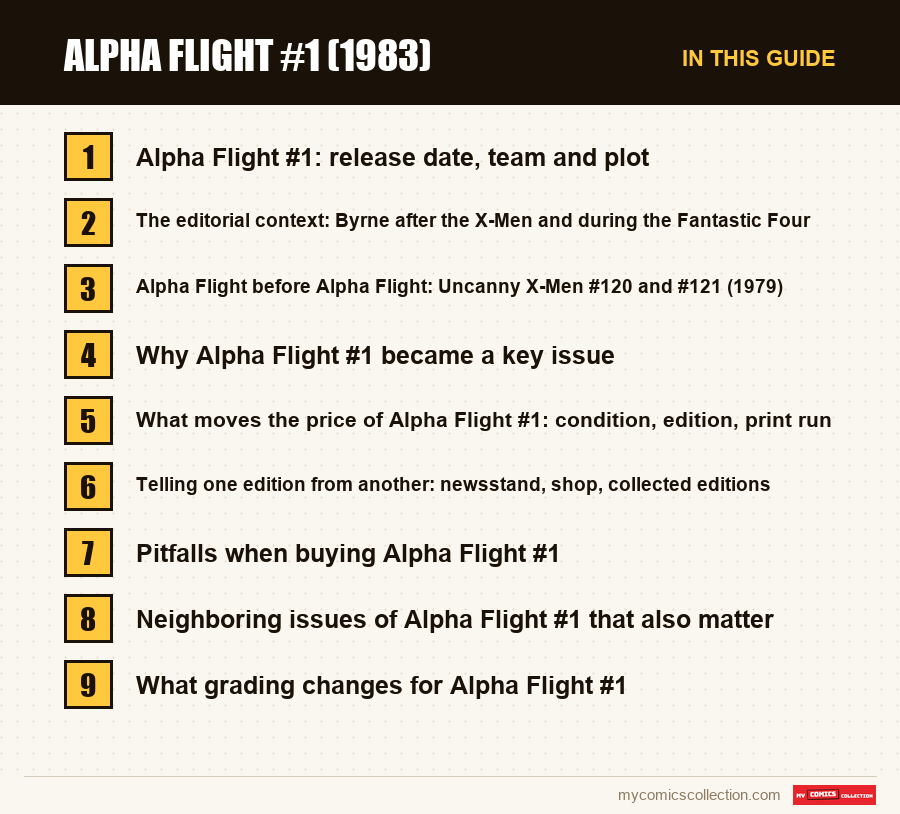
Pitfalls when buying Alpha Flight #1
The most frequent pitfall is mixing it up with the relaunches. Marvel produced other Alpha Flight series, in 1997, then in 2004, 2011 and more recently, each with a first issue. A listing that doesn't specify the year may point to one of them; insist on the August 1983 date and Byrne's name in the indicia.
Second pitfall: selling this issue dressed in an argument that belongs to X-Men #120, by speaking of a "first appearance of Alpha Flight". The argument is true for another comic and approximate for this one. Read the listing with that nuance in mind, and don't pay a premium that isn't owed.
Third pitfall: price variants. Some Marvel comics of the period circulated with Canadian prices printed, which, for a Canadian series, adds a curiosity. Our guide to Canadian price variants explains how to recognize them; the existence of such a version for this specific issue is not assured here, and it must be verified before presenting it as an asset.
Neighboring issues of Alpha Flight #1 that also matter
The first neighbor is Uncanny X-Men #120, from April 1979, where the team makes its entrance, followed by #121 which concludes the clash. These two comics are the true first appearances of the team, and they sit in a highly sought-after period of the X-Men series. For benchmarks of that era, our article on #129 of the same title shows how the market values an issue from this cycle.
In the series itself, #12 tells the death of Guardian, and #28 closes Byrne's run and marks a clear border: below it, the series carries its creator's signature; above it, it becomes a relay series. Much later issues also have their audience, notably #106, where Northstar reveals his orientation, a moment that mattered to readers and that the market has noticed.
To put the whole in perspective, the articles on first appearances of teams help distinguish what belongs to the birth of a group from what belongs to the birth of a series.
What grading changes for Alpha Flight #1
On a high-print-run issue, certification follows a different logic from that of rare comics. It is not there to authenticate: it is there to tell copies apart. An ungraded copy in decent condition trades at a level that does not always justify the shipping costs; a copy that looks flawless, on the other hand, deserves careful study, since the gain in grade can be high on a comic this common.
Learn to read a label as well. Each color flags a category: unrestricted copy, restored copy, signed copy. Our guide to reading a grading label details the meaning. If you buy an already certified copy, compare its grade with completed sales at the same grade, not with listings.
Finally, visual appeal weighs in. Alpha Flight #1 has a very colorful cover, and early-eighties printers sometimes left registration shifts or uneven color edges. These details don't always appear in the grade, and they justify looking at the copy rather than reading the number.
How to track Alpha Flight #1 in a collection
Several logics coexist. The Byrne collector will shelve #1 with the other series debuts Byrne signed, next to the first issue of The Man of Steel. The X-Men collector will pair it with X-Men #120 and #121, to build a small set on the Canadian team. The complete-series collector will aim for the 130 issues, a long but achievable goal because most of the comics remain accessible.
In every case, note the condition, the edition (newsstand or shop) and the purchase date, and keep the successive series apart so as not to mix 1983 with the relaunches. For fans of the Wolverine character, that character's hub recalls why he is the link between the two series.
Conclusion: Alpha Flight #1 in brief
Alpha Flight #1 is a good issue, not a rare one. It marks the start of a long series, the first appearance of Puck and Marrina, and a moment in John Byrne's career. The group's first appearance belongs to Uncanny X-Men #120 and #121, and remembering that precision avoids overpaying. Buy it for the condition, for the creator and for the series, without lending it a status it does not have.
Frequently asked questions
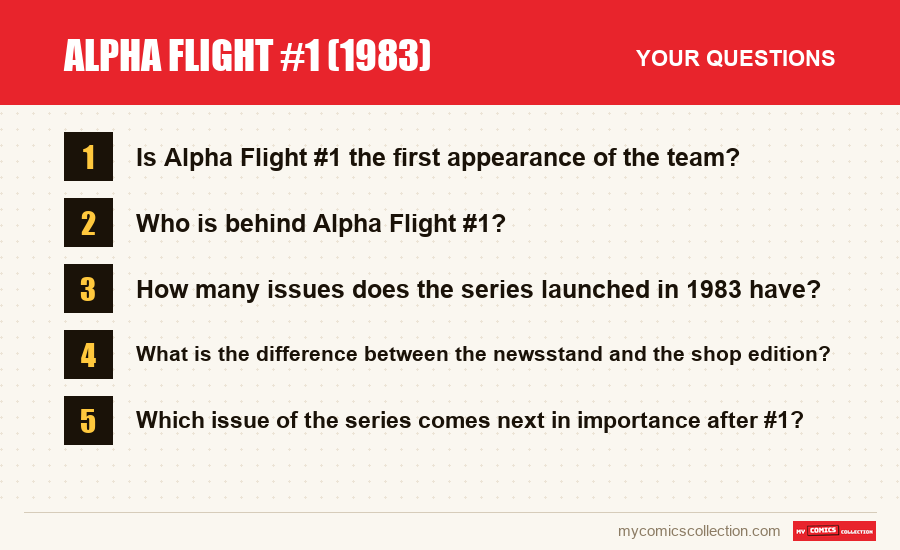
No. The group debuted in 1979 in Uncanny X-Men #120 and #121, with text by Claremont and art by Byrne. Alpha Flight #1, from August 1983, is the first issue of the dedicated series, and the first appearance of Puck and Marrina. Don't confuse the two in a listing.
John Byrne handles the script and the art, and keeps this double role until #28 of the series. Inking and lettering credits differ depending on the listings consulted; the indicia of the copy is the surest reference before citing a name in your inventory.
The series has 130 issues, from 1983 to 1994. Byrne signs only part of them, up to #28, before other creative teams take over. Completing it is a long but realistic project, because most comics of the period were widely printed and remain easy to find.
The newsstand edition carries a barcode in a cover corner, while the specialty-shop edition shows an illustrated box in its place. The content is identical. Both are authentic; the difference is an identification marker, and the price depends first on condition.
#12, which tells the death of Guardian, is one of the series landmarks, and #28 marks the end of Byrne's run. Much later, #106 is cited for the moment Northstar affirms his orientation. None rivals X-Men #120 for the team's first appearance.
Do you own a 1983 Alpha Flight #1 or a 1979 Uncanny X-Men? Estimate it according to its condition and edition.
Estimate my comic