
Collect Amazing Spider-Man #1-100 (Silver Age, 1963-1971): full budget estimated from $200,000 for mid-grade (4.0-6.0) to more than $2 million for high-grade (8.0+). Ultra-rare numbers: #1 (CGC 6.0 = $80,000-120,000), #14 (1st Green Goblin = $8,000-15,000 in 7.0), #50 ("No More" = $8,000-12,000 in 7.0). Recommended strategy: complete in mixed grades over 5-10 years.
Collect the first 100 issues Amazing Spider-Man is the holy grail of any Spider-Man collector. This period (March 1963 to September 1971) covers the entirety of the Stan Lee era, the groundbreaking drawings of Steve Ditko (#1-38) and then John Romita Sr. (#39-100), and the introduction of virtually every classic supporting character in the franchise.
This guide is designed for the ambitious collector who is seriously considering building a complete #1-100 run. We detail the rarity levels, the grades typically available, the pitfalls to avoid and the strategies for progressively building such a set.
Tiers of rarity: the five categories of numbers
Not all top 100 issues are equal in terms of rarity and price. Here is the segmentation:
Tier S. The “Big Keys” (3 issues):
- ASM #1 (March 1963): First regular series. CGC 4.0 = $30,000-45,000, CGC 6.0 = $80,000-120,000. The most expensive number of the run after AF#15.
- ASM #14 (July 1964): First appearance of the Green Goblin. CGC 6.0 = $5,000-8,000, CGC 8.0 = $15,000-25,000.
- ASM #50 (July 1967):“Spider-Man No More!” CGC 6.0 = $3,000-5,000, CGC 8.0 = $12,000-20,000.
Tier A: Major key issues (8-10 numbers):
- #2 (Vulture), #3 (Doc Ock), #4 (Sandman), #6 (Lizard), #9 (Electro), #13 (Mysterio), #15 (Kraven), #20 (Scorpion), #28 (Molten Man 1st): each between $2,000 and $10,000 in CGC 6.0
Tier B: Key secondary issues (15-20 numbers):
- #31 (Gwen Stacy 1st), #39 (Romita 1st issue), #40 (Green Goblin origin), #42 (MJ face reveal), #86 (Black Widow new costume): between $500 and $3,000 in CGC 6.0
Tier C: Intermediate numbers (30-40 numbers):
- Crossovers, guest stars, secondary character development: between $200 and $800 in CGC 6.0
Tier D: “Filler” issues (30-40 numbers):
- Issues without a major first appearance or key event: between $100 and $400 in CGC 6.0
Grades typically available by number range
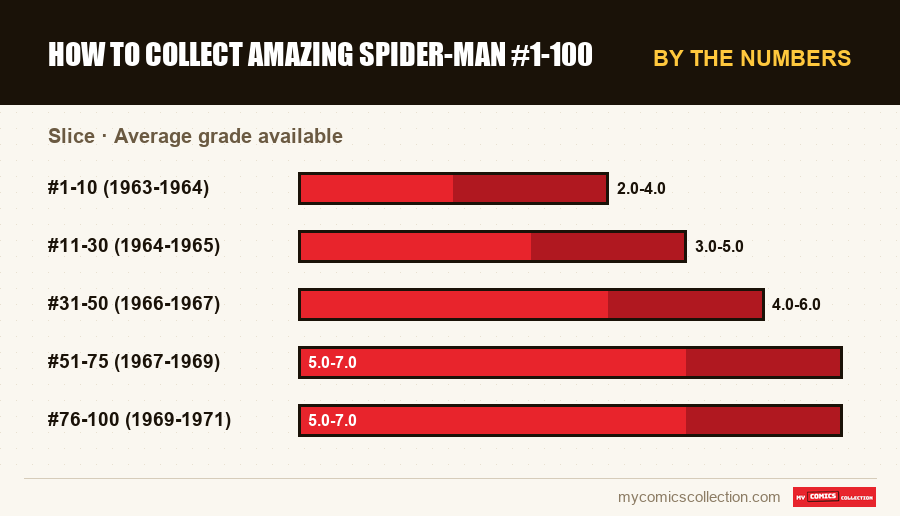
The older the number, the rarer the high ranks. Here's what you can reasonably find:
| Slice | Average grade available | 8.0+ exists? | 9.0+ exists? |
|---|---|---|---|
| #1-10 (1963-1964) | 2.0-4.0 | Very rare, expensive | Some known examples |
| #11-30 (1964-1965) | 3.0-5.0 | Rare but available | Rare, premium auction |
| #31-50 (1966-1967) | 4.0-6.0 | Available regularly | Uncommon but existing |
| #51-75 (1967-1969) | 5.0-7.0 | Relatively accessible | Available with patience |
| #76-100 (1969-1971) | 5.0-7.0 | Accessible | Available |
Gradual construction strategy
Building a run #1-100 is a 5-10 year project for most collectors. Here is the recommended strategy:
Phase 1. The “easy” ones (#51-100): Start with the most accessible and available numbers. Budget: $15,000-40,000 in grades 5.0-7.0. These numbers allow you to quickly build the skeleton of the run and stay motivated.
Phase 2: Mid-range (#21-50): Gradually move up to older, more expensive numbers. Budget: $20,000-60,000 in grades 4.0-6.0. Include keys from Tier B (#31, #39, #40, #42).
Phase 3: Rarities (#2-20): The first major appearances require patience and budget. Budget: $30,000-80,000 in grades 3.0-5.0. Wait for good deals at conventions or estate sales.
Phase 4: ASM #1: Save #1 for last. It is the most expensive and symbolic piece. Budget: $25,000-120,000 depending on the grade targeted. A CGC 2.0-3.0 is a realistic goal for most collectors.
Common pitfalls and mistakes
Silver Age ASM collectors frequently make these mistakes:
- Buy restored copies without knowing it: Comics from this era have often been restored (color touch, piece fill, trimming). ONLY purchase CGC Blue Label copies for key issues. The Purple Label (restored) is discounted by 50-70%.
- Aiming for grades that are too high: A full run in 8.0+ would cost several million. Accept mixed grades (3.0-7.0) to stay within a realistic budget.
- Ignore married covers: Some unscrupulous sellers replace the cover of an issue with that of a better preserved copy. CGC detects this but always check the type label.
- Buy an entire run at once:"ASM #1-100 Complete" lots sold as a set are often low grades with hidden issues. Build number by number to control quality.
- Neglecting the origin: A known pedigree (Pacific Coast, Don/Maggie Thompson, Bowling Green) adds 20-50% value. Search CGC pedigrees for the best long-term deals.
Do you own Spider-Man comics? Estimate the value of your collection for free to know their current rating.
Frequently asked questions
Three issues dominate the run: #1 (March 1963), the first regular series issue, #14 (July 1964), the first appearance of the Green Goblin, and #50 (July 1967), "Spider-Man No More!". Next come the first appearances of the great villains, such as the Vulture (#2), Doc Ock (#3), Sandman (#4), the Lizard (#6) or Electro (#9).
For most collectors it is a project of five to ten years. It is better to proceed in phases and buy issue by issue to control quality, rather than aiming for a "complete" lot sold in one block.
Start with the most accessible ones, #51 to #100, which let you build the skeleton of the run quickly. Then move up to #21 to #50, then the rarities from #2 to #20, and keep #1 for the end.
No, a complete run in high grade would be out of reach for almost every budget. Accepting mixed grades, from 3.0 to 7.0, is the realistic way to build the set, saving the best copies for the main keys.
Comics from this era were often restored (color touch, added pieces, trimming), sometimes without the buyer knowing. For key issues, favor graded copies with a blue label: a purple label signals restoration and makes the issue drop noticeably in value.