
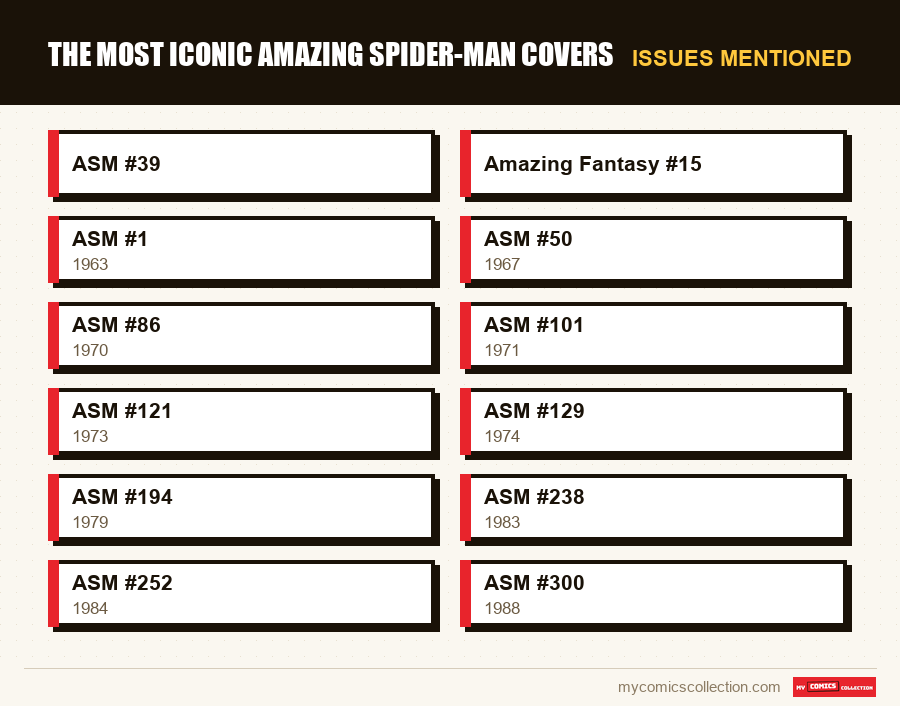
The most iconic Amazing Spider-Man covers: ASM #39 (Romita Sr., late Ditko era), #50 ("Spider-Man No More"), #101 (first Morbius), #129 (Punisher), #238 (Hobgoblin), #300 (Venom, McFarlane), #601 (J. Scott Campbell MJ), #678 (Venom variant). These hedges command premiums of 20-200% over adjacent non-key numbers.
The covers of Amazing Spider-Man are among the most recognizable images in American pop culture. From Jack Kirby's iconic Amazing Fantasy #15 cover to J. Scott Campbell's modern variations, each decade has produced visual works that transcend the comic book to become cultural icons.
This guide analyzes ASM's highest-rated and most sought-after covers, explains why certain images command extraordinary premiums, and identifies the covers every serious collector should aim for. The value of a cover depends as much on its visual impact as on its narrative importance.
Silver Age: The Founding Covers (#1-100)
The Silver Age era (1963-1971) under Steve Ditko and then John Romita Sr. established the visual DNA of Spider-Man:
ASM #1 (March 1963): Ditko: The very first cover of the regular series. Spider-Man hanging from his web with the Chameleon and J. Jonah Jameson. CGC 9.0+ exceeds $400,000. Even in 2.0, this cover is worth $15,000-25,000 for its absolute historical significance.
ASM #39 (August 1966): Romita Sr.: The Green Goblin unmasking Peter Parker. Romita's first cover on ASM. Historical transition Ditko→Romita. CGC 9.4 = $8,000-12,000. One of the first covers to show the vulnerability of the hero.
ASM #50 (July 1967): Romita Sr.:“Spider-Man No More!” Peter Parker walking in the rain, abandoning his costume in a trash can. The most reproduced image in all of Spider-Man history. Directly adapted in Spider-Man 2 (Raimi, 2004). CGC 9.4 = $20,000-30,000, CGC 6.0 = $2,000-3,500.
ASM #86 (July 1970): Romita Sr.: Origin of Black Widow (new costume). Bonus cover for the iconic design of Natasha's black suit. CGC 9.4 = $2,000-3,500.
Bronze Age: the golden age of covers (#101-200)
The Bronze Age combines the mature storytelling of Conway/Wolfman with the visual dynamism of Romita, Kane and Andru:
ASM #101 (October 1971): Gil Kane: First appearance of Morbius. Spider-Man with six arms faces a vampire against a nighttime backdrop. Powerful image that combines body horror and action. CGC 9.8 = $25,000-40,000, CGC 9.4 = $5,000-8,000.
ASM #121 (June 1973): Kane:“The Night Gwen Stacy Died.” The Green Goblin holding Gwen unconscious on the bridge. Among the 10 most important covers in comics history. CGC 9.4 = $8,000-14,000.
ASM #129 (February 1974): Kane/Romita: First appearance of the Punisher. Spider-Man in the sights of a shooter. Cinematographic composition before its time. CGC 9.8 = $80,000-120,000.
ASM #194 (July 1979): Keith Pollard: First appearance of Black Cat. Felicia Hardy in a black suit against a nighttime background. CGC 9.8 = $4,000-7,000. The character's design remains unchanged 45 years later.
Copper/Modern Age: collector's covers (#200-500)
The modern era has produced some of the most valuable covers thanks to McFarlane, Larsen and the variants:
ASM #238 (March 1983): John Romita Jr.: First appearance of the Hobgoblin. Dramatic composition with Hobgoblin dominating the cover. Includes the original tattoo (without which the comic loses 30-50% value). CGC 9.8 = $3,000-5,000.
ASM #252 (May 1984): Ron Frenz: First appearance of the black suit. Spider-Man in black silhouette swinging in front of the moon. Iconic cover in dozens of tributes. CGC 9.8 = $2,500-4,000.
ASM #300 (May 1988): Todd McFarlane: First appearance of Venom. Double-page cover with Venom towering over Spider-Man. The definitive image of McFarlane. CGC 9.8 = $2,000-4,000.
ASM #316 (June 1989): Todd McFarlane: Venom close-up, tongue out, organic webs. THE Venom cover par excellence, even more reproduced than #300. CGC 9.8 = $400-700.
Modern Era and Variants: Premium Covers (#500+)
The era of variants has created a new market for collectible covers:
ASM #601 (September 2009): J. Scott Campbell: Mary Jane Watson in a bikini, seen from behind, looking over her shoulder. Campbell's most famous variation. CGC 9.8 = $600-1,000. Regularly in the top 10 of modern comics sales on eBay.
ASM #607 (November 2009): Campbell: Black Cat in dynamic pose. CGC 9.8 = $200-400. Second most wanted Campbell cover.
ASM #678 (March 2012): Venom variant: Mary Jane in the Venom costume (Joe Quinones). Viral image that combines two fan-favorites. CGC 9.8 = $300-600.
ASM #667 (October 2011): Dell'Otto variant: Spider Island. Gabriele Dell'Otto at his best. CGC 9.8 = $150-300.
ASM #1 (2014): Jerome Opena 1:75 variant: The rarity of the ratio (1 in 75 ordered) and the quality of the art create prices at $500-1,000 in CGC 9.8.
Investing in hedges: valuation factors
The hedges that increase in value share certain characteristics:
- First appearance on cover: A character appearing for the first time ON the cover (not just inside) benefits from a visual bonus.
- Homageable: The covers frequently used as homages (ASM #50, #300, #252) gain recognition and value.
- Emotional impact: Covers that tell a story (ASM #50 with the abandoned costume) transcend simple drawing.
- Star artist: McFarlane, Campbell, Peach Momoko, Artgerm: some artists command premiums regardless of narrative content.
- Variant rarity: High ratios (1:50, 1:100, 1:200) create artificial scarcity which supports prices.
Do you own Spider-Man comics? Estimate the value of your collection for free to know their current rating.
Frequently asked questions
Among the most famous: ASM #39 (Romita Sr., end of the Ditko era), #50 ("Spider-Man No More"), #101 (first Morbius), #129 (Punisher), #238 (Hobgoblin), #300 (Venom, McFarlane), #601 (MJ by J. Scott Campbell) and #678 (Venom variant).
It shows Peter Parker walking in the rain, leaving his costume in a trash can, drawn by John Romita Sr. (July 1967). It is the most reproduced image in Spider-Man history, directly adapted in Spider-Man 2 (Raimi, 2004).
Published in August 1966, it shows the Green Goblin unmasking Peter Parker and marks Romita's first cover on the series. It is the historic transition between the Ditko era and the Romita era, and one of the first covers to show the hero's vulnerability.
Amazing Spider-Man #1 (March 1963), drawn by Steve Ditko, shows Spider-Man hanging from his web with the Chameleon and J. Jonah Jameson. It is the first cover of the regular series.
It depends as much on its visual impact as on its narrative importance. Covers tied to a first appearance or a landmark moment command a premium over adjacent non-key issues.