In short
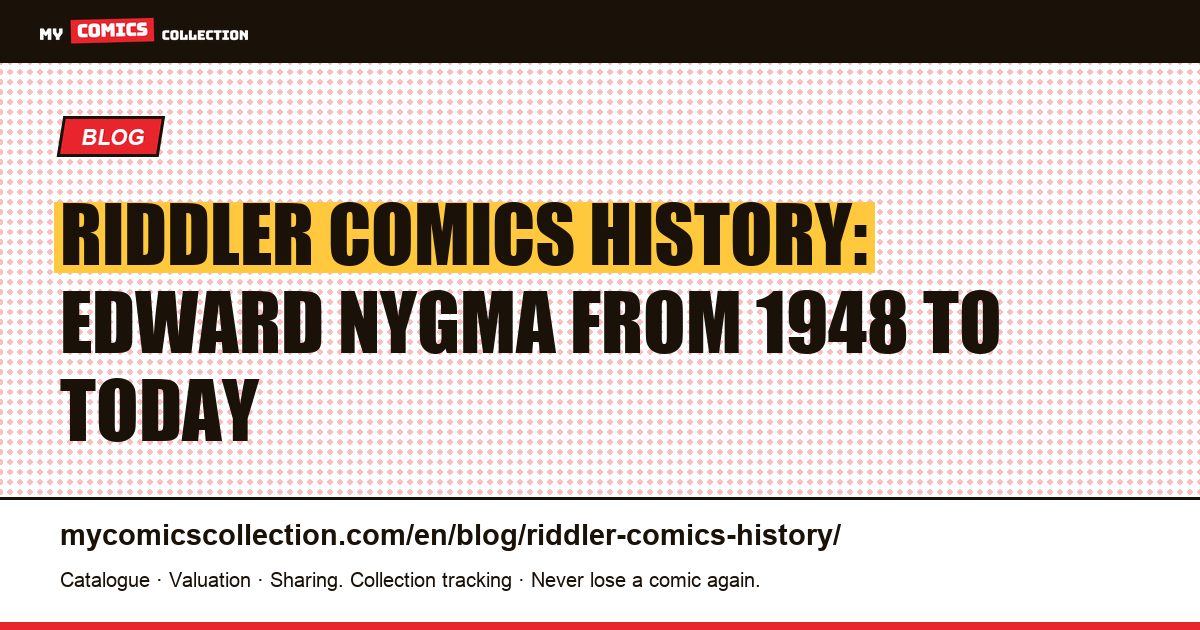
The Riddler debuts in Detective Comics #140 (1948), created by writer Bill Finger and artist Dick Sprang. After a long absence he returns in Batman #171 (1965), and the 1966 television series makes him a household name. Three turning points define his comics life: Jeph Loeb and Jim Lee's Hush (2002 to 2003), Paul Dini's reformed detective in Detective Comics #822 (2006), and Scott Snyder and Greg Capullo's Zero Year (2013 to 2014), which turns Edward Nygma into a city-wide threat.
Most villains in Gotham announce themselves with a weapon or a face. Edward Nygma announces himself with a question, and that single habit has carried him through seven decades of comics in which he disappears, reforms, is rebuilt and returns. His history is a good one to follow because it is uneven: long quiet stretches, sudden reinventions, and a handful of issues where one writer changes what the character is for.
Every Riddler credit and cover date in this timeline was confirmed before it went in. What each period means for Nygma is interpretation on our part, and nothing here quotes a page.
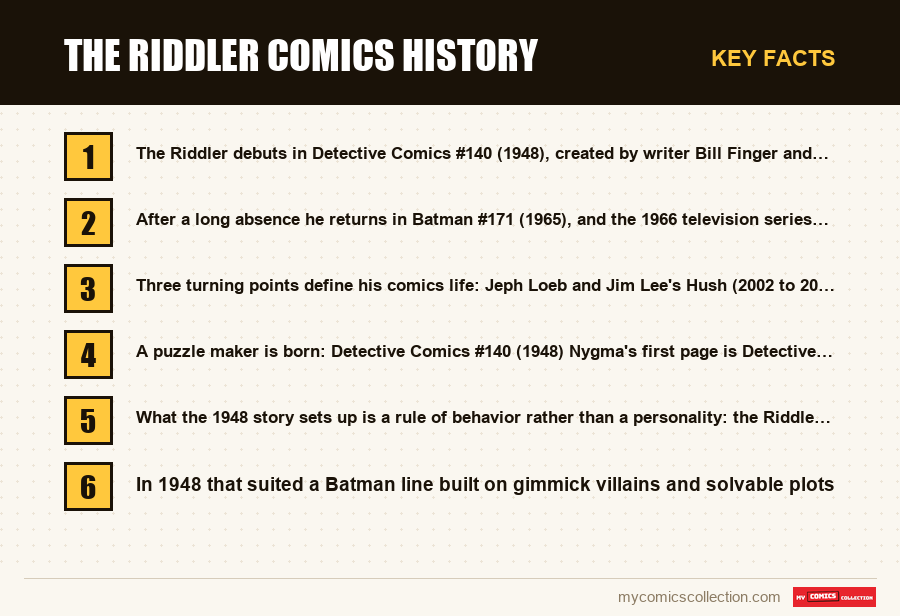
A puzzle maker is born: Detective Comics #140 (1948)
Nygma's first page is Detective Comics #140 (October 1948). Finger scripted it, Sprang drew the story, and Mortimer is credited with the cover.
Nigma's opening adventure closes on a pier, where his trap for the Dynamic Duo is a glass labyrinth whose door locks behind them before the whole structure blows up. The heroes get out, the villain is knocked into the sea, and only his question mark symbol floats on the surface. The ending is worth noticing, because a character who vanishes without a capture or a death is a character who can return whenever an editor wants him.
What the 1948 story sets up is a rule of behavior rather than a personality: the Riddler cannot commit a crime without telling the detective how to solve it. Every later version, the playful and the cold, keeps that rule. In 1948 that suited a Batman line built on gimmick villains and solvable plots. In the character's own history, the compulsion starts as a plot device and slowly becomes a psychological trait.
Gone for years, back in Batman #171 (1965)
After the 1948 debut the Riddler does not become a fixture. He returns in Batman #171, cover-dated May 1965, after a long absence. That return belongs to the Silver Age reshaping of Batman's rogues gallery, when editors were looking for recognizable adversaries and a lighter, more colorful tone.
The 1965 story gives him a reason to be different. Released from prison, the Riddler swears off leaving clues, then discovers that he cannot stop himself. This is a significant revision: the gimmick of 1948 is now framed as a compulsion he cannot control. It makes the character more sympathetic and more tragic than a prankster, and it prepares the ground for every later writer who treats the riddles as a flaw that Batman can exploit.
If you are tracing the character in order, treat Detective Comics #140 as the creation and Batman #171 as the relaunch.
The television Riddler and the long shadow of 1966
In 1966 the Batman television series brought the Riddler to a mass audience, with Frank Gorshin and John Astin among the actors who played him. The comics did not control that image, and they could not ignore it. The green suit and the question mark cane, the bright theatrical menace and the broad grin, became the default picture of the character for anyone who had never opened a comic.
A character who is famous for a theatrical style invites writers either to lean into the theater or to react against it. For several decades the second choice dominates: serious writers keep the riddles but remove the clown, and the Riddler's comics history becomes a long argument about how much of the 1966 version to keep.
That argument is the thread to follow through the next sections. When you read a modern Riddler story, ask which side of the argument it takes: does the story want the showman, the strategist, or the broken man behind the compulsion described in 1965?
Rebuilding the character: Legends of the Dark Knight and The Long Halloween
The late 1990s are where the Riddler is quietly rebuilt. Batman: Legends of the Dark Knight #109 to #111 (August to October 1998) carry "The Primal Riddle," written by Steve Englehart, a three-part story that treats the Riddler as a serious problem for Batman rather than a comic interlude. It is a good example of the era's approach: keep the riddle rule from 1948 and 1965, and ask what kind of mind needs it.
In the same period the Riddler appears as an informant in Batman: The Long Halloween, the Jeph Loeb and Tim Sale story that places Gotham's rogues around a mystery of holiday murders. The role is small, but it is telling. A character who was once a headline villain is now a source of information in someone else's story, a sign that the Riddler's value to writers had shifted from his own crimes to his intelligence. A nearby guide, Two-Face's comics history, shows how the same story shaped another classic villain.
What changes for the Riddler in this period is his place in the ecosystem of Gotham. He stops being a self-contained puzzle-box villain and becomes a connected figure: someone who sells knowledge, who watches the others, and who can be used by writers to move a plot along.
Hush: the Riddler who knows too much (2002 to 2003)
The next turn is Hush, a twelve-chapter saga across Batman #608 to #619 from Jeph Loeb (writer) and Jim Lee (artist), opening in December 2002. The story is built as a mystery in which a masked adversary uses Batman's usual enemies against him, and the Riddler has a decisive supporting role: he is the one who works out who is behind Batman's mask. In Batman #619, cover-dated November 2003, he threatens to expose that identity, and Batman dismisses the threat.
This is the point at which the Riddler becomes more dangerous in a new way. His whole identity is that he knows things and wants credit for it, and Hush gives that trait a stake that cannot be undone. A villain who has solved the central secret of the hero is not a prankster any longer, and the writers who follow have to deal with that.
The arc is also a major event for collectors of the period, which is why the market guide to Batman: Hush and the page on Batman #608 exist. For the character history, the useful point is simpler: Hush is where the Riddler's intelligence becomes plot-critical rather than decorative.
Do you collect this series?
Track what you own, what you are missing and what your collection is worth. 7-day trial.
Start my trial →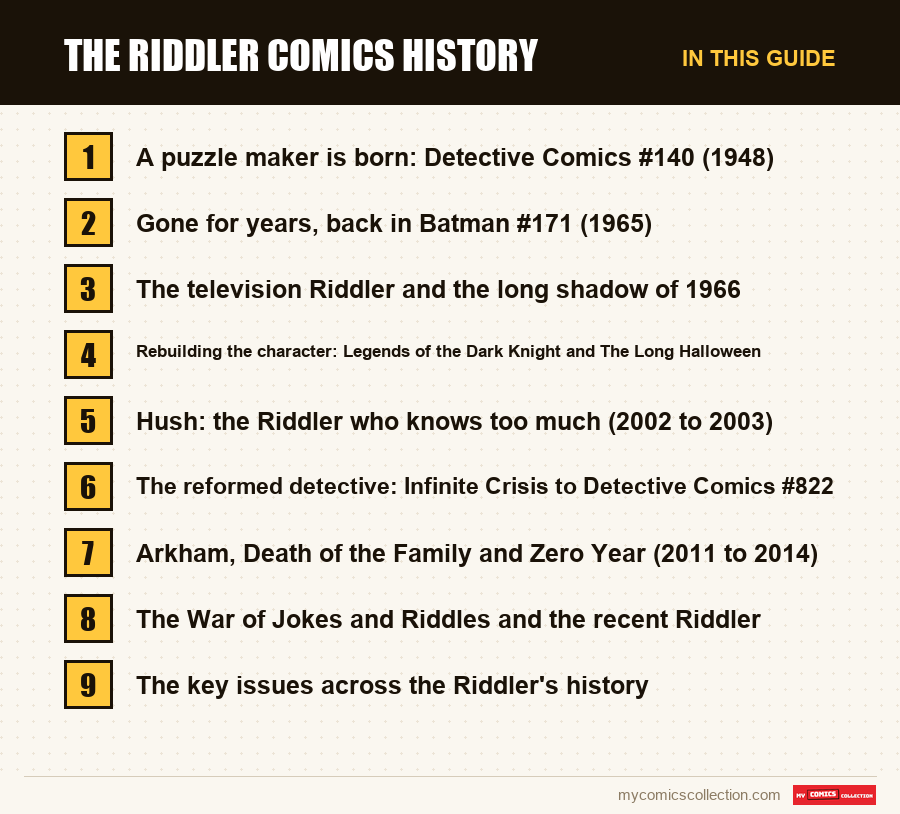
The reformed detective: Infinite Crisis to Detective Comics #822
After Hush the Riddler is used in two very different ways. In the DC event books of the mid 2000s he is a villain among villains, appearing in Infinite Crisis #1 (December 2005) and in Villains United: Infinite Crisis Special (June 2006). Then comes the reinvention that changes the shape of his history.
Beginning with Detective Comics #822, cover-dated October 2006, Paul Dini writes a reformed Riddler who works as a private detective, selling his gift for solving mysteries instead of setting them. The series returns to this idea in Detective Comics #828 (April 2007), where the Riddler saves Batman by setting a killer on fire with an arrow, then sees his offer of an alliance turned down. It is a clever inversion, because the compulsion described in 1965 is now put to use: a man who cannot stop thinking in puzzles can be paid for solving them.
The reformed detective is the issue range collectors look for when they want to see the Riddler on the other side of the law.
Arkham, Death of the Family and Zero Year (2011 to 2014)
The 2011 relaunch brings a redesigned Riddler in Batman vol. 2 #1, and he takes a place in the "Death of the Family" story, in Batman #15, titled "And Here's the Kicker." But the biggest change in this period belongs to Zero Year, the Scott Snyder and Greg Capullo retelling of Batman's early years, which runs in Batman vol. 2 #21 to #27 and #29 to #33 between June 2013 and July 2014.
In Zero Year Edward Nygma appears as the strategist for Philip Kane, and he tries to have Bruce Wayne killed, then hires the Red Hood Gang to do it. Later, as the Riddler, he cuts the power to Gotham and issues his challenge to Batman. He and Doctor Death flood the catacombs, he keeps the means to flood the city by blowing up the reservoir, he takes control of a flooded Gotham, and he ends up in Arkham Asylum.
This is the moment when the Riddler changes scale. In 1948 he threatens two people in a glass maze; in 2013 he threatens a city of millions with the dark. The riddle is no longer the gimmick, it is the pretext, and the city itself becomes the puzzle. For a collector following a character through time, Zero Year is the clearest evidence that the Riddler can carry a major event, and it also connects to Snyder's other Gotham work, such as the Court of Owls key issues.
The War of Jokes and Riddles and the recent Riddler
The next major turn is in the third Batman series, where the Riddler helps Bane open a high-tech door to reach Batman in Batman vol. 3 #19. Tom King's long run then devotes the eight parts of Batman #25 to #32 to "The War of Jokes and Riddles," a war between the Joker and the Riddler. The Riddler there kills a police officer, survives a bullet from the Joker and poisons the son of Charles Brown, the man who becomes Kite Man: the opposite of the colorful figure of 1966. A reader who wants to place the writer in context can use the Tom King author page.
From 2022 two projects add new layers. Batman: One Bad Day: The Riddler #1 (October 2022), with a cover by Brian Bolland, gives the character a revised origin. The Riddler: Year One pairs writer Paul Dano with artist Stevan Subic for six issues from 2022 to 2023, tracing Edward Nashton from an orphanage childhood toward crime. Both are origin stories, and both are written for readers who want the man, not the costume.
The pattern across seventy years is clear: whenever the character risks becoming a joke, someone rebuilds him around a more serious idea, and the compulsion that Batman #171 described in 1965 remains the one constant.
The key issues across the Riddler's history
- Detective Comics #140 (1948): the debut, by Bill Finger and Dick Sprang, with the glass maze on the pier and the floating question mark.
- Batman #171 (1965): the return after a long absence, with the Riddler unable to stop leaving clues.
- Batman: Legends of the Dark Knight #109 to #111 (1998): "The Primal Riddle" by Steve Englehart.
- Batman #608 to #619 (2002 to 2003): Hush, by Jeph Loeb and Jim Lee, with the Riddler working out the secret behind the mask.
- Detective Comics #822 (2006): Paul Dini's reformed Riddler as a private detective.
- Batman vol. 2 #21 (2013): the opening chapter of Zero Year, by Scott Snyder and Greg Capullo.
- Batman vol. 3 #25 (2017): the start of "The War of Jokes and Riddles" by Tom King.
- Batman: One Bad Day: The Riddler #1 (2022): the revised origin, with a Brian Bolland cover.
How to follow the Riddler in a collection
The easiest mistake is to treat the character as one continuous run. He is not: his comics history is a set of separate appearances in different series, and the numbering reflects it. The debut belongs to Detective Comics, the 1965 return to Batman, and the modern turning points to three different Batman volumes, so the volume number matters as much as the issue number.
A practical method is to build in three layers. First, decide whether you want the original debut or an archive collection of it, since the Golden Age book is fragile and most readers know it only through reprints. Second, shelve the stories that rewired him, in trade form if you prefer: Loeb and Lee's Hush, Snyder and Capullo's Zero Year, and King's wartime flashback. Third, finish with the two 2022 origin books. If the parent title's long numbering confuses you, the Detective Comics collecting guide maps it out.
Catalog searches should try both spellings, Nigma and Nygma.
Frequently asked questions
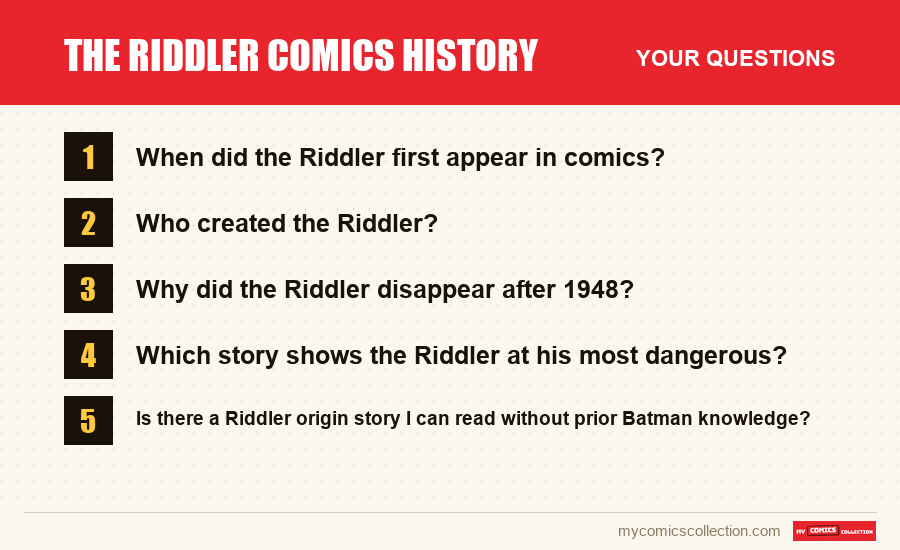
Edward Nigma debuts in Detective Comics #140 with an October 1948 cover date. Writer Bill Finger and artist Dick Sprang made the story, while Win Mortimer is credited with the cover. He ends it lost in the water with only a question mark floating behind.
The creator credit for the Riddler names writer Bill Finger and artist Dick Sprang, who produced his debut in Detective Comics #140 in 1948. Batman as a whole goes back to Bob Kane, but a record of this particular character should follow the Finger and Sprang credit.
His first story ends with him knocked into the sea and apparently gone, and he returns only in Batman #171, cover-dated May 1965, after a long absence. In that issue he is released from prison, swears off clues and discovers he cannot stop leaving them, which becomes his defining trait.
Zero Year, by Scott Snyder and Greg Capullo in Batman vol. 2 #21 to #33 (2013 to 2014), is the clearest case. Nygma cuts Gotham's power, floods parts of the city and broadcasts challenges to Batman, then ends up in Arkham Asylum after the lights return.
The Riddler: Year One is a six-issue series published from 2022 to 2023 by writer Paul Dano and artist Stevan Subic, covering Edward Nashton's road from an orphanage childhood and foster homes to crime, so it reads as a self-contained portrait. Batman: One Bad Day: The Riddler #1 also offers a revised origin.
Own a Riddler key issue such as Batman #171 or a Hush first printing? Get an estimate of your copy before you decide what to keep.
Estimate my comic