
Two-Face (Double-Face in French editions) is Harvey Dent, Gotham's district attorney, scarred by acid and living by the flip of a coin, and this Two-Face comics history starts with his first appearance in Detective Comics #66, cover-dated August 1942, from an idea by Bob Kane with Bill Finger writing. He has remained Batman's most tragic enemy: a former ally of the law whom chance and duality tipped over the edge, and whom every generation of writers has tried to heal, then break all over again.
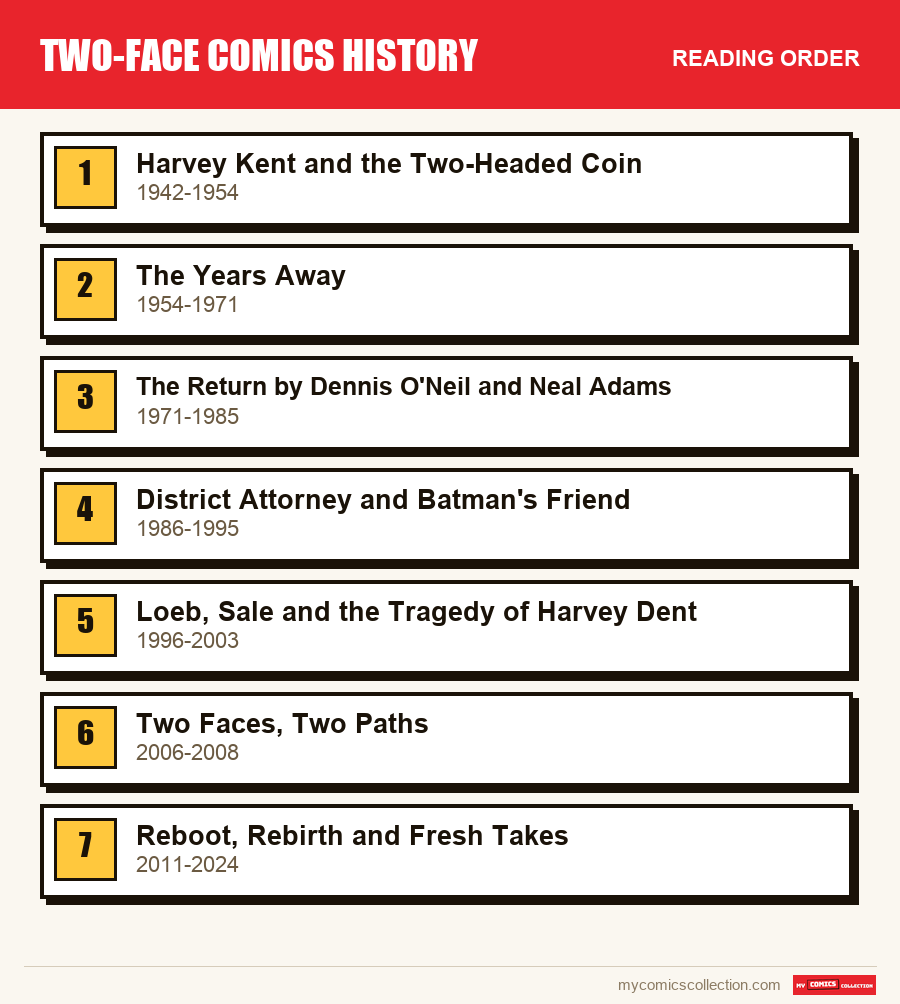
Few of Batman's adversaries carry a drama as readable as Harvey Dent's: a man who embodied justice, half a face destroyed, a two-sided coin to settle every decision. The journey below runs from the summer of 1942 to the 2024 miniseries, in seven eras.
As always in this guide, only verified facts (creators, issue numbers, dates) are stated as fact; the analysis is our own, with no reproduction of protected pages or dialogue.
His first appearance
Detective Comics #66, on newsstands with an August 1942 cover date, presents "The Crimes of Two-Face." The character was conceived by Bob Kane; the script is by Bill Finger, and Kane's art was inked by Jerry Robinson and George Roussos. At first he is not yet called Dent: the district attorney is named Harvey Kent, a surname that becomes Dent in Batman #50 (1948).
What stands out in this issue is that the central idea is already there, intact: a respected magistrate, an acid attack that destroys half of his face, and a coin that becomes the judge of his actions. The immediate follow-up appears in Detective Comics #68, with "The Man Who Led a Double Life!", which closes the plot. Two-Face collectors almost always start with these two issues.
For editorial context: in 1942, Batman's rogues gallery was being built at top speed. Unlike the Joker, a criminal with no readable past, Dent is a distorted mirror of Bruce Wayne: he too belongs to Gotham's elite, and he too fights crime. It is this parallel, far more than the makeup, that explains the character's staying power.
Era 1: Harvey Kent and the Two-Headed Coin (1942-1954)
Two-Face's Golden Age comes down to a handful of issues, but they set the rules of the game. Detective Comics #80 (1943) carries an unambiguous title, "The End of Two-Face": Kent is cured by plastic surgery and starts over. At that time the editorial logic was that of the self-contained story: an enemy is defeated, then can return in a new episode, sometimes reformed, sometimes relapsed.
The cycle of cure and relapse takes hold right away. Detective Comics #187 (1952), "The Double Crimes of Two-Face!", shows him reformed. In the meantime, Batman #50 (1948) introduces, besides the name Dent, an impostor named Wilkins: the idea of a fake Two-Face serves as a reminder that the character can be imitated but not replaced. Other impostors pass through the series later, including Paul Sloane in Batman #68 and George Blake in Detective Comics #187.
The period closes with Batman #81 (1954), "Two-Face Strikes Again!", a story that Earth-Two continuity does not retain. For a collector, this group forms a small, coherent body of work: the pivotal issues are Detective Comics #66 and #68, then #80 for the cure. The titles of this era are scarcer than modern series, and condition matters more than edition.
Era 2: The Years Away (1954-1971)
After Batman #81, the character leaves center stage for many years. The Comics Code era, which softened Batman's stories and favored science fiction and gadgets, was hardly friendly to a disfigured criminal. One issue from this period deserves a mention: World's Finest Comics #173 (1968), where Batman himself turns into Two-Face, a plot detail rather than a true return of the character.
This absence matters in Two-Face's history as much as his appearances do. It explains why the writers who bring him back in the early 1970s treat him almost like a brand-new creation: the acid, the coin and the moral ambivalence are known, but the psychology remains to be written. For a collection, this gap is worth remembering: do not expect key issues between 1954 and 1971, and do not pay a premium for an issue from this era that its content does not justify.
Era 3: The Return by Dennis O'Neil and Neal Adams (1971-1985)
"Half an Evil," in Batman #234 (1971), reopens the Two-Face file: script by Dennis O'Neil, art by Neal Adams, edited by Julius Schwartz. O'Neil and Adams were then the creators giving Batman back his nocturnal mood, and Two-Face benefits: he becomes a serious criminal again, instead of a comic-book repentance role. O'Neil fans will find the writer on the Dennis O'Neil page.
The following decade then deploys several uses of the character. He crosses paths with the Justice League of America in issues #125 and #126, "The Men Who Sold Destruction!" and "The Evil Connection." In Batman #313 and #314, a New Orleans plot around a missile launch code gives him a fresh setting, and Batman #328 and #329 introduce the Carl Ternion identity. These are issues that portray a criminal in search of a cause, more than a tragic figure.
This period reads like a laboratory. The writers try several registers: large-scale criminal, team adversary, prankster with a rigged coin. None of these attempts settles on a definitive version, which explains why the great reinvention of the character came from outside, in the mid-1980s, with the rereading of the series' origins.
Era 4: District Attorney and Batman's Friend (1986-1995)
With Batman: Year One, Frank Miller reworks Batman's Gotham, and Harvey Dent reappears on the side of the law, alongside Batman and Gordon, which sets the stage for the tragedy to come. You will find more on this retelling on the page about Year One and its collector value, and on the Frank Miller page.
The origin story then receives several touch-ups. Batman Annual #14 (1990), "The Eye of the Beholder," is written by Andrew Helfer and revisits the character's origin. In Showcase '93 #7 (June 1993), his origin is told again, with art by Klaus Janson. Then comes Batman/Two-Face: Crime and Punishment (1995), written by J. M. DeMatteis with art by Scott McDaniel.
What this era changes: Two-Face stops being a themed criminal and becomes a former ally. The question is no longer "what is he doing?" but "how did he end up here?" It is this shift, more than the disfigurement itself, that prepares the dramatic material the next era will exploit to the fullest.
Do you collect this series?
Track what you own, what you are missing and what your collection is worth. 7-day trial.
Start my trial →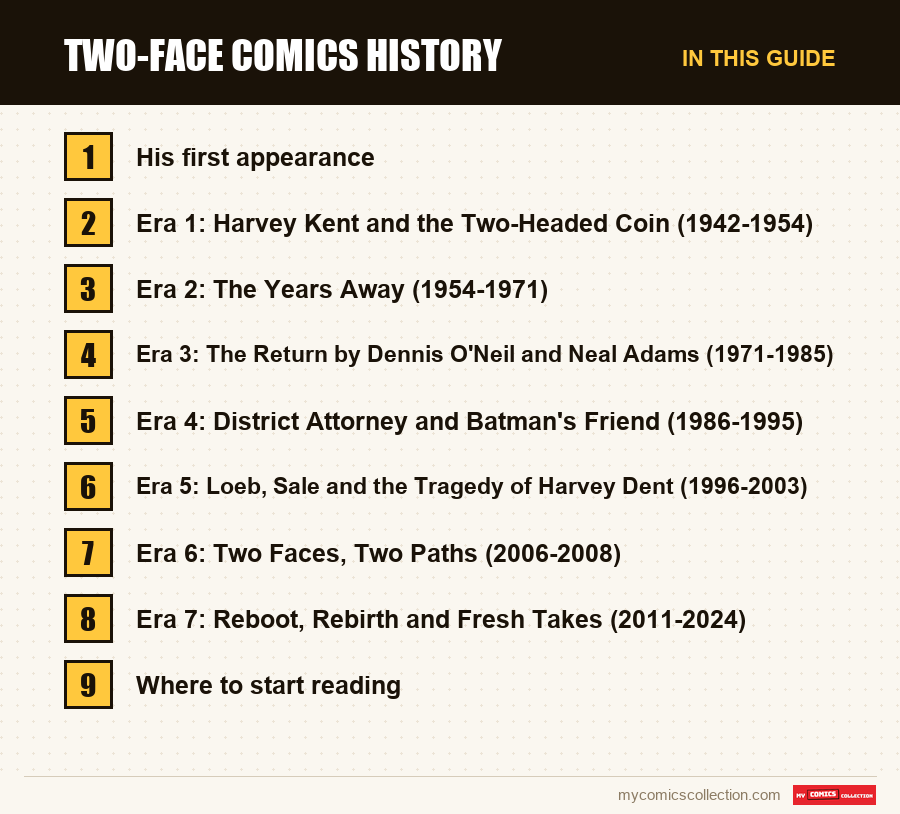
Era 5: Loeb, Sale and the Tragedy of Harvey Dent (1996-2003)
The Long Halloween runs for thirteen monthly issues, from December 1996 to December 1997, and brings together Jeph Loeb, Tim Sale and, on colors, Gregory Wright. Harvey Dent is one of the story's three pillars, alongside Batman and Jim Gordon, in their fight against Carmine Falcone. A trial goes wrong, Sal Maroni throws acid in his face, and the district attorney becomes Two-Face. The miniseries serves as the origin, and it is probably the most recommended read today.
Loeb and Sale extend the story in Batman: Dark Victory, a direct sequel where Dent is now Two-Face, then in Catwoman: When in Rome, which runs in parallel with that sequel. To compare the French editions, the page on The Long Halloween in French details the collected editions, and the page on the 2021 film shows how the adaptation departs from the comic.
In 2002, the same writer, Jeph Loeb, returns to Dent in Batman: Hush, published in Batman #608 to #619 between 2002 and 2003, with Jim Lee on pencils, Scott Williams on inks and Alex Sinclair on colors. Spoiler warning: in this arc, Dent's face is repaired, which seems to end Two-Face, and it is Dent himself who shoots Thomas Elliot in the final confrontation. The character plays a pivotal role there, not the hero of the story.
In these years, other writers work on the human dimension. Batman Chronicles #16 (1999), written by Greg Rucka, ties in the link with Renee Montoya. The Gotham Central arc "Half a Life," in five parts, then pits Two-Face against the series' team of police officers, rather than against Batman.
Era 6: Two Faces, Two Paths (2006-2008)
After the repair in Hush, the question becomes: what is left of Two-Face when the face is healed? The weekly series 52 (2006) shows a reformed Dent, and the "Face the Face" arc, written by James Robinson starting with Detective Comics #817, is part of the "One Year Later" shift. The story examines the relapse as a psychological consequence and not as an accident.
The miniseries Two-Face: Year One, written by Mark Sable, then revisits the origins for a new generation of readers. This step is useful for a collector interested in the evolution of the mythology: we see the character, after The Long Halloween, treated as a figure who has to be explained again for each generation.
In this era, Two-Face stops being solely the consequence of an assault. He becomes a choice, or at least a state that requires a degree of consent. The writers refuse the easy way out of a definitive cure, while accepting that Dent may sincerely desire one.
Era 7: Reboot, Rebirth and Fresh Takes (2011-2024)
The September 2011 reboot gives the character a revised origin. The "The Big Burn" arc, written by Peter J. Tomasi in Batman and Robin, belongs to this period. Later, Scott Snyder's All-Star Batman offers the "My Own Worst Enemy" arc, where a road across the United States frames an attempt at a cure: a road-trip idea that makes Dent the center of a full story of his own.
The latest chapter to date, the 2024 Two-Face miniseries, comes out under the DC All In banner: Christian Ward writes it, Fábio Veras draws it, Ivan Plascencia colors it and Hassan Otsmane-Elhaou letters it. It is a self-contained story, and it places the character at the center rather than as a passing adversary.
What this latest era changes: Two-Face can now carry a series in his own name, which was far from a given for an adversary created as a foil for Batman. A character's longevity is measured by his ability to carry his own stories, and that is the case here.
Where to start reading
- Batman: The Long Halloween (Loeb and Sale): the obvious entry point for a reader who wants to understand Dent's fall in a complete story, in thirteen issues.
- Detective Comics #66 and #68: for the reader who wants to know the origin as Finger and Kane wrote it, and compare it with the modern retellings.
- Batman #234 (O'Neil and Adams): for anyone interested in the Bronze Age and the character's return to the Gotham of the 1970s.
- Batman: Hush (Loeb and Lee): for the reader who already knows Dent and wants to see how he is used in a story bigger than he is.
- Two-Face (2024) (Ward and Veras): for the reader who wants a contemporary take, in a miniseries.
If you then want to widen your reading to a more cross-cutting selection, the page The best Two-Face comics offers a ranking; this page tells you the character's life story, that one tells you what to read first.
The key issues to know
- Detective Comics #66 (August 1942): the first appearance, by Finger and Kane.
- Batman #50 (1948): the surname becomes Dent.
- Detective Comics #80 (1943): "The End of Two-Face," the cure through plastic surgery.
- Batman #234 (1971): "Half an Evil," the reintroduction by O'Neil and Adams.
- Batman: The Long Halloween #1 (December 1996): the start of the definitive version of the origin.
- Batman #608 (2002): the opening of Hush.
To put these six issues together without overpaying, think in ratios: place each copy relative to comparable ones for sale, and save the high grade for Detective Comics #66 rather than for a modern issue with an abundant print run. Storing a vintage copy follows precise rules, detailed in this preservation guide, and a grading label can be decoded line by line thanks to this page.
A note on method: the oldest issues on the list are not chosen like the others. A Detective Comics #66 is compared mostly with other Detective Comics issues from the same period, not with modern issues, and restored copies are recognized by the label rather than by eye.
Frequently asked questions
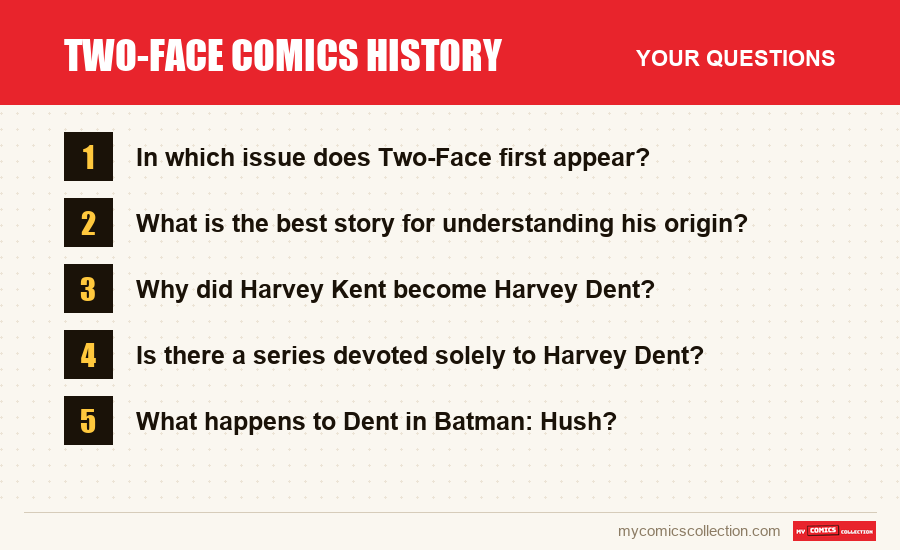
In Detective Comics #66, cover-dated August 1942, under the title "The Crimes of Two-Face." The character was conceived by Bob Kane, with Bill Finger writing. At the time he is named Harvey Kent; the name Dent only arrives in Batman #50 in 1948.
Batman: The Long Halloween, published from December 1996 to December 1997 in thirteen issues by Jeph Loeb and Tim Sale. Dent is one of the story's three pivots, and the miniseries serves as the modern origin. For the 1942 version, turn to Detective Comics #66 and #68.
The surname change happens in Batman #50 in 1948. At his creation, in 1942, the district attorney is named Harvey Kent; Dent is the name modern stories keep, and it has not changed since in the best-known adaptations.
He has had miniseries: Two-Face: Year One, written by Mark Sable, and the 2024 Two-Face miniseries, written by Christian Ward and drawn by Fábio Veras. He also appears in many Batman series, but these two titles are his own.
Spoiler warning: his face is repaired, which seems to close the Two-Face chapter, then he shoots Thomas Elliot in the final showdown. Published between 2002 and 2003, the arc covers Batman #608 to #619, with Jeph Loeb and Jim Lee at the helm. The character's return comes later, in Face the Face.
Do you own a Detective Comics, a Bronze Age Batman or a copy of The Long Halloween? Get its condition and its place in your collection appraised.
Appraise my comic