Batman #608, dated October 2002, opens "Hush", a twelve-chapter arc written by Jeph Loeb and drawn by Jim Lee, inked by Scott Williams and colored by Alex Sinclair. The chapter involves Batman in a kidnapping case that leads him face to face with Killer Croc, and puts Catwoman in his path. Collectors seek it mainly for its sketch variant cover, far rarer than the standard edition, and for the starting point of the best-selling run of the series in the 2000s.
There are two ways to buy Batman #608, and they have almost nothing in common. One is to pick up a standard copy, available in quantity in any back-shop bin, to read the start of the arc. The other is to hunt the pencil-sketch variant, whose availability has nothing to do with that, and whose price gap with the ordinary edition is measured in multiples. These are two different objects under the same reference, and most buying errors on this issue come from that.
As always on this guide, only verified information (creators, issue numbers, dates) is stated as fact; the analysis is our own, with no reproduction of panels or protected dialogue.
The October 2002 issue and what the first chapter contains
The cover date is October 2002, for a newsstand and specialty shop release the summer before that date, following the American practice of the cover-date offset. The credits stayed stable across all twelve chapters: script by Jeph Loeb, pencils by Jim Lee, inks by Scott Williams, colors by Alex Sinclair. This team continuity over a year, rare on a monthly series of that period, partly explains why the arc was perceived as a single object rather than a sequence of episodes.
The opening chapter is built as a street investigation rather than a clash of super-villains: a kidnapping, a trail to follow through the sewers, and a confrontation with Killer Croc. Catwoman's intervention in the middle of the operation introduces the thread that will run through the whole arc, that of a relationship that stops being a game of pursuit. Nothing in this issue yet signals the antagonist who will give the story its name.
This is a point to know before buying. The bandaged character who made the arc's reputation does not appear in the first chapter, and sources do not always agree on which issue to retain as first appearance. If that appearance is what you are after, check the contents of the issue on offer rather than the mention in the listing: many sellers attach the first appearance to #608 as a shortcut, because it is the first chapter.
What Batman was publishing in 2002
The issue arrives just after a long sequence of crossover stories, where the main series first served to advance plots shared with the other titles of the publisher's family. The 2002 reader was coming out of several years of heavy crossovers, in which following Batman meant buying five or six series at once. "Hush" takes the exact opposite stance: a long, self-contained story, readable with nothing else than its twelve issues.
The second context element is industrial. Jim Lee had not drawn a regular monthly series for this publisher before this period, and his arrival on the title was treated as a commercial event. The print runs of the first chapters were calibrated accordingly, which is the direct cause of the current abundance of standard #608 copies. An issue printed widely because it was expected does not become rare fifteen years later.
Why such a recent issue became a key
A 2002 issue has no mechanical reason to be rare. The paper is good, print runs were high, and copies were bought by collectors who stored them properly from the start. Batman #608's value therefore does not come from the title's rarity, but from three cumulative factors.
The first is the gateway function. The arc became one of the most recommended starting points for anyone discovering the character, and a permanently recommended first chapter keeps a demand that never runs dry. The second is the lasting popularity of the antagonist created in the arc, later reused elsewhere, including outside comics, with each reuse renewing the search for the point of origin.
The third, and the one that makes the value gap, is the variant cover. Without it, #608 would be a reading issue at bargain price. With it, there is a narrow, documented, tracked market segment where the same reference changes category entirely. To understand this issue's value, you must therefore always begin by asking which cover is meant.
Two covers, two markets
The standard edition carries Jim Lee's color cover, as distributed on newsstands and in shops. The variant reuses exactly the same composition, but rendered in pencil without coloring, in what the market calls a sketch cover. It is the same drawing, the same logo, the same number: only the graphic treatment changes, and that detail separates a standard copy from a collector's copy.
The variant was distributed in limited quantity to retailers, and sources disagree on the exact ratio applied at the time. Be cautious about any listing that displays a precise print figure as if it were established: the only reliable data point you have is the observable availability gap, and it is considerable. On any given sales site, you will find dozens of standard copies and a handful of variants at any moment.
Practical consequence: never reason in terms of a percentage premium when comparing the two. They are two independent curves. The standard edition follows reading demand, which is stable and low. The variant follows collector demand, which reacts to adaptation announcements and recent graded sales. A movement in one says nothing about the other.
Recognizing the first printing from reprints
The arc's success led to reprints of the first chapter, which is unusual for a monthly issue of this period and constitutes the second trap of this issue. A reprint is recognized by the notice in the indicia block, in small print on the first or last interior page, where the printing rank appears. That is the only place to look, and it is rarely the one shown in listing photos.
Some reprints also differ in cover treatment, but do not rely on that criterion alone: visual recognition without reading the indicia block leads to confusion, particularly between a reprint and the pencil variant, since both depart from the appearance of the standard edition. A correctly identified variant remains a first printing; a reprint never becomes one.
A third object to exclude: bound volumes. The arc has been reissued in collections, in several formats and several languages, and listings mixing the issue and the collection are frequent in keyword searches. A collection containing the opening chapter has no value as a key issue, whatever its manufacturing quality.
Do you collect this series?
Track what you own, what you are missing and what your collection is worth. 7-day trial.
Start my trial →
What moves the value, and what grading changes
On a 2002 issue, raw condition is hardly an argument: the vast majority of copies in circulation are in very good condition, because they were bought by collectors and stored immediately. The abundance of healthy copies pulls expectations upward, and what trades sits in the upper range of grades, not in the average.
That shifts the inflection point of the value. On an older issue, moving from an average grade to a decent one often suffices to double the value. Here, the gap only plays out at the highest grades, where a single notch separates a standard copy from a sought-after one. The defects that matter are therefore tiny: a factory-level cover misalignment, a slight trimming offset, a whitening start on the fold, all points that do not hinder reading and yet weigh on a modern issue.
For professional grading, the calculation differs by cover. On a standard copy, the cost of certification is rarely justified by the gain, unless you aim for a top-tier grade. On the variant, certification becomes the means of making the rarity legible to a buyer who cannot authenticate it themselves, and the graded market is far more active there. Simply check that the cover is clearly identified on the label: a graded variant without an explicit mention sells poorly, because nothing distinguishes it from a standard edition in a photo.
The buying traps
The first trap is the cropped photo. A pencil cover reproduced as a low-resolution thumbnail on a phone screen looks like a badly lit color cover. Always ask for a photo of the full cover taken straight on, and a photo of the indicia block. If the seller cannot provide them, treat what you are buying as a standard edition.
The second is the listing that sells one chapter for another. The twelve issues of the arc carry covers by the same hand and in the same treatment, and it is not unusual for a lot listing illustrated with #608 to deliver an intermediate issue. Read the written reference rather than the image.
The third is the copy presented as signed. Signing sessions were numerous for this title, and an unauthenticated signature adds nothing to value: it reduces it, becoming a mark on the cover. Pay for a signature only if it is documented by a third party.
Neighboring arc issues that matter too
The next chapter, Batman #609, is the one many references identify as the antagonist's true debut, and its demand partly follows that of #608. If your interest lies in the character more than in the start of the story, that is the issue to examine first, and again the question of the cover arises.
In the middle of the arc, the chapter devoted to the clash with Superman has gained its own fame, carried by its cover. In the second half, chapters featuring the Joker also circulate above the rest of the series at this time. The final chapter, Batman #619, is sought for its group cover, which existed in several presentations: check which one you are buying, the reasoning is the same as for #608.
Between these high points, the intermediate chapters remain low-priced reading issues. This is good news for anyone wanting to assemble the complete arc: only three or four issues need attention, the rest turn up effortlessly.
How to track it in a collection
This issue is a textbook case for inventory keeping, because the reference alone is not enough to describe it. If your record only says "Batman #608", you lose the information that carries all the value. Note three distinct fields: the cover, the printing rank, and the grade if the copy is graded. Without these three fields, your inventory will not let you tell your own copies apart on the day you own two.
If you hold both the standard edition and the variant, record them as two separate lines rather than as two copies of the same line. Their evolution is not correlated, and tracking them together produces a false valuation, dragged down by the standard copy. The same principle applies to any reprint kept for reading: it has its place in the inventory, but not on the same line as the first printing.
Finally, add a note on provenance and acquisition date. On a modern issue whose authentication rests on an edition detail, knowing where a copy came from and when it was bought helps settle an ambiguity years later. You will find other organization methods by character in the Batman hub and across our collecting guides.
What to remember before buying
Batman #608 has two faces. Its standard edition is a reading purchase, easy and low-stakes, giving access to the first chapter of a twelve-issue arc by Loeb and Lee. Its pencil variant is a genuinely scarce collector's object, whose value depends on correctly identifying the cover and the printing rank.
The discipline to remember fits in one sentence: before talking price, establish which cover and which printing you have in front of you. On this specific issue, that check matters more than assessing condition, because it separates two markets instead of ranking two grades. And if the appearance of the antagonist is what you are after, look first at the next chapter, then at the Catwoman thread that runs across the whole arc.
You are torn between a standard edition and a pencil variant of Batman #608? Have your copy examined before setting a price.
Appraise my comic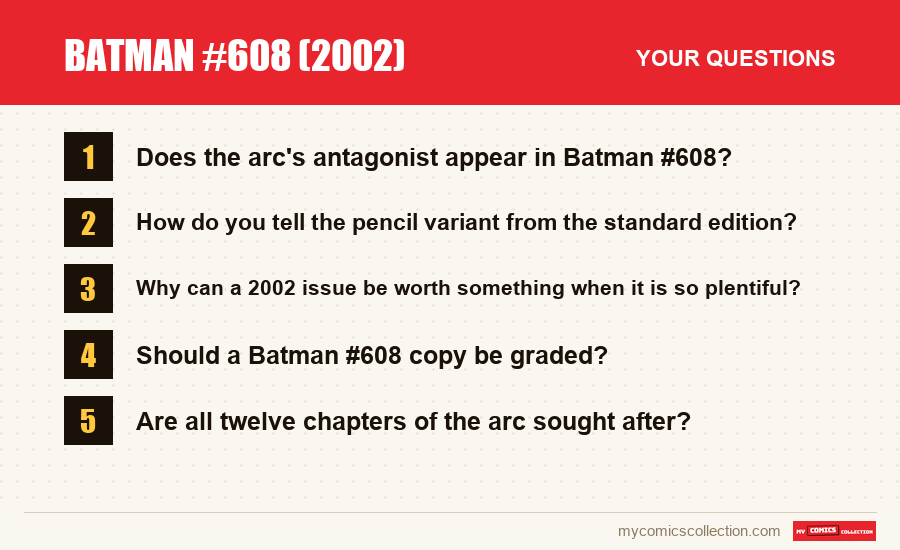
Frequently asked questions
No. The bandaged character who gives the story its name does not appear in the opening chapter, which features a kidnapping investigation, Killer Croc and Catwoman. References do not always agree on the issue to retain as first appearance, and the following chapter is generally the one cited. Check the contents rather than the listing's mention.
Jim Lee's composition is identical on both, but the variant is printed in pencil, without coloring. On a small thumbnail, confusion with a poorly lit photo is common. Ask for a picture of the full cover taken straight on, and read the indicia block to rule out a reprint whose cover also departs from the standard edition.
Because the value does not attach to the issue but to one of its two covers. The standard edition was printed widely to accompany Jim Lee's arrival on the series and remains very available. The variant was distributed in limited quantity to retailers, and it is this availability gap, not the issue's age, that creates the sought-after segment.
On a standard edition, certification is rarely justified unless you aim for a top-tier grade, since the abundance of healthy copies limits the gain. On the pencil variant, it makes the rarity legible to a buyer who cannot authenticate it from a photo. Make sure the cover is explicitly mentioned on the label in that case.
No. Only a few issues stand out: the first chapter, the next one for the antagonist's entrance, the clash with Superman, and the last one for its group cover released in several presentations. The intermediate chapters are easy to find at low prices, which makes assembling the complete arc affordable.