
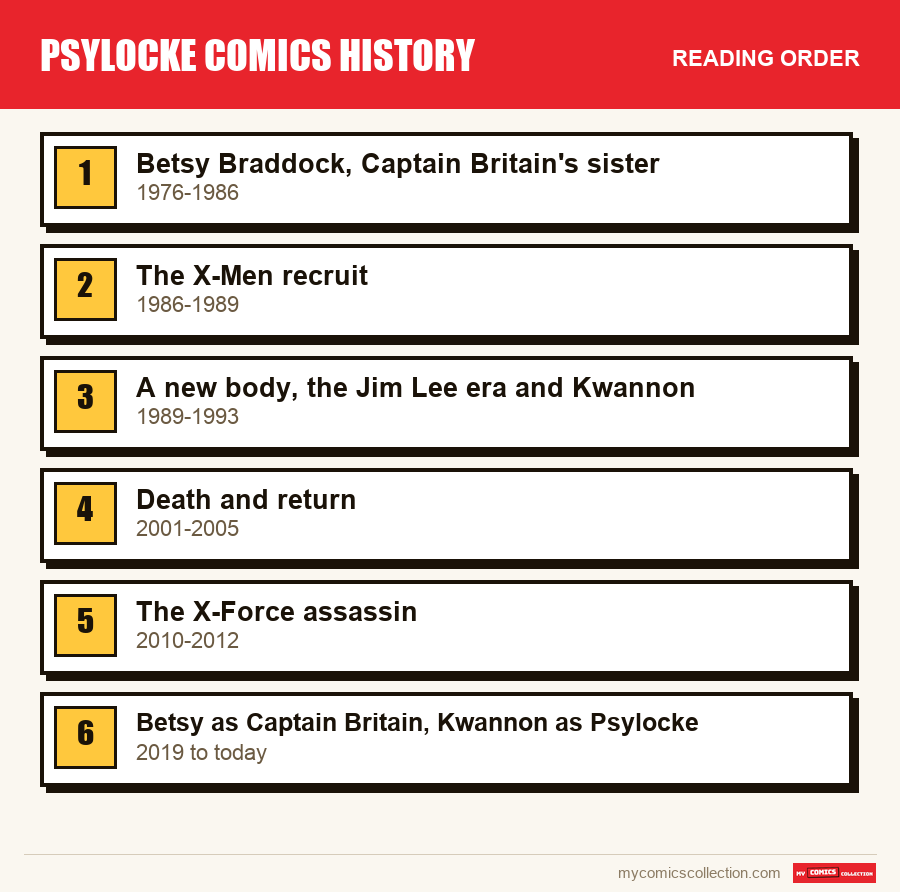
The Psylocke comics history starts with a British telepath named Betsy Braddock, who first appears in late 1976 in Captain Britain #8, created by Chris Claremont with Herb Trimpe. Sister of Brian Braddock, she only becomes Psylocke in 1986, when Claremont moves her into the mutant world and then into the X-Men. Since then her story has been one of a swapped body, a death followed by a return, a role as an assassin in Uncanny X-Force and, from 2019 to 2022, a split life: Betsy as Captain Britain, Kwannon under the name Psylocke.
Few mutant characters are as hard to sum up in a sentence. Betsy Braddock has had three series as a home base, two public identities, a change of appearance that occupied readers for years, and an explicit rewrite of that change in the early 1990s. For a collector, this history is not background noise: each turning point matches a specific issue, and some turning points hide in series you would not naturally connect to the character.
As always in this guide, only verified facts (creators, issues, dates) are stated as fact; the analysis is our own, with no reproduction of protected pages or dialogue.
Her first appearance
The December 1976 issue of Captain Britain #8, published by Marvel UK, is where Betsy Braddock is born. Chris Claremont and Herb Trimpe create the character. She is introduced as the twin sister of Brian Braddock, the physicist turned hero Captain Britain, and she plays a supporting role: a familiar face in the hero's life, with nothing in common with the fighter of later years. Her first cover comes with Captain Britain #10, carrying the same date as the previous issue.
This clears up a common confusion among buyers. Betsy was not born in the X-Men, and her code name does not exist yet. The name Psylocke only arrives with The New Mutants Annual #2, in October 1986, when Claremont opens the door to the mutant world for Betsy. Ten years therefore separate the creation of the character from the birth of the code name: two separate landmarks, two issues to hunt down separately.
A British weekly from 1976 is not handled like an American single issue from the same year: format, distribution and preservation all differ, and original condition has to be judged on the actual copy. To place this issue within her brother's career, the timeline of Captain Britain details the Marvel UK releases.
Era 1: Betsy Braddock, Captain Britain's sister (1976-1986)
The character's first decade is quiet. After Captain Britain #8 and the cover of #10, Betsy remains a secondary figure in her brother's world: an ordinary Briton on the surface, whose psychic abilities do not yet have the place they will later hold. It would be wrong to give her a costume or a fighter's role at this stage. Readers at the time could not have guessed she would become one of the lasting faces of the X-Men.
The pivot comes in 1986. In the October 1986 New Mutants annual, Claremont gives her the code name while his mutant universe keeps expanding. Choosing a Briton is no accident: Claremont, writer of Uncanny X-Men since the 1970s, had already created Betsy at Marvel UK; the Braddocks give him a natural bridge between two publishing traditions, the British and the American. For a collection, this annual is the entry point to modern Psylocke, and its annual format sets it apart from an issue of a monthly series.
This era also teaches a method: when a character changes status, look for the first issue of the name and not only the first issue of the face. Betsy and Psylocke are two catalog entries for one character, separated by ten years.
Era 2: The X-Men recruit (1986-1989)
Psylocke moves from the margins to the center with Mutant Massacre, the big mutant crossover of late 1986, written by Chris Claremont, Louise Simonson and Walter Simonson. In the aftermath of the crossover, Uncanny X-Men #213, dated January 1987, puts her face to face with Sabretooth in the mansion: alone, she holds the killer off long enough to prove her worth in combat. By the end of that issue, she is accepted by the X-Men.
This is the moment her telepathic powers become a combat tool. Betsy is no longer a hero's supporting cast: she drives the action. This sequence makes Uncanny X-Men #213 the reference issue for understanding her status as an X-Man, and it reads better if you know the context of Mutant Massacre, whose period is reprinted in dedicated volumes.
During this period, Psylocke's collection overlaps with that of the Braddocks. Around her, the Braddocks occupy another series: Excalibur, conceived by Claremont and Alan Davis, whose special issue came out in 1987. Claremont's scripting stops at issue 34, in 1991; Davis writes and draws from issue 42. Psylocke is not in the original team, but the family tie to Captain Britain gives these issues contextual interest for anyone who wants to understand the world Betsy comes from. For a team-focused reading, see our best Excalibur runs.
Era 3: A new body, the Jim Lee era and Kwannon (1989-1993)
Spoiler warning: this section covers Betsy's body swap.
In December 1989, Uncanny X-Men #256 shows an amnesiac Betsy, captured by the ninjas of the Hand, who does not come out of it in the same body. Jim Lee draws this issue and Betsy's new outfit, which defines the decade. From this issue on, Psylocke fights with a psychic knife and ninja imagery: the aesthetic turn is abrupt, and it fixes for a long time the silhouette the general public associates with her name.
The follow-up plays out in 1993. In X-Men vol. 2, issues 31 and 32, written by Fabian Nicieza, the explanation is given after the fact: Betsy and Kwannon, a fighter tied to the Hand, swapped bodies. Betsy's mind therefore lives in Kwannon's body, while Kwannon occupies Betsy's original body. A few months before this explanation, Fabian Nicieza and Andy Kubert had introduced Kwannon, then named Revanche, in issue 17 of the same series, in February 1993.
For a reader discovering the character, this chronology is the central trap: the body changes in 1989, the reason arrives in 1993, and you need to read both moments for the mechanics to make sense. Fans of the Lee era will find the creative team described in our guide Jim Lee, where to start, and the defining issues of this period appear in the Jim Lee hub.
Era 4: Death and return (2001-2005)
Spoiler warning: this section covers Psylocke's death.
The start of the new century is darker. In X-Treme X-Men #2, published in 2001 and written by Chris Claremont, Betsy dies. The character disappears in this issue, at the very start of a series that is only getting going. The return comes in Uncanny X-Men #455, in 2005, which leaves several years of absence in the character's run.
Meanwhile, the editorial logic of the mutant universe has shifted. As early as 2001, even before her death, an Excalibur miniseries reunited her with Captain Britain, Meggan and the Black Knight to save Otherworld: a reminder that a popular character often moves from one series to another, and that you should follow Betsy's name rather than the title of a single collection.
From a collecting standpoint, the pair of X-Treme X-Men #2 and Uncanny X-Men #455 is often forgotten in favor of the Lee years. Yet these two issues bracket her death and return, and reading them back to back shows what Marvel can do with a mutant character without setting her aside.
Do you collect this series?
Track what you own, what you are missing and what your collection is worth. 7-day trial.
Start my trial →
Era 5: The X-Force assassin (2010-2012)
Rick Remender writes Uncanny X-Force for issues 1 through 35, launched in 2010. On art, Jerome Opeña opens the series, and several artists follow him in blocks of issues, including Esad Ribic and Phil Noto. From the first issue, Betsy joins the covert unit with Wolverine, Archangel, Fantomex and Deadpool. The series shows her on a team handling missions the X-Men could not take on in public, and her psychic knife becomes a tool of execution rather than a heroic attribute.
Two arcs structure the series. The opener, The Apocalypse Solution, puts the team in front of the child Apocalypse, and ends with Fantomex's shot. Further on, The Dark Angel Saga tells how Archangel's personality takes over from Warren and how the team looks for a way out. Spoiler warning: it is Betsy who strikes Archangel with the Life Seed, which kills him and erases Warren from Angel's body. This is the setting in which the image of a harder, more tired Psylocke takes hold, less bound to the dynamic of a classic hero team.
For a collection, this era is the most accessible: the covers line up, the series is regular, and it reads in one sitting. Our pages Remender at Marvel and Rick Remender detail all of his work on the subject.
Era 6: Betsy as Captain Britain, Kwannon as Psylocke (2019 to today)
Spoiler warning: this section covers the separation of the two identities.
The Krakoa period, launched by Dawn of X, gives the character a new shape. In Excalibur vol. 4, which begins in October 2019, Betsy takes up the title of Captain Britain and forms a new team. The name Psylocke is no longer hers: it is taken over by Kwannon, who adopts it in Fallen Angels vol. 2 #1, dated November 2019, the first issue of that series.
Kwannon then carries the role in Hellions in 2020 and in Marauders in 2022, two series where she goes by Psylocke. Betsy, for her part, takes on the mantle of Captain Britain and the Braddock tradition. The 1993 equation is thus inverted: what was an involuntary body swap becomes two trajectories that part ways, each with its own name and series.
After the fall of Krakoa, a Psylocke vol. 2 series, launched in November 2024, is entrusted to Alyssa Wong, with Vincenzo Carratù on art. For this final stretch of reading, our Fall of X reading order gives the event context that comes before these series.
Where to start reading
- For the reader who wants to understand the character: Uncanny X-Men #213 (January 1987), at the heart of the Mutant Massacre aftermath.
- For the Jim Lee era fan: Uncanny X-Men #256 (December 1989), the moment the body changes, to be read with X-Men vol. 2 #31 and #32 (1993) for the explanation.
- For the reader of covert teams: the first issue of Uncanny X-Force (2010) and the run that follows, written by Remender.
- For the reader of the Krakoa era: Excalibur vol. 4 #1 (October 2019), then Fallen Angels vol. 2 #1 (November 2019) for Kwannon.
Each entry targets a profile, because Psylocke is not a character you read in a straight line. A complete chronological read means moving between four or five series, and most collectors prefer to pick one era, then work backward or forward depending on interest.
The key issues to know
The list follows the character's turning points more than her publishing popularity. A key issue is not just a rare issue: it is an issue that marks the entry of a lasting element.
- Captain Britain #8 (December 1976): first appearance of Betsy Braddock. A Marvel UK weekly issue, to be identified with care.
- Captain Britain #10 (December 1976): her first cover.
- The New Mutants Annual #2 (October 1986): first appearance as Psylocke.
- Uncanny X-Men #213 (January 1987): her entry into the team.
- Uncanny X-Men #256 (December 1989): the body change and the Jim Lee costume.
- X-Men vol. 2 #17 (February 1993): first appearance of Kwannon.
- Uncanny X-Force #1 (2010): start of Rick Remender's run.
- Fallen Angels vol. 2 #1 (November 2019): Kwannon under the name Psylocke.
As a collecting method, always compare an issue to its counterpart from the same period and in the same format: a British weekly, an annual and a monthly series are not judged on the same scale. To place these landmarks among the other issues of the parent series, open the page on the key issues of Uncanny X-Men.

Frequently asked questions
It is in Captain Britain #8, in late 1976, that Chris Claremont and Herb Trimpe bring Betsy Braddock onto the page. The Psylocke code name does not exist yet; it arrives with The New Mutants Annual #2, in October 1986. For a collection, these are two landmarks to hunt down separately.
A fighter tied to the Hand, Kwannon enters under the name Revanche in February 1993, in X-Men vol. 2 #17, created by Fabian Nicieza and Andy Kubert. Issues 31 and 32 of that same series explain a body swap with Betsy. She then takes the name Psylocke starting with Fallen Angels vol. 2 #1, in November 2019.
The transformation shows in Uncanny X-Men #256, from December 1989, after Betsy is kidnapped by the Hand. Jim Lee is then drawing the series and the new costume, on a script by Chris Claremont. The explanation through the swap with Kwannon only arrives in 1993, in X-Men vol. 2 #31 and #32.
If you want the character at her entry into the X-Men, start with Uncanny X-Men #213 from January 1987. For a continuous and darker read, Uncanny X-Force, written by Rick Remender from 2010, reads in one sitting. For the Krakoa era, go for Excalibur vol. 4, from October 2019.
Betsy is the twin sister of Brian Braddock, the hero of Captain Britain, a series in which she appears as early as 1976. In October 2019, Excalibur vol. 4 sees her take up the Captain Britain title herself. The Psylocke name then passes to Kwannon in Fallen Angels vol. 2.
A Captain Britain #8 or an Uncanny X-Men #256 in your collection deserves an appraisal based on its actual condition.
Appraise my comic