
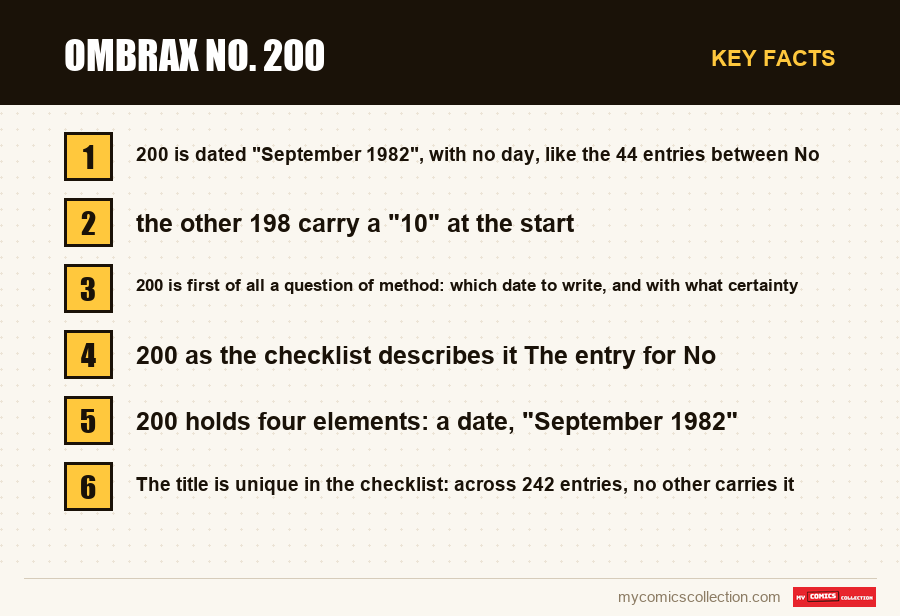
In the checklist, Ombrax No. 200 is dated "September 1982", with no day, like the 44 entries between No. 193 and No. 236; the other 198 carry a "10" at the start. Its story is titled "Les statues de cire", with writing credited to Maurizio Torelli and Pier Carpi. The checklist does not say what the copy prints: this page separates what the checklist attests from what still has to be read on the cover.
A round number catches the eye, and this one falls in a zone where the date loses its day. For someone sorting a pile of magazines by publication order, No. 200 is first of all a question of method: which date to write, and with what certainty.
As always on this guide, only verified information (creators, issue numbers, dates) is stated as fact; the analysis is our own, with no reproduction of panels or protected dialogue.
No. 200 as the checklist describes it
The entry for No. 200 holds four elements: a date, "September 1982"; a story title, "Les statues de cire"; two writers, Maurizio Torelli and Pier Carpi; three artists, Jean Frisano, Giancarlo Agnello and Luciano Bernasconi. That is all, and it must be read as such.
The title is unique in the checklist: across 242 entries, no other carries it. That is a useful point for a collector, because some titles run over several numbers ("Le Dernier Ricanement" occupies Nos. 214 to 216). Here, no neighbor shares the title: No. 199 is "L'insigne des Thugs" and No. 201 "La secte de l'araignée". Still, the checklist gives only one title per issue: it does not say whether "Les statues de cire" is the only story in the issue, or whether it fills the whole of it.
The credits too belong to the issue, not to an episode. Nothing allows you to attribute a particular writer or artist to a particular passage of the issue.
Where the day disappears, and where it returns
No. 192 is dated "10 January 1982". No. 193, "February 1982", no longer has a day. The absence continues up to No. 236, "September 1985".
No. 237 gives "10 October 1985" again, and the form with the day continues to the last number in the checklist, No. 242, dated March 1986. The block therefore runs from 193 to 236: 44 entries, or 18% of the 242 in the checklist.
This block covers exactly 44 consecutive months, from February 1982 to September 1985, one issue per month. No. 200 is the eighth of them: seven entries without a day precede it in the block, and 36 follow it. It is neither at the entrance nor at the exit, which makes it representative of the block and without any particular feature on this point.
One detail matters for method: the two edges of the block coincide with no change of credits. No. 193 is credited like No. 192, and No. 237 like No. 236 (same writers, same artists). Nothing in the team therefore explains the appearance or disappearance of the day in the checklist.
A fact of the checklist, or a fact of the object?
Two claims need to be separated. First claim, verified: in the checklist, 44 consecutive entries have no day. Second claim, not verified: the corresponding issues do not print one. The first describes a catalog; the second would describe an object, and the checklist does not allow us to move from one to the other.
At least three situations remain compatible with the data. The numbers in the block may genuinely carry a date reduced to month and year. They may also carry a day that the checklist did not record for that period. Finally, the "10" of the other 198 entries may reflect a recording convention rather than a reading made on each copy: an identical value across 198 entries calls for caution, without allowing us to decide.
The practical consequence is simple. Do not copy into your list a "10 September 1982" that nobody has established for No. 200, and do not infer from the absence of a day any property of your copy. Look at the cover and note what it shows, distinguishing what you read from what you deduce.
Around No. 200: a writer who leaves, a team that changes eleven numbers later
No. 200 closes a run: Pier Carpi is credited on each of Nos. 176 to 200, twenty-five in a row. After him, the checklist lists him only once, at No. 208.
On the neighboring entries, Nos. 201 to 203 are credited to Maurizio Torelli alone, and No. 204 likewise; No. 206 adds Nino Laccisaglia, and No. 210 Gallieno Ferri. For a collector who sorts by creative team, No. 200 is therefore a natural boundary: it is the last number of the run in which Pier Carpi joins Torelli on writing.
On art, No. 200 sits within the run of Luciano Bernasconi, present on every entry from 178 to 203, twenty-six in a row. No. 204 replaces him with Ivo Pavone in the third position, before his return at No. 205. Jean Frisano and Giancarlo Agnello, for their part, hold the first and second positions without a break from No. 149 to No. 210.
The real change of register comes later. At No. 211, "Wampus [partie 1]", the credits switch: Alfredo Castelli and Franco Frescura replace Torelli and Carpi, Giancarlo Alessandrini joins on art, and Agnello, like Torelli, no longer appears after No. 210.
The new team settles in: Castelli is credited on entries 211 to 242, the last number in the checklist. Frisano, meanwhile, leaves the credits for a long interlude and returns at No. 228.
Be careful not to merge these two landmarks. No. 200 is not the border between two teams, and No. 211 is not the border of the dates: the day has already been missing for eighteen numbers when the team changes. A list that put "no day" and "Castelli era" in the same column would confuse two independent phenomena.
Do you collect this series?
Track what you own, what you are missing and what your collection is worth. 7-day trial.
Start my trial →
Dating a copy when the day is missing
Within the block, the pair of month and year is enough to order the numbers: 44 entries, 44 distinct months, no month shared between two numbers. The day would therefore not separate anyone, and its absence makes no ranking ambiguous. This is a reassuring point: the precision that is missing is not the one a chronological sort needs.
A cross-check by rank confirms it. No. 1 is dated February 1966, and one issue per month brings rank 200 to September 1982, which is what the checklist indicates. Among the 242 entries, only one contradicts this arithmetic, No. 113. Rank and month therefore agree for No. 200. But this cross-check validates the consistency of the checklist, not the content of your copy: it does not replace reading the cover.
For the general method, see the guide on dating Lugs without a cover date and the article on cover price and dating. The useful rule here fits in one line: write "September 1982", without a day.
Immediate neighbors and list errors
In a list of gaps, No. 200 is easily confused with its neighbors, because their dates have the same form: "August 1982" for 199, "October 1982" for 201. Sorting is done by number, printed in large type, and the story title serves as a check: "L'insigne des Thugs", "Les statues de cire", "La secte de l'araignée".
Two traps. The first: noting 200 as "date unknown" on the grounds that the day is missing, when month and year are read. The second: copying No. 200 into a "block without a day" column to conclude that the day existed and then disappeared from the object. The checklist describes entries, not issues, and it is better to have two separate columns: "checklist date" and "day printed on my copy".
To place No. 200 within the whole magazine, the series entry gives the frame, and the publication schedule guide explains why a monthly rhythm makes this arithmetic possible.
Condition and tracking of the collection
A 1982 issue is judged on the object: cover, spine, interior, any trace of damp, and none of that can be read in a checklist. Record the condition separately from the date, and do not mix the two columns: a fine copy does not make its date more certain, and an incomplete date does not devalue it in itself.
To track a set of Ombrax, a simple key works: number, month, year, story title, condition, and a box "day read on the copy". Filled in for the 44 numbers of the block, this box will give you, copy by copy, what the checklist cannot. To complete a long run, the method described for completing a Strange collection applies as is to another magazine from the same house.
Frequently asked questions
Write "September 1982", without a day. That is the checklist's form, and No. 200 is placed there between "August 1982" (No. 199) and "October 1982" (No. 201). Add a day only if you read it on your copy.
The checklist does not say. The absence may come from the issues or from the way these entries were recorded. The credits do not change at the entrance to the block, so they explain nothing. Only the copy in hand can settle it.
Not quite. Pier Carpi closes an unbroken run there, from 176 to 200, but Maurizio Torelli and the artists stay in place. The team really changes at No. 211, with Alfredo Castelli and Franco Frescura.
By the cover number first, then by the story title given in the checklist: "Les statues de cire", as opposed to "L'insigne des Thugs" at 199 and "La secte de l'araignée" at 201. The title is a check, not a contents list.
No. Within the block, each number corresponds to a distinct month, so month, year and number are enough to identify it. The day would add precision, not identification, and it changes nothing about the order of the issues.