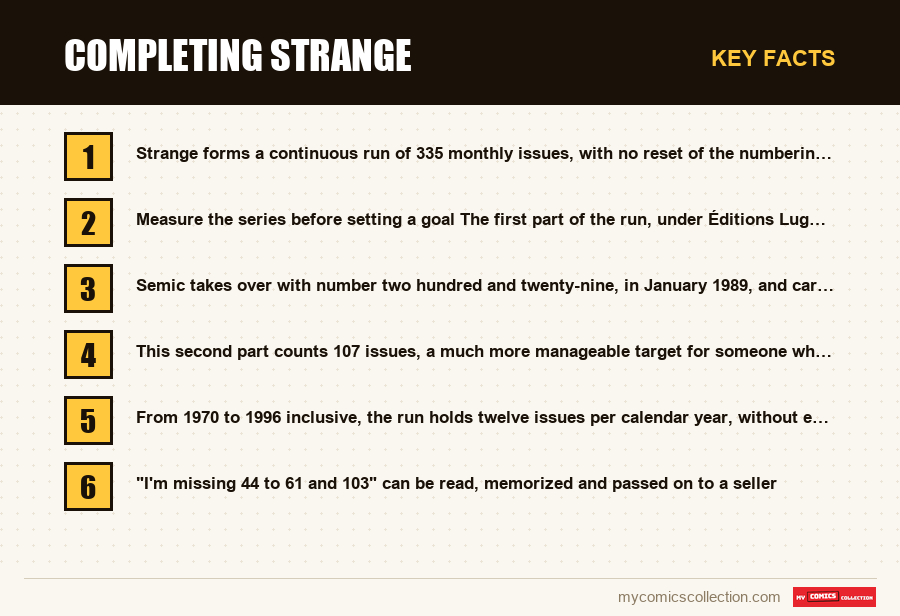
Start with the inventory, never with a purchase: list what you own, issue by issue, before looking for anything. Strange forms a continuous run of 335 monthly issues, with no reset of the numbering when the publisher changed. The method that works is to fill the isolated gaps in the regular stretches first, to buy in blocks of consecutive numbers, and to reserve single-issue buying for the early years and the very end.
A pile of Strange owned by a French collector rarely looks like a collection: it looks like an inheritance. Issues that arrived in flea-market lots, a few purchases from youth, sometimes two copies of the same issue because nobody kept a list. The question is not whether the series is beautiful; it is which end to tackle it from without buying at random for three years.
As always on this guide, only verified information (creators, issue numbers, dates) is stated as fact; the analysis is our own, with no reproduction of panels or protected dialogue.
Start with the inventory, and nothing else
The first move is not a purchase, it is a record. Lay out the pile, take each issue and note its spine number, and nothing else: no title, no date, no condition yet. The number is the only identifier of this series that never changes form, and it is the one you will see in every listing.
This record pays off immediately: it turns a pile into an interval. As long as you do not know whether you own thirty or eighty numbers, you cannot decide on a goal, and you will buy whatever comes along instead of what is missing. One hour of sorting saves you months of duplicates.
Then sort by hundreds. The series reads naturally this way, since it runs from number one to number three hundred and thirty-five without a break in the count. You will see at once whether your pile is concentrated in one period or scattered across the whole run: the two situations call for very different buying strategies.
Measure the series before setting a goal
The first part of the run, under Éditions Lug, goes from the inaugural issue dated 5 January 1970 to number two hundred and twenty-eight, dated December 1988. That is a huge block, and it decides the feasibility of your project: it alone makes up more than two-thirds of the series.
Semic takes over with number two hundred and twenty-nine, in January 1989, and carries the magazine to its last issue dated March 1998. This second part counts 107 issues, a much more manageable target for someone who wants a complete and coherent set without devoting a decade to it.
Remember the practical consequence: "completing Strange" is not one goal but three possible ones. The full run of both periods, the Semic period alone, or a stretch of one hundred issues chosen for the creators who worked on it. Choose before you buy, not after.
Build a want list that holds up
The rhythm of this magazine makes the want list surprisingly simple to build. From 1970 to 1996 inclusive, the run holds twelve issues per calendar year, without exception: one issue a month, always. An issue missing from your pile therefore corresponds exactly to a missing month.
Write your list as intervals, not as isolated numbers. "I'm missing 44 to 61 and 103" can be read, memorized and passed on to a seller; a column of forty numbers cannot, and it will make you miss the lot that would have filled an entire block. The interval is the working unit of the magazine collector.
Add one column beside it: "seen" or "not seen", to separate what you are actively looking for from what you have never yet come across for sale. After a few months, that distinction will show you where your real difficulties lie, and it will show them better than any intuition.
Why the catalogue entry is not enough to identify an issue
The catalogue keeps only one story title per issue, whereas the art credits almost always list three for the same number. The explanation is structural: the magazine assembled several episodes under a single cover, and the entry names only one. The real contents are always broader than the line you are reading.
That single title is not even always the title of an episode. Number 105 carries as its title the continuation of the results of the contest launched at the hundredth issue, and two issues far apart, the eighteenth and the thirty-third, both carry the same letters-page heading. A title can therefore name a page of editorial content, and it can repeat.
The dating notation also varies. The early years are recorded with the day, in the form "5 January 1970", while from number two hundred and ninety-seven onward the entry gives only the month and year. If you search by date in a listing, that difference alone can lead you to believe you are looking at a different issue.
Operational conclusion: always identify an issue by its number. The title serves to confirm, never to decide. And when a seller describes contents your list did not expect, that is not necessarily an error on their part: it is the rest of the contents, to be checked on the copy itself.
The episodes to follow, and the order they impose
Several issues carry a title explicitly numbered in parts. You read "The War of the Seas, Part 2" on number 268, then "Part 4" on number two hundred and seventy: the intermediate parts exist, in the issues that separate them, without the entry naming them.
The same thing happens later, with chapter two of "Operation AIM" in number 317 and its resolution two issues further on. The buying lesson is direct: in these passages, a single isolated issue leaves you with an amputated story, and you will end up buying its neighbors anyway.
So buy in contiguous blocks as soon as you know that an episode runs over several months. This is also true at the end of the run, where a two-part story occupies the May and June 1997 issues. Three consecutive issues bought together almost always take less effort than three issues hunted separately.
Do you collect this series?
Track what you own, what you are missing and what your collection is worth. 7-day trial.
Start my trial →
In what order to buy
Start with the most recent period, the one Semic published. It is shorter, closer in time, and its issues circulate in coherent sets, because many readers of that generation kept their series together. You quickly obtain a complete segment, and a complete segment is motivating.
Then tackle the bulk of the Lug period's core, roughly the second and third hundreds. These issues were printed during the years when the magazine was well established, and the monthly rhythm remained perfectly steady. This is the stretch where lots are easiest to find and most uniform in condition.
Save the two extremes for last: the very first years, and the last handful of issues. They will demand the most patience, and it is better to approach them when your list is precise and you know exactly what you are missing.
Lot or single issue: how to decide
The lot is the right tool wherever the run is regular and abundant. Across the nineteen full years at twelve issues a year that the Lug period covers, a seller clearing a cellar almost always offers consecutive runs: that is where a lot saves you time and gives you a coherent condition.
Buying a single issue becomes the right reflex as soon as you are aiming for a specific issue. That is the case for the inaugural issue, dated January 1970 and credited to Stan Lee and Larry Lieber on the script, and it is the case for the final issues, too few to appear often in a lot.
A simple decision rule: if the lot fills at least three slots on your list, take it even with duplicates; if it fills only one, buy that issue alone. The duplicates from a regular stretch get resold; the duplicates from a rare stretch tie up your money for nothing.
Do not buy the same issue twice
A duplicate almost never comes from forgetting; it comes from a list that is not where you need it. Your list has to be consultable at the moment of purchase, so in your pocket, and updated when you order, not when the item arrives. In between, several weeks can pass during which you keep searching.
The second trap is reading a three-digit number. In a series that climbs to the three hundred and thirty-fifth issue, the thirteenth, the one hundred and thirtieth and the one hundred and thirty-first are easily confused in a badly written listing or in a photo of a worn spine. Have the number confirmed, not just the cover.
The third trap is the title. Since one and the same letters-page heading serves as the title of two far-apart issues, a seller acting in good faith may offer you "the issue with the fan mail" and send you the one you already have. Never validate a purchase on a title alone.
Finally, note the condition beside each box you tick. It is the only way to know whether a copy you come across again is a useless duplicate or a legitimate replacement for an issue you own in poor condition.
Where the series gets difficult
The difficulty shows in the rhythm. Until 1996, every calendar year brings its twelve issues without missing a month, then the regularity breaks: the December 1996 issue is followed by one dated May 1997, and the four months in between carry no issue at all.
The ending is shorter still. The year 1997 holds only eight issues, and the run finishes after three issues in 1998, the last one dated March. This tight ending explains why the very last issues rarely appear in lots: they were printed and kept under conditions that no longer resemble those of the full years.
At the other end, the difficulty is one of age rather than editorial scarcity. The issues from the early 1970s are nearly thirty years older than the end of the series, and they were read by children: the question is not finding them, it is finding them in a condition you will accept keeping.
Keeping the collection going over time
A magazine collection is tracked by segments, not by total. Noting "212 out of 335" tells you nothing actionable; noting "complete Semic period, complete second hundred, early years in progress" tells you where to put your next purchase. The overall counter only serves to look good.
Follow the creators too, if you want a reading grid rather than a race for numbers. Jean Frisano appears in the art credits of the great majority of Lug issues, and Jean-Yves Mitton on a large share as well; on the Semic side, Mark Bagley returns on roughly a third of the issues. Collecting a signature is as legitimate a goal as a full run, and far more attainable.
Finally, accept that your list will stay open for a while. A series that appeared monthly for nearly three decades cannot be completed in one season, and the two extremes are won through opportunities. What must be complete from the first month, however, is the inventory: everything else follows from it. Our other collecting guides cover the edition and condition points that this record does not.
Frequently asked questions
The series has 335 issues, numbered in one continuous sequence from the first to the last. The counter was never reset, including at the change of publisher: a given number therefore always designates a single issue, which greatly simplifies keeping a want list and writing a search listing.
With the most recent period, published by Semic from January 1989. It is noticeably shorter than the previous one, its issues are closer in time, and they often circulate in coherent runs. You reach a complete segment within a few months, which gives you a solid base before you tackle the bulk of the run.
By relying on the spine number alone. The story title is not enough: the entry keeps only one per issue even though several episodes share it, and some titles repeat from one number to the next. Ask the seller for the number, confirm it against your list, and only then discuss the contents.
On the stretches where the magazine appeared twelve times a year without interruption, yes: consecutive runs are common there and the condition is uniform. On the very last issues, much less so: the publication tightened, and a lot that contains them is rare. There, buying single issues remains the safest route.
Both ends, for opposite reasons. The ending is short: after a break of several months at the end of 1996, only a handful of issues remain until March 1998. The beginning is not hard to find, but it is rarely in a satisfactory condition, because those copies were read and handled for a very long time.