
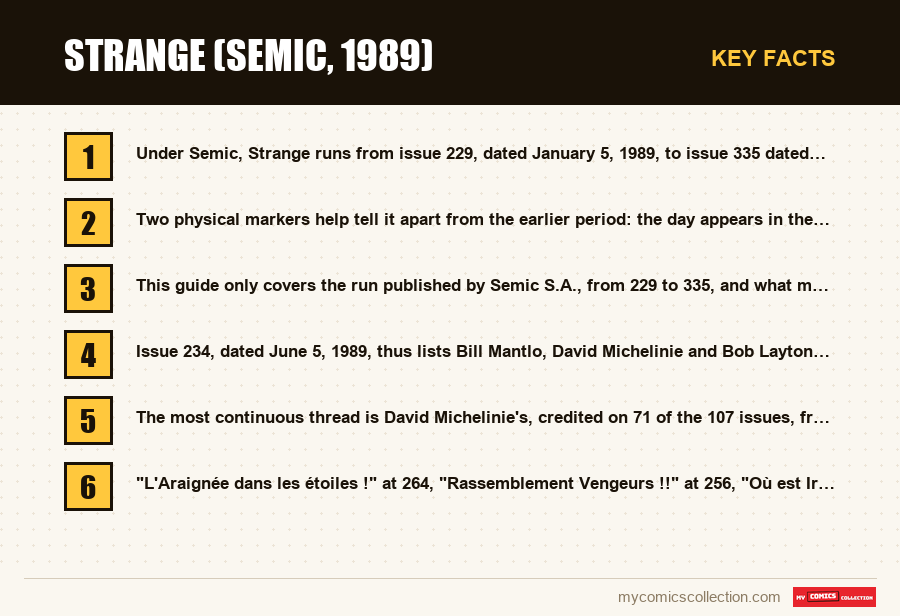
Under Semic, Strange runs from issue 229, dated January 5, 1989, to issue 335 dated March 1998, that is 107 monthly issues. The French magazine keeps the existing numbering and publishes three series per issue, as shown by the three writers and three artists credited on each issue. Two physical markers help tell it apart from the earlier period: the day appears in the cover date up to issue 296, and the creative team changes completely from issue 325 onward.
You have a stack of Strange on a shelf, the spines are lined up, and you do not know where one run ends and the other begins. The question is not theoretical: at a flea market, two copies in the same format and the same layout can belong to two different editorial periods, with prices and rarity that have nothing in common. This guide only covers the run published by Semic S.A., from 229 to 335, and what makes it distinct.
As always in this guide, only verified information (creators, issue numbers, dates) is stated as fact; the analysis is ours, with no reproduction of artwork or protected dialogue.
What the magazine published, and how to read it in the credits
Each catalogue entry, for a given issue, lists three writer names and three artist names. This is not a data entry error: it is the signature of an issue that stacks several episodes under a single cover. Issue 234, dated June 5, 1989, thus lists Bill Mantlo, David Michelinie and Bob Layton as writers, with Todd McFarlane, Jim Lee and M. D. Bright on art. Three writers, three pencillers, one single issue.
The most continuous thread is David Michelinie's, credited on 71 of the 107 issues, from the very first one through issue 307 of July 1995. For a buyer, this figure tells you something useful: the magazine's main storyline does not change hands for nearly seven years. You can buy scattered issues within this range without running into a break in tone, which is not true of everything sold in lots.
The French titles give an idea of what filled the pages. "L'Araignée dans les étoiles !" at 264, "Rassemblement Vengeurs !!" at 256, "Où est Iron-Man ?" at 267: three parallel series that alternate from issue to issue. The catalogue keeps only one title per issue, we come back to this, but these three are enough to show the content.
The real rhythm, as the cover dates tell it
On paper, the monthly is regular: one issue per month from January 1989 to March 1998. In practice, reading the dates one by one reveals three irregularities, and each has a practical consequence for anyone completing the series.
The first is discreet. Issues 279 and 280 both carry the date March 5, 1993, and the next issue jumps straight to May 5. In other words, two issues were dated the same month, and none is dated April 1993. If you sort your collection by date rather than by number, you will think something is missing when it is not. Always sort by number: the numbering, for its part, does not skip a single one across the 107 issues.
The second is the most visible: between issue 324, dated December 1996, and issue 325, dated May 1997, four months pass without publication. A gap like this in a newsstand monthly is rarely accidental, and here it coincides with the team change described further on. The third is purely typographical and concerns a single issue, 232, which reads "April 1989" when its immediate neighbours carry a precise date.
The artists who make the 1989 to 1994 run valuable
This is the strongest argument for the period, and it reads unambiguously in the credits. Todd McFarlane appears on 23 issues, from 232 to 274, and Jim Lee on ten, from 232 to 244. Erik Larsen covers 18 issues starting at 252. So you have, in newsstand issues sold at cover price, art signed by names that would carry great weight on the American market a few years later.
Mark Bagley is in fact the most present artist in the entire series, with 38 issues from 272 to 323. His longevity in the magazine has a concrete effect on the second-hand market: his issues are numerous, and therefore rarely hard to find, whereas the ten issues where Jim Lee is credited form a narrow range that buyers spot more quickly. When a short run concentrates a sought-after signature, this is where asking prices pull away from the rest.
On the writing side, Bill Mantlo stops at issue 247 in July 1990, while Len Kaminski joins at issue 282 in June 1993 and stays for 35 issues. These two markers divide the content into three quite different thirds, useful to know if you want to buy a period rather than a list of issue numbers.
French names in the credits, and what they signal
One detail stands out when you browse the entire series: Ciro Tota is credited on 18 issues, from 231 to 282, among American artists. Further on, three names appear only once each: Christian Goussale at issue 289 of January 1994, Eleonor Duport at issue 301 of January 1995, Gabriel Gecko at issue 309 of September 1995.
These isolated appearances point to the fact that the issue did not simply translate: part of the pages, covers included, was produced in France. Sources differ on the exact nature of each contribution, and the catalogue does not specify whether it is a cover, a complete story or an illustration. This is something to check on the copy itself, and a good point to make when you describe an issue for sale.
The last eleven issues do not look like the previous ninety-six
From issue 325 of May 1997 onward, the credits change completely. Doug Moench, Grant Morrison, then Chris Claremont on writing; Howard Porter, Kelley Jones, Humberto Ramos, Oscar Jimenez, J. H. Williams III on art. None of these names had appeared in the magazine during the previous eight years, and none of the earlier pillars survives the break.
The story titles confirm the turn: "Course à la présidence" at 325 and 326, "Le Flash des deux cités" at 328, "La théorie de la monosynapse" at 332. These teams were then associated by readers with other editorial universes than the one that had filled the magazine until then. The series stops eleven issues later, at 335 of March 1998.
For a collector, this tail end is a category of its own. It is short, it is rarely present in lots assembled by early readers, and its content does not appeal to the same audience. Always check whether a lot advertised as "complete" stops at 324: it is the most common cut, and it leaves eleven gaps.
Do you collect this series?
Track what you own, what you are missing and what your collection is worth. 7-day trial.
Start my trial →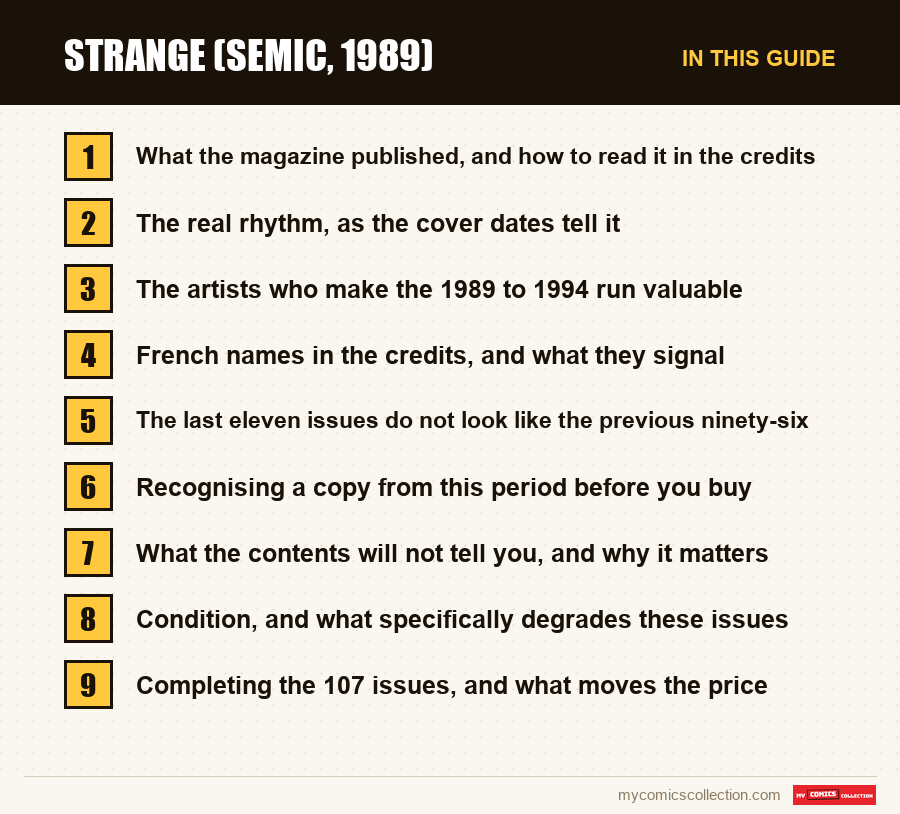
Recognising a copy from this period before you buy
Three checks are enough, in this order. First the numbering: if the issue number is between 229 and 335, you are in the range described here, whatever the layout. Next the cover date: from 229 to 296, it carries a day mention, "January 5, 1989", "August 5, 1991", "August 5, 1994". From issue 297 of September 1994 to the end, the date is reduced to month and year.
This change of format, in the middle of the series, is the quickest marker you have at a stall. It splits the collection into two clear blocks, 67 issues on one side and 40 on the other, and it immediately tells you which third of the series you are holding without opening the issue.
Finally, the inside credits. A copy that lists Mark Bagley or Kevin Hopgood in the contents must be later than 272. A copy featuring Bill Mantlo and Jim Lee must necessarily be earlier than 247. This cross-reading spares you paying for a period you already own in duplicate.
What the contents will not tell you, and why it matters
The catalogue keeps only one story title per issue, whereas the issue contained several. The three writer names per entry prove it: for each issue, two or three contents entries are missing. We therefore cannot tell you what a copy contains in full, and nobody should claim to do so from this source alone.
The consequence is harsh and deserves to be stated plainly: with this data, it is impossible to claim that a given French issue contains the first French appearance of a character, or that it corresponds to a particular American issue. A single story could be cut up, shifted or postponed. Any claim of this kind, in a listing or on a forum, must be verified on the copy itself, contents page in hand.
A further trap compounds this: the title "Premier contact" appears twice in the series, at 280 of March 1993 and at 288 of December 1993. Never identify an issue by its story title alone. And issue 300, dated December 1994, carries irregular credits in the catalogue, with a "divers" (various) mention where the other entries name three artists. That issue deserves a direct examination before purchase.
Condition, and what specifically degrades these issues
A monthly sold at newsstands for nine years ages in a predictable way. On this series, first look at the spine: the issues from the lower range, the earliest years, were often read and re-read, and the central fold ends up turning white. The paper, for its part, yellows along the edges before yellowing across the whole, which lets you estimate storage without opening the issue.
Staples are the second checkpoint. A rusted staple stains the paper in a half-moon around it, and the stain does not come out. Finally, check the upper corners, the most exposed when a stack has been handled standing up. A copy from the later years, less read, is often in better condition than its 1989 equivalent, but it has sometimes been stored longer without protection.
Completing the 107 issues, and what moves the price
The series is completed in blocks, not issue by issue, and that is the least costly method. Lots sold by former readers almost always cover a continuous period of reading, which gives you twenty or thirty issues at once. List your gaps in ranges of ten, compare them with the full numbering from 229 to 335, and buy where the lot covers the most holes.
Three factors change what you will be asked to pay. Condition first, as always, and it weighs more heavily on a newsstand magazine than on an album. Then the signature: issues featuring a short run such as Jim Lee's are priced differently from the abundant issues of the middle range. Finally the boundaries, first and last issue, which always sell above their immediate neighbours for a reason that has nothing to do with their content.
To keep track of all this, maintain an inventory by issue number rather than by title, noting the cover date as it is printed. This is what will allow you, two years from now, to see at a glance whether the lot offered to you fills real gaps.
Frequently asked questions
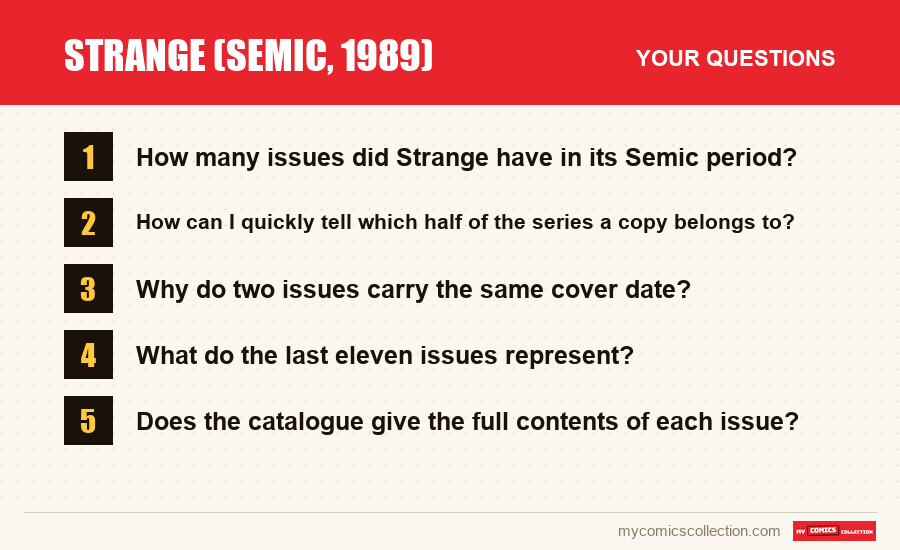
One hundred and seven issues, from 229 dated January 5, 1989 to 335 of March 1998. The numbering is continuous across the whole range, with no missing issue. A collection advertised as complete must therefore include all 107 issues, boundaries included, and not stop at the end of 1996.
By the cover date. From 229 to 296, it carries a day mention, such as "May 5, 1990". From issue 297 of September 1994 to the last issue, it is limited to month and year. Only one issue breaks the rule in the first half, issue 232.
Issues 279 and 280 are both dated March 5, 1993, and 281 jumps to May 5: no issue is dated April 1993. This duplicate does not indicate a gap in your collection. Sort your copies by number rather than by date to avoid this false alarm.
From issue 325 of May 1997 to 335 of March 1998, the credits no longer include any of the creators present in previous years: Doug Moench, Grant Morrison and Chris Claremont write, while Howard Porter and Kelley Jones draw. These eleven issues form a distinct tail end, often absent from older lots.
No, and this is a limitation to be aware of. It keeps only one story title per issue, whereas the three credited writers indicate several stories per release. No match with an American issue, nor any first French appearance, can be deduced from this source alone.