
At a flea market, time is short and the light is poor, so you need a short routine that never changes. Bring a torch, a rigid bag and your list of gaps. In front of the box, sort by title before looking at the covers. For each issue you keep, check four things: the continuous pagination, the condition of the staples, the two central pages, and the games pages. Decide afterwards, not before.
A village car-boot sale can turn up a batch of Lug magazines that you would hunt for six months elsewhere, and let you leave with two incomplete issues because you decided standing up, in thirty seconds, with the sun in your eyes. The difference between the two outcomes is not luck: it comes down to having a method, carried out in the same order every time, short enough to hold while a queue forms behind you.
As always on this guide, only verified information (creators, numbers, dates) is stated; the analysis is our own, without reproducing any panel or protected dialogue.
What you take with you fits in a pocket
The temptation to bring equipment is the first trap. You need neither a magnifying glass, nor a ruler, nor plastic sleeves: your hands will be full, and every object pulled out of the bag is one you put down on a wobbly table. Three things are enough. A small torch, because a clear-out often takes place under a marquee and the matt black of an old cover swallows light. A bag with a rigid base, so that what you buy does not travel folded against a bottle. And your list of gaps, readable without a network connection, because flea markets happen precisely where the phone has no signal.
Add one habit rather than an accessory: clean, dry hands. A kiosk magazine from the sixties marks at the touch of a finger, and the mark does not come off. If you eat on the way, you have just lost the right to handle the stock, and an attentive seller will notice before you do.
One last detail that changes the rest of the morning: decide on arrival how long you will give to a stall. Two minutes per box, no more, and you will come back at the end if the haul has been thin elsewhere. Without that limit, you will spend an hour on the first clear-out and leave just as the good stacks have already gone.
The first seconds in front of a stall
Do not look at the covers. This goes against instinct, yet it is the only way to move quickly: a cover draws the eye, holds the attention, and makes you forget there are four boxes left. Look first at the spines and the formats.
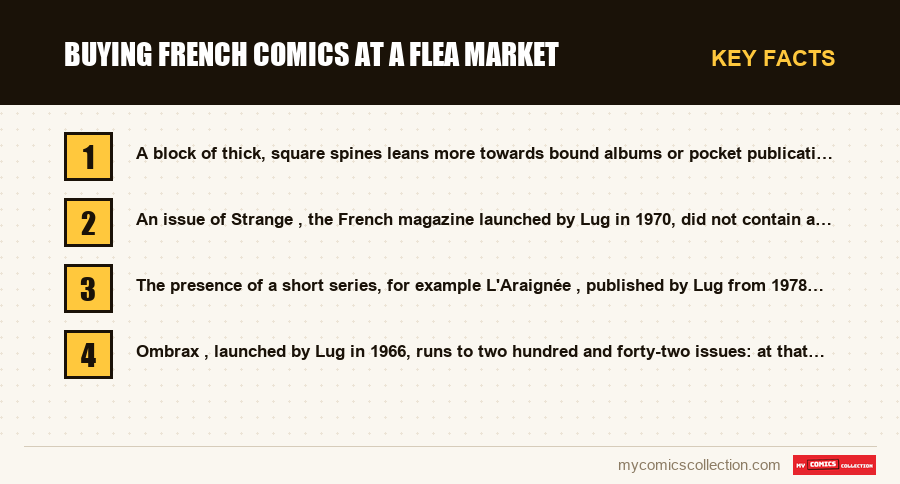
The format tells you more than the title does. A stack of small paperback-style formats points to the French kiosk series of the sixties and seventies. A block of thick, square spines leans more towards bound albums or pocket publications, among which Superman Poche, published by Sagédition from 1976, is a common example: with its ninety-six issues, it is a title often found in loose bundles, and so a title where the value of a find depends on condition, not on rarity.
The height of the pile, for its part, tells you whether you are dealing with a broken-up collection or a miscellaneous attic lot. Around twenty issues of the same title, roughly in order, come from someone who bought them as they came out: these are the piles that reward digging, because they hold consecutive numbers and sometimes an almost complete run.
Going through a box without damaging anything
The most common mistake is to flick through the box like a record bin, tipping the issues towards you with a nudge. On old kiosk paper, this movement creases the cover upright and leaves a mark that never fades. Do it differently: take out a bundle, lay it flat, and unfold it from the top.
Ask permission before emptying anything, then put the box back the way you found it. This is not just politeness: flea-market sellers come back, and the one whose tidying you respected will bring out the second box, the one kept in the boot.
If the box is on the ground, crouch down rather than hauling the issues up at arm's length. Old stapled magazines come apart under their own weight when held by the cover: hold the issue by its spine, flat on your palm, never pinched by a corner.
Checking that an issue is complete
This is the check that will save you the most regret, and almost nobody does it on the spot. A stapled issue is made of gatherings: if one sheet has gone, it is not one but two pages that are missing, and they are missing from two different places in the issue.
The check comes down to two movements. Open the issue in the middle, make sure you have a double-page spread held by the staples, then run through the numbering with your thumb, stopping at any jumps. If the issue carries no page numbers, which happens on small formats, count the gatherings from the centre: the thickness should be symmetrical on either side of the staple. One half visibly thinner means a torn-out sheet.
In a classic French anthology magazine, this check counts double. An issue of Strange, the French magazine launched by Lug in 1970, did not contain a single episode but several, and a missing sheet often deprives you of the middle of a story without the contents page saying so. The catalogue will tell you later what an issue was supposed to contain; on the stall, you detect it through the thickness and the pagination.
The spine, the staples and the central pages
Beyond completeness, three areas carry almost all the rest of the diagnosis, and none of the three shows in a photo or on a cover laid flat.
The spine first. Hold the issue closed, spine towards you, and look along the line of the fold: a spine whitened in a continuous band signals an issue folded back, read and re-read, often by a child. A spine marked with short, parallel creases is something else: it has been rolled up in a pocket or a satchel.
Then the staples. Two rusty staples stain the paper around them, and the stain spreads towards the centre. Above all, run your fingernail around the edge of the hole: if the staple has been working, the paper is split, and the central gathering will eventually come loose. An issue whose staples have been replaced shows in the number of holes, and it is worth pointing out to the seller calmly, because that can be discussed.
Finally, the central pages. These are the most exposed, because they often held a full-page illustration that readers tore out to put on the wall. Open them every time, even if the rest is flawless.
Do you collect this series?
Track what you own, what you are missing and what your collection is worth. 7-day trial.
Start my trial →
The pages of games, letters and coupons
French kiosk magazines included editorial pages: readers' letters, games, crosswords, sometimes a coupon to send back. They are your best indicator of real use, and the quickest to read.
A grid filled in with pen cannot be cleaned, and it puts the issue in the category of reading copies, however fresh the cover looks. A detached coupon is a truncated page: it counts as a gap, even if the rest of the sheet is there. Readers' letters, meanwhile, are often annotated, and the ink bleeds through thin paper: look at the reverse before concluding that the mark is on the surface.
These pages have a second use, and this one is in your favour. They sometimes give you a clue to the period when the cover is too damaged to read, because their layout changed over the years.
Working out the period of the issue you are holding
On the ground, you do not have time to trace an editorial genealogy. You need a single marker, and that marker is the publisher's name printed in the imprint or on the spine.
Take Strange. The series was launched by Lug and reaches its two hundred and twenty-eighth issue; Semic then takes over without resetting the count. The immediate practical consequence: a number beyond that point is not a duplicate of an earlier issue, it is an issue from another period, printed differently, and it has nothing to do with the early years. Check the name in the imprint rather than relying on the cover number alone.
The same caution applies to titles sharing a name. Several series carry the same name at different publishers, Hulk and Thor being examples, and the number of issues published differs completely depending on the period: looking up the publisher's name is what stops you from going home with an issue that completes nothing.
Deciding in front of a mixed lot
The most frequent case is not a clean pile of a single title, but the box where a bit of everything lies in disorder, often offered as one lot. You need a decision rule, or you will buy on impulse.
Ours comes down to one question: what would I keep if everything else were unsellable? Mentally isolate the two or three issues that justify the spend on their own, and treat the rest as worthless. If those two or three pieces are not enough to decide you, the lot is not for you, even at a bargain price, because the volume you bring home has a cost in space and in sorting time.
Two signs tip a mixed lot in the right direction. The presence of a short series, for example L'Araignée, published by Lug from 1978 and which ran to only twenty-five issues: short series rarely circulate in bulk, so finding several of their issues together is unusual. And the regularity of consecutive numbers, which betrays an original collection rather than a dump of unsold stock.
What to ask the seller, and how
The best finds are not on the table. They are in the car, or with the seller, and they come out for whoever asks the right question. The one that works is not "do you have other comics?", which is too vague, but a question that shows you know what you are talking about: ask whether there are more issues of the same title, naming the title you are holding.
Then ask two questions about origin, because their answers are worth a diagnosis. Where the magazines came from, and where they were stored. A stock kept in a lived-in room and one brought down from an attic or up from a cellar do not look the same, and the seller will tell you without suspecting anything.
On price, stick to a simple principle: state what you observe, without interpreting it out loud. "The central double page is missing" is a fact, verifiable with the seller, and it carries the discussion. The rest, the comparisons, the rarity arguments, the speeches about the market, put off a private seller who is selling their father's things. If the numbers do not add up, thank them and leave your number: a share of the good lots is settled the following day.
Not buying what you already own, and getting home intact
The mistake costs little per item and a lot cumulatively: three duplicates a season, and you have paid for an issue you really did need. It has a single cause: your list of gaps is not readable where you are. A useful list at a flea market is one organised by title and by number ranges, readable offline, and updated the evening you get back. A phone searching for a signal under a marquee replaces nothing.
For long titles, the list changes in nature. Ombrax, launched by Lug in 1966, runs to two hundred and forty-two issues: at that scale nobody remembers their gaps, and without a written record you will buy the same issue twice before the year is out. Note ranges rather than isolated numbers: that is what can be read in two seconds in front of a box.
Then there is the journey home. What you checked for ten minutes can be damaged in ten minutes in the car: flat in the rigid bag, never upright, never under anything else, and out of the boot as soon as you arrive rather than left warm for a day. In the evening, one task before you put things away: update the list, otherwise the next outing will start again with the same blind spots.
Frequently asked questions
No. Protecting an issue while standing at a wobbly table takes time and draws attention to your purchase. A bag with a rigid base, in which everything travels flat, protects better on the journey than a sleeve slipped on in a hurry. Sleeving is done on the way back, once the issues are sorted and the list of gaps is updated.
Open it in the middle: you should see a full double-page spread held by the staples. Then look at the thickness on either side of the fold, which should be symmetrical. A half that is thinner, or a central double page that is no longer attached, signals a torn-out sheet, and so two missing pages at two places in the issue.
Yes, but as a reading copy and as a stopgap in a series you are building. A grid filled in with pen cannot be removed, and it classes the issue regardless of how fresh the cover is. Take it if you are missing it, on the understanding that you will replace it later with an unmarked copy.
Look for the publisher's name in the imprint or on the spine, never the cover number alone. Titles such as Hulk or Thor were published in different periods by different houses, with issue counts that have nothing to do with each other. The publisher's name is the quickest and most reliable marker in the field.
Judge the lot on the two or three issues you would keep if everything else were unsellable. If they justify the spend on their own, take the bundle: consecutive numbers betray an original collection, often better kept. Otherwise, choose individually, because a filler lot costs you space and sorting time.