
Specials, one-shots, albums, satellite titles and hardcover editions fall outside the lists because their number does not belong to them: it is borrowed from the parent magazine, it starts partway through the run, it doubles up, or it was never printed on the cover. The catalogue keeps a trace of them under discreet markings, a "bis", a "hors série", a "cartonné", sometimes a figure in square brackets. Spotting them means reading the marking before the number.
You have a stack of French magazines, a file where you tick off what you own, and the nagging feeling that the count never quite adds up. The fault is not your file: the output of French newsstand publishers never fitted into a column of ascending numbers. Alongside the regular magazines, the same houses published specials, albums, collections devoted to a single character, and hardcover reprints. These items sell, and they are the blind spot of most inventories.
As always on this guide, only verified information (creators, issue numbers, dates) is stated as fact; the analysis is our own, with no reproduction of artwork or protected dialogue.
Why these releases fall off the lists
A collection list rests on an unstated assumption: a title has a counter, the counter starts at 1, and it advances by one with each release. As long as that holds, ticking boxes is enough. The releases we are discussing break it, each in its own way: one borrows the counter of another magazine, another opens its own at an advanced rank, a third occupies two ranks at once, and a fourth shows no number at all.
The result is always the same: the release becomes invisible in the tool used to search for it. A table sorted by number places it among issues that have nothing to do with it, or it appears nowhere because no box corresponds to it. From there, people conclude that the object does not exist, or that they already own it, and both mistakes are costly.
The way out is not technical. It consists in ceasing to treat the number as the identity of an issue, and filing it among its other characteristics: marking printed on the cover, date, format, binding, collection it belongs to. The five forms that follow are the ones actually found in the catalogue of French magazines, and each has its own way of signalling itself, of being misdescribed, and its own point to verify.
First form: the special that borrows its parent magazine's counter
This is the most elegant and the most treacherous. A house publishes a supplement attached to an existing magazine, and rather than giving it a new counter, it has it carry the rank of the magazine at the time of release, followed by a marking. In the catalogue, this produces ranks that do not follow each other, spaced three apart, with a "bis" or a "hors série" attached to the number: the series of specials devoted to the origins of the Strange characters provides the example, first with ranks suffixed "bis", then with ranks suffixed "hors série".
It is recognisable by the gap between ranks: a regular magazine advances by one, this form jumps, because it counts the releases of the parent magazine and not its own. The seller, for his part, copies the number and drops the marking, because the marking is small, often printed in the top strip of the cover, and it does not look like numbering information. His listing then becomes an issue of the regular magazine, at the same rank.
Before buying, ask for a photograph of the whole cover, top strip included, not a crop of the illustration: the marking is read there, or nowhere. Also check the announced page count, since a supplement of this kind does not weigh as much as an ordinary issue.
Second form: the collection devoted to a single team
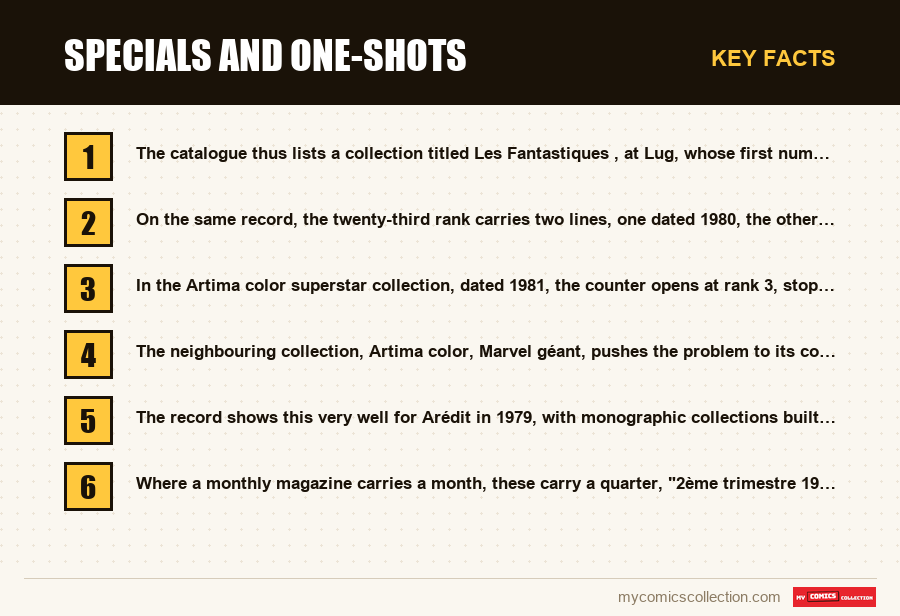
Newsstand anthologies mixed several serials in one issue. In parallel, the same houses launched monographic collections, devoted to a single team or a single character, which reprinted those same heroes elsewhere and in other ways. The catalogue thus lists a collection titled Les Fantastiques, at Lug, whose first numbered line carries rank 19 and the episode "Les Sortilèges de Diablo", credited to Archie Goodwin and John Buscema, and whose highest rank, "La Panthère noire", is dated 1986.
A counter that opens at an advanced rank is the signature of this form. It means the object you hold extends something: an earlier title, a renowned collection, an editorial division that the cover does not tell. On the same record, the twenty-third rank carries two lines, one dated 1980, the other 1986, and the fortieth rank is missing. A gap and a duplicate on the same counter: enough to defeat any table sorted by number.
The seller misdescribes it because he looks for rank 1, does not find it, and therefore assumes that the lowest issue in front of him is the first of the collection. Ask a simple question then: which number is printed on the cover, and which number appears in the imprint? When the two differ, the discussion about price changes in nature. Character hubs, such as the one for the Fantastic Four, help place parallel series devoted to the same team.
Third form: the album-format collection
French publishers also sold, outside the newsstand, collected volumes in album format: larger, thicker, often sold by bookshops rather than newsagents. The catalogue keeps two instructive examples from Arédit. In the Artima color superstar collection, dated 1981, the counter opens at rank 3, stops at rank 24, and rank 12 is missing: gaps that you need to know, before chasing them, whether they come from the record or from the release itself.
Even more revealing: the lines of this collection are not titled after an episode but after a character or a team, "Les Vengeurs", "Miss Marvel", "Les Défenseurs", "Docteur Strange", "Les Micronautes". And the last recorded rank is called "La Ligue de justice", which places heroes from two different American stables within the same album collection. The collection label therefore says nothing about the contents, and that is exactly what makes these albums difficult to search for.
The neighbouring collection, Artima color, Marvel géant, pushes the problem to its conclusion: its first rank appears in the record under two years, 1979 then 1981, with two unrelated titles, and the same goes for the two following ranks. In other words, in this form the number stops identifying the object. Before buying, demand the cover measurements in centimetres and the page count. These are the only two data points that distinguish an album from an issue when the number no longer distinguishes anything.
Do you collect this series?
Track what you own, what you are missing and what your collection is worth. 7-day trial.
Start my trial →
Fourth form: the satellite title born in the same year
A house that runs a collection of albums does not launch one title, it launches several at once, to fill the display rack. The record shows this very well for Arédit in 1979, with monographic collections built on the name of a single hero, Captain America and Thor le fils d'Odin, to which is added a long-titled item, Gamma la bombe qui a créé Hulk. Three objects from the same year, the same publisher, and covers similar enough to be confused from a distance.
These titles give themselves away through their cover date. Where a monthly magazine carries a month, these carry a quarter, "2ème trimestre 1979", "4ème trimestre 1980", because they did not follow the same commercial rhythm. They also give themselves away through their promotion: in place of an episode title, the record has registered the strips these issues carried to advertise the collection, "Arédit présente 4 albums Super Star", "Voici la collection Super Star", "Albums déjà parus". These satellites announced one another, and one of them even displays the line "Conan hors série" at rank 23, in 1983.
Faced with three neighbouring titles from the same publisher, the seller attributes to the best-known one what belongs to the most obscure, because the name of the star hero sells better. So read the publisher's mention printed on the spine or in the imprint and compare it with the title: it is the combination of publisher, year and format that identifies the collection, not the character's name. A tour of the collecting guides gives the format markers specific to each house.
Fifth form: the bracket, and the hardcover marking
The last form is the most underground: certain catalogue lines carry a number in square brackets. The bracket is not decorative: it signals a rank not printed on the object, reconstructed from the place the release holds in the sequence. The record for a collection devoted to L'Araignée at Lug contains two, titled "Docteur Octopus" and "L'Araignée et le robot". An object with no printed number is the one nobody finds again.
Sometimes this bracket comes with a binding marking. In the record for Conan le Barbare at Arédit, two lines carry a rank followed by the word "cartonné", and these two lines are dated 1981, exactly like the two paperback issues bearing the same ranks. The same thing appears in the record for Captain America, where a rank 1 hardcover from the first quarter of 1979 sits next to an ordinary rank 1 from the same quarter. Two objects, one number, a single date: the number does not settle the matter.
The seller does not misdescribe out of malice: he describes what he sees, and what he sees is a number. Hardcover, however, is detected by touch and by the thickness of the spine, not by a scan of a cover. So ask for a photograph of the spine, in profile, with the object lying flat. A square, rigid spine and marked corners: you are not holding the same object as the paperback copy of the same rank, and you should not pay for it as if you were.
What a listing label never says
Taken together, these five forms reveal an uncomfortable fact: the label on a listing is almost always a reconstruction. The seller read a number, recognised a hero, copied a cover title, and assembled a reference that appears on no object. This is not fraud, it is a loss of information, and your work as a buyer is to trace back to the actual object.
Three questions are usually enough. What exactly does the cover say, marking and strips included? What are the dimensions and the page count? Is the spine flexible or rigid? Whoever can answer all three has the object in hand; whoever dodges them is copying a card.
Keeping an inventory that does not confuse the two
The method rests on one idea: your inventory must stop having one number column and have two. The first holds the printed rank, copied exactly, marking and brackets included. The second holds the place it occupies in the sequence, which you calculate. The two coincide for a regular release and diverge for everything else, and that divergence flags a special for you without your having to qualify it.
The case of double issues shows the value of splitting the column. In the record of a pocket collection published by Sage, several lines carry two ranks joined by a hyphen, such as the line "106-107" dated September 1986. Counting lines understates the collection; counting ranks overstates it. With two columns, the line occupies two places and counts as only one object, and your total stops lying.
Then add four short fields, and only four, otherwise you will not fill them in. Marking printed on the cover, as free text. Binding: paperback or hardcover. Format, in centimetres or using your own label. Status of the rank: printed or reconstructed. These four fields are enough to separate the five forms described above, and they are filled in by looking at the object, never by consulting a list. That is their virtue: they force you to describe what you own rather than tick what you believe you own.
One last piece of framing advice: do not try to complete these forms the way you complete a magazine. A collection of albums with discontinuous ranks has no sequence to chase, but a set of titles to spot one by one. Accepting this difference in kind lets you find, among sellers, the objects other buyers walk past without seeing. Parallel series devoted to a single hero, such as those of Spider-Man, are the ground where this difference in method pays off fastest.
Frequently asked questions
Read the marking before the number. A "bis", a "hors série", or a "spécial" printed in the top strip is enough to decide. Without any marking, two clues remain: a rank that jumps several units from the previous one, and a cover date given as a quarter where the regular magazine shows a month.
That the number does not appear on the object and was deduced from its position in the sequence. This is common on the first releases of an album collection, when the publisher had not yet decided to number them. For you, it means that no search by number will bring up this object, and that it has to be searched for by its title.
No. The record for Conan le Barbare at Arédit shows this: two hardcover lines from 1981 sit alongside the paperback lines of the same ranks. The content may be identical, but the objects, their condition and buyers' expectations are distinct. Check the spine in profile before concluding, since a photograph of the cover cannot tell them apart.
No. An album collection appears in waves and has ranks missing from the record, such as rank 12 of the Artima color superstar collection from 1981. There is therefore no continuous sequence to work up through, only a list of titles to spot. Work by title and by format, not by ascending number.
Because some lines occupy two ranks at once. A pocket collection published by Sage includes, for example, a release "106-107" dated September 1986. If you count copies, you miss a rank; if you count ranks, you invent a copy. Two separate columns, printed rank and place occupied, solve the problem.