The single issue is the object as it circulated, with its cover, its pagination and its supplementary pages. The bound volume is a container that gathers episodes and makes them comfortable to read and to shelve. The two do not replace each other: a volume may leave out part of what the issue carried, and no publication listing lets you check what is missing. The choice depends on what you want to own, reread, resell or pass on.
When a pile of French magazines climbs up the wall, the question always comes up: should you carry on hunting single issues one by one, or switch to volumes that gather several of them? The answer is not ideological. It depends on what you expect from your collection, and it has very concrete consequences for space, for condition, for what you can resell and for the reliability of your own inventory.
As always on this guide, only verified information (creators, numbers, dates) is stated; the analysis is our own, without reproducing any panel or protected dialogue.
Two objects that do not promise the same thing
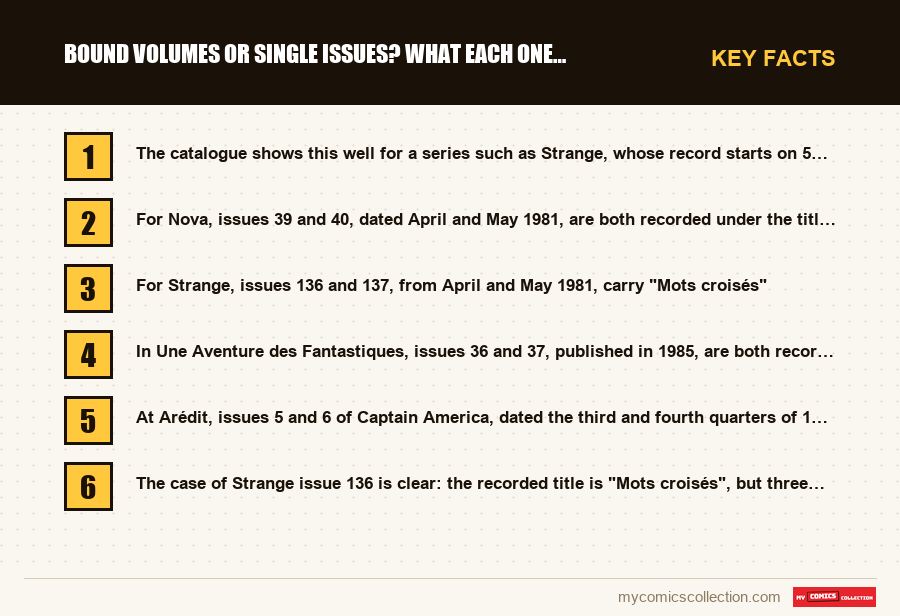
A single issue is a periodical. It was printed for a given date, sold for a few weeks, then withdrawn. Its cover, its printed price, its pagination and its promotional pages belong to a precise moment in French publishing. That anchoring is what you keep when you hold it: the material trace of a monthly appointment. The catalogue shows this well for a series such as Strange, whose record starts on 5 January 1970 and ends with issue 228, dated 5 December 1988, with "Bénis soient les innocents..." by Ann Nocenti, David Michelinie and Bob Layton. Each line corresponds to an object that existed on the newsstand on its date.
A bound volume, by contrast, is a container. Whether it was assembled at the time or published much later, its function is to gather several episodes into a single object, sturdier, easier to reread, more presentable on a shelf. What it promises is comfort and continuity of reading. What it does not promise is the material completeness of what it reprints.
Framing the difference this way avoids many disappointments. You are not buying the same product: on one side a dated document, on the other convenient access to a story. Both are legitimate. They simply are not measured by the same yardstick.
What the issue carries that the volume often leaves out
French magazines of this period were mixed in content. An issue did not contain only episodes: it also held editorial material, games, readers' letters, and promotional pages for the publisher's other titles. This material almost always disappears when episodes are gathered into a volume, because it does not belong to the story.
The catalogue keeps a trace of it by accident. For Nova, issues 39 and 40, dated April and May 1981, are both recorded under the title "Jeux". For Strange, issues 136 and 137, from April and May 1981, carry "Mots croisés". These labels do not describe the contents: they describe what an indexer picked up from a page that was not a story. They mainly show that these pages existed, that they took up real space in the object, and that a reader of the time sometimes filled them in in pencil.
Promotion is even more telling for our subject. In Une Aventure des Fantastiques, issues 36 and 37, published in 1985, are both recorded under the heading "Collection albums 'Super Héros Lug'". At Arédit, issues 5 and 6 of Captain America, dated the third and fourth quarters of 1979, appear under "Arédit présente 4 albums Super Star". The issues were thus advertising the albums themselves. This coexistence is the best proof that the two objects served two uses, not two audiences that exclude each other.
Why a publication listing does not settle the question
We would like to compare line by line: this volume reprints these issues, so the single issues become dispensable. A publication listing does not allow that check, and it is better to say so plainly rather than let it seem otherwise.
The reason is structural. A listing associates each issue with one story title, sometimes two creators' names, and a date. Yet a French magazine often carried three or four episodes. The case of Strange issue 136 is clear: the recorded title is "Mots croisés", but three writers are associated with it, Marv Wolfman, Bob Layton and David Michelinie. One label, several signatures: the record describes part of the object, not the whole object.
The practical consequence: to know whether a volume really reprints everything the relevant issues contained, there is no documentary shortcut. You have to open both and compare the printed contents, page by page. It is tedious, and it is still the only reliable method. Any faster claim is a disguised assumption.
Preservation raises different problems
A single issue ages through its known weak points: the spine fold, staples that rust and stain the central pages, the cover corners, and interior paper that is often very sensitive to humidity. It is light, so it deforms quickly under a badly stacked pile, but it remains easy to isolate individually.
A bound volume shifts the constraints. It stands upright, it protects its inner pages through its own mass, and it tolerates repeated handling better. Its spine, however, takes all the stress: glue that dries out eventually gives way in whole gatherings, and a thick volume that is poorly supported splays open under its own weight. Its weight, precisely, rules out the tall stacks that single issues still tolerate.
There is therefore a trade-off, not a hierarchy. If you read a lot, the volume copes better. If you want to preserve an object in the state in which it circulated, the individually protected single issue remains the only option, and our notes on keeping them in good condition apply in full detail.
Storage, and what a metre of shelving really costs
Long French series impose an arithmetic of storage volume. Ombrax is the extreme example: the record runs from 10 February 1966 to issue 242, dated 10 March 1986. Two hundred and forty-two single issues of one series means several boxes, a filing system to maintain, and a search that becomes painful as soon as you want to find one particular episode.
The bound volume solves that search problem and creates another. It can be read standing up, its spine is legible, and it is found in three seconds. But it takes up height, it needs a sturdy shelf, and it sits awkwardly beside different formats. A collector who mixes the two almost always ends up with two parallel storage systems, which is not a failure: it is simply an organisation to decide on rather than endure, as our notes on organising a growing collection explain in detail.
Do you collect this series?
Track what you own, what you are missing and what your collection is worth. 7-day trial.
Start my trial →
What sells separately, and what cannot be broken up
This is the most often overlooked difference, and perhaps the heaviest. A set of single issues remains divisible. You can sell one issue, keep the rest, resell a range of years and keep the early ones. Each unit has its own value, which depends on its own condition.
A bound volume cannot be broken up. It sells whole, and its condition is that of its worst spot: a split spine or a water stain penalises the whole, including the intact parts. The reverse is also true, and that is its advantage: a uniform volume trades as a coherent block, without the issue-by-issue checking that a lot of single issues demands.
For a collector thinking long term, the question is therefore: do you want retail liquidity, or simplicity in bulk? Both answers can be defended, but they do not combine on the same object.
Completing a run, replacing, and the case of serials
Completing a run in single issues means accepting a long hunt, where the last missing numbers account for most of the effort. Completing it in volumes means depending on what has been gathered, and on what has not. Neither route guarantees completeness.
Serialised stories complicate the picture further. The catalogue shows, for Ombrax, one title running across three consecutive issues: "Le Dernier Ricanement" appears on issues 214, 215 and 216, from November 1983 to January 1984, under the signatures of Alfredo Castelli and Franco Frescura. On the Spidey side, "L'Araignée et le Robot" covers issues 28 and 29, in May and June 1982. If an issue is missing from the middle of such a sequence, it is the story itself that breaks, not just the run of numbers.
In that specific case, the volume is genuinely useful: it restores the continuity in one go. But it does not replace the single issues for all that, since it reconstitutes neither their covers, nor their supplementary pages, nor the rhythm that made you wait a month for the next instalment.
What each one does to your inventory
An inventory of single issues is long but regular: one line per issue, one condition per line. Its difficulty lies elsewhere, and the catalogue exposes it bluntly: the number is not a reliable key. For Un Récit complet Marvel at Lug, two distinct entries carry the number 2, one dated 1982 with "Serval" by Christopher Claremont, the other from 1984 with "Hercule l'Olympien" by Bob Layton. Two different objects, one number.
The phenomenon is not isolated. In the record for Artima color, Marvel géant, several lines share issue 1, some under the bare collection title, others under "Conan le barbare" credited to Roy Thomas, John Buscema and Tony DeZuniga. If your inventory records only the series and the number, you will no longer know, ten years from now, which of these objects you put away.
An inventory of volumes avoids this trap by construction, since a volume has its own title. But it introduces another: it hides the detail. Recording a volume as a single line makes you lose track of what it contains, and with it your ability to answer the only question that really matters on the day of a sale or a declaration: what do I own, exactly? Good practice is symmetrical in both cases: record the object, its date, and whatever distinguishes it from a namesake.
Deciding by use, and sometimes keeping both
Three uses dominate, and each leans one way. If you want to read and reread, the volume wins, without discussion: it holds up, it is easy to find, and it does not have you handling fragile paper. If you want to keep the memory of a French edition, its covers, its dates and its commercial context, the single issue is irreplaceable, because nothing else carries that information. If you are aiming at passing on or gradual resale, the divisibility of single issues becomes a decisive argument.
There is also a strategy that many collectors apply without having put it into words: read in the volume, keep the single issue. The duplicate is then accepted and useful, each object doing what it does best. It costs space, and at the same time it resolves the contradiction between rereading and preservation. For the series that matter to you, and only those, it is often the best trade-off. The most followed characters in France, from Spider-Man to Hulk, are precisely those for which both formats circulate the most.
What you should not do, however, is part with single issues on the assumption that a volume reprints them in full. Check first, on the objects themselves. The assumption is easy to make; going back on it is not.
Frequently asked questions
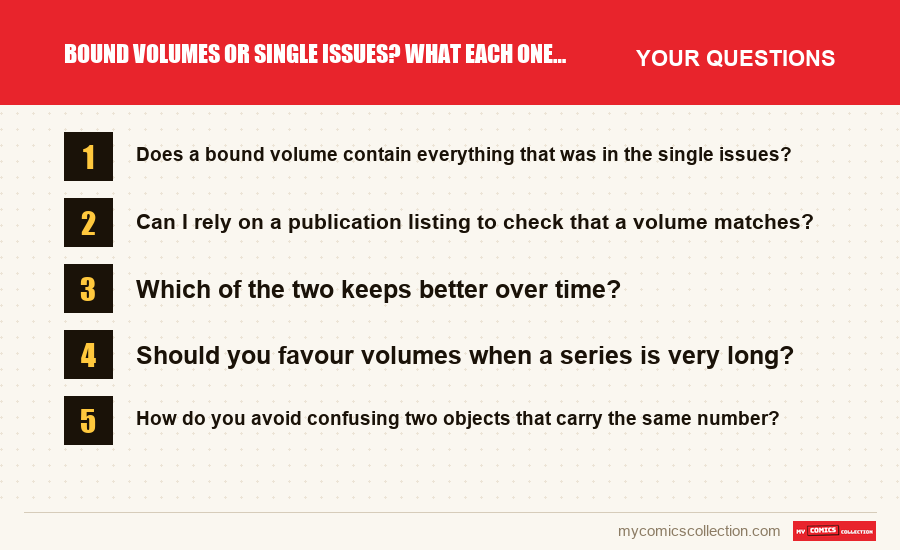
Not necessarily. Editorial material, games, readers' letters and promotional pages that took up real space in the magazines are almost always left out. The catalogue keeps a trace of these pages, for example "Jeux" for issues 39 and 40 of Nova, in 1981. Only a comparison of the printed contents shows what has been kept.
No. A listing associates only one story title with each issue, whereas a French single issue often carried several. For Strange issue 136, the recorded title is "Mots croisés" but three writers are credited. The record therefore describes part of the contents, never the whole, and cannot serve as proof of equivalence.
Each has its weak points. The single issue suffers from staples, spine fold and humidity, but it isolates easily in a sleeve. The volume protects its pages better and tolerates rereading, while its glued spine eventually gives way and its weight rules out tall stacks. The storage environment matters more than the format.
It is tempting for series such as Ombrax, whose record reaches issue 242 in March 1986. Volumes reduce the number of objects to store and find. On the other hand, they make you dependent on what has been gathered, and they can no longer be resold individually. Decide series by series, not for the whole collection.
By always recording something other than the series and the number. At Lug, two entries of Un Récit complet Marvel carry the number 2, one from 1982 with "Serval", the other from 1984 with "Hercule l'Olympien". Add the date, the title read on the cover and a photograph: these three elements remove almost all ambiguity.