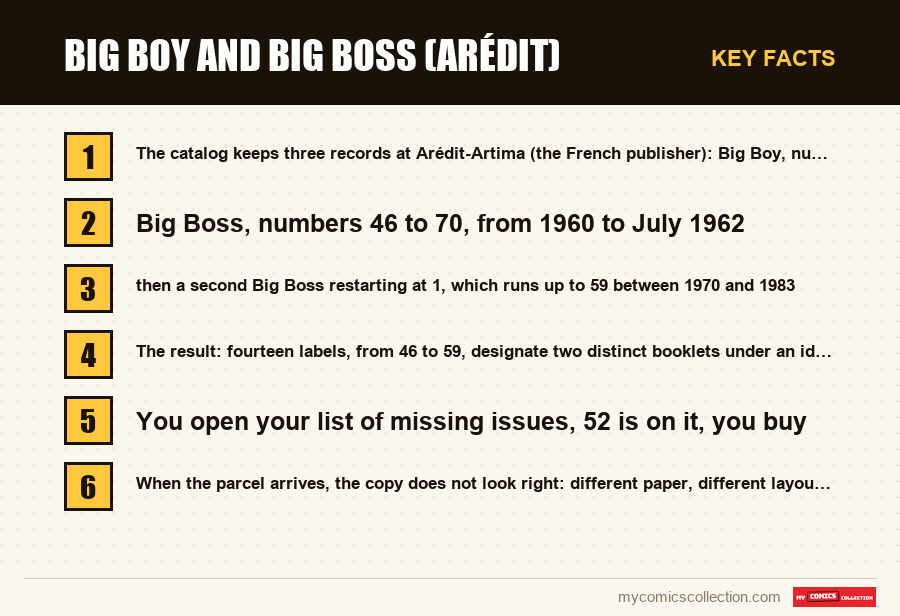
The catalog keeps three records at Arédit-Artima (the French publisher): Big Boy, numbers 1 to 45, from October 1956 to June 1960; Big Boss, numbers 46 to 70, from 1960 to July 1962; then a second Big Boss restarting at 1, which runs up to 59 between 1970 and 1983. The result: fourteen labels, from 46 to 59, designate two distinct booklets under an identical title. The number alone identifies nothing.
You come across a listing that says "Big Boss No. 52, good condition". You open your list of missing issues, 52 is on it, you buy. When the parcel arrives, the copy does not look right: different paper, different layout, and a number 52 that seems to belong to another era from the one you were looking for. You have not got the title, the number or the publisher wrong: you have got the series wrong, and this trap is specific to these two neighboring titles.
As always on this guide, only verified information (creators, numbers, dates) is stated as fact; the analysis is ours, with no reproduction of any panel or protected dialogue.
Three records, two titles, one publisher
The situation takes one sentence to describe and is much less simple to live with. Arédit-Artima carried two almost identical titles, and the catalog draws three records from them: one for Big Boy, launched in 1956, and two for Big Boss, starting in 1960 and in 1970. Same house, same family of content, one letter's difference in the title.
None of the three records shows on its own what this configuration produces. Taken separately, each is exemplary in its regularity: no gap, no missing number, no "bis" to muddle the count. It is when you lay them over one another that the problem appears, and the error is all the easier to make: the seller was not lying, he was describing a record you were not looking at.
Number ranges, measured
Big Boy occupies numbers 1 to 45 without interruption, the first Big Boss numbers 46 to 70, also without interruption. These two ranges are contiguous and never overlap: no number of Big Boy can therefore be confused with a number of this first Big Boss, for the simplest reason in the world, the labels are not the same.
The second Big Boss record breaks this arrangement. It restarts at number 1 and climbs to 59. It therefore crosses the whole range of Big Boy, then begins that of the first Big Boss. Two of the three records start at 1; only one starts at a high number, and it is precisely the one that poses no identification problem.
Keep this geography in mind, it covers the essentials: labels 60 to 70 exist in only one record, labels 46 to 59 in two records with identical titles, labels 1 to 45 in two records with different titles. No number is shared by all three.
Big Boy, the numbering that fools no one
Let us dispose of the calm record right away. Big Boy starts with number 1 dated October 1956, whose recorded story is titled "Appât humain", and ends at 45 in June 1960: forty-five booklets, forty-five months, without desynchronization. For a collector, the consequence is practical: no invisible gap to fear, and a range whose end is known, hence a finite goal.
The record dates every number to the month, which is rare, but unevenly: most dates are written in English, only two in French, at numbers 38 and 39 at the end of 1959. This inconsistency says nothing about the booklets, it says how the records were compiled, and it has a concrete consequence: a search for the month in French will miss part of the series.
On the creators' side, the credits revolve around a stable core: Henry Boltinoff as the most frequent writing credit, John Prentice, Bill Ely or Nick Cardy on art. Be careful, however: the record retains only one story per booklet while these periodicals published several, so these names are not the full list of contributors to an issue.
The 46 that follows the 45: what the dates allow us to say
Big Boy ends at 45 in June 1960. The first Big Boss opens at 46, dated 1960. Same publisher, no gap in the sequence of labels, no overlap, and a common year. Anyone who lines up these two records draws the same spontaneous reading: the title changed and the counter carried on.
This reading is plausible, it is not demonstrated, and the difference governs your purchasing decisions. The records show a continuity of numbering between two titles from the same publisher. They do not show the editorial act: nothing in them indicates a change of title, no notice explicitly links the two sets, and the catalog keeps them as two autonomous series.
The detail of the dates even weakens the precision of the argument. The 45 is dated to the month, the 46 carries only a year. We therefore cannot claim that the second followed the first by a month: the only thing we can measure is that they share the same year. On the exact nature of the link between the two titles, sources disagree, and the defensible position is as follows: treat the continuation as a solid hypothesis, and never treat it as a fact on which your inventory would rest.
The real collision: fourteen labels doubled under an identical title
The serious problem is not between Big Boy and Big Boss: two different titles are told apart by eye, and their ranges do not overlap. The problem lies inside the Big Boss title, and it is far more stubborn.
From numbers 46 to 59, there are two booklets bearing the same label and the same cover title, separated by some twenty years of publication. Fourteen labels in this situation: that is small in proportion, enormous in practice, because nothing in a listing written in three words lets you choose. Under the Big Boss title alone, the two records add up to eighty-four booklets for seventy labels; the gap of fourteen is exactly the collision zone.
One example is worth more than a rule. Number 59 of the first record is dated 1961 and its recorded story is titled "Sidéral". Number 59 of the second is dated 1983 and carries "L'homme de l'île des robots". Same magazine title, same number, two objects that have nothing to do with each other. The same goes for 46: "La ville martienne des U.S.A." in 1960 on one side, "Le secret de l'homme de bronze" in 1980 on the other. The contents allow you to decide, the number alone never does.
Do you collect this series?
Track what you own, what you are missing and what your collection is worth. 7-day trial.
Start my trial →
What story titles reveal, and where they stop helping
Story titles are a good discriminator, provided you know their weakness. The second Big Boss record reuses stories already recorded twenty years earlier in Big Boy: "J'étais le roi des casse-cou" appears as number 4 of Big Boy in January 1957, then as number 2 of the 1970 record, and "L'homme microscopique" as number 23 in August 1958, then as number 55 in 1982. A story title alone therefore does not tell you which record you are in.
Worse, a single heading can come back twice within one record. "J'ai traqué l'animal de la forêt de Montrouge" appears as number 1 of the 1970 record, then as number 50 in 1981, after having appeared as number 2 of Big Boy in November 1956: three occurrences, two of them under the same numbering. A story title identifies content, not a position.
Finally, two booklets escape this method altogether. Numbers 35 and 52 of the second record, dated 1978 and 1981, have no recorded story title, writer or artist. For these two, no cross-check by content is possible from the catalog: you need the copy in hand, or precise photographs, and this is the kind of gap better known before betting on a listing than after.
What cover dates allow, and their limit
The date is the most robust discriminator, because the two Big Boss records never touch in time. The first runs from 1960 to July 1962, the second from 1970 to 1983: eight years separate the end of one from the start of the other, and no year is shared. A Big Boss dated before 1963 therefore belongs to the first record, and a Big Boss dated 1970 or later to the second, without exception in the available data.
Its limit is granularity. Contrary to expectation, the oldest record is the one best dated: Big Boy carries a month on each of its forty-five numbers, whereas the first Big Boss gives only four, from December 1961 to July 1962, and the second only two, May 1975 and December 1980. For the vast majority of Big Boss booklets, you therefore have only a year.
A year is nonetheless enough to settle the ambiguity that matters, since the two periods do not overlap. What it does not allow is the reconstruction of a precise publication order. An order of magnitude can still be calculated, and it is telling: the second Big Boss spreads fifty-nine numbers over fourteen years, a rhythm roughly four times slower than the monthly Big Boy. Same family of objects, two very different publishing economies.
Identifying your copy in front of a listing
Here is the procedure, in the order that costs the least effort. First move, read the exact title on the cover, letter by letter: two characters separate Big Boy from Big Boss, and a listing copied from memory often gets it wrong.
Second move, read the number and apply the geography of the ranges. A Big Boy belongs to the 1956 record, whatever its number, and the matter is closed. A Big Boss numbered 60 or above belongs to the first record; numbered 45 or below, to the second. Only the band from 46 to 59 remains to be handled.
Third move, for that band only, ask for the date printed on the copy, and failing that a photo of the opening story. The title-plus-number pair is not enough, the number-plus-year pair always is. With twenty years separating the two printings, the paper and the cover graphics differ visibly: a useful clue, not proof, and a photograph of the back cover will settle it better than a general impression.
Keeping a list of missing issues that does not count the same number twice
The classic inventory mistake is to open a "Big Boss" line and tick numbers off in it. It guarantees two symmetrical errors: you will believe you own a booklet you do not have, in the 46 to 59 band, and you will buy a duplicate believing you are filling a gap.
The identification key must have three components, not two: the title, the record, the number. In practice, keep three separate lines, which you can name "Big Boy, 1 to 45", "Big Boss first numbering, 46 to 70" and "Big Boss second numbering, 1 to 59". In the shared band, open two distinct boxes for each label, and tick only one of them.
Two precautions. Do not merge Big Boy and the first Big Boss into one line from 1 to 70, even if the continuation hypothesis convinces you: if it is wrong, you will have manufactured phantom gaps in a set that has none. And for each number acquired, note the date read on the copy rather than the one copied from a listing: it is that date which will tell you, six months from now, which of the two 52s is sleeping in your box. The same discipline serves the other titles of this period whose numberings overlap.
What we can state, and what we cannot
We can state the ranges: 1 to 45 for Big Boy, 46 to 70 for the first Big Boss, 1 to 59 for the second, the three records being complete, with no number absent. We can state the contiguity of the 45 of June 1960 and the 46 dated 1960, the absence of any temporal overlap between the two Big Boss records, and the fact that fourteen labels designate two different objects under an identical title.
We cannot state that the first Big Boss is the administrative continuation of Big Boy: the numbers and the years make the hypothesis very plausible, nothing in the data confirms it, and sources disagree. Nor can we state that a story reprinted in 1982 reproduces exactly the one recorded in 1958 under the same heading: the catalog gives a title, not a collation. And since only one story is retained per booklet, no complete table of contents can be reconstructed from here; it has to be checked on the copy.
This caution is the tool, not an admission of weakness: a buyer who knows where his certainty stops asks the seller the right question, and it is that question, not the number advertised, that spares him the wrong parcel. The creators credited here, from Carmine Infantino to Gil Kane or Nick Cardy, are moreover associated with series you may follow: the Flash and Aquaman hubs shed light on these signatures, without allowing any conclusion about the content of a specific French booklet.
Frequently asked questions
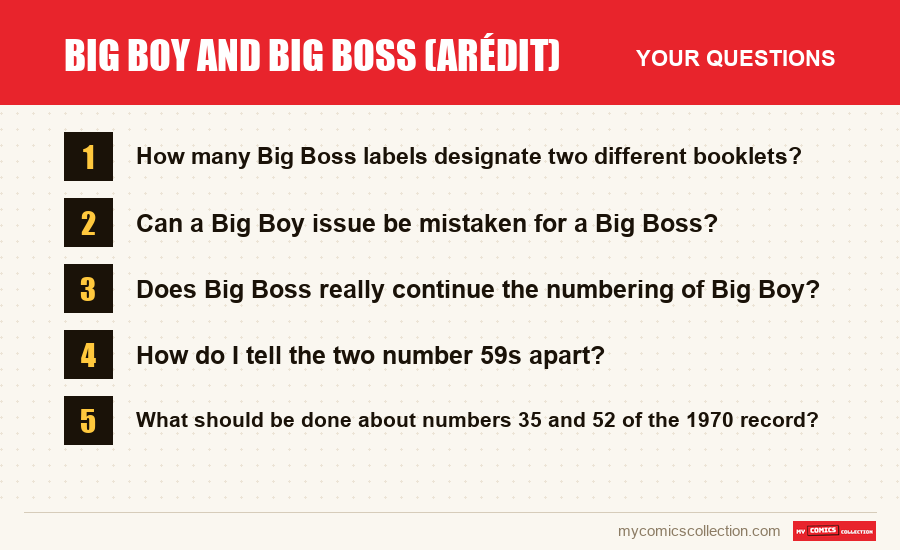
Fourteen, from number 46 to number 59. The first Big Boss record covers numbers 46 to 70, the second restarts at 1 and climbs to 59: their intersection is this band of fourteen labels. Beyond 59, that is from 60 to 70, only one booklet exists per number, and below 46 likewise.
The ranges overlap, since the second Big Boss record reuses numbers 1 to 59, but the cover titles differ and are enough to decide. The real risk is a listing copied wrongly, two letters separating the two titles: ask for a photo of the cover before buying any number below 46.
It is probable, and it is not demonstrated. Big Boy ends at number 45 in June 1960, the first Big Boss opens at 46 dated 1960, from the same publisher, with no gap or duplicate. Nothing in the records, however, states a change of title, and the catalog keeps them separate: on this point, sources disagree.
By the date and by the recorded story. The one from the first record is dated 1961 and its story is titled "Sidéral"; the one from the second is dated 1983 and carries "L'homme de l'île des robots". More generally, any Big Boss dated before 1963 belongs to the first record, and any Big Boss dated 1970 or later to the second.
These two booklets, dated 1978 and 1981, have no recorded story title and no recorded creators. Cross-checking by content is therefore impossible from the catalog. Rely on the year printed on the copy, which is enough to attach them to the second record, and ask for photos of the table of contents if you need to document precisely what you are buying.