A newsstand magazine could change its look without resetting its counter. The collector then finds himself facing a checklist that opens at a high number, or two lists that describe the same object under two different titles. Cover dates and story titles can often prove it. Not always. Telling the two situations apart keeps you from buying the same issue twice and from chasing a number that never existed.
You sort a pile of small-format magazines and run into an inconsistency: your list says twenty-five issues under one title, and the first one you hold already carries a two-digit number. Nothing is necessarily missing. The counter may simply have kept going under another look, and the list you have only knows the magazine through the second half of its life. It is the most uncomfortable situation in sorting, because it looks like a hole when it is not one.
As always on this guide, only verified information (creators, issue numbers, dates) is stated as fact; the analysis is our own, with no reproduction of panels or protected dialogue.
The counter belongs to the publication, not to the title
In newsstand publishing, the number printed on the cover serves first of all for distribution: it tells the distributor which issue to pull and when, and it secures the place of the next one on the rack. A title, on the other hand, is a commercial argument. It can gain a subtitle, shorten to fit a banner, or be modernized. Nothing in the mechanics of publication obliges the publisher to restart the count when it touches up the cover.
The consequence is counterintuitive for anyone who sorts a collection: the counter is often more stable than the name. Two issues whose covers do not carry the same title can belong to the same run, and two checklists that seem to describe two magazines may describe the same stack of paper seen by two different cataloguers.
This guide does not cover cases where an identical number refers to two genuinely distinct series, nor transfers from one publishing house to another. It covers the reverse, more discreet case: the title moves, and the counter does not.
The first clue: a checklist that opens high
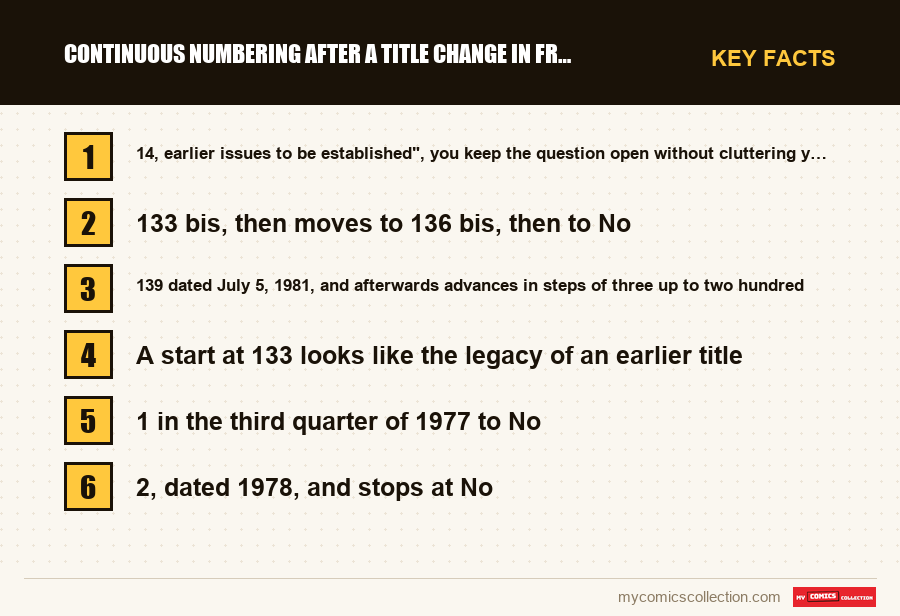
The simplest signal to spot is a checklist that begins at a high number, with nothing explaining the absence of the earlier ones. In the catalog, the list for Top BD opens at No. 14, dated March 1989. No other entry ends just before it, and the title looks like none other. We can therefore state that the checklist does not begin at its beginning; we cannot state what came before it, or even that another title existed.
This caution has an immediate practical value. If you note "thirteen first issues missing" in your inventory, you are creating thirteen lines that may correspond to nothing, and you will take them to the trade show. If you note "checklist known from No. 14, earlier issues to be established", you keep the question open without cluttering your list of gaps.
When a high start proves nothing at all
The same clue can be misleading, and the catalog offers a clear demonstration. The list for Strange Spécial Origines, attached to Lug, opens at No. 133 bis, then moves to 136 bis, then to No. 139 dated July 5, 1981, and afterwards advances in steps of three up to two hundred. A start at 133 looks like the legacy of an earlier title. The steps of three say something else: this quarterly special issue borrowed its number from the magazine it accompanied, and the suffix "bis" on the first two installments confirms it.
Remember the method rather than the example. When faced with a checklist that starts high, look at the gap between two successive numbers before drawing a conclusion. A step of one is the rhythm of a clean sequence, inherited or not. A regular step greater than one almost always signals a borrowed counter, and therefore an object that never had a No. 1.
Two labels, one object: the case of L'Araignée
The richest case in the catalog is that of two overlapping checklists. The first is titled Une Aventure de l'Araignée: its list runs from No. 1 in the third quarter of 1977 to No. 31 in 1987.
The second is titled L'Araignée, and its list opens at No. 2, dated 1978, and stops at No. 29 in 1987. Two titles, two entries, different counts. One object.
The proof does not come from the titles, it comes from lining the two lists up entry by entry. At the same numbers, the two checklists carry the same story titles, allowing for capitalization and spelling: "Le Titan vert" then "Le Titan Vert", "Les Tentacules ensorcelés" then "Les tentacules ensorcelés", "La Veuve et le Samouraï" in both lists, and the same "Folie de Mysterio" as the closing entry. Overlap this dense across some twenty numbers does not occur between two independent magazines.
What we can state: the short label and the long label describe the same run, and the short entry is a partial view of it, ignoring some of the numbers. What we cannot state: which of the two titles actually appeared on each cover, or whether it changed along the way. The catalog records catalog-entry labels; it does not photograph the masthead of the issue.
The same demonstration, run on Les Fantastiques
The mechanism repeats exactly in another family, which is the best argument for seeing it as a cataloging habit rather than an accident. Une Aventure des Fantastiques runs from No. 1 to No. 43 in 1987. The entry titled Les Fantastiques only knows the stretch that begins at No. 19 in 1979 and ends at No. 41 in 1986. Again the story titles match number by number, from "Sortilèges de Diablo" to "La Panthère noire".
One detail deserves your attention, because it shows the limit of the exercise. Under the long label, No. 41 is dated December 1986 and its title specifies "2ème édition", as does No. 42 from April 1987. In other words, a single number can correspond to two successive print runs. A list of gaps built only on the numbers cannot distinguish a reprint from the original, and it is the copy in your hand, not the table, that has to settle it.
Do you collect this series?
Track what you own, what you are missing and what your collection is worth. 7-day trial.
Start my trial →
What the publisher's label adds, and what it does not prove
When comparing these entries, you will also see the name of the house vary: sometimes the short form, sometimes the full form with "Éditions", and, for the other major supplier of small formats, an imprint that is sometimes spelled with an accent, sometimes without, and sometimes followed by the name of the printer. It would be tempting to read a change of corporate name into the middle of the run. The data does not allow it: these are variations in data entry, and two entries from the same period can carry two forms.
For you, the lesson is operational. Do not use the publisher's name as a fine sorting criterion, and try it in both forms when you query a database, a sales site or a bookseller's catalog. A seller who entered the full form stays invisible to someone searching for the short form.
Numbers in square brackets, and what they signal
Some entries carry a number in square brackets. The convention is transparent: the cataloger reconstructed a number he could not read on the object. The checklist for L'Araignée contains two of them, at Nos. 9 and 15, among printed numbers. The one for Les Fantastiques has a single isolated one, with a 1986 date that does not fit the 1979-1986 sequence, and the checklist also contains a second entry at No. 23 dated the same year.
These entries are a warning, not an error. They mean that issues of the family circulated without a visible number, or in an album format that the counter does not cover. When your list of gaps falls precisely on a bracketed number, treat the slot as uncertain rather than empty.
Building a gap list without inventing numbers
Here is the method we recommend, and it comes down to three moves. First move: for each issue in hand, note the printed number, the most visible headline on the cover, and the date or quarter mention, without interpreting them. Second move: order by number, not by title; if two of your entries follow each other while their mastheads differ, you have probably caught a change of label.
Third move, the most important: physically separate two columns. On one side, the numbers whose existence you can prove, because they frame an issue you own or because a checklist lists them. On the other, the presumed numbers, those that precede the opening of a checklist or fall on a bracket. The first column is your shopping list. The second is a list of questions, and it must not go out on automatic search, or you will end up buying empty space.
A collection documented this way also sells better, because the buyer can see exactly where your certainty stops.
Framing your search when the title has moved
Looking for an issue whose label has varied means giving up the reflex of searching for the exact title. Three tactics work. First, search by the core of the title, stripped of its articles and introductory words, since that is the part the two labels share. Second, search by number alone, accepting that you will have to sort through noise: a precise number paired with a character often brings up the right listing even when the title typed by the seller matches nothing you were looking for.
Third tactic, the most profitable: search by story title. It is the datum the two checklists share most faithfully, and careful listings copy it from the cover. Beware, however, of the reverse trap, which the catalog illustrates: at No. 11 of Artima color superstar, dated 1981, the recorded story title is "Thor, le fils d'Odin", which is also the title of another series from the same house. A magazine label can turn up as an episode title somewhere else, and vice versa.
This trap has a counterpart among twin titles. Two catalog entries carry, one, Thor, whose list runs from No. 1 in August 1977 to No. 27 in September 1983, and the other, Thor le fils d'Odin, whose list closes at No. 24 in September 1984. Both belong to the same house, and their date ranges overlap widely. An added subtitle is therefore not the signature of a renamed title: here, the two counters run in parallel, and only comparing the dates can tell you so.
What to ask the seller, and in what order
Three questions are enough, asked in this order. First: what exactly does the top banner of the cover say, word for word, articles included? The answer separates a short label from a long one much faster than a compressed photograph. Next: which number appears on the cover, and does it also appear elsewhere, on the spine or at the foot of the back page? A number printed in two places is a solid number; a number absent from the cover puts you in front of an issue that even a catalog would have put in brackets.
Finally: the date or quarter mention, and the possible presence of a reprint notice. That is what will tell you whether the issue on offer is the original passage in the sequence or a second print run of the same number. For a lot, ask for a photograph of the spines: it shows at once the breaks in layout, and a layout break in the middle of a regular numbering is exactly the trace this guide teaches you to read.
If the seller cannot answer, that is not disqualifying for a common small format. It matters more for a number you believe to be rare: character hubs, such as the one devoted to Spider-Man, help you locate what you are looking for before you commit, and the rest of the guide details the other counter accidents.
Frequently asked questions
Line up the two lists by number, then compare the story titles entry by entry. On the L'Araignée checklists, the same story titles return at the same numbers, allowing for capitalization, across some twenty lines. Overlap of that density does not occur between two independent publications. Two or three coincidences, however, prove nothing.
No. It only means that the checklist does not cover the start of the numbering. The earlier numbers may have appeared under another look, or the counter may have been borrowed from another publication. Until you have seen a cover or a list that carries them, file them as questions, not as gaps.
Because the number was reconstructed by deduction rather than read on the object. This happens when the cover carried no visible number, or when the issue was presented as an album. The corresponding slot in your inventory deserves a note of uncertainty: otherwise you risk searching for an object whose real form escapes you.
Not necessarily, and you check it through the dates. Two collections from the same house can share a common name and a distinct subtitle while coming out at the same time, each with its own counter: that is the case of the two Thor entries, whose publication ranges overlap. Periods that follow one another without overlapping, on the other hand, point to a renamed title.
By number, keeping the title as a simple annotation. Sorting by label splits a continuous run in two whenever its look has changed, and leads you to buy the overlapping number twice. Sorting by number, on the other hand, brings out the layout breaks, which are the visible sign of the phenomenon described here.