No publisher ever carried this American line through from start to finish in French. The catalogue shows several publishers succeeding one another or sharing the market, titles that stopped with no one to take them over, and a silence of nearly a decade before a late and irregular return. The consequence for you is direct: you do not collect a hero from this line, you collect separate titles, sometimes bearing the same name, none of which picks up the numbering of the one before.
A French collector who wants to gather the adventures of Superman or the Flash in French quickly discovers that the question is badly framed. For the other major American line, it was for a long time enough to follow one magazine and its numbering. Here, you first need to know which publishers released what, and when, because the thread breaks several times and never reconnects.
As always on this guide, only verified information (creators, issue numbers, dates) is stated as fact; the analysis is our own, with no reproduction of panels or protected dialogue.
Several publishers, and none took over from another
The listing of issues we hold shows different publisher names for this line depending on the title: the northern house that signed as Artima and then Arédit, the one that published under the Sagédition label, and later Semic. These three names do not form a lineage. They shared the same American material at different times, without any title from one continuing a title from another.
On the legal history of these houses, sources disagree, so we will not write any contract or transfer date. What the listing does allow us to say is more modest and more useful: in this line, there is no case of a takeover in which one publisher carries on the numbering left open by another. For the other catalogue, such a takeover did happen, and a collector can follow a single series from beginning to end. Here, never.
That is the whole gap between the two lines. One had, for two decades, a flagship magazine that served as its backbone and as a mental index. The other had only parallel titles, unequal in quality, some lasting a few years and others stretching out irregularly.
The early years: a line diluted in anthologies
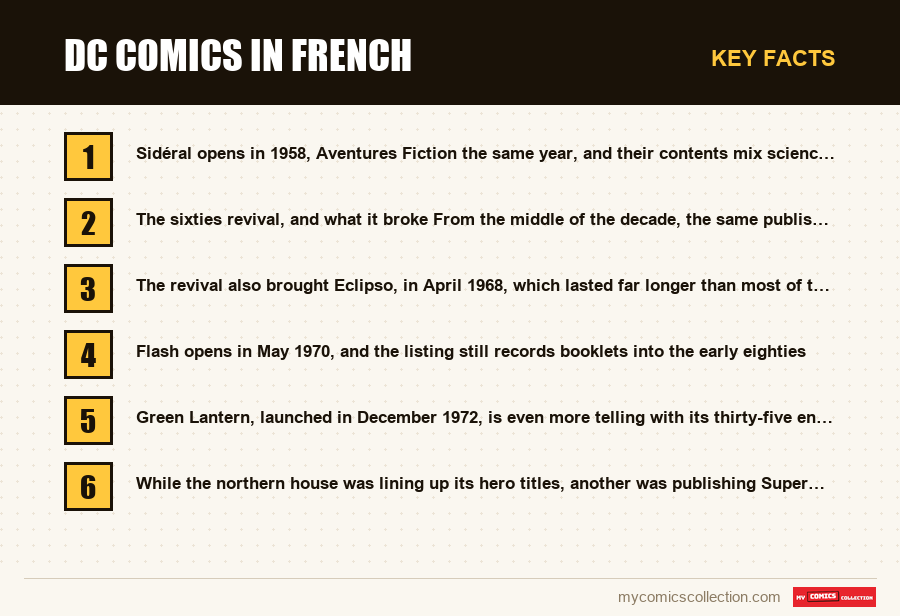
The oldest titles in the listing for this line are not hero titles. Sidéral opens in 1958, Aventures Fiction the same year, and their contents mix science fiction, twist stories and costumed adventures. A reader of the time did not buy a character, he bought an anthology magazine.
The creator names recorded on these booklets are nonetheless the ones that matter: Gardner Fox, Otto Binder and John Broome on scripts, Carmine Infantino, Gil Kane or Sid Greene on art. In other words, the American material arriving in France at that point was already first-hand material. It is the French presentation that scattered it, not the quality of what was translated.
These early series came to an end at the start of the sixties. Nothing immediately followed them under the same name: the house changed its titles, and the reader who followed a hero lost track of him. This was the first break, and it sets the pattern for all the ones that followed.
The sixties revival, and what it broke
From the middle of the decade, the same publisher came back with new anthology magazines: Étranges Aventures opens in 1966, and a title already used eight years earlier, Aventures Fiction, starts again from a first issue as if the earlier one had never existed. The two series carry the same name on the newsstand and have no numbering connection whatsoever.
For a buyer, the consequence is immediate and lasting: an advert that mentions this title and a small issue number does not designate a single booklet. You need the date, and sometimes the cover, to decide. This is not an isolated accident of the French market; it is the way this line was exploited here.
The revival also brought Eclipso, in April 1968, which lasted far longer than most of the house's magazines. Its interest for our argument is not its longevity: it is that the creators recorded in its contents belong to both of the major American catalogues at once. The name of a magazine therefore guarantees nothing about the material it contains.
Hero titles, but a rhythm that rules out continuity
Titles bearing a hero's name arrive late. Flash opens in May 1970, and the listing still records booklets into the early eighties. Seen from a distance, this looks like a long, continuous run.
Seen up close, it is something else: fifty-nine entries across an interval of fourteen years. No monthly behaves like that. The recorded cover dates jump from one quarter to the next, and several issues have neither a story title nor a creator in the listing, which means that even the basic inventory has to be completed from the copies themselves.
Green Lantern, launched in December 1972, is even more telling with its thirty-five entries. The first booklet carries "La menace géante", written by Gardner Fox and John Broome and drawn by Gil Kane: material from the great years, served at a pace that did not allow a continuity to be told. You can own the whole title and have, of the character, nothing more than a string of unconnected episodes.
Meanwhile, another publisher was releasing Superman
The scattering is not only chronological, it is simultaneous. While the northern house was lining up its hero titles, another was publishing Superman and Batman in a shared magazine launched in January 1969, which the listing follows through to January 1975.
Then that magazine stopped, and two separate titles took over in 1976, one for each hero, each with its own first issue. A reader who had built up the shared magazine found himself with stacks that did not join up, in a different format, from the same publisher. This is the second break, and it was deliberate: it was a new product, not a continuation.
Better still, a third title devoted to the same hero opens in February 1979 and coexists for years with the previous one. Two parallel series, two numberings, one character, and contents that draw on the same American material without any coordination.
One last trap awaits anyone who wants to complete the longest of these series: some booklets carry two numbers at once, so that the last announced number exceeds the number of entries actually recorded by more than ten. Counting the numbers is therefore not enough to tell you how many objects you are looking for.
Do you collect this series?
Track what you own, what you are missing and what your collection is worth. 7-day trial.
Start my trial →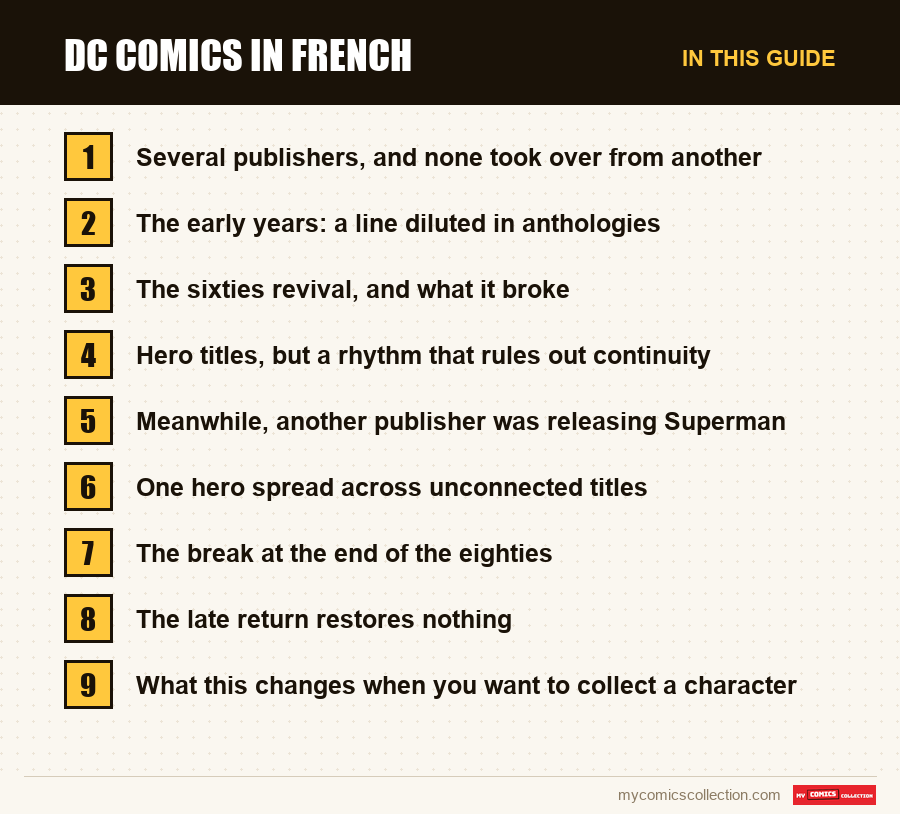
One hero spread across unconnected titles
The clearest case is that of a team of young heroes. The listing records a story bearing their name in a Faucon Noir booklet dated February 1978, then another, titled "L'origine des Jeunes Titans", in the same title in December 1979. Nothing tells the reader that these form a series.
These same heroes then got a title of their own, launched in March 1985 with a story called "Cyborg", written by Marv Wolfman and drawn by George Pérez. The title closes in October 1987 with "Le mangeur de soleil". Between the appearances tucked into an anthology magazine and this title of their own, there are years, a publisher that changed its policy, and not a single linking issue.
If you want the French adventures of this group, you must therefore search at least two series that share neither the same name, nor the same period, nor the same format. Multiply this pattern by the number of heroes in the line and you will see why a "by character" list does not hold up here.
The break at the end of the eighties
The last entries of the pocket titles devoted to this line date from 1987, and the young heroes' title closes the same year. After that, the listing holds nothing for this catalogue for a very long time.
During these years of silence, the other American catalogue continued to fill the newsstand racks with well-established monthly magazines. A collector who had started with this line no longer had any appointment at the newsstand: his series were closed, and nothing replaced them. On the reasons for this absence, sources disagree, and we will refrain from offering an explanation about rights that the listing does not document.
This break has a very concrete consequence on the second-hand market: booklets from this line did not benefit from the steady flow of readers that, for other magazines, feeds flea markets and lots. They circulate in inherited bundles, often incomplete, and short series rebuild more slowly than one might imagine.
The late return restores nothing
The listing picks up again in July 1997 with a publication devoted to this catalogue, from the third publisher. Only twenty-four entries, and the last one is dated April 2005: the pace was never that of a regular periodical, and some years carry no more than a handful of entries.
This return has no link with what came before. New name, new numbering, new editorial format. The recorded entries show this in other ways: several of them are not stories but magazine pages, a contents page or a back cover, and the credits mix American authors with French editorial contributors. Worth knowing before you assume that one entry equals one episode.
For you, this means there is no bridge to look for between the booklets of the seventies and those of the end of the century. They are two collections, not two halves of the same collection.
What this changes when you want to collect a character
The first consequence is methodological. Your unit of collection is not the hero, it is the title. You cannot say "I am missing three Superman issues"; you can only say "I am missing three issues of such-and-such a series, from such-and-such a publisher, from such-and-such a period". Until the list is written that way, it protects you from no mistake at all.
The second is financial, though no figure is needed: for the same number of copies, a collection split across several short series takes more effort than a single series. You buy more often, in smaller quantities, and postage weighs proportionally more than on a uniform lot. So prefer lots by title, even imperfect ones, to purchases issue by issue.
The third is documentary. The listing gives only one entry per booklet, whereas these magazines published several episodes. You therefore cannot infer from a story title what a given issue actually contains, and no serious list can be built without checking the copy. If you keep an inventory, note what you have seen, not what you have assumed.
Building the list, and avoiding confusion at the point of purchase
Start by fixing your periods. For each hero who interests you, write down the titles that hosted him, the publisher's name and the years covered, and only then the missing issues. The hubs devoted to Supergirl or to Batgirl give you the American context; the French column is for you to build, title by title.
Next, be wary of listings that cite only a hero's name. The listing shows that the same title can appear in booklets belonging to two different catalogues: an entry naming Superman thus appears in a booklet devoted to a hero from the other house, and a single title mentioning this hero turns up in four booklets from the same period, which looks more like a repeated advertising page than a story reprinted four times. The seller, in good faith, copies what he reads on the cover.
Three habits are enough to avoid most of the errors: always ask for the cover date as well as the number, ask for a photo of the contents page rather than of the cover alone, and check the publisher's name printed on the booklet before you confirm. On a line this discontinuous, these questions are not distrust: they are the only details that identify a copy.
Frequently asked questions
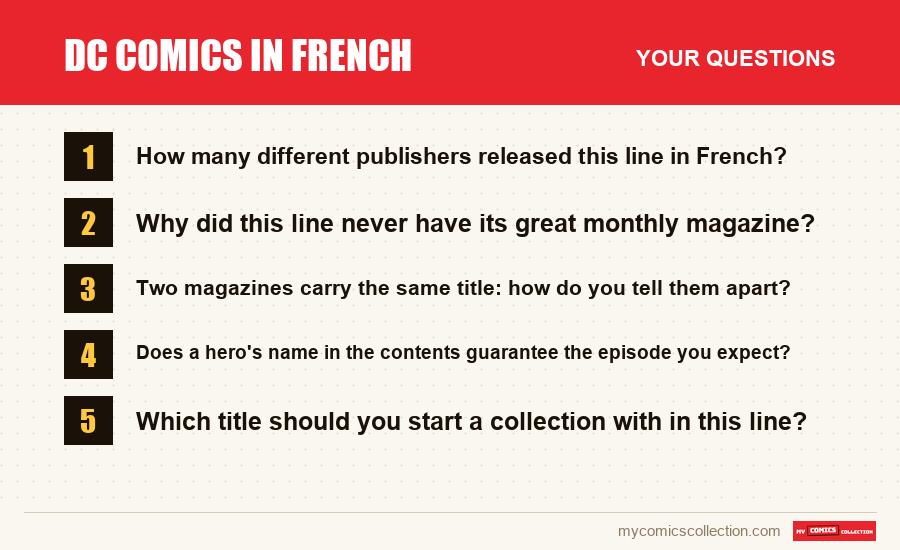
The listing we hold shows three publisher names for this catalogue, spread from the fifties to the two thousands. They did not succeed one another by taking over each other's series. On the legal links between these houses and their successive labels, sources disagree, and we do not state them.
The reasons given vary between accounts and sources disagree, so we will not settle the matter. What the publications do show, however, is clear: no title in this line ever reached the longevity or regularity of an established monthly, and the most durable series were anthologies that mixed several catalogues.
First by the cover date, then by the printed publisher. The same magazine name was used for two series launched years apart, each starting again from a first issue. In an inventory, always note the title, the year and the number together: the number on its own designates nothing.
No. These magazines published several stories per booklet, and our listing records only one. Some entries even correspond to editorial or advertising pages. Before buying an issue for one particular story, ask for a photograph of the complete contents page: it is the only document that truly answers the question.
With a short, bounded series whose end you can see. Titles devoted to a single hero in the seventies come to a few dozen booklets, which remains within reach. Long-running anthologies, on the other hand, require years of searching and fit together poorly issue by issue.