
The words used in French-language comics listings do not describe an object, they describe a seller's intention. “Hors-série,” “bis,” “album,” “complet” or “deuxième édition” cover realities that the catalog allows us to tell apart, issue by issue. For each term, this glossary gives what it designates, what it does not designate, and the precise question to ask before paying.
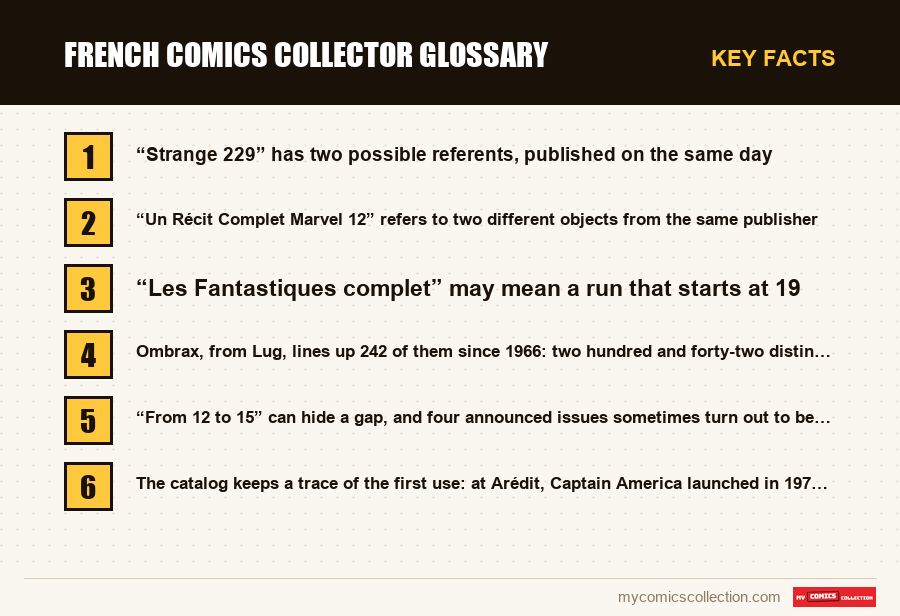
A buyer of French magazines spends more time decoding a title than examining the goods. “Strange 229” has two possible referents, published on the same day. “Un Récit Complet Marvel 12” refers to two different objects from the same publisher. “Les Fantastiques complet” may mean a run that starts at 19. None of this is bad faith: the numbering of pocket formats was flexible, and sellers' vocabulary followed suit.
As always on this guide, only verified information (creators, issue numbers, dates) is stated as fact; the analysis is our own, with no reproduction of panels or protected dialogue.
Petit format, grand format, poche, géant: four words for one measure
These four terms designate a size, and nothing else. The catalog records titles that carry the word in their very name: Superman Poche and Batman Poche from Sagédition, Superman Géant from the same house, Artima color Marvel géant from Arédit. When the format is printed on the cover, the seller's label is reliable; otherwise, the word is no more than an impression.
What these words do not designate: a quality of manufacture, a page count, or a publication frequency. A “géant” is not necessarily thicker than a monthly, and a “poche” is a page height, not an editorial subcategory. The catalog records issues and their contents, it does not record dimensions: nothing here replaces a graduated ruler.
The question to ask: the height and width in centimeters, and the number of pages. Two figures settle the debate, whereas “grand format” leaves room for disappointment when the parcel is opened.
Fascicule: the neutral word that defuses half the misunderstandings
The fascicule is the unit of publication: a stapled booklet, sold at the newsstand, bearing a number and a date. It is the object the catalog describes line by line, with its cover date and at least one story title. Ombrax, from Lug, lines up 242 of them since 1966: two hundred and forty-two distinct objects to find, not a series of a few volumes.
What the word does not designate: a collected volume, an album, or a reissued number. It is worth imposing it in a buying conversation, even when the seller says “revue.”
The question to ask: is it a stapled booklet as it came out at the newsstand, with its original cover, or a repackaged set? A serious seller answers in one line.
Collected volume and publisher binding: you buy several issues that have become a single object
Small-format publishers cleared their unsold stock by binding them three or four at a time under a new hardback cover. A collected volume is therefore not a chosen anthology: it is an assembly of issues whose original covers are sometimes kept inside, sometimes removed. The difference matters: without these inside covers, the collected volume does not give you the issue numbers, it gives you their contents.
What the word does not designate: an edition. The collected volume creates no new issue, and its own numbering, when it carries one, has nothing to do with that of the magazine.
The question to ask: which issues exactly, and are the original covers bound inside? Ask for the list, not the range. “From 12 to 15” can hide a gap, and four announced issues sometimes turn out to be three plus a duplicate.
Album and hardback: two uses that do not overlap
In listings, “album” sometimes designates a hardback volume issued as such, and sometimes any object thicker than a booklet. The catalog keeps a trace of the first use: at Arédit, Captain America launched in 1979 includes, alongside its issues 1 to 27, an entry noted as a hardback, and Conan le Barbare, launched the same year, counts two, placed in 1981.
The trap lies elsewhere, and it is formidable for anyone searching lists: the word also appears in titles recorded from the interior pages. Nova, from Lug, starts on 10 February 1978 with a mention referring to the Spider-Man album number 2, “La nuit du Lézard”; Strange number 58 refers to the Fantastiques album number 4, “Dr. Fatalis.” These are advertisements printed in the magazine, not a description of the booklet: a text search on this word brings back a flood of ordinary issues.
The question to ask: does the word “album” appear on the cover, or only in your description? The binding is visible in a photo of the edge, which you have every right to request.
Hors-série and spécial: two words, two numberings that overlap
This is the point where a buyer loses the most money, and the catalog shows it with rare clarity. Strange Spécial Origines, taken over by Semic in 1989, carries no numbering of its own: its releases are recorded as 229 hors série, 232 hors série, 235 hors série, and so on, in steps of three. Yet Strange, on the same date, reached number 229, dated 5 January 1989. Two objects, one number, the same day, and different contents.
The step of three is no whim: it betrays a quarterly rhythm pegged to a monthly, the special borrowing the number of the month in which it comes out. From 301 onward, the mention disappears from the records and the series adopts a continuous numbering. A seller who writes “Spécial Origines 241” is therefore accurate, and a buyer who ticks his Strange 241 is ticking the wrong box.
The question to ask: have the full title confirmed as printed on the cover, mention included, and not the number alone.
Do you collect this series?
Track what you own, what you are missing and what your collection is worth. 7-day trial.
Start my trial →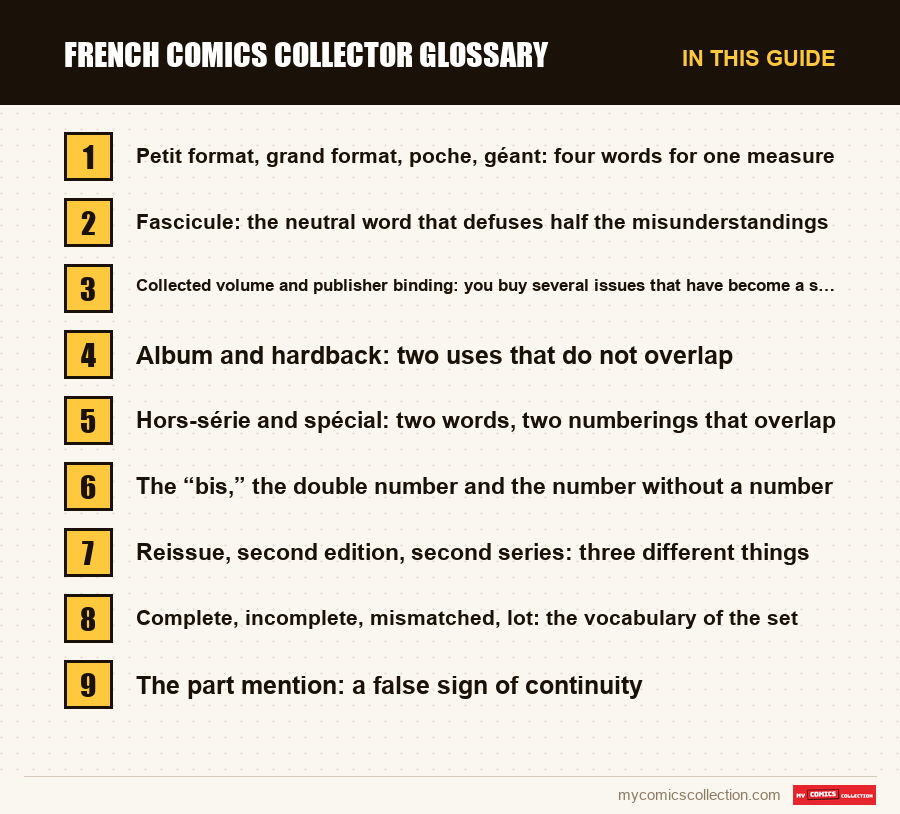
The “bis,” the double number and the number without a number
Three numbering anomalies, three distinct consequences on a list of gaps.
The “bis” signals an object inserted into a numbering already occupied. Strange Spécial Origines, in the Lug days, opens in January 1981 on a 133 bis followed by a 136 bis, before moving on to 139 without any mention; at Sagédition, Superman et Batman et Robin carries a 50bis written without a space. It is neither a cover variant nor a second print run, but a full-fledged issue, which is missing from a collection even when the plain number is present.
The double number is a single booklet bearing two numbers. Superman Poche counts about fifteen of them, from 51-52 up to 108-109, and the same house elsewhere writes 65 - 66 with spaces. It is sold once and it fills two slots. The symmetrical error is common in both directions: buying separately a 51 and a 52 that never existed apart, or believing a gap exists where a double number provides the link.
The number without a number is an object whose figure is not printed, and which the catalog then notes in square brackets. L'Araignée, from Lug starting in 1978, provides two, placed where the plain numbers are lacking. Les Fantastiques, launched by the same house in 1979, includes one dated 1986 alongside numbers running from 19 to 41. These copies are real; they are simply impossible to claim by their figure.
The question to ask: read me what is printed on the cover, mention after the figure included. And if nothing is printed there, say so: that is information in itself.
Reissue, second edition, second series: three different things
A reissue puts back on sale content that has already appeared. A second edition is a new print run of the same issue, sometimes years later. A second series starts again at 1 under the same title. All three exist in the catalog, and all three get confused in listings.
Artima color Marvel géant, opened by Arédit in 1979, gives the clearest case: its numbers do not go beyond 16, yet the records count many more, because the same number appears at several dates. Number 1 is attested in 1979 and then in 1981, with different announced contents: buying “number 1” does not tell you which one you are buying. The same logic applies to Un Récit Complet Marvel, of which Lug holds two numbered sets from 1 to 20 whose contents do not line up, one and the same story appearing as number 12 in one and as number 16 in the other.
Conversely, the revival of a title does not always reset the counters, and that is what makes the rule unpredictable. Strange continues at Semic from 229, Titans from 120, Nova from 132: titles that change houses without breaking their run. Hulk, for its part, starts again at 1 at Semic in 1992, although Arédit had published twenty-nine issues since 1976; and Aventures Fiction, at Arédit, has two open series both starting at 1, one in 1958 and one in 1966.
The question to ask: which year of publication, and which publisher on the cover? These two elements almost always remove the ambiguity that the number alone leaves open.
Complete, incomplete, mismatched, lot: the vocabulary of the set
“Complete” only has meaning when measured against a boundary. Les Fantastiques, from Lug, run between 19 and 41, and 40 appears nowhere in the records: a complete set of this title does not start at 1 and does not contain every number within its interval. Top BD, from Semic, is recorded from 14 and not from 1. A seller can therefore offer an honest “complete” set that does not cover what you imagined, and another an “incomplete” one that contains everything that exists.
“Mismatched” signals that the copies do not come from the same source and do not look alike: used openly, the word announces a heterogeneity that group photos conceal. “Lot” says nothing beyond a quantity, with no sequence, no coherence and no guarantee against duplicates.
The question to ask, in two stages: the exact list of numbers, figure by figure; then, for a lot, the number of duplicates. On a long series, count for yourself: a Strange from the Lug days announced as complete should show two hundred and twenty-eight lines.
The part mention: a false sign of continuity
“1st part,” “2nd part,” “conclusion”: these mentions appear in story titles, and they mislead, because they do not number the French issue. Spider-Man, launched by Semic in 1991, opens its number 1 on a story announced as fourth part. Captain America, at Arédit, likewise opens its 1979 number 1 on a second part, whose title also turns up in Dracula at number 23. You have missed nothing: the French series begins where it begins.
Jumps are just as normal. In Spider-Man, one and the same long serial is recorded as second part at 11, sixth part at 12, tenth at 13, fourteenth at 14. This step of four indicates that a French issue gathers several episodes of different origins, which the catalog lets you guess without detailing. Facteur X shows the same gap between its numbers 27 and 28. And the wording drifts: Spécial Strange announces at 41 a first part whose subtitle becomes the main title at 43, where the mention changes to third part.
The question to ask: these mentions are a reason to request photos of the contents, not to conclude that something is missing. The catalog keeps only one story title per issue, whereas a magazine such as Strange published three or four: only the copy settles it, and caution is an argument here, not a weakness. There remains an entire area that this glossary does not cover, that of condition and its grading, which is the subject of separate guides on this site.
Frequently asked questions
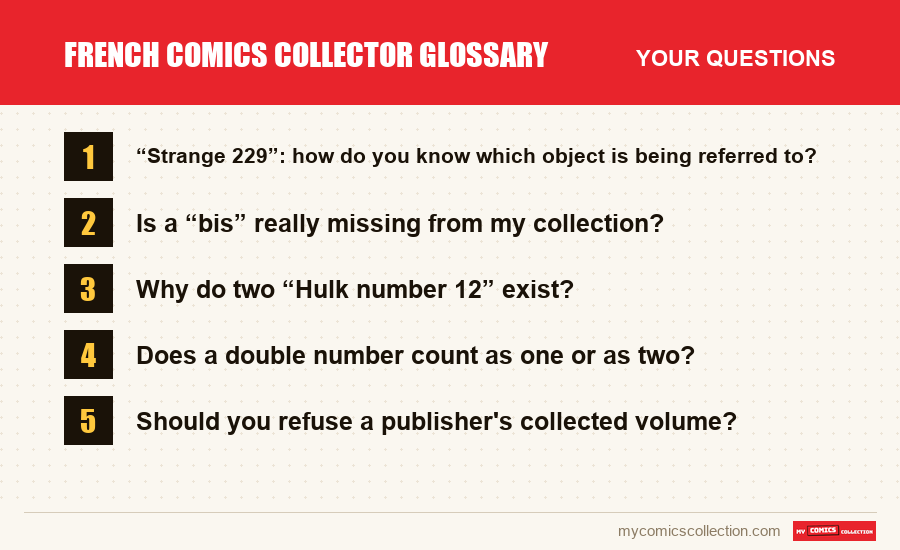
By asking for the full title printed on the cover. Strange and Strange Spécial Origines both carry a 229 dated January 1989, the second with the hors-série mention. Their contents differ. The number alone does not settle it, the full title does, and a cover photo resolves it in a minute.
Yes. A 133 bis is a distinct object, not a variant of the 133: it has its own date, contents and cover. At Lug, Strange Spécial Origines even opens on two bis-marked numbers before adopting a plain numbering. Whoever ticks the plain number believes he has completed what he did not buy.
Because the title was taken over by another publisher with its counter reset to zero. Twenty-nine issues at Arédit since 1976, twenty-nine others at Semic since 1992: the two series occupy the same figures. Always specify the year and the publisher, or you are buying a lottery between two unrelated objects.
As one object and two slots. Superman Poche counts about fifteen of them, from 51-52 to 108-109, and a seller may write 65 - 66 with spaces. Do not look for the figures separately: they were never printed on their own, and do not count a gap where the double number provides continuity.
No, but know what it contains. Some keep the original covers inside, others have removed them: in the second case you get the stories without the booklets. Ask for the exact list of bound issues and a photo of the edge, then decide whether it fills your slots or not.