You can establish the French publication date, the French title of the featured story, and the creators that the catalogue associates with the issue. You cannot mechanically deduce the corresponding American edition from these: a magazine such as Strange stacked several episodes per instalment, retranslated titles and shuffled the order. The equivalence is established by cross-checking, copy in hand, and is always stated with an acknowledged margin of uncertainty.
You have a pile of Lug magazines in a box, and a question that seems simple: this Strange you are holding, which American comic does it correspond to? If you have already searched for the answer, you know it does not come easily. French databases record an issue number, a date and a translated title. American databases record a series, an issue number and a cover date. Nobody has built the bridge between the two, and not out of laziness: the bridge is not unique. A French issue does not have one American equivalent, it has three or four, sometimes cut up, sometimes reissued later under a different packaging.
As always on this guide, only verified information (creators, numbers, dates) is stated as fact; the analysis is our own, with no reproduction of panels or protected dialogue.
Why the question has no mechanical answer
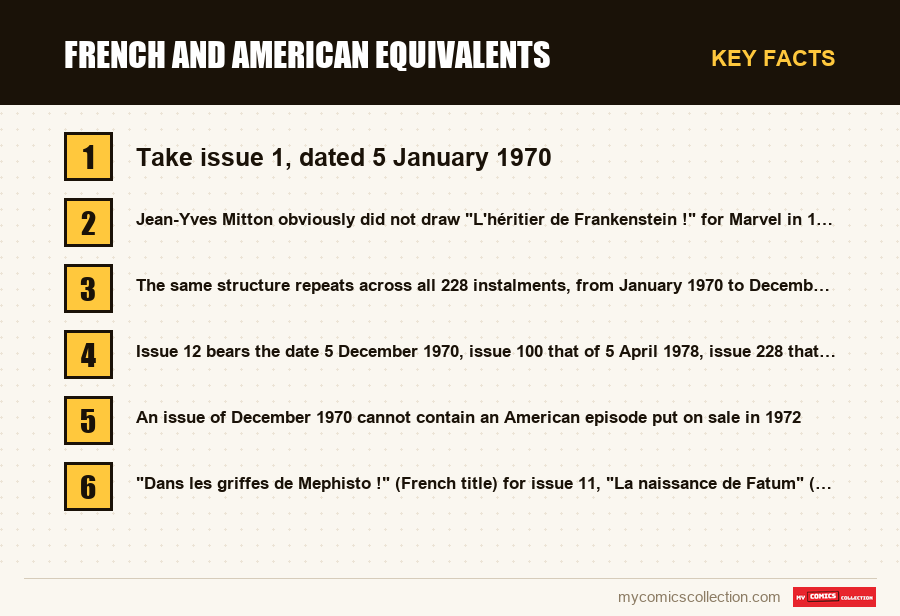
The catalogue we use gives, for each Strange instalment, five pieces of information: the issue number, the cover date, a story title, the writers and the artists. Take issue 1, dated 5 January 1970. The recorded title is "L'héritier de Frankenstein !" (French title). The writers credited are Stan Lee and Larry Lieber. The artists credited are John Buscema, Jean-Yves Mitton and Jack Kirby. Three artists, one title: the contradiction is in the record itself, and it is instructive. It tells you that the "artist" field describes the entire issue, not the named story.
In other words, the record is not a contents listing. It is a partial summary that highlights one story among several and aggregates the credits of all of them. Until you understand this, you draw wrong conclusions from correct data. Jean-Yves Mitton obviously did not draw "L'héritier de Frankenstein !" for Marvel in 1969: he was working for the French publisher. His presence on the line signals work carried out in France, cover, retouching or supplement, not an American episode.
The same structure repeats across all 228 instalments, from January 1970 to December 1988. Accepting this resistance is the first step of serious work; denying it produces collection records that contradict one another between collectors.
What the French date allows you to assert
The French publication date is the most solid piece of information you have, because it is printed on the object and carried into the catalogue. Issue 12 bears the date 5 December 1970, issue 100 that of 5 April 1978, issue 228 that of 5 December 1988. These dates are not open to debate.
What they give you is a boundary. The American material contained in a French instalment must have been published in the United States before that instalment was printed. An issue of December 1970 cannot contain an American episode put on sale in 1972. The boundary looks modest; it eliminates most of the false hypotheses.
Be careful, however, not to tighten it too far. The American cover date is not a release date: American comics were postdated by several months so they would stay on the newsstands longer. The boundary therefore applies to the actual American release, not to the year printed on the cover, and that year may run a few months past the French date without this proving an impossibility. Keep a margin, and state it when you record your deduction.
The story title: useful, and sometimes off-topic
A French title helps when it describes a plot. "Dans les griffes de Mephisto !" (French title) for issue 11, "La naissance de Fatum" (French title) for issue 16, "Le Chasseur de Minuit" (French title) for issue 15: these are episode titles, they refer to identifiable situations, and you can search the American side for the story from the same years that corresponds to them.
But look at what the same field contains elsewhere. For issue 2, it reads "Le Surfer d'Argent dans Strange n°3" (French title). That is not a story title, it is an announcement for the next instalment. For issue 20, "Offre d'abonnement et sommaire" (subscription offer and contents). For issues 18 and 33, "Le courrier des fans de Strange" (readers' letters). For issue 42, "Maxi-grille" (crossword). For issue 43, "Zoo-test" (a puzzle). For issues 136, 137 and 148, "Mots croisés" (crosswords). In all these cases, the recorded data describes an editorial, puzzle or advertising page, not a translated episode. Looking for the American equivalent of a French crossword makes no sense, and the catalogue will not warn you.
This observation has an immediate practical consequence: before using a title as a clue, ask whether it names a story. If it names a column, a subscription or an upcoming album, it tells you nothing about the American content of the issue, and the rest of the contents must be read from the copy itself.
The credited creators: the best clue, but a mixed field
Names are what will bring you closest to an American dating, provided you read them as a list rather than as an attribution. The catalogue records Chris Claremont among the writers of issue 60, dated 5 December 1974. Jim Starlin appears on issue 71, dated 5 November 1975. Frank Miller appears on issue 162, dated 5 June 1983. John Byrne is among the artists of issue 120, dated 5 December 1979.
Each of these names has a known window of activity on American series, and crossing that window with the French date narrows the field of possibilities. A name with a long career helps you less than one active over a short period.
The trap here is the mixing of teams. Americans and French share the same fields. Jean Frisano recurs over dozens of instalments, and his cover work is French. Thomas Frisano appears on issues 122, 138, 155 and 163. We also find Jacques Martin on issue 2, Claude Vistel on issues 57 and 58, Yves Chantereau on issue 46, Manuel Jonville on issue 183. None of these names tells you anything about an American edition. The list must therefore be sorted before it is used, and that sorting requires knowing who was working on which side of the Atlantic.
Pagination and cutting: the factor nobody measures
A French magazine of this format published several episodes per instalment, and space was counted. When an American episode was too long for the number of pages available, it could be split, with its continuation carried over to the next issue. The result is that a single American episode can feed two French issues, and two consecutive French issues can point back to the same original comic.
The most accessible sign of this in the data is the repetition of a title. The title "Une aventure de Ka-Zar n°1" (French title) is recorded three times, on issues 73, 74 and 76, that is, on the January, February and April 1976 instalments. "Album Conan n°2 : le peuple des ombres" (French title) appears twice, on issues 82 and 84, in October and December 1976. These repetitions may signal a continuation, a repeated advertising reference, or a uniform entry of the same insert. The catalogue does not decide, and it would be dishonest to decide on its behalf: what remains to be verified is whether the pages concerned tell the same story or announce the same album.
If you are reconstructing a series, therefore, count the pages of each segment when you have the copy in front of you. A period American episode ran to a fairly standard number of pages; a French segment that is clearly shorter is very probably half an episode, and that changes your reading of the contents as much as your search for an equivalent.
Do you collect this series?
Track what you own, what you are missing and what your collection is worth. 7-day trial.
Start my trial →
Reversed order and names that change
The French publication order does not follow the American order. A publisher who launches a magazine in 1970 with already older material chooses what hooks readers, not what comes next. You will therefore see arcs picked up later, isolated episodes inserted to fill space, and series started at a different point from their first issue.
On top of this comes the instability of translated names. The catalogue records "La naissance de Fatum" (French title) on issue 16, then "Le retour de Fatalis!" (French title) on issue 34, then "Une Aventure des Fantastiques n°4 : Docteur Fatalis" (French title) on issue 55, then "Album les Fantastiques numéro 11 : les robots de Fatalis" (French title) on issue 85. Two French spellings for one American villain, in the same magazine, fifteen years apart in the most extreme cases. If you index your collection by translated character name, you will get two separate entries for a single figure, and your searches will miss half the occurrences.
A final warning, which applies to any structured source: data entry contains errors. Issue 66 carries in the catalogue the title "Spécial Srange 1" (French title), with a typo in the magazine's name. Issue 164 is dated "5 Août 1983" while its neighbours 165, 166 and 167 carry only the month, without the day. Imperfect data remains usable, provided you do not build a fine deduction on a single character.
The honest method, step by step
Here is the sequence we recommend when you want to link a French instalment to its original material. First step: record the full contents from the copy, title by title, noting the number of pages of each segment. It is the only source that really contains the information, and no database replaces it.
Second step: set the date boundary from the French publication, with the margin mentioned above. Third step: sort the credited creators, separating Americans from French, and keep the name whose window of activity is the narrowest. Fourth step: cross that window with the series and character identified, and propose an equivalence hypothesis. Fifth step, the one most often omitted: note next to your hypothesis what has not been verified, and by what means it could be verified.
This fifth step separates a record that will still be usable in ten years from one that propagates an error. A hypothesis accompanied by its doubt can be corrected; a flat assertion gets copied.
What to write, and what to forbid yourself from writing
In your inventory, write what you have observed. "Strange issue 9, dated 5 September 1970, title recorded in the contents: Le Surfer et l'Araignée !.., three other unidentified segments, pagination to be checked." This line is accurate, useful, and will not age badly.
Forbid yourself, however, two formulations. The first is the claim of a first French appearance of a character: you cannot back it up, since the full contents of earlier instalments and of the other magazines from the same publisher escape you. The second is the flat equality between a French issue and an American issue. Even when your cross-check is sound, the equality is wrong by construction, because the French issue contains several sources. Write "contains, by cross-checking, material from" rather than an equals sign.
If you keep a file shared with other collectors, provide a column for the degree of certainty. Three values are enough: read from the copy, deduced by cross-checking, assumed. You will quickly see that the third column is the most filled, and that is good news: it makes your work refutable.
What a cautious equivalence is worth on the market
An honestly documented lot of French magazines sells better than a lot described with flattering equivalences. The experienced buyer knows that correspondences announced without reservation are often copied from a forum, and they discount the risk. An inventory that separates what was read from what was assumed spares them a verification, and that saving has value.
Conversely, a listing promising the first French appearance of a major figure in a specific issue exposes you to a challenge you will not be able to sustain. Price is built on the object's condition, its completeness and the quality of its description, and a description is worth its verifiability more than its enthusiasm.
There remains the pleasure of the work itself. Reconstructing the journey of an episode of Iron Man or of the X-Men from an American newsstand to a French one, with only a date, a retranslated title and a list of mixed-up names as tools, is an investigation. It yields partial answers and does not tolerate shortcuts, and that is what makes it reliable when it succeeds.
Frequently asked questions
Because the magazine stacked several episodes per instalment. The record for issue 1, dated 5 January 1970, carries only one title, "L'héritier de Frankenstein !" (French title), but credits three artists. The credits describe the whole issue, not the named story. The equivalence is therefore plural by construction, never a simple equality.
It sets a boundary on the actual American release, which necessarily precedes the French printing. But the American cover date was postdated by several months. An American year slightly later than the French date is therefore not an impossibility. Keep a margin and mention it in your record.
Because they are not. The catalogue records "Offre d'abonnement et sommaire" (subscription offer and contents) on issue 20, "Le courrier des fans de Strange" (readers' letters) on issues 18 and 33, and "Maxi-grille" (crossword) on issue 42. These titles describe editorial material or games. They tell you nothing about the American material translated in the instalment.
It is a hypothesis, not a certainty. "Une aventure de Ka-Zar n°1" (French title) is recorded on issues 73, 74 and 76, that is January, February and April 1976. It may reflect a split episode, or a repeated advertising insert. Only the pagination recorded on the copies can decide between the two.
Index by the American name and keep the French spellings as variants. The magazine records "La naissance de Fatum" (French title) on issue 16, then "Le retour de Fatalis!" (French title) on issue 34: two spellings for one villain. An index based only on the translated name splits your collection into two separate records.